
RF Interconnect Market Outlook: Size, Share, Trends, Growth Analysis, Competitive Landscape & Forecast, 2026-2033

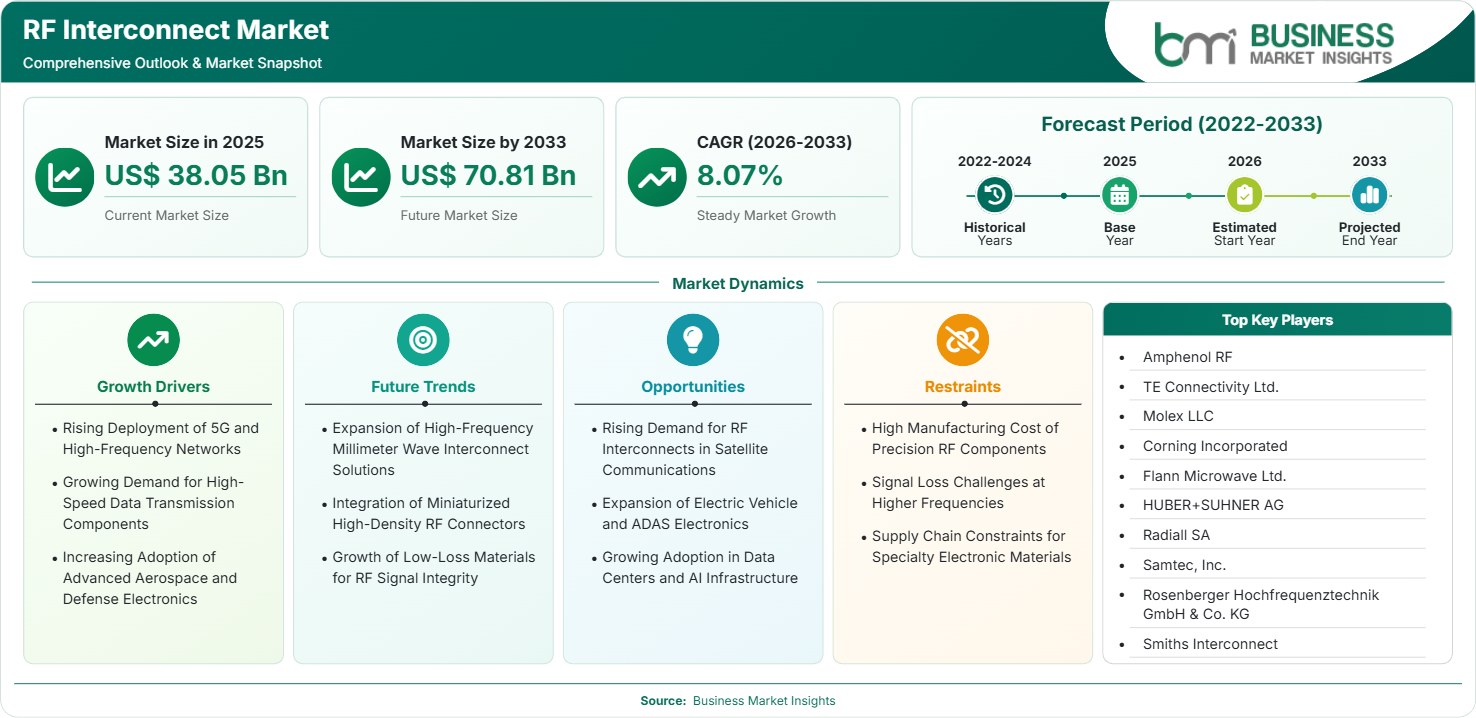
The RF Interconnect Market size was valued at US$ 38.05 Billion in 2025 and is projected to reach US$ 70.81 Billion by 2033, growing at a CAGR of 8.07% during 2026–2033. Rising deployment of 5G infrastructure, increasing adoption of high-frequency communication technologies, growing defense and aerospace modernization programs, and expanding demand for high-speed connectivity solutions are supporting market growth globally.

Report Coverage
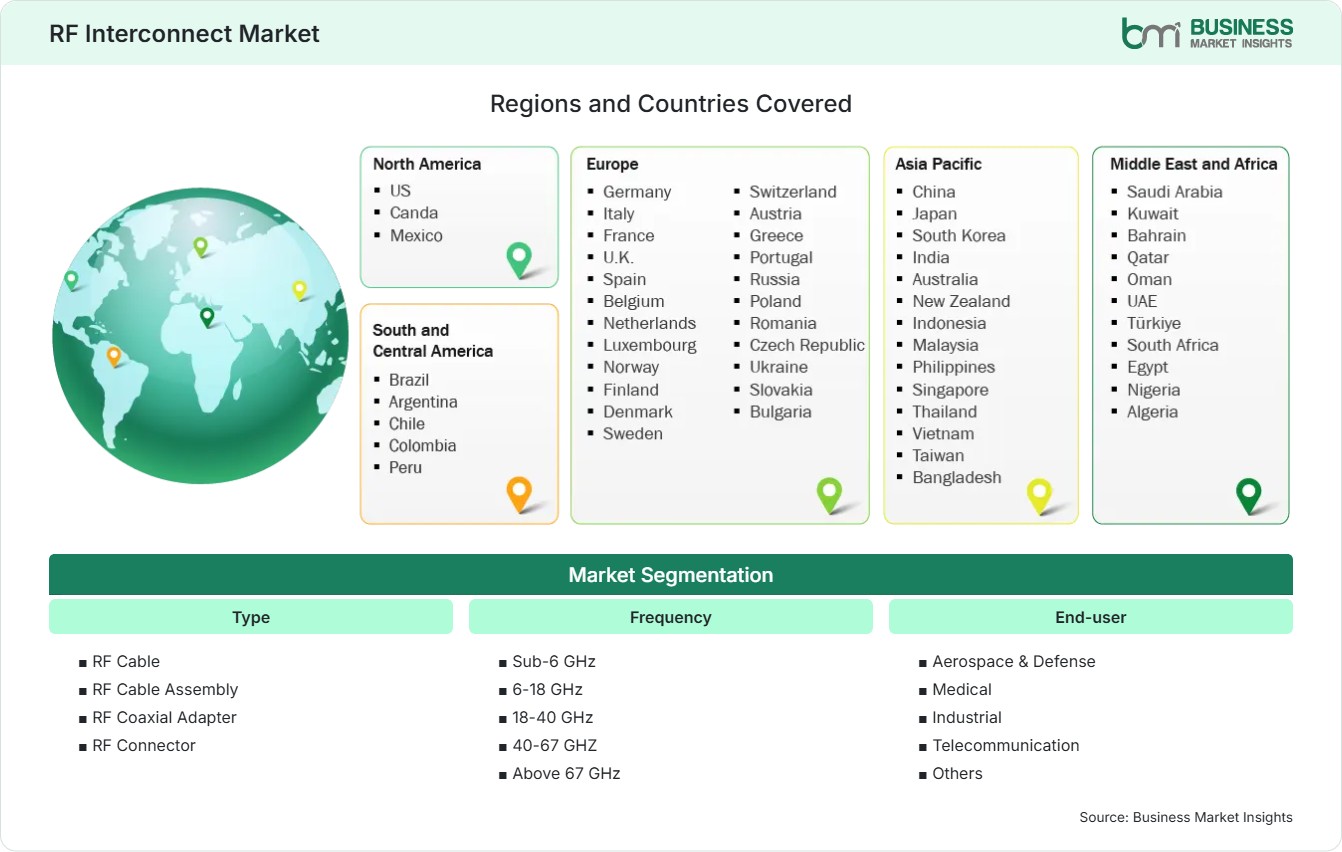
  • Type: RF Cable, RF Cable Assembly, RF Coaxial Adapter, RF Connector
  • Frequency: Sub-6 GHz, 6-18 GHz, 18-40 GHz, 40-67 GHZ, Above 67 GHz
  • End-user: Aerospace & Defense, Medical, Industrial, Telecommunication, Others
US$ 38.05 Bn Market size in 2025
US$ 70.81 Bn Market Size by 2033
8.07% CAGR, 2026 - 2033
2026-2033 Forecast Period

AI Overview

RF Interconnect Market Summary

  • North America Region: North America holds a RF interconnect market share of 36%-39% in 2025, growing with a CAGR of 7.4%-8.0% during 2026–2033. Strong investments in aerospace and defense systems, increasing 5G deployments, growing satellite communication activities, and widespread adoption of high-frequency RF technologies continue supporting regional leadership. The U.S. market is expected to register a CAGR of 7.5%-8.1%.
  • Fastest Growing Region: Asia Pacific accounts for 24%-27% share in 2025 and is projected to grow at a CAGR of 9.3%-9.9% through 2033. Expansion of telecommunications networks, rising electronics manufacturing activities, growth in defense spending, and increasing deployment of advanced wireless technologies continue supporting regional expansion.
  • Leading Segment: RF Connector represents 34%-37% share in 2025 and is expected to grow at a CAGR of 8.1%-8.7% through 2033. Broad deployment across telecommunications, aerospace, industrial electronics, and defense communication systems continues supporting segment leadership.
  • High Growth Segment: Above 67 GHz accounts for 8%-11% share in 2025 and is forecast to grow at a CAGR of 11.2%-11.9% during 2026–2033. Growing development of next-generation communication systems, advanced radar platforms, and high-frequency testing applications continues driving growth.
  • Key Market Opportunity: Increasing commercialization of advanced satellite communications, 5G/6G infrastructure, and high-frequency radar systems is creating significant opportunities for RF interconnect manufacturers.
  • Major Market Players: Amphenol RF, TE Connectivity Ltd., Molex LLC, Corning Incorporated, Flann Microwave Ltd., HUBER+SUHNER AG, Radiall SA, Samtec, Inc., Rosenberger Hochfrequenztechnik GmbH & Co. KG, Smiths Interconnect.
Strategic Insights

RF Interconnect Market: Strategic Insights

RF Interconnect Market Strategic Framework
FREE PDF
Request your free sample
Request free sample
Stakeholder View

Key Takeaways

  • RF interconnect technologies remain critical components supporting modern communication, networking, aerospace, and defense systems.
  • RF connectors continue dominating revenue generation due to widespread deployment across multiple industries.
  • High-frequency applications above 67 GHz represent a significant growth opportunity as advanced communication systems evolve.
  • Asia Pacific offers strong expansion potential because of telecom infrastructure investments and electronics manufacturing growth.
  • The increasing adoption of 5G and future 6G technologies continues accelerating demand for advanced interconnect solutions.
  • Signal integrity, miniaturization, and high-frequency performance remain major innovation priorities across the industry.
Geographic Outlook

RF Interconnect Market Regional Highlights

North America RF Interconnect Market

North America accounts for 36%-39% RF Interconnect Market share in 2025 and is projected to grow at a CAGR of 7.4%-8.0% through 2033. Strong defense spending, advanced aerospace programs, expanding telecommunications infrastructure, and growing investments in satellite communication continue supporting regional leadership.

  • Aerospace and defense organizations continue investing in advanced communication, radar, and electronic warfare systems requiring high-performance RF interconnect solutions.
  • Growing deployment of 5G infrastructure is generating substantial demand for connectors, cable assemblies, and high-frequency transmission components.
  • Increasing adoption of cloud infrastructure and data-intensive communication networks is strengthening market opportunities.
  • Manufacturers are focusing on high-reliability products capable of supporting mission-critical applications within demanding operating environments.
  • Satellite communication projects and space technology investments continue supporting demand for advanced RF connectivity solutions.
  • Technological innovation remains concentrated on signal integrity, miniaturization, and performance improvement across high-frequency applications.

US RF Interconnect Market

The United States contributes approximately 84%-88% of North American revenue and is expected to register a CAGR of 7.5%-8.1% through 2033. Strong leadership in aerospace, defense electronics, and telecommunications infrastructure continues supporting RF interconnect market growth.

  • Advanced military modernization programs continue generating demand for high-performance RF components.
  • Expansion of commercial and government satellite initiatives is increasing adoption of advanced interconnect solutions.
  • Telecommunications operators continue investing in network expansion and performance enhancement projects.
  • Research activities focused on next-generation wireless technologies are supporting innovation across the RF ecosystem.
  • Growing demand for high-bandwidth connectivity continues accelerating product deployment.

Europe RF Interconnect Market

Europe represents 25%-28% of global revenue in 2025 and is anticipated to expand at a CAGR of 7.8%-8.4% through 2033. Increasing investments in industrial automation, telecommunications infrastructure, aerospace innovation, and defense modernization continue supporting regional growth. Germany remains the leading RF interconnect market, while Poland demonstrates stronger growth momentum.

  • Germany continues leading regional demand through advanced manufacturing activities and strong aerospace engineering capabilities.
  • Poland is among the fastest-growing markets and is expected to register a CAGR of 8.8%-9.4% during the forecast period.
  • Telecommunications network upgrades continue increasing deployment of RF transmission components.
  • Defense modernization programs are creating additional opportunities for ruggedized interconnect solutions.
  • Industrial automation projects continue expanding the application scope of RF technologies.
  • Demand for reliable high-frequency performance remains a major adoption driver across industries.

Asia Pacific RF Interconnect Market

Asia Pacific accounts for 24%-27% of global revenue in 2025 and is expected to achieve the fastest CAGR of 9.3%-9.9% through 2033. Rapid telecommunications expansion, strong electronics manufacturing capabilities, and increasing defense investments continue supporting strong market growth.

  • China remains the largest regional market due to large-scale telecommunications deployments and advanced electronics production capacity.
  • India is projected to achieve approximately 10.0%-10.7% CAGR, supported by 5G infrastructure deployment, defense modernization, and expanding industrial digitization.
  • Semiconductor manufacturing growth continues supporting demand for RF connectivity solutions.
  • Satellite communication and space technology programs are generating new opportunities for specialized components.
  • Rising industrial automation activities are expanding market applications.
  • Continued investment in wireless technologies is supporting sustained long-term growth.

Rest of World RF Interconnect Market

Rest of World accounts for 8%-11% of global revenue in 2025 and is projected to expand at a CAGR of 8.0%-8.6% through 2033. Growing telecommunications investments, increasing defense procurement activities, and expanding industrial infrastructure continue supporting market development.

  • Brazil continues generating market demand through telecommunications modernization and industrial expansion projects.
  • The UAE is investing in advanced communication infrastructure and smart technology initiatives.
  • Saudi Arabia is expected to achieve approximately 8.9%-9.5% CAGR through 2033, supported by digital transformation and defense capability enhancement programs.
  • Government-led infrastructure development initiatives continue supporting connectivity investments.
  • Growth in industrial applications is creating additional deployment opportunities.
  • Demand for reliable communications remains a primary driver across emerging markets.
Global Market Geography
FREE PDF
Request your free sample
Request free sample
Segment Analysis

RF Interconnect Market Segmentation

Type

The type segment forms the core of the RF interconnect ecosystem, providing the connectivity infrastructure required for wireless communications, aerospace systems, defense electronics, industrial automation, medical devices, and next-generation networking applications. The segment accounts for approximately 34%-37% share in 2025 and is projected to grow at a CAGR of 8.3%-8.9% through 2033. The expanding RF Interconnect Market scope is supported by increasing deployment of 5G infrastructure, growing demand for high-frequency communication systems, expansion of satellite networks, and rising adoption of advanced electronic systems requiring reliable signal transmission.

  • RF Cable: RF cables continue witnessing strong demand due to their critical role in transmitting radio frequency signals with minimal interference across communication and networking systems.
  • RF Cable Assembly: RF cable assemblies provide integrated connectivity solutions offering enhanced reliability, simplified installation, and optimized system performance in mission-critical applications.
  • RF Coaxial Adapter: Coaxial adapters are increasingly utilized to support compatibility among diverse RF interfaces and communication equipment while maintaining signal integrity.
  • RF Connector: RF connectors represent the leading segment due to their extensive deployment across telecommunications, defense systems, medical equipment, industrial electronics, test and measurement systems, and aerospace applications.

Frequency

Frequency-based segmentation continues gaining importance as communication technologies migrate toward higher bandwidth and higher frequency operations. This segment accounts for approximately 31%-34% share in 2025 and is expected to register a CAGR of 8.7%-9.3% through 2033. Current RF Interconnect Market trends indicate growing investments in millimeter-wave technologies, advanced radar systems, and high-speed wireless communications.

  • Sub-6 GHz: This segment continues representing a large installed base due to widespread deployment in conventional wireless communication networks, industrial systems, and telecommunications infrastructure.
  • 6-18 GHz: Applications within this range remain important across military communications, radar systems, satellite communications, and commercial wireless solutions.
  • 18-40 GHz: Rising deployment of advanced communication technologies and sophisticated sensing applications continues supporting growth in this frequency range.
  • 40-67 GHz: Demand is increasing due to growing utilization of millimeter-wave communication systems, high-capacity wireless networks, and advanced testing environments.
  • Above 67 GHz: This represents the fastest-growing segment driven by research into next-generation communication technologies, high-frequency radar systems, advanced aerospace applications, and evolving 6G infrastructure developments.

End-user

End-user demand significantly influences product specifications, performance standards, durability requirements, and innovation priorities across the RF interconnect market. This segment accounts for approximately 39%-42% share in 2025 and is forecast to expand at a CAGR of 8.5%-9.1% through 2033.

  • Aerospace & Defense: Aerospace and defense remain major adopters due to increasing use of radar systems, military communications, satellite platforms, electronic warfare systems, and mission-critical electronics.
  • Medical: Medical equipment manufacturers increasingly utilize RF interconnects in diagnostic imaging systems, monitoring equipment, and advanced healthcare technologies.
  • Industrial: Industrial applications continue expanding due to automation trends, connected manufacturing systems, wireless monitoring solutions, and smart factory deployments.
  • Telecommunication: Telecommunications remains the dominant end-user category owing to rapid expansion of 5G infrastructure, fiber-wireless integration, network modernization, and growing mobile data traffic.
  • Others (Automotive, etc.): Additional applications include connected vehicles, autonomous systems, advanced driver assistance systems, transportation infrastructure, and emerging smart mobility technologies.
Market Forces

RF Interconnect Market Dynamics

Key Market Drivers

Rising Deployment of 5G and High-Frequency Networks

The global expansion of 5G infrastructure is one of the most significant drivers supporting the RF interconnect industry. Telecommunications operators continue investing heavily in network modernization to meet growing demand for high-speed connectivity, ultra-low latency communication, and increased network capacity. Advanced 5G systems require highly reliable RF connectors, cable assemblies, adapters, and transmission components capable of operating efficiently across higher frequency ranges. In addition, ongoing research into future 6G technologies is creating demand for increasingly sophisticated RF interconnect solutions that can support even greater bandwidth requirements. The migration toward dense network architectures, small-cell deployments, and advanced antenna systems further increases component demand. As global communication networks continue evolving, RF interconnect products remain critical enablers of next-generation connectivity infrastructure.

Growing Demand for High-Speed Data Transmission Components

The rapid growth of digital applications, cloud computing, streaming services, connected devices, and industrial digitalization is creating substantial demand for high-speed data transmission infrastructure. Organizations increasingly require communication systems capable of handling large data volumes while maintaining signal quality and operational reliability. RF interconnect technologies play a central role in ensuring efficient signal transmission within networking equipment, telecommunications systems, and advanced electronics. Improvements in data transmission performance are becoming increasingly important as industries embrace artificial intelligence, edge computing, and connected ecosystems. Manufacturers continue developing advanced products featuring enhanced shielding, lower insertion loss, and superior signal integrity. These developments are accelerating adoption across a broad range of end-use industries.

Increasing Adoption of Advanced Aerospace and Defense Electronics

Modern aerospace and defense platforms increasingly rely on sophisticated electronic systems requiring high-performance RF connectivity solutions. Military communications, radar platforms, avionics systems, intelligence applications, satellite communications, and electronic warfare equipment depend on reliable signal transmission under demanding operational conditions. Governments worldwide continue investing in defense modernization initiatives that emphasize advanced communication and surveillance capabilities. In addition, growth in commercial aviation, space exploration activities, and satellite deployment programs is creating further opportunities for specialized RF interconnect products. Manufacturers are focusing on ruggedized, lightweight, and highly reliable solutions capable of meeting strict aerospace and defense performance requirements. Increasing adoption of advanced electronics remains a major driver supporting market expansion.

Key Market Opportunities

Rising Demand for RF Interconnects in Satellite Communications

Satellite communication networks are expanding rapidly due to increasing demand for broadband connectivity, earth observation services, navigation systems, remote communications, and defense applications. Both government agencies and commercial operators continue launching new satellite constellations to enhance global coverage and support emerging digital services. RF interconnect components are essential for maintaining signal integrity across satellite payloads, ground stations, and communication infrastructure. Demand is increasing for high-reliability products capable of operating in challenging environmental conditions while supporting advanced communication requirements. As investments in low-earth orbit and next-generation satellite networks continue growing, manufacturers are presented with significant opportunities for long-term expansion.

Expansion of Electric Vehicle and ADAS Electronics

The automotive industry is increasingly integrating sophisticated communication, sensing, navigation, and connectivity technologies within electric vehicles and advanced driver assistance systems. Radar sensors, vehicle-to-everything communication platforms, infotainment systems, and autonomous driving technologies rely heavily on RF connectivity solutions. As vehicle architectures become more digitally connected and communication-intensive, demand for compact, high-performance RF interconnect components is expected to increase significantly. Automotive manufacturers continue investing in advanced electronics to enhance safety, efficiency, and user experiences. These trends are creating attractive opportunities for RF component suppliers seeking to diversify beyond traditional telecommunications and defense applications.

Growing Adoption in Data Centers and AI Infrastructure

Modern data centers and artificial intelligence infrastructures require extensive connectivity solutions capable of supporting high-speed communications and large-scale data processing environments. Cloud service providers, hyperscale operators, and AI infrastructure developers are expanding investments in advanced networking technologies designed to optimize performance and reduce latency. RF interconnect solutions contribute to communication reliability within networking equipment, wireless systems, testing infrastructure, and supporting data transmission environments. The accelerating adoption of AI applications and digital transformation initiatives is creating additional demand for advanced connectivity components. Long-term RF Interconnect Market Forecasts remain favorable as data center expansion and AI infrastructure investment continue strengthening globally.

Market Restraints and Challenges

High Manufacturing Cost of Precision RF Components

Factor: Manufacturing high-performance RF interconnect products requires specialized materials, precision engineering, advanced testing procedures, and stringent quality control processes. Components designed for aerospace, defense, medical, and high-frequency communication applications often involve complex production techniques that significantly increase manufacturing expenses. Maintaining performance consistency across demanding operating conditions further adds to production complexity and cost. Impact: Elevated manufacturing costs can increase product pricing and place pressure on profit margins. Cost-sensitive customers may delay upgrades or seek alternative solutions, particularly in highly competitive markets. Manufacturers must continuously invest in production efficiency improvements and innovation to remain competitive.

Signal Loss Challenges at Higher Frequencies

Factor: As communication systems shift toward higher frequencies, maintaining signal integrity becomes increasingly challenging. Factors such as insertion loss, electromagnetic interference, connector mismatches, material limitations, and environmental conditions can affect transmission quality. High-frequency systems often require advanced engineering solutions and premium materials to minimize performance degradation. Impact: Signal loss challenges may increase system complexity, development costs, and technical requirements for both manufacturers and end users. Companies must continuously develop innovative designs and materials capable of supporting reliable high-frequency performance while meeting evolving industry requirements.

Company Analysis

Competitive Landscape

The RF Interconnect Market analysis is highly competitive and innovation-driven, with leading manufacturers focusing on high-frequency performance, low signal loss designs, miniaturization, high-density connectivity solutions, and ruggedized interconnect systems. Market participants are investing in advanced connector technologies, millimeter-wave communication products, aerospace-grade RF assemblies, and next-generation telecommunications infrastructure solutions. The rapid deployment of 5G networks, growing satellite communication investments, expansion of defense electronics programs, and increasing adoption of AI-driven data center infrastructure continue creating significant opportunities for RF interconnect providers worldwide.

Company Name

Overview

Products and Services relevant to this market

Amphenol RF

Global manufacturer specializing in RF interconnect solutions for telecommunications, aerospace, military, and industrial applications.

RF connectors, cable assemblies, coaxial adapters, antenna interconnect solutions, and high-frequency connectivity products.

TE Connectivity Ltd.

Connectivity and sensing solutions provider serving telecommunications, automotive, industrial, aerospace, and defense sectors.

RF connectors, microwave components, cable assemblies, high-speed interconnect systems, and communication infrastructure solutions.

Molex LLC

Electronics and connectivity company offering advanced interconnect technologies for communication and industrial markets.

RF connectors, cable systems, signal transmission components, telecom connectivity products, and industrial interconnect solutions.

Corning Incorporated

Materials science company serving telecommunications and high-performance networking applications.

Fiber-optic connectivity solutions, RF infrastructure support products, communication network components, and advanced interconnect technologies.

Flann Microwave Ltd.

Specialist manufacturer focused on microwave and millimeter-wave communication components.

RF and microwave interconnects, precision adapters, test equipment components, waveguide products, and high-frequency connectivity solutions.

HUBER+SUHNER AG

Connectivity technology provider serving communication, transportation, industrial, and aerospace industries.

RF connectors, cable assemblies, antenna solutions, microwave interconnects, and communication infrastructure products.

Radiall SA

Aerospace, defense, and telecommunications connectivity solutions provider.

RF connectors, cable assemblies, microwave interconnect products, aerospace communication solutions, and defense-grade connectivity systems.

Samtec, Inc.

Electronics interconnect company offering high-performance connectivity solutions across multiple industries.

RF connectors, high-speed cable systems, microwave assemblies, communication interconnects, and signal integrity solutions.

Rosenberger Hochfrequenztechnik GmbH & Co. KG

Manufacturer of high-frequency connectivity technologies serving wireless communication and industrial applications.

RF connectors, coaxial assemblies, communication components, test and measurement interconnects, and telecom infrastructure solutions.

Smiths Interconnect

Provider of advanced electronic components serving aerospace, defense, medical, and industrial sectors.

RF interconnect systems, microwave assemblies, cable harnesses, ruggedized connectors, and mission-critical connectivity solutions.

Trust & Transparency

Research Methodology

The market analysis combines proprietary research with secondary data from government agencies, company disclosures, regulatory filings, industry databases and expert interviews. Market estimates are validated through data triangulation, cross-market benchmarking and analyst review.

View Full Research Methodology

Questions Answered

Frequently Asked Questions

How are emerging technologies influencing RF interconnect demand?

Technologies such as 5G infrastructure, satellite broadband, autonomous vehicles, AI data centers, advanced radar platforms, and industrial automation systems are increasing demand for high-performance RF transmission and connectivity solutions.

What does this RF Interconnect Market Report cover?

This report covers type analysis, frequency segmentation, end-user assessment, regional analysis, competitive landscape evaluation, market dynamics, growth opportunities, restraints, and future market prospects through 2033.

Why is the above 67 GHz frequency segment growing rapidly?

This segment is benefiting from advancements in millimeter-wave communications, next-generation radar systems, satellite technologies, defense electronics, and ongoing research into future 6G communication networks.

Which type segment holds the largest market share?

RF connectors represent the leading segment because they are widely deployed across telecommunications, aerospace, defense, industrial automation, medical equipment, and testing applications.

What is driving growth in the RF interconnect market?

The market is primarily driven by rising deployment of 5G networks, increasing demand for high-speed data transmission, growing adoption of advanced aerospace and defense electronics, and expansion of satellite communication infrastructure.

Access the Full RF Interconnect Market Report

Get segment-level forecasts, regional estimates, competitive benchmarking, company profiles and downloadable Excel datasets.

Access the full RF Interconnect Market Report
350 pages PDF & Excel | 2026-08-12