
Recreational Vehicles Market Outlook: Size, Share, Trends, Growth Analysis, Competitive Landscape & Forecast, 2026-2033

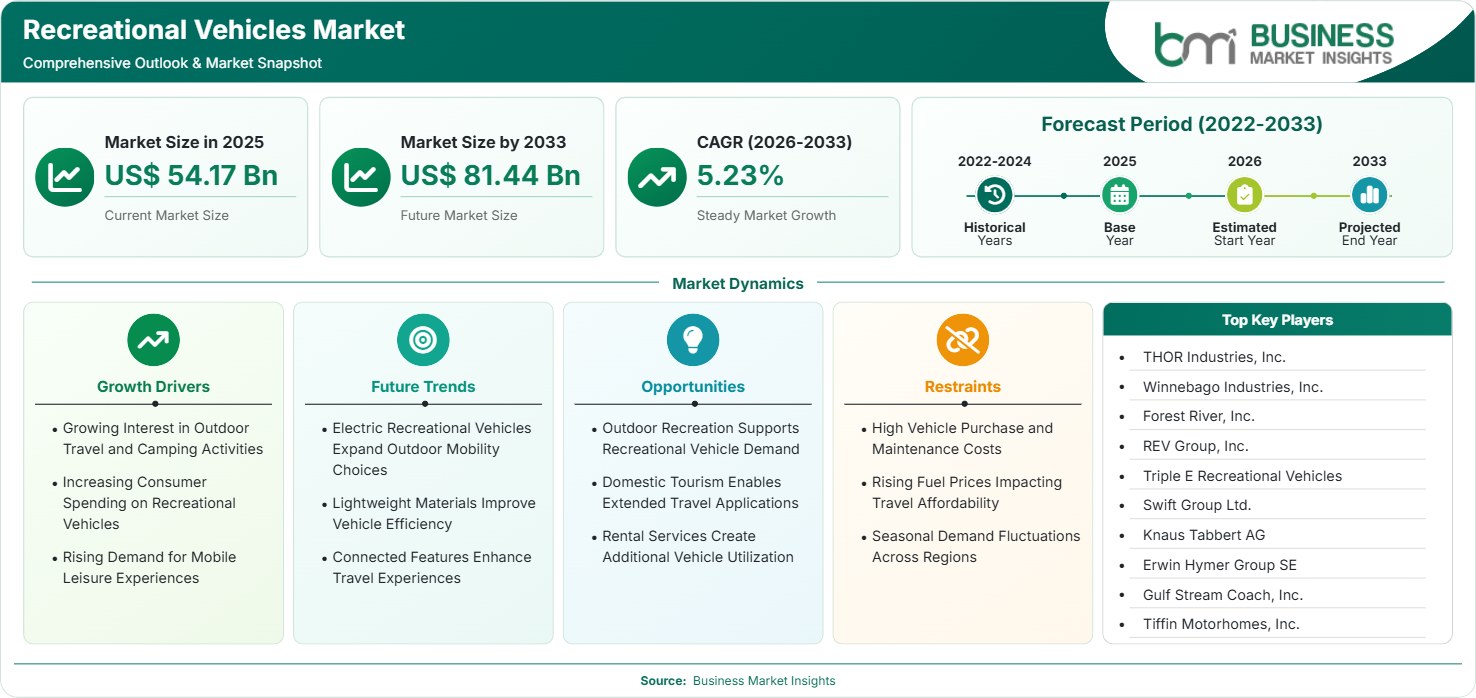
The Recreational Vehicles Market size was valued at US$ 54.17 Billion in 2025 and is projected to reach US$ 81.44 Billion by 2033, growing at a CAGR of 5.23% during 2026–2033, supported by rising outdoor tourism, expanding campground infrastructure, vehicle electrification initiatives, and increasing consumer demand for flexible leisure travel.

Report Coverage
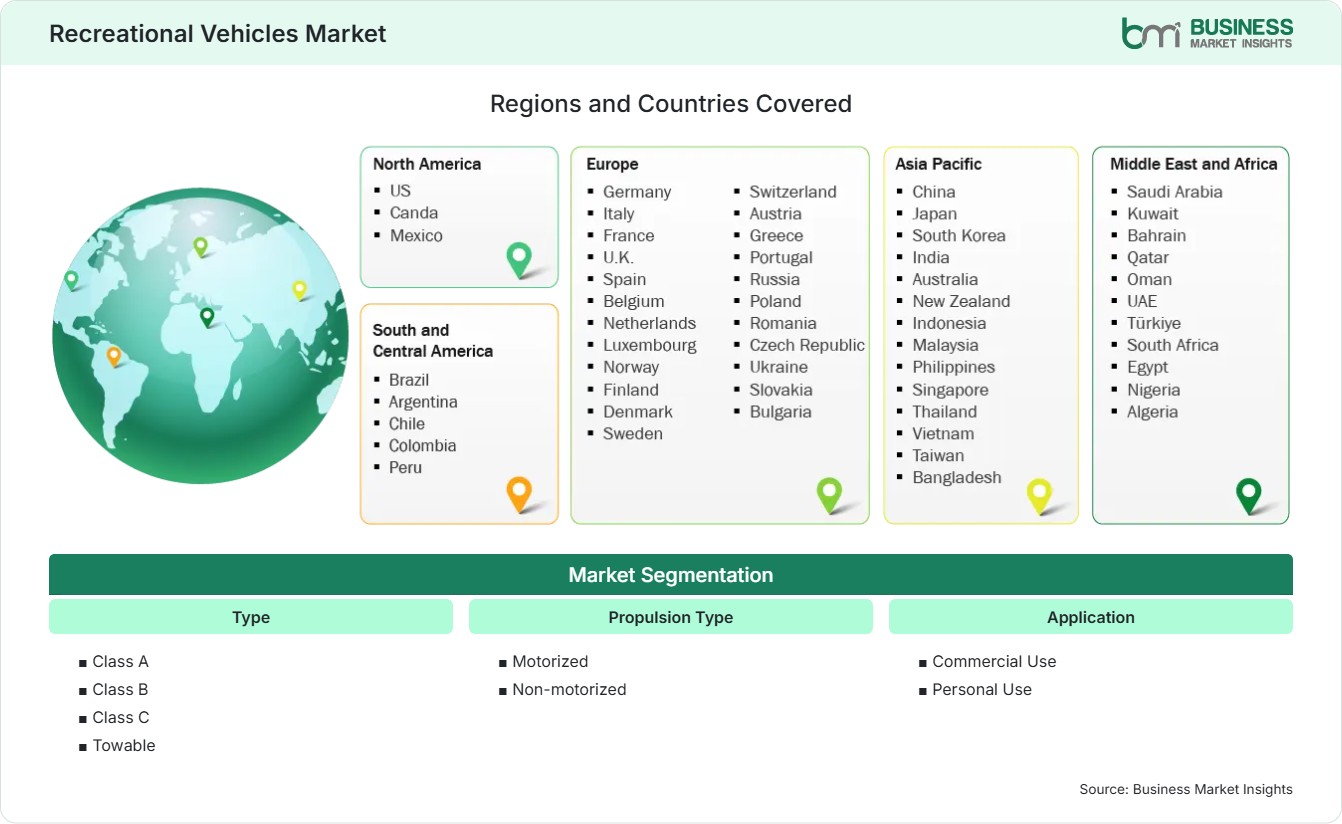
  • Type: Class A, Class B, Class C, Towable
  • Propulsion Type: Motorized, Non-motorized
  • Application: Commercial Use, Personal Use
US$ 54.17 Bn Market size in 2025
US$ 81.44 Bn Market Size by 2033
5.23% CAGR, 2026 - 2033
2026-2033 Forecast Period

AI Overview

Recreational Vehicles Market Summary

  • North America Region: North America holds a market share of 62%–65% in 2025, growing at a CAGR of 4.8%–5.2% during 2026–2033. Strong campground networks, favorable financing availability, premium motorhome adoption, and digital nomad lifestyles continue supporting demand. The US market remains dominant, benefiting from extensive RV ownership culture and a projected CAGR of 4.9%–5.3%.
  • Fastest Growing Region: Asia Pacific holds a market share of 13%–16% in 2025 and is expanding at a CAGR of 6.8%–7.4% during 2026–2033. Rising domestic tourism, improved road infrastructure, increasing disposable incomes, campground investments, and growing recreational travel awareness are accelerating regional adoption.
  • Leading Segment: Towable accounts for 54%–58% share in 2025 and is expected to grow at a CAGR of 4.9%–5.4% through 2033. Lower ownership costs, wider vehicle compatibility, easier maintenance, family travel preferences, and growing dealership availability continue supporting segment leadership.
  • High Growth Segment: Motorized propulsion type represents 42%–46% share in 2025 and is forecast to expand at a CAGR of 5.8%–6.4% through 2033. Premium feature integration, telematics deployment, luxury tourism demand, fleet modernization, and connected vehicle technologies support accelerated expansion.
  • Key Market Opportunity: Electrified recreational platforms, smart energy management systems, subscription-based ownership models, rental ecosystem growth, and sustainable tourism initiatives are creating new revenue streams across both mature and emerging destinations.
  • Major Market Players: THOR Industries, Inc.; Winnebago Industries, Inc.; Forest River, Inc.; REV Group, Inc.; Triple E Recreational Vehicles; Swift Group Ltd.; Knaus Tabbert AG; Erwin Hymer Group SE; Gulf Stream Coach, Inc.; Tiffin Motorhomes, Inc.
Strategic Insights

Recreational Vehicles Market: Strategic Insights

Recreational Vehicles Market Strategic Framework
FREE PDF
Request your free sample
Request free sample
Stakeholder View

Key Takeaways

  • The industry value chain is increasingly interconnected through chassis suppliers, component manufacturers, digital technology providers, campground operators, dealerships, and rental platforms, creating greater opportunities for ecosystem partnerships.
  • Commercial rental fleets and premium adventure tourism operators represent attractive growth avenues due to higher vehicle utilization rates and increasing consumer preference for experience-driven travel.
  • Innovation is moving beyond vehicle construction toward energy independence, smart connectivity, predictive maintenance, and integrated mobility ecosystems that enhance long-distance travel capabilities.
  • Asia Pacific offers a compelling investment proposition as campground networks, road infrastructure improvements, and domestic tourism initiatives continue supporting market penetration.
  • Strategic acquisitions and portfolio optimization activities among major manufacturers are strengthening brand diversification while improving geographic reach and operational efficiency.
  • Sustainable vehicle design, lightweight construction materials, and electrification-ready architectures are becoming major differentiators in premium product categories.
Geographic Outlook

Recreational Vehicles Market Regional Highlights

North America Recreational Vehicles Market

North America remains the industry's largest revenue contributor, accounting for approximately 62%–65% Recreational Vehicles Market share in 2025 while advancing at a CAGR of 4.8%–5.2% through 2033. Consumer awareness, an advanced dealer network, advanced campground infrastructure, and high household penetration help maintain the top position. The USA is a major contributor to the regional demand, while Canada benefits from outdoor recreational activities and domestic tourism. Luxury motorhomes and premium towable models continue to attract wealthy customers.

  • Extensive campground infrastructure supports multi-season vehicle utilization and strengthens replacement demand across established ownership bases.
  • Financing accessibility and strong dealer ecosystems improve consumer purchasing confidence and support steady sales volumes.
  • Premium vehicle categories increasingly incorporate smart connectivity, advanced safety technologies, and energy-efficient power systems.
  • Rental platform expansion introduces new consumers to recreational travel and encourages future ownership conversion.
  • Outdoor lifestyle participation remains a fundamental demand driver supporting long-term market resilience.

US Recreational Vehicles Market

The United States represents approximately 82%–86% of North American demand and is projected to grow at a CAGR of 4.9%–5.3%. Spending on outdoor activities, the availability of parks, and a well-developed system of financing the purchase of RVs make for a positive environment. Companies involved in renting RVs are growing their fleets, while manufacturers are working hard on innovations like connectivity features, weight reduction, and additional amenities. Recreational vacations remain a preferred alternative to certain types of vacations.

  • National parks and recreational destinations encourage recurring vehicle utilization across diverse demographic groups.
  • Connected vehicle technologies improve convenience, maintenance monitoring, and route-planning capabilities.
  • Rental fleet operators broaden market accessibility for younger travelers and first-time users.
  • Luxury motorized vehicle demand benefits from increasing preference for premium travel experiences.

Europe Recreational Vehicles Market

Europe accounts for 21%–24% market share in 2025 and is forecast to expand at a CAGR of 5.4%–5.9%. Germany still leads the pack, and Spain, along with other Central European countries, is adapting more quickly. The use of compact campervans is still going strong, owing to the availability of roads and the necessity of accessibility in urban settings. The creation of strong demand is thanks to the policies for sustainable tourism and cross-border convenience, as well as investments in campsites.

  • Germany remains the largest regional market supported by strong manufacturing capabilities and ownership culture.
  • Spain records one of the fastest regional expansion rates through tourism-driven demand growth.
  • Compact vehicle formats gain traction due to parking flexibility and operational efficiency.
  • Sustainability priorities encourage adoption of energy-efficient vehicle platforms.
  • Cross-border tourism strengthens long-distance travel demand throughout the region.

Asia Pacific Recreational Vehicles Market

Asia Pacific represents 13%–16% share in 2025 and delivers the highest CAGR of 6.8%–7.4% through 2033. China, Australia, Japan, and South Korea are influencing regional demand trends. Increasing disposable income, domestic tourism, and an understanding of the camping lifestyle are aiding adoption. Improvements in infrastructure and campaigns to promote regional tourism are continuously improving investment potential. Recreational Vehicles Market growth in the region is increasingly linked to emerging middle-class consumers seeking flexible travel experiences.

  • Australia remains a leading market with established caravan culture and extensive travel routes.
  • China presents significant long-term potential driven by infrastructure development and leisure tourism expansion.
  • Japan benefits from compact camping solutions aligned with geographic and parking constraints.
  • Domestic tourism campaigns increase awareness of recreational travel experiences.
  • Rental penetration supports consumer trial opportunities and future ownership growth.

Rest of World Recreational Vehicles Market

The Rest of World region accounts for 4%–6% share in 2025 and is expected to grow at a CAGR of 5.7%–6.2%. South and Central America are benefiting from improving tourism ecosystems and increasing interest in road-based travel. Meanwhile, Middle East and Africa markets remain niche but increasingly supported by outdoor hospitality investments.

Commercial tourism operators are leading demand creation, especially in destinations focused on adventure travel experiences. Recreational Vehicles Market share remains comparatively small; however, infrastructure investments and rental platform expansion create favorable long-term conditions.

  • Brazil leads South American demand through expanding domestic leisure travel activity.
  • Chile demonstrates strong potential due to adventure tourism and road exploration culture.
  • UAE supports niche premium demand associated with luxury tourism offerings.
  • South Africa benefits from nature-based tourism and growing vehicle rental services.
  • Infrastructure development remains the primary catalyst for future regional expansion.
Global Market Geography
FREE PDF
Request your free sample
Request free sample
Segment Analysis

Recreational Vehicles Market Segmentation

Type

Type represents a core differentiation factor across the industry. This segment accounts for approximately 100% market scope, with Towable leading at 54%–58% share in 2025. The overall type segment is expected to advance at 4.9%–5.6% CAGR through 2033 due to broader use cases, diverse pricing structures, and increasing recreational travel participation.

  • Class A: Premium motorhomes attract high-income consumers seeking luxury amenities, long-distance travel capability, and extended living functionality.
  • Class B: Compact camper vans benefit from urban maneuverability, fuel efficiency, and increasing interest among younger adventure travelers.
  • Class C: Balanced pricing and functionality support adoption by families seeking practical recreational mobility solutions.
  • Towable: Broad affordability, lower maintenance costs, and compatibility with existing vehicles sustain strong segment demand.

Propulsion Type

Propulsion design influences vehicle cost, comfort, and usage flexibility. The motorized category holds 42%–46% share in 2025 and is projected to record a CAGR of 5.8%–6.4%. Recreational Vehicles Market trends indicate stronger demand for connected mobility features, energy management systems, and premium onboard technologies.

  • Motorized: Integrated driving and living functions appeal to consumers prioritizing convenience and luxury travel experiences.
  • Non-motorized: Cost efficiency, storage flexibility, and wider accessibility continue supporting buyer preference among value-focused consumers.

Application

Application segmentation reflects evolving travel behavior and commercial fleet expansion. Personal use represents 71%–75% share in 2025, while the segment advances at 5.0%–5.5% CAGR through 2033. Increasing outdoor recreation participation, digital work flexibility, and tourism diversification continue stimulating demand.

  • Commercial Use: Rental fleets, tourism operators, and experiential travel businesses increasingly deploy vehicles to expand service offerings.
  • Personal Use: Family travel, road tourism, remote work mobility, and outdoor recreation remain dominant adoption drivers.
Market Forces

Recreational Vehicles Market Dynamics

Key Market Drivers

Expansion of Outdoor Recreation Participation

Outdoor recreation participation continues to increase across major economies, strengthening demand for self-contained travel solutions. The industry associations in North America have stated that there is a continuous interest in camping and an increasing interest among young people. Consumers are showing a preference for travel solutions that integrate transport, accommodation, and leisure. Travel solutions are supported by changing work patterns and the emergence of hybrid working, which enables mobility. The ownership of recreational vehicles helps people travel independently and reduces reliance on accommodation. Increased involvement in nature tourism, adventure activities, and road trips among families is thus a basic demand driver in developed and developing countries.

Technology Integration Enhancing User Experience

These manufacturers offer technologies such as ADAS, telematics, solar power, lithium-ion batteries for energy storage, and remote diagnostics. These advances make driving more convenient, efficient, safe, and independent of fossil fuels. Customers are now beginning to consider digital attributes along with the traditional performance of vehicles. Connectivity solutions allow predictive maintenance and increased asset efficiency for fleet owners. Smart control panels allow central management of all on-board functions such as climate, lighting, water systems, and energy storage. This helps differentiate products and increases customer satisfaction, leading to industry growth in the future.

Growth in Domestic Tourism Infrastructure

Investment in campgrounds, recreational parks, road transport infrastructure, and tourism ecosystems directly supports vehicle adoption. Governments have become increasingly aware that domestic tourism can be used as a means of developing the economy, leading to infrastructure improvement and diversification of destinations. Better accessibility means there are more customers to target, providing a chance for businesses to profit. Infrastructure improvements lead to greater efficiency and a good experience for the clients. Such a structure removes barriers to recreational travel and leads to increased demand for cars.

Key Market Opportunities

Electrification and Sustainable Mobility Platforms

Electrified recreational mobility represents a substantial growth avenue as manufacturers accelerate research into battery technologies, lightweight construction materials, and energy-efficient powertrains. Improved charging infrastructure and sustainability objectives encourage product innovation. Recreational Vehicles Market forecasts now increasingly take into account the scenario of electrification being adopted owing to changing regulatory and consumer demands. The use of hybrid systems, solar power, and energy management systems could provide a differentiated business proposition. First-movers who build scalable electrified systems could gain a premium position.

Expansion of Rental and Subscription Models

Rental marketplaces continue to reduce ownership barriers by enabling consumers to access vehicles without substantial capital commitments. Subscription-based access models further diversify monetization opportunities. Such business models facilitate customer acquisition as well as create a roadmap towards eventual ownership. Data-led vehicle use and price optimization are useful for commercial entities. The use of more digital platforms ensures higher visibility and convenience. Consumer familiarity with sharing services sets positive conditions for further market growth.

Emerging Tourism Corridors Across Asia and Middle East

Developing tourism infrastructure across Asia Pacific and selected Middle Eastern markets offers considerable untapped potential. Governments are building road infrastructure, tourist attractions, and tourist facilities to diversify sources of income for the industry. Higher incomes among the middle class provide the necessary boost to create demand, while global cooperation drives ecosystem development. Such conditions can be exploited by manufacturers through local product offerings, an increasing number of dealerships, and rental fleets.

Market Restraints and Challenges

High Acquisition Costs and Financing Sensitivity

Factor: Recreational vehicles require significant upfront capital investment, particularly within premium motorized categories. Impact: Elevated purchase costs limit accessibility for some consumer groups and increase sensitivity to interest-rate fluctuations. Financing conditions directly influence purchasing decisions, especially among first-time buyers. Rising insurance, maintenance, and storage expenses further increase total ownership costs. Economic uncertainty can therefore delay discretionary purchases and affect demand stability. Manufacturers must balance premium feature integration with affordability considerations to maintain broad market accessibility.

Supply Chain Complexity and Component Dependence

Factor: Production relies on diversified supply networks covering chassis, electronics, energy systems, furnishings, and specialty components. Impact: Supply disruptions can increase production costs, extend delivery timelines, and affect inventory availability. Dependence on global component sourcing exposes manufacturers to logistics volatility, commodity price movements, and geopolitical risks. Delays may reduce dealer inventory turnover and impact customer satisfaction. Strengthening supply-chain resilience remains essential for operational continuity and margin protection across the industry.

Company Analysis

Competitive Landscape

The Recreational Vehicles Market analysis indicates a competitive structure dominated by diversified manufacturers, premium motorhome specialists, and regional caravan producers focused on innovation, brand portfolios, and distribution expansion.

Company Name

Overview

Products and Services relevant to this market

THOR Industries, Inc.

World's largest RV manufacturer with extensive North American and European brand portfolio.

Motorhomes, travel trailers, fifth wheels, camper vans, connected RV solutions.

Winnebago Industries, Inc.

Major recreational mobility company with strong premium branding and innovation focus.

Motorhomes, towables, camper vans, outdoor recreation vehicles.

Forest River, Inc.

Diverse RV producer operating multiple brands across value and premium categories.

Travel trailers, motorhomes, fifth wheels, toy haulers and accessories.

REV Group, Inc.

Specialty vehicle maker serving commercial and recreational transportation segments.

Luxury motorhomes, recreational coach platforms, vehicle services.

Triple E Recreational Vehicles

Canadian manufacturer recognized for premium craftsmanship and compact designs.

Motorhomes, touring coaches, camper solutions.

Swift Group Ltd.

Leading European caravan and motorhome manufacturer.

Caravans, motorhomes, holiday lodges and support services.

Knaus Tabbert AG

Prominent European producer with multi-brand recreational portfolio.

Caravans, camper vans, motorhomes and digital mobility features.

Erwin Hymer Group SE

Major European recreational mobility specialist operating multiple vehicle brands.

Motorhomes, camper vans, caravans and mobility solutions.

Gulf Stream Coach, Inc.

Established US manufacturer targeting broad consumer segments.

Travel trailers, motorhomes and lightweight recreational vehicles.

Tiffin Motorhomes, Inc.

Premium motorhome producer known for luxury travel platforms.

Class A motorhomes, diesel coaches and related services.

Trust & Transparency

Research Methodology

The market analysis combines proprietary research with secondary data from government agencies, company disclosures, regulatory filings, industry databases and expert interviews. Market estimates are validated through data triangulation, cross-market benchmarking and analyst review.

View Full Research Methodology

Questions Answered

Frequently Asked Questions

What does a Recreational Vehicles Market Report typically evaluate?

A comprehensive Recreational Vehicles Market Report assesses market size, competitive positioning, regional dynamics, technology trends, demand drivers, regulatory influences, and future growth opportunities.

How is electrification influencing future product strategies?

Manufacturers are investing in battery systems, solar integration, energy efficiency, and lightweight construction technologies to align with sustainability goals and evolving consumer expectations.

What role do rental platforms play in industry development?

Rental platforms lower entry barriers, allow product trial experiences, expand customer reach, and create pathways toward eventual ownership while enhancing asset utilization among commercial operators.

Why is North America the leading revenue contributor?

The region benefits from extensive campground infrastructure, strong outdoor recreation culture, mature dealership networks, and high consumer awareness, creating favorable conditions for ownership and replacement demand.

Which factor most strongly influences purchasing decisions?

Purchase affordability, financing availability, vehicle size requirements, and intended travel frequency remain the most significant decision variables. Consumers increasingly evaluate energy systems and connectivity features before purchasing.

Access the Full Recreational Vehicles Market Report

Get segment-level forecasts, regional estimates, competitive benchmarking, company profiles and downloadable Excel datasets.

Access the full Recreational Vehicles Market Report
350 pages PDF & Excel | 2026-09-16
Similar Research

Related Market Reports