
Alternative Fuel Vehicles Market Outlook: Size, Share, Trends, Growth Analysis, Competitive Landscape & Forecast, 2026-2033

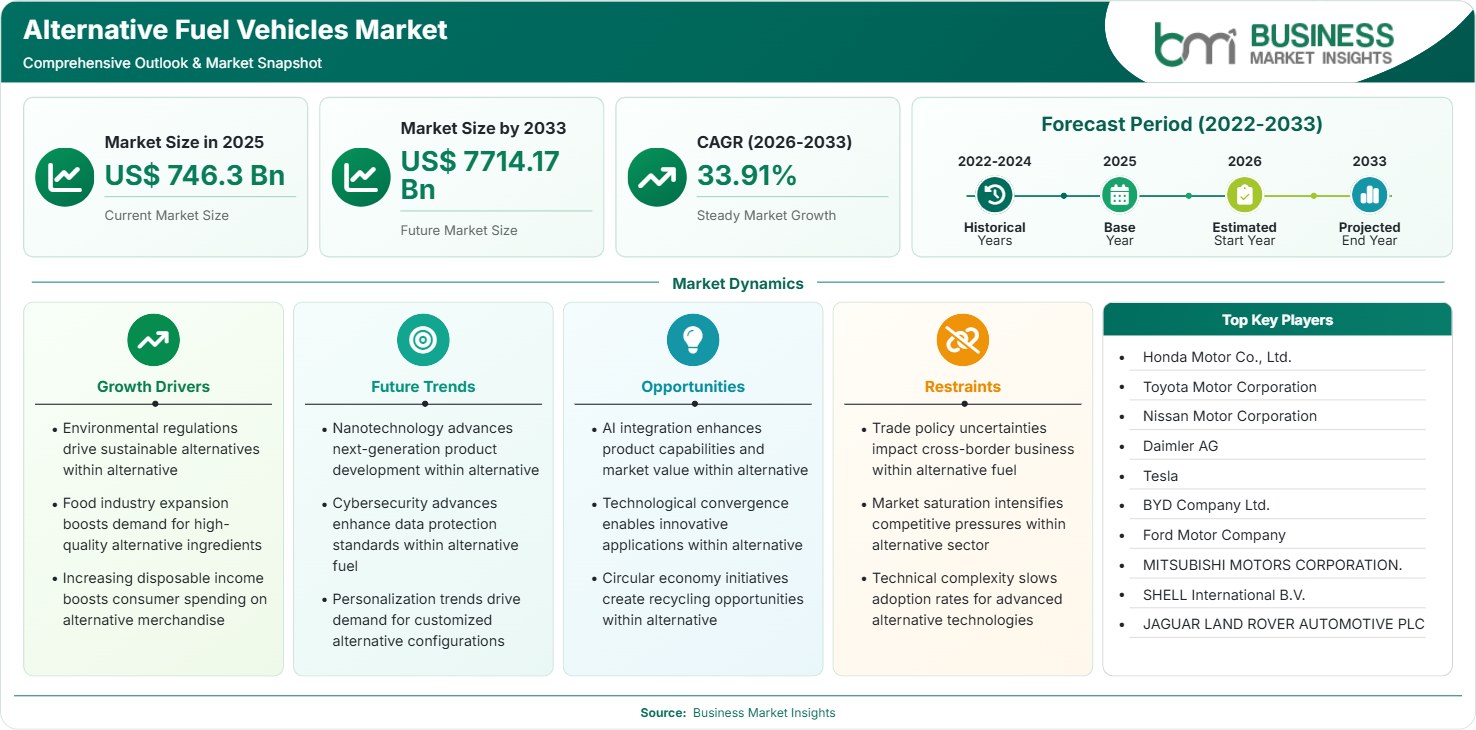
The Alternative Fuel Vehicles Market size was valued at US$ 746.3 Billion in 2025 and is projected to reach US$ 7,714.17 Billion by 2033, growing at a CAGR of 33.91% during 2026–2033. Strong government decarbonization policies, rapid battery technology advancements, expanding charging and hydrogen refueling infrastructure, and increasing investments by global automakers are accelerating market expansion while creating significant opportunities across passenger and commercial transportation.

Report Coverage
  • Fuel Type: BEV, HEV, PHEV, FCV, CNG, Biofuels, Other Gaseous Fuels
  • Vehicle Type: Passenger Cars, Commercial Vehicles
US$ 746.3 Bn Market size in 2025
US$ 7714.17 Bn Market Size by 2033
33.91% CAGR, 2026 - 2033
2026-2033 Forecast Period

AI Overview

Alternative Fuel Vehicles Market Summary

  • North America Region: North America holds 31%–34% market share in 2025 and is projected to register a 32.4%–33.2% CAGR during 2026–2033. Government incentives, rapid charging infrastructure expansion, battery manufacturing investments, fleet electrification, and emission reduction regulations continue supporting market expansion across public and private transportation. The U.S. accounts for nearly 76%–79% of the regional market and is projected to grow at 32.8%–33.6% CAGR, supported by domestic battery production and clean transportation investments.
  • Fastest Growing Region: Asia Pacific accounts for 27%–30% market share in 2025 while expanding at a 35.4%–36.3% CAGR through 2033. Strong manufacturing capacity, supportive industrial policies, large-scale EV adoption, battery supply chain localization, and increasing urban mobility investments continue strengthening regional competitiveness.
  • Leading Segment: Battery Electric Vehicles (BEV) represent 38%–41% market share in 2025 and are forecast to expand at a 35.2%–36.1% CAGR. Falling battery costs, expanding fast-charging infrastructure, government purchase incentives, and continuous improvements in vehicle range encourage widespread consumer and commercial fleet adoption globally.
  • High Growth Segment: Commercial Vehicles account for 29%–32% market share in 2025 while recording a 36.5%–37.4% CAGR during the forecast period. Fleet electrification, logistics decarbonization targets, government procurement programs, and lower operating costs are accelerating deployment across freight and public transportation sectors.
  • Key Market Opportunity: Expansion of integrated battery manufacturing, hydrogen infrastructure, vehicle-to-grid technology, and intelligent charging ecosystems creates attractive long-term investment opportunities for automakers, utilities, infrastructure providers, and mobility technology companies worldwide.
  • Major Market Players: Honda Motor Co., Ltd.; Toyota Motor Corporation; Nissan Motor Co., Ltd.; Mercedes-Benz Group AG; Tesla, Inc.; BYD Company Limited; Ford Motor Company; Mitsubishi Motors Corporation; Shell plc; Jaguar Land Rover Automotive PLC.
Strategic Insights

Alternative Fuel Vehicles Market: Strategic Insights

Alternative Fuel Vehicles Market Strategic Framework
FREE PDF
Request your free sample
Request free sample
Stakeholder View

Key Takeaways

  • The industry is rapidly evolving into an integrated ecosystem where battery manufacturers, semiconductor suppliers, charging infrastructure providers, utilities, and automotive OEMs increasingly collaborate to strengthen supply chain resilience and improve production efficiency.
  • Commercial transportation presents one of the strongest investment opportunities as logistics operators, municipal transit agencies, and corporate fleets accelerate fleet electrification to reduce operating costs and comply with stricter emission regulations.
  • Continuous innovation in battery chemistry, hydrogen fuel-cell systems, lightweight materials, and vehicle software platforms is reshaping product competitiveness while extending driving range, improving safety, and reducing lifecycle ownership costs.
  • Asia Pacific offers the strongest manufacturing and investment potential due to extensive battery production capacity, supportive industrial policies, integrated component supply chains, and rising domestic demand for clean mobility solutions.
  • Strategic partnerships, mergers, and long-term battery material agreements are becoming increasingly important as automakers secure critical raw materials, manufacturing capacity, and technology expertise to strengthen global competitiveness.
  • Digital fleet management, vehicle-to-grid integration, predictive maintenance, and AI-enabled energy optimization are emerging as valuable differentiators for manufacturers seeking sustainable long-term revenue beyond vehicle sales.
Geographic Outlook

Alternative Fuel Vehicles Market Regional Highlights

North America Alternative Fuel Vehicles Market

North America accounts for 31%–34% of global revenue in 2025 and is anticipated to register a 32.4%–33.2% CAGR during 2026–2033. The Alternative Fuel Vehicles Market share in the region is supported by expanding battery manufacturing facilities, favorable federal and state incentives, increasing investments in public charging infrastructure, and accelerating fleet electrification. The U.S. and Canada continue strengthening domestic battery supply chains while automakers localize production to reduce import dependence. Growing renewable electricity generation and supportive industrial policies further enhance regional competitiveness across passenger and commercial mobility applications.

  • Federal tax incentives and domestic manufacturing programs continue encouraging vehicle production, battery investments, and charging infrastructure deployment, creating a resilient ecosystem for long-term clean mobility adoption across the region.
  • Battery gigafactory investments by leading automotive manufacturers and cell producers are strengthening local supply chains while reducing logistics costs and improving production security for electric vehicle manufacturers.
  • Commercial fleet operators increasingly adopt electric delivery vans, buses, and medium-duty trucks to lower operating expenses, comply with emission regulations, and achieve corporate sustainability targets.
  • Vehicle software innovation, connected mobility platforms, and advanced driver assistance systems continue improving operational efficiency while enhancing consumer confidence and supporting long-term market competitiveness.
  • Utility companies are expanding smart charging and grid modernization initiatives, improving charging reliability while supporting renewable energy integration for large-scale vehicle electrification.

US Alternative Fuel Vehicles Market

The United States represents approximately 76%–79% of North American demand and is projected to expand at a 32.8%–33.6% CAGR through 2033. The country benefits from large-scale battery manufacturing investments, rising consumer acceptance of electric vehicles, strong clean transportation funding, and expanding domestic mineral processing initiatives. The Alternative Fuel Vehicles Market growth is reinforced by continuous charging network expansion, advanced automotive R&D, and increasing corporate fleet electrification supported by favorable regulatory frameworks and public-private investment partnerships.

  • Large-scale investments in battery cell manufacturing continue strengthening domestic production capabilities while supporting employment generation and long-term industrial competitiveness across the automotive sector.
  • Public charging infrastructure continues expanding across interstate highways and metropolitan areas, reducing range anxiety while improving accessibility for passenger and commercial vehicle operators.
  • Technology companies and automotive manufacturers increasingly collaborate on connected vehicle software, artificial intelligence integration, and energy management solutions to improve ownership experience.
  • Fleet operators continue replacing conventional vehicles with electric alternatives to reduce maintenance expenses, fuel consumption, and carbon emissions across logistics and municipal transportation operations.

Europe Alternative Fuel Vehicles Market

Europe holds 24%–27% of the global Alternative Fuel Vehicles Market in 2025 and is forecast to record a 33.5%–34.3% CAGR during the assessment period. Strong emission reduction regulations, extensive charging infrastructure, and ambitious climate targets continue supporting regional expansion. Germany remains the leading national market with a CAGR of 33.2%–34.0%, while Poland represents one of the fastest-growing countries, expanding at 35.1%–36.0% CAGR due to increasing manufacturing investments and supportive industrial policies.

  • European Union carbon reduction targets continue encouraging manufacturers to accelerate electrification strategies while increasing investments in battery manufacturing and recycling infrastructure.
  • Germany maintains leadership through advanced automotive engineering capabilities, premium vehicle manufacturing, and significant investments in battery research and electric mobility technologies.
  • Poland is attracting new battery component manufacturing facilities and supplier investments, strengthening Central Europe's position within the regional electric vehicle supply chain.
  • Hydrogen mobility initiatives continue expanding across heavy-duty transportation applications, supported by public funding and cross-border infrastructure development programs.
  • Renewable energy integration and smart charging technologies continue improving sustainability while lowering lifecycle emissions associated with vehicle charging operations.

Asia Pacific Alternative Fuel Vehicles Market

Asia Pacific accounts for 27%–30% of global Alternative Fuel Vehicles Market demand in 2025 and is projected to achieve the fastest regional CAGR of 35.4%–36.3% through 2033. China leads regional production with a CAGR of 35.5%–36.2%, while India records one of the fastest growth rates at 36.8%–37.6% CAGR, supported by expanding domestic manufacturing, government incentives, and rising urban mobility demand. Integrated battery supply chains and strong export capabilities continue strengthening regional leadership.

  • China dominates battery manufacturing, electric vehicle production, and raw material processing, creating significant economies of scale for global automotive manufacturers.
  • India continues expanding charging infrastructure and production-linked incentive programs, encouraging domestic manufacturing while attracting international automotive investments.
  • Japan and South Korea remain global leaders in battery technology innovation, fuel-cell development, and advanced automotive component manufacturing.
  • Regional governments continue strengthening localization policies to reduce import dependence while improving supply chain resilience for critical battery materials.
  • Increasing urbanization and supportive clean mobility policies continue driving strong demand across passenger vehicles, buses, and commercial transportation fleets.

Rest of World Alternative Fuel Vehicles Market

The Rest of World region accounts for 12%–15% of global Alternative Fuel Vehicles Market revenue in 2025 and is projected to expand at a 31.6%–32.5% CAGR during the forecast period. South & Central America is experiencing increasing investment in electric mobility infrastructure, while the Middle East & Africa is gradually expanding charging networks and clean transportation initiatives. Brazil leads South & Central America with a CAGR of 32.4%–33.1%, whereas the United Arab Emirates records one of the fastest regional growth rates at 33.5%–34.2% CAGR.

Growing urban transportation modernization programs, renewable energy integration, and government-backed sustainability initiatives continue encouraging adoption across emerging economies despite infrastructure challenges and higher upfront vehicle costs.

  • Brazil continues strengthening domestic electric bus deployment and charging infrastructure, supported by municipal sustainability programs and growing investment in renewable energy.
  • Gulf countries are investing in hydrogen mobility, charging infrastructure, and smart city transportation projects to diversify their energy and mobility ecosystems.
  • Mining investments supporting battery mineral production continue enhancing long-term supply chain opportunities across several African economies.
  • International development funding and public-private partnerships are improving charging accessibility and accelerating electric mobility adoption across emerging markets.
  • Fleet modernization initiatives across logistics, public transportation, and municipal services continue supporting gradual transition toward lower-emission transportation systems.
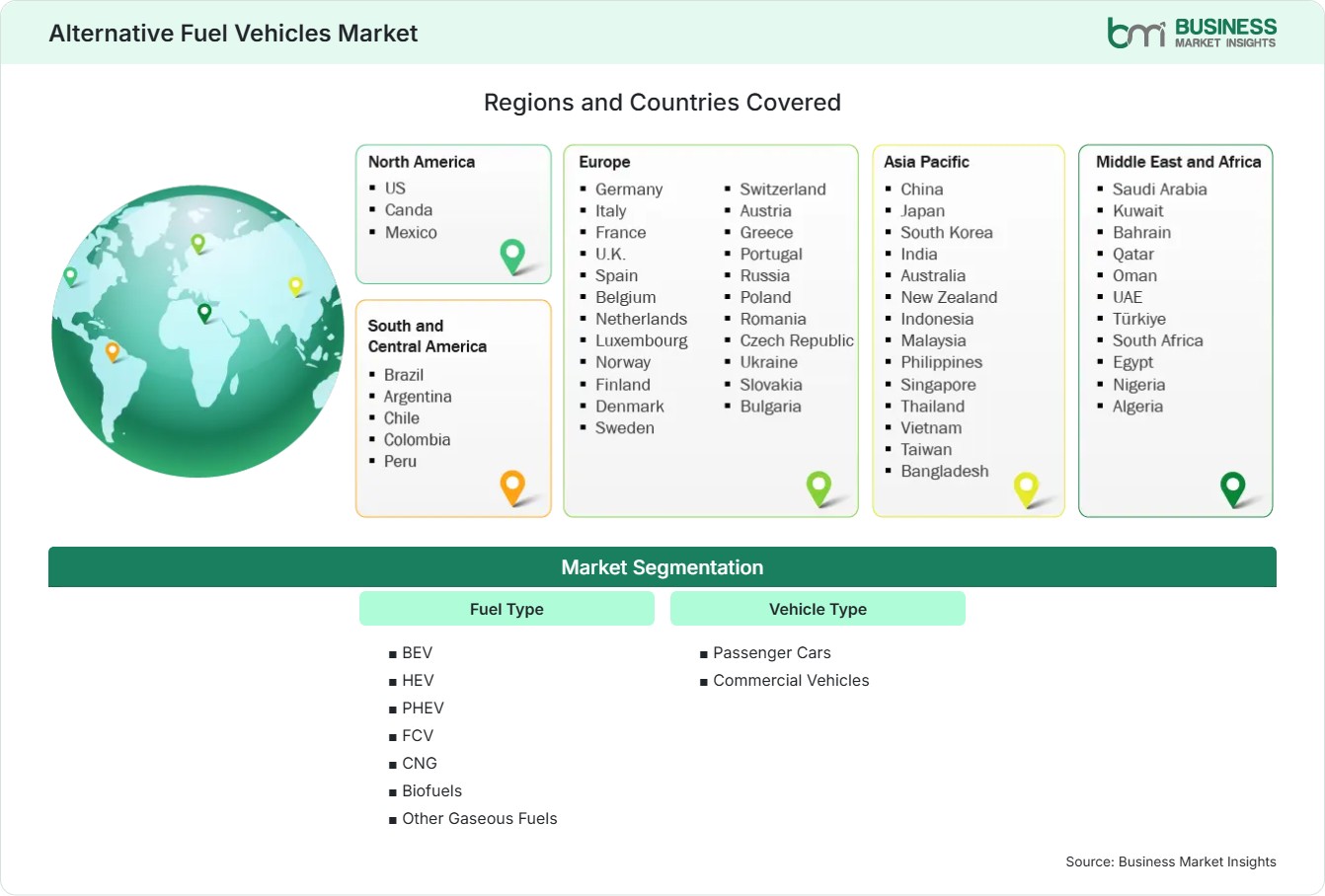
Global Market Geography
FREE PDF
Request your free sample
Request free sample
Segment Analysis

Alternative Fuel Vehicles Market Segmentation

Fuel Type

The Fuel Type segment accounted for 100% of the market by classification in 2025, with Battery Electric Vehicles leading overall demand. The segment is projected to expand at a 34.0%–34.8% CAGR through 2033 as governments tighten emission regulations, battery costs continue declining, and charging infrastructure expands globally. The Alternative Fuel Vehicles Market scope continues broadening through diversified propulsion technologies that address varying consumer preferences, commercial fleet requirements, and regional energy strategies.

  • BEV: Battery Electric Vehicles dominate adoption owing to zero tailpipe emissions, declining battery costs, expanding fast-charging infrastructure, and strong government incentives supporting passenger vehicles, commercial fleets, and urban mobility applications worldwide.
  • HEV: Hybrid Electric Vehicles remain attractive where charging infrastructure is developing, offering improved fuel efficiency, lower emissions, reliable driving range, and reduced ownership costs for mainstream consumers transitioning toward electrified mobility.
  • PHEV: Plug-in Hybrid Electric Vehicles combine electric driving capability with conventional engines, providing flexibility for long-distance travel while supporting emission reduction targets across personal and fleet transportation applications.
  • FCV: Fuel Cell Vehicles continue gaining momentum in heavy-duty transportation, supported by hydrogen infrastructure investments, rapid refueling capability, extended driving range, and industrial decarbonization initiatives in selected economies.
  • CNG: Compressed Natural Gas vehicles remain relevant for commercial transportation, municipal buses, and logistics operations where established fueling infrastructure and lower operating expenses encourage continued fleet modernization.
  • Biofuels: Biofuel-powered vehicles support decarbonization strategies by utilizing renewable fuel sources while leveraging existing internal combustion technologies, particularly across agricultural, commercial, and heavy-duty transportation sectors.
  • Other Gaseous Fuels: Alternative gaseous fuels continue serving niche transportation applications where regional energy availability, industrial infrastructure, and regulatory frameworks encourage adoption beyond conventional petroleum-based fuels.

Vehicle Type

Passenger Cars remain the largest category, accounting for 68%–71% Alternative Fuel Vehicles Market share in 2025 and expanding at a 33.2%–34.0% CAGR through 2033. Increasing consumer preference for sustainable transportation, wider model availability, supportive purchase incentives, and technological innovation continue strengthening demand. Meanwhile, Commercial Vehicles represent the fastest-growing category as logistics providers, transit authorities, and corporate fleets accelerate electrification to reduce operating costs and comply with evolving emission standards.

  • Passenger Cars: Strong consumer demand, expanding charging accessibility, enhanced driving range, connected vehicle technologies, and attractive ownership incentives continue supporting widespread adoption across developed and emerging automotive markets.
  • Commercial Vehicles: Fleet electrification, public transportation modernization, last-mile delivery expansion, and sustainability commitments encourage logistics operators and municipal authorities to increasingly adopt alternative fuel-powered commercial transportation solutions.
Market Forces

Alternative Fuel Vehicles Market Dynamics

Key Market Drivers

Stringent Emission Regulations Accelerating Vehicle Electrification

Governments across the world are working on stricter emissions standards in order to attain carbon neutrality and clean up the air in cities. In particular, the EU’s CO₂ fleet emissions targets, U.S. Environmental Protection Agency’s vehicle emissions standards, and Chinese New Energy Vehicle strategy are urging manufacturers to speed up their electrification plans. According to the International Energy Agency (IEA), global electric vehicle sales exceeded 17 million units in 2024, demonstrating strong consumer acceptance. The Alternative Fuel Vehicles Market growth is also being driven by increased public incentives, rising fuel economy requirements, and growing investments in charging stations. Car manufacturers are focusing on electric batteries and hydrogen-based vehicle systems to meet changing environmental requirements and build future competitive advantages in the global market.

Rapid Advancements in Battery Technology and Manufacturing

Continuous innovation in lithium-ion batteries, solid-state battery research, battery management systems, and advanced power electronics is significantly improving vehicle performance while reducing production costs. The high energy density, fast charging capacity, and increased battery life make alternative fuel vehicles more appealing to both individuals and companies using fleets. The battery gigafactories which have been set up on large scales in North America, Europe, and Asia Pacific continue bolstering the resilience of their supply chains even as they cut down costs of manufacture. Increased investments in battery recycling processes and localized processing of critical minerals enhance long term resource security.

Expansion of Charging and Hydrogen Infrastructure

Public and private investments in charging networks and hydrogen refueling stations continue improving accessibility for zero-emission transportation. Governments, utilities, and private infrastructure providers are collaborating to expand fast-charging corridors across urban centres and highways. The International Energy Agency has found that there is a steady increase in the number of public charge stations available each year, which has led to an increased number of electric cars. Smart charging technology, the use of renewable energy sources, and digital energy management systems have made infrastructure more efficient. The increasing faith in charging facilities reduces range anxiety and helps consumers move to greener modes of transport.

Key Market Opportunities

Vehicle-to-Grid Integration and Smart Energy Ecosystems

Vehicle-to-grid technology is emerging as a major investment opportunity by allowing electric vehicles to function as distributed energy storage assets. Vehicle-to-grid technology allows cars to contribute electricity to grids during peak consumption periods, thereby adding stability to the grid and providing extra sources of income for car owners. Energy management systems are being developed by utilities, electric chargers and automakers in order to facilitate this development. The Alternative Fuel Vehicles Market Forecasts indicate that growing renewable electricity generation will further increase demand for integrated mobility-energy solutions, creating long-term opportunities across software, hardware, and grid modernization services worldwide.

Commercial Fleet Electrification Across Logistics and Public Transit

There is continued heavy investment by governments as well as fleet management companies in electric buses, trucks, delivery vans, and other large fleets in order to save on fuel costs and carbon emissions. The growth in e-commerce, company sustainability objectives, and strict environmental regulations have motivated logistics firms to speed up their vehicle replacement programs. Fleet management companies now appreciate low maintenance costs among others associated with alternative fuels. Manufacturers developing commercial platforms with longer driving range, faster charging capability, and digital fleet management solutions are well positioned to capitalize on this expanding opportunity across both developed and emerging economies.

Hydrogen Economy Development for Heavy-Duty Mobility

Future Alternative Fuel Vehicles Market Trends indicate that Hydrogen-powered transportation presents substantial long-term opportunities, particularly for heavy commercial vehicles, industrial transportation, rail applications, and long-distance freight operations. Hydrogen fuel cell systems are receiving significant attention from the European, Asian, and Middle Eastern governments due to their investment in hydrogen production, storage, and distribution infrastructure and green hydrogen initiatives. The fuel cell vehicles offer greater driving range and fast refueling than the battery-powered vehicles in some commercial operations. With decreasing production costs and growth in the hydrogen fuel cell infrastructure, many companies will benefit from its use in various transportation segments.

Market Restraints and Challenges

High Initial Vehicle Cost and Battery Material Dependency

Factor: Alternative fuel vehicles continue carrying higher upfront purchase prices than comparable internal combustion vehicles due to expensive battery packs and critical mineral requirements.

Impact: Increased purchasing costs may slow down uptake among cost-conscious consumers as well as small businesses with commercial vehicle fleets, especially in emerging countries. Uncertainty regarding lithium, nickel, cobalt, and graphite could result in higher manufacturing costs as well as pricing instability. While batteries become increasingly affordable as a result of innovations in technology and large-scale production, material availability poses a strategic issue that impacts profitability and planning.

Uneven Infrastructure Development Across Emerging Economies

Factor: Charging infrastructure and hydrogen refueling networks remain unevenly distributed across many developing countries, limiting accessibility for consumers and fleet operators.

Impact: Infrastructure unavailability is an aspect that undermines consumer confidence, causes operational uncertainty, and limits widespread adoption even with favorable policies from the government. The limitations in electricity supply networks, expensive infrastructure investments, and complicated approval procedures also limit the adoption process. Manufacturers seeking to enter new markets need to work closely with governments, power companies, and infrastructure investors in order to foster adoption.

Company Analysis

Competitive Landscape

The Alternative Fuel Vehicles Market analysis indicates an increasingly competitive environment characterised by rapid technological innovation, strategic partnerships, battery supply chain integration, software-defined vehicle development, and investments in charging and hydrogen infrastructure. Leading manufacturers are strengthening their global presence through new product launches, localized manufacturing, and long-term investments in sustainable mobility solutions.

Company Name

Overview

Products and Services Relevant to this Market

Honda Motor Co., Ltd.

Global automotive manufacturer investing in hybrid, battery electric, and hydrogen mobility technologies with expanding electrification initiatives across key international markets.

Hybrid vehicles, battery electric vehicles, hydrogen fuel-cell technologies, automotive R&D, mobility solutions, connected vehicle technologies, and energy management systems.

Toyota Motor Corporation

Leading global automaker recognised for pioneering hybrid technology while expanding battery electric and hydrogen vehicle portfolios worldwide.

Hybrid electric vehicles, battery electric vehicles, fuel-cell vehicles, battery technologies, mobility services, and intelligent transportation solutions.

Nissan Motor Co., Ltd.

Major Japanese automotive company focused on mass-market electric mobility, connected vehicles, and sustainable transportation innovation.

Electric passenger vehicles, battery technologies, intelligent driving systems, connected mobility platforms, and vehicle energy management solutions.

Mercedes-Benz Group AG

Premium automotive manufacturer accelerating luxury electric mobility through advanced battery technology and software-driven vehicle platforms.

Luxury battery electric vehicles, plug-in hybrid vehicles, digital vehicle platforms, charging services, and premium mobility technologies.

Tesla, Inc.

Global leader in battery electric vehicles supported by integrated battery manufacturing, software innovation, and proprietary charging infrastructure.

Battery electric vehicles, energy storage systems, Supercharger network, autonomous driving software, and renewable energy integration solutions.

BYD Company Limited

Vertically integrated manufacturer combining battery production with large-scale electric vehicle manufacturing for passenger and commercial markets.

Electric cars, electric buses, battery technologies, commercial electric vehicles, battery storage systems, and clean energy solutions.

Ford Motor Company

Global automotive manufacturer expanding electric vehicle production through dedicated platforms and strategic battery manufacturing investments.

Electric pickup trucks, electric SUVs, commercial electric vehicles, charging services, connected mobility platforms, and fleet management technologies.

Mitsubishi Motors Corporation

Japanese automaker focusing on electrified SUVs and plug-in hybrid technologies for global consumer markets.

Plug-in hybrid vehicles, electric vehicles, advanced powertrain technologies, intelligent safety systems, and connected mobility solutions.

Shell plc

International energy company investing extensively in electric vehicle charging networks and hydrogen infrastructure development globally.

EV charging infrastructure, hydrogen refuelling solutions, renewable energy services, fleet charging management, and integrated energy solutions.

Jaguar Land Rover Automotive PLC

Premium automotive manufacturer transitioning toward fully electrified luxury mobility through sustainable vehicle development strategies.

Luxury electric vehicles, plug-in hybrid vehicles, premium mobility technologies, connected vehicle software, and sustainable automotive engineering.

Trust & Transparency

Research Methodology

The market analysis combines proprietary research with secondary data from government agencies, company disclosures, regulatory filings, industry databases and expert interviews. Market estimates are validated through data triangulation, cross-market benchmarking and analyst review.

View Full Research Methodology

Questions Answered

Frequently Asked Questions

Why should businesses invest in the Alternative Fuel Vehicles Market Report?

The Alternative Fuel Vehicles Market Report provides comprehensive insights into market dynamics, technology trends, regional opportunities, competitive benchmarking, investment prospects, and strategic developments, helping businesses make informed long-term decisions.

Which companies are shaping industry competition?

Major participants include Honda Motor Co., Ltd., Toyota Motor Corporation, Nissan Motor Co., Ltd., Mercedes-Benz Group AG, Tesla, Inc., BYD Company Limited, Ford Motor ompany, Mitsubishi Motors Corporation, Shell plc, and Jaguar Land Rover Automotive PLC.

Which region is expected to witness the fastest growth?

Asia Pacific is expected to record the fastest growth because of strong manufacturing capabilities, favourable industrial policies, battery production leadership, increasing electric vehicle adoption, and expanding export capacity.

Which fuel type leads the market?

Battery Electric Vehicles (BEVs) currently lead the market due to falling battery costs, longer driving ranges, expanding charging infrastructure, and supportive government policies encouraging zero-emission transportation.

What is driving demand for alternative fuel vehicles?

Demand is primarily driven by stricter emission regulations, government incentives, advances in battery technology, expanding charging infrastructure, and increasing consumer preference for sustainable transportation solutions that reduce operating costs and carbon emissions.

Access the Full Alternative Fuel Vehicles Market Report

Get segment-level forecasts, regional estimates, competitive benchmarking, company profiles and downloadable Excel datasets.

Access the full Alternative Fuel Vehicles Market Report
350 pages PDF & Excel | 2026-08-17
Similar Research

Related Market Reports