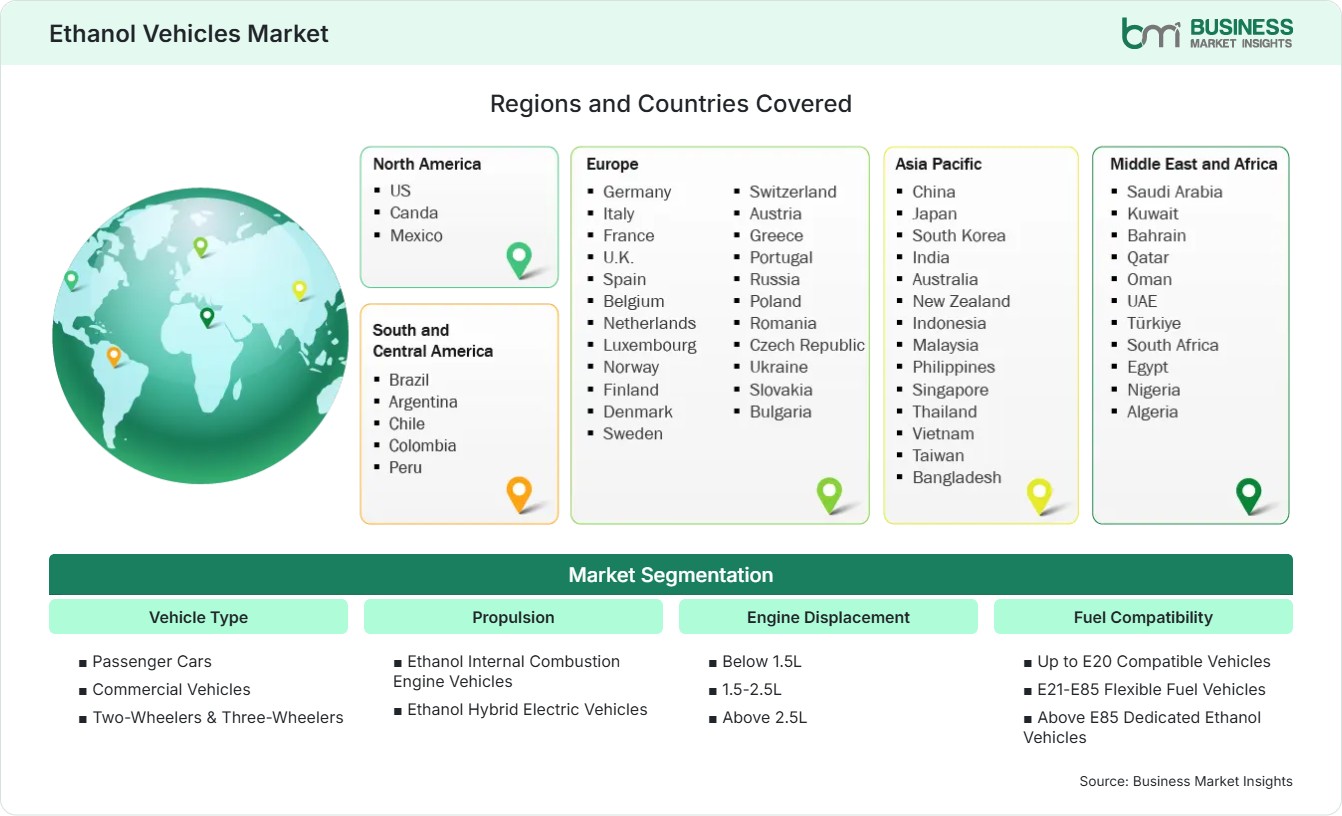
Ethanol Vehicles Market Regional Highlights
North America Ethanol Vehicles Market
North America represented 34%–37% of global revenue in 2025 and is projected to grow at a CAGR of 9.8%–10.4% during 2026–2033. Strong Renewable Fuel Standard implementation, established ethanol distribution networks, and extensive flexible-fuel vehicle adoption continue supporting regional demand. The United States dominates regional sales, while Canada strengthens renewable transportation through clean fuel policies. Continued investment in agricultural feedstocks, advanced engine technologies, and biofuel infrastructure reinforces the Ethanol Vehicles Market share across the region.
- Renewable fuel regulations encourage higher ethanol consumption, enabling vehicle manufacturers to expand flexible-fuel model portfolios while strengthening long-term fuel availability through nationwide infrastructure investments.
- Corn-based ethanol production provides a stable domestic fuel supply, improving energy security and supporting collaboration among agricultural producers, fuel suppliers, and automotive manufacturers.
- Fleet operators increasingly deploy ethanol-compatible commercial vehicles to reduce lifecycle emissions without major infrastructure replacement, particularly in logistics, municipal transportation, and government fleets.
- Investments in advanced biofuel technologies and hybrid-flex powertrains continue improving vehicle efficiency while supporting sustainable transportation objectives across North America.
US Ethanol Vehicles Market
The United States contributes 76%–80% of North American revenue and is forecast to expand at a CAGR of 9.9%–10.3% through 2033. Extensive corn ethanol production, mature fueling infrastructure, and supportive renewable fuel policies create a favorable environment for ethanol-compatible vehicles. Major automotive manufacturers continue investing in flexible-fuel technologies, advanced engine calibration, and hybrid systems to improve efficiency while supporting national energy diversification goals.
- Federal renewable fuel programs strengthen long-term ethanol demand while encouraging continued investment in compatible vehicle platforms and fueling infrastructure.
- Automotive manufacturers continue improving engine efficiency for higher ethanol blends through advanced combustion technologies and intelligent electronic engine management.
- Commercial fleet operators increasingly evaluate ethanol-powered vehicles to reduce emissions while maintaining operational flexibility and manageable ownership costs.
Europe Ethanol Vehicles Market
Europe Ethanol Vehicles Market growth accounted for 22%–25% of global market revenue in 2025 and is expected to record a CAGR of 10.2%–10.9% during the forecast period. Renewable Energy Directive implementation, decarbonization targets, and sustainable mobility policies continue encouraging ethanol-compatible vehicle development. Western Europe remains the largest regional contributor, while Central and Eastern Europe steadily increase renewable fuel investments and automotive production capacity.
- France leads regional adoption through established E85 infrastructure, favorable taxation policies, and strong consumer acceptance of renewable transportation fuels.
- Sweden represents the fastest-growing national market with an estimated 11.4%–12.0% CAGR, supported by ambitious climate objectives and expanding renewable fuel utilization.
- European automakers continue integrating flexible-fuel technologies with hybrid propulsion systems to satisfy evolving environmental regulations and consumer demand.
- Growing investment in second-generation bioethanol production improves sustainability by utilizing agricultural residues and industrial biomass instead of conventional feedstocks.
Asia Pacific Ethanol Vehicles Market
Asia Pacific held 24%–27% of global revenue in 2025 and is anticipated to record the fastest expansion at a CAGR of 12.8%–13.6% during 2026–2033. Government-led ethanol blending programs, increasing domestic biofuel production, rising vehicle ownership, and expanding automotive manufacturing capacity continue driving regional demand. India and China account for significant investments, while Southeast Asian countries strengthen renewable fuel ecosystems through supportive regulations and agricultural feedstock development.
- India continues expanding E20 implementation, supported by sugarcane-based ethanol production, favorable government incentives, and increasing availability of ethanol-compatible passenger vehicles.
- China invests in advanced biofuel technologies and localized automotive manufacturing while promoting diversified low-carbon transportation solutions alongside vehicle electrification.
- Thailand remains among the fastest-growing Southeast Asian markets with a 13.4%–14.1% CAGR, supported by mature ethanol policies and abundant agricultural resources.
- Regional manufacturers increasingly introduce hybrid-flex platforms, intelligent engine controls, and lightweight vehicle architectures to improve efficiency and reduce emissions.
Rest of World Ethanol Vehicles Market
Rest of World accounted for 14%–17% of the global market in 2025 and is forecast to expand at a CAGR of 11.1%–11.8% through 2033. South & Central America remains the principal contributor because of mature ethanol production and widespread flexible-fuel vehicle adoption. The Middle East & Africa is gradually increasing renewable transportation investments to diversify energy sources and strengthen long-term sustainability strategies.
- Brazil remains the regional leader because of nationwide ethanol infrastructure, strong sugarcane production, and decades of flexible-fuel vehicle adoption.
- Argentina continues strengthening ethanol blending initiatives, creating additional opportunities for renewable transportation and domestic agricultural industries.
- South Africa demonstrates promising long-term potential with a projected 11.8%–12.5% CAGR, supported by renewable fuel policy development and improving biofuel investment.
- Strategic investments in advanced bioethanol facilities and supply chain modernization continue strengthening renewable mobility across emerging economies.