
Radio Frequency Cables Market Outlook: Size, Share, Trends, Growth Analysis, Competitive Landscape & Forecast, 2026-2033

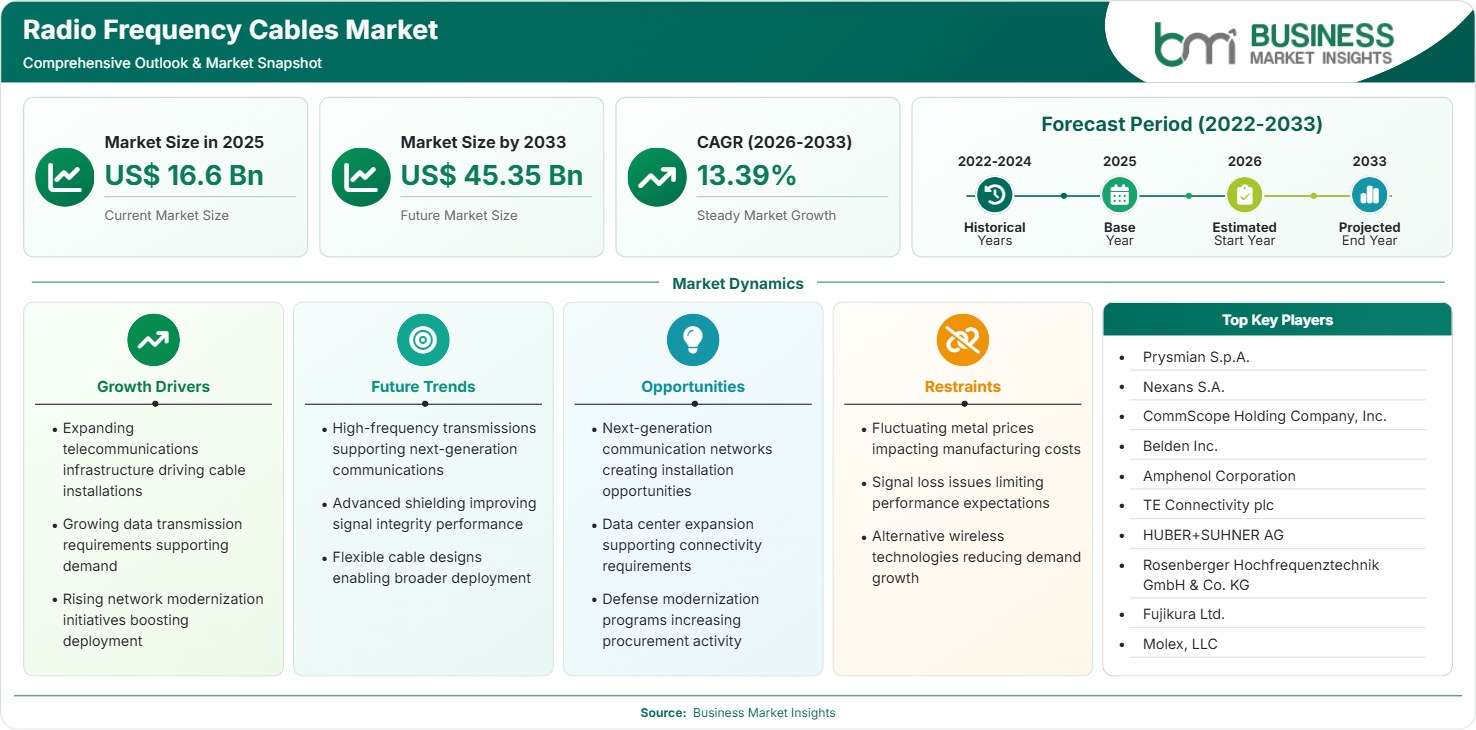
The Radio Frequency Cables Market size was valued at US$ 16.6 Billion in 2025 and is projected to reach US$ 45.35 Billion by 2033, growing at a CAGR of 13.39% during 2026–2033. Key growth drivers include 5G infrastructure expansion, rising data center deployments, aerospace communications modernization, defense electronics demand, and increasing adoption of high-bandwidth connectivity solutions across industrial and consumer applications.

Report Coverage
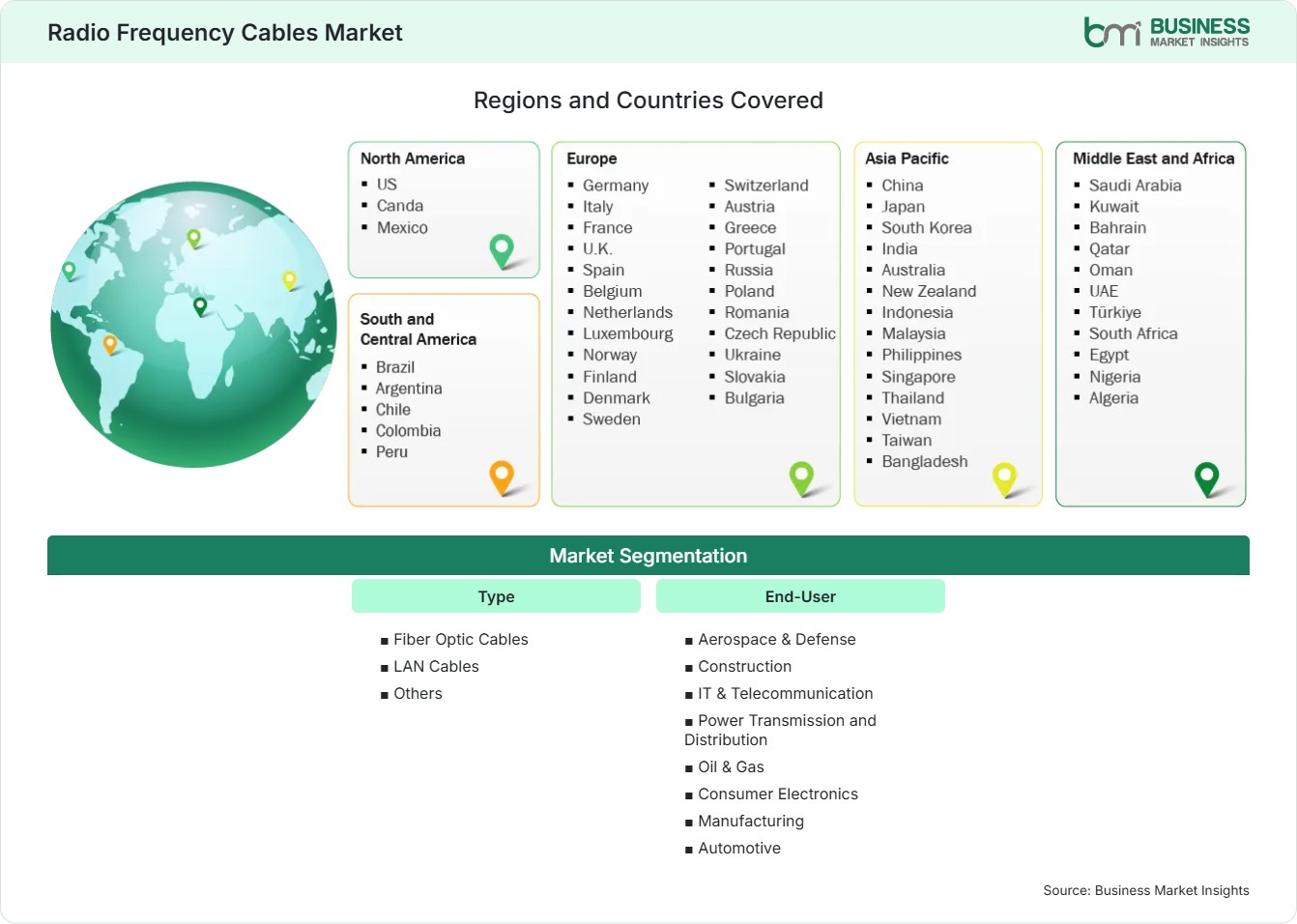
  • Type: Fiber Optic Cables, LAN Cables, Others
  • End-User: Aerospace & Defense, Construction , IT & Telecommunication, Power Transmission and Distribution, Oil & Gas, Consumer Electronics , Manufacturing, Automotive
US$ 16.6 Bn Market size in 2025
US$ 45.35 Bn Market Size by 2033
13.39% CAGR, 2026 - 2033
2026-2033 Forecast Period

AI Overview

Radio Frequency Cables Market Summary

  • North America Region: North America holds a market share of 34%–37% in 2025, growing at a CAGR of 12.4%–13.2% during 2026–2033. Growth is supported by 5G densification, hyperscale data centers, aerospace modernization, defense communication upgrades, private wireless deployments, and continued investment in broadband infrastructure across commercial and industrial sectors. US market benefits from telecom modernization and defense communication programs, advancing at a CAGR of 12.8%–13.4%.
  • Fastest Growing Region: Asia Pacific holds a market share of 29%–32% in 2025 and is expected to grow at a CAGR of 14.8%–15.7% during 2026–2033. Strong electronics manufacturing, expanding telecom infrastructure, smart city projects, data center investments, semiconductor production growth, and industrial automation initiatives continue accelerating regional adoption.
  • Leading Segment: IT & Telecommunication accounts for 24%–28% share in 2025 and expands at a CAGR of 14.0%–14.8% during 2026–2033. Growth stems from broadband expansion, fiber backhaul investment, 5G rollout programs, cloud connectivity requirements, network modernization initiatives, and increasing enterprise bandwidth consumption worldwide.
  • High Growth Segment: Aerospace & Defense represents 12%–15% share in 2025 and advances at a CAGR of 15.5%–16.4% through 2033. Demand is supported by secure communications, radar systems, satellite deployments, electronic warfare programs, defense modernization budgets, and next-generation airborne connectivity projects globally.
  • Key Market Opportunity: Emerging satellite communication networks, low-earth-orbit constellations, industrial digitalization, edge computing environments, and advanced defense communications programs are creating substantial demand for low-loss high-frequency cabling solutions across multiple industries.
  • Major Market Players: Prysmian S.p.A., Nexans S.A., CommScope Holding Company, Inc., Belden Inc., Amphenol Corporation, TE Connectivity plc, HUBER+SUHNER AG, Rosenberger Hochfrequenztechnik GmbH & Co. KG, Fujikura Ltd., and Molex, LLC.
Strategic Insights

Radio Frequency Cables Market: Strategic Insights

Radio Frequency Cables Market Strategic Framework
FREE PDF
Request your free sample
Request free sample
Stakeholder View

Key Takeaways

  • The value chain is becoming more integrated, with cable producers working closely with telecom operators, defence contractors, semiconductor suppliers, and data center providers in order to improve transmission performance.
  • The aerospace sector, together with satellite communications and advanced telecom infrastructure, offers the greatest potential for medium-term revenue growth due to the growing need for low-loss, high-frequency transmission environments.
  • Cable designs that are lightweight, flame-retardant, free from halogens, and have very low attenuation are now being developed so as to be suitable for use in high-frequency and high-bandwidth applications.
  • The Asia Pacific region offers the most attractive investment opportunity due to strong growth in telecommunications, an expanding electronics manufacturing sector, and various national digitalization programs.
  • Strategic acquisitions and expansions of the product portfolio continue to enhance suppliers' capabilities in specialty connectivity solutions, RF transmission systems, and aerospace-grade communications products.
  • Sustainability initiatives are having an effect on procurement decisions and are promoting the development of materials that can be recycled and the creation of cable manufacturing processes that comply with environmental regulations.
Geographic Outlook

Radio Frequency Cables Market Regional Highlights

North America Radio Frequency Cables Market

North America accounted for approximately 34%–37% of revenue in 2025 and is forecast to grow at 12.4%–13.2% through 2033. There is well-established telecom infrastructure upgradation, substantial defense budget, sophisticated aerospace manufacturing facilities, and large scale hyperscale data centers in the region.
The Radio Frequency Cables Market share is further supported by continued investments in private wireless networks, automation technology, infrastructure development in cloud computing, and broadband expansion initiatives. The continued need for low-loss transmission systems enhances the replacement cycle of these products.

  • The process of densifying 5G networks is still going on and this is fuelling the demand for advanced connectivity infrastructure in both metropolitan and enterprise settings.
  • The modernisation of defence communications is leading to the acquisition of rugged and high-performance transmission systems.
  • Operators of data centres are now increasingly using high-capacity interconnect solutions for cloud and AI workloads.
  • The investment in industrial automation leads to new demands regarding signal integrity and network resilience.

US Radio Frequency Cables Market

The United States contributes approximately 78%–82% of the regional Radio Frequency Cables Market demand and grows at 12.8%–13.4% through 2033. High-level defense expenditure, development in telecom, innovation in aerospace industry, and cloud computing infrastructure deployment ensure market growth. Significant expenditures on behalf of hyperscale operators and communications services providers keep delivering stable purchase volumes for high-quality cable systems.

  • Aerospace and defense projects are still the principal purchasers of specialized cable products.
  • The construction of data centres using AI is leading to greater demands for high-bandwidth infrastructure.
  • The number of private networks being deployed is growing in industrial and logistics operations.
  • Efforts to provide broadband access are still encouraging investment in communication infrastructure.

Europe Radio Frequency Cables Market

Europe represents 24%–27% Radio Frequency Cables Market share in 2025 and expands at a CAGR of 12.0%–12.8%. The growth in the region has been facilitated through industrial connectivity, improved railway communications, renewable energy generation, and increased demand for electronic automotive parts. Germany is still the largest market for these products, but Eastern European countries show greater growth in terms of their infrastructural developments.

  • Germany is leading the way in regional adoption due to its substantial investments in industrial and telecommunications infrastructure.
  • Poland and Romania are showing growth rates that are approaching 13.5% to 14.2%.
  • To carry out renewable energy projects, it is necessary to have advanced communication and monitoring networks.
  • The integration of automotive electronics is behind the demand for specialized signal transmission products.

Asia Pacific Radio Frequency Cables Market

Asia Pacific accounts for 29%–32% of global revenue and records the fastest expansion at 14.8%–15.7% CAGR. Electronics production, broadband implementation, building of data centers, and smart city programs create demand for copper wire. China is at the top of regional consumption, and India boasts the fastest-growing trend. The Radio Frequency Cables Market growth outlook remains supported by rising semiconductor investment, industrial automation projects, and increasing digital infrastructure spending.

  • China achieves its dominance by carrying out large-scale manufacturing in the fields of telecommunications and electronics.
  • India is projected to record growth of approximately 16.5%–17.2%.
  • Regional hyperscale data center investments keep speeding up, with buying activity.
  • The adoption of smart manufacturing leads to an expansion of the network infrastructure.
  • Initiatives for broadband that are supported by the government lead to better visibility of future demand.

Rest of World Radio Frequency Cables Market

The Rest of World region contributes 8%–11% Radio Frequency Cables Market share and grows at 13.1%–14.0% through 2033. Transformation programs of digitization prove beneficial to the markets of the Middle East region, while those of telecom modernization prove beneficial to the markets of South and Central America. The leading regional markets include Saudi Arabia and the United Arab Emirates, while Brazil shows great growth prospects.

  • The Gulf countries are still making investments in advanced telecom and smart city ecosystems.
  • Brazil has gained benefits from the upgrade of its mobile broadband and enterprise connectivity.
  • The mining, energy, and industrial sectors meet the demand in several emerging economies.
  • The expansion of both fiber and wireless networks provides suppliers with opportunities for procurement.
Global Market Geography
FREE PDF
Request your free sample
Request free sample
Segment Analysis

Radio Frequency Cables Market Segmentation

Type

Type-based demand remains influenced by transmission performance, bandwidth requirements, deployment environment, and lifecycle cost considerations. This segment accounts for 100% of market distribution, with Fiber Optic Cables emerging as the dominant category. The Radio Frequency Cables Market scope continues widening as operators invest in higher-capacity networks requiring advanced transmission technologies. Average segment CAGR ranges between 12% and 16%.

  • Fiber Optic Cables: Support long-distance transmission with minimal signal loss, making them preferred for telecom backhaul, data centers, and high-capacity communication infrastructure deployments.
  • LAN Cables: Widely adopted in enterprise networking, industrial automation, commercial facilities, and smart buildings where reliable connectivity and efficient data transmission remain critical.

End-User

End-user demand varies according to communication intensity, connectivity requirements, digital transformation initiatives, and infrastructure investments. IT & Telecommunication holds approximately 24%–28% Radio Frequency Cables Market share in 2025 and remains the largest contributor. Diverse applications across industrial sectors create stable demand foundations while supporting long-term market expansion.

  • Aerospace & Defense: Utilized across radar systems, aircraft communications, military electronics, surveillance equipment, and secure networking applications requiring superior reliability.
  • Construction (Commercial and Residential): Connectivity infrastructure requirements in smart buildings, broadband networks, surveillance systems, and digital facility management support adoption.
  • IT & Telecommunication: Continues benefiting from network upgrades, broadband expansion, cloud connectivity growth, and increasing data traffic requirements.
  • Power Transmission and Distribution: Communication-enabled grid operations and monitoring systems require dependable signal transmission infrastructure.
  • Oil & Gas: Remote monitoring systems, industrial communications, and hazardous-environment connectivity requirements support specialized cable deployment.
  • Consumer Electronics (High Tech Products, Small Appliances, Household Appliances, White Goods, HVAC): Growing device connectivity and smart functionality continue expanding addressable opportunities.
  • Manufacturing: Industrial automation, robotics integration, and digital factory programs increase requirements for resilient communication infrastructure.
  • Automotive: Connected vehicle architectures, advanced driver assistance systems, and in-vehicle communications stimulate demand growth.
Market Forces

Radio Frequency Cables Market Dynamics

Key Market Drivers

Global Expansion of 5G and Advanced Connectivity Networks

Telecom operators worldwide are accelerating investments in 5G standalone architectures, fiber backhaul systems, and private wireless networks. Rising mobile data consumption, enterprise digitalization, and network densification requirements increase demand for advanced signal transmission infrastructure. The Radio Frequency Cables Market growth trajectory  will continue to be linked to initiatives aimed at developing communication networks. There will continue to be a need for cabling solutions that can perform in high-frequency operations. The use of edge computing facilities is becoming more widespread.

Rising Data Center and Cloud Infrastructure Investments

Data centre capacity around the world is still expanding as a result of AI, cloud computing, and the digital transformation taking place within businesses. High-performance transmission systems are necessary to maintain low-latency communication among servers, networking equipment, and the storage infrastructure. The growing level of construction of hyperscale data centers in North America, Europe, and in the Asia Pacific region is leading to increased procurement. The demand for reliable and scalable connectivity solutions is promoting the use of more advanced cable technologies. The rise in digital workloads is also strengthening the drive for further investment.

Aerospace and Defense Communication Modernization

Defense agencies and aerospace companies are investing heavily in next-generation communication systems, radar systems, satellite technologies, and electronic warfare capabilities. These applications call for durable transmission solutions that can preserve signal integrity when faced with difficult conditions. Demand for national security priorities and as a result of modernization programs, is resilient and does not depend on the general economic cycles. The growing level of activity in the deployment of satellites also contributes to the expansion of the market.

Key Market Opportunities

Low-Earth-Orbit Satellite Communication Expansion

The fast expansion of satellite communication networks results in high demand for specific transmission technology. It is important to develop sophisticated cable technology for gateways, ground stations, testing laboratories, and aerospace facilities. Radio Frequency Cables Market Forecasts increasingly reflect stronger demand from space-based connectivity ecosystems. Growing government and private-sector investment supports long-term revenue creation opportunities for suppliers capable of meeting stringent technical specifications.

Industrial Digitalization and Smart Manufacturing

Manufacturing plants are incorporating connected machinery, industrial networking, robotics, and real-time monitoring technologies. The need arises for an infrastructure for high-performing communications that can operate in difficult conditions. The use of modern RF cables helps to increase efficiency and provides for predictive maintenance and automated manufacturing. With more use of Industry 4.0, there is an increasing number of application cases in different industries.

Emerging Market Telecom Infrastructure Development

Broadband expansion and mobile network modernization programs across developing economies create significant growth potential. Governments and service providers are investing in communication infrastructure to improve connectivity, digital inclusion, and economic competitiveness. Current Radio Frequency Cables Market Trends indicate that expanding urban populations and rising internet penetration rates strengthen long-term deployment opportunities. Suppliers with cost-effective and scalable offerings can capture meaningful market share.

Market Restraints and Challenges

Volatility in Raw Material Costs

The factor is price fluctuations in the case of copper, aluminum, specialty polymers, and shielding materials. The effect is that manufacturing costs can increase in an unpredictable manner, leading to narrower margins and making it more difficult to establish pricing strategies for long-term contracts. Producers often encounter problems with procurement whenever there are disruptions in raw-material markets or when there is geopolitical uncertainty. Pressure on margins may reduce the flexibility to make investments and result in greater pricing volatility for customers, especially in those end-use sectors which are sensitive to cost.

Complex Regulatory and Performance Requirements

The fact is that compliance requirements in the areas of safety, electromagnetic compatibility, environmental standards and product certification are increasing. As a result, development times are extended, and product qualification costs go up. In order to meet the requirements of different regions, suppliers have to make extensive investments in testing, documentation and certification procedures. These obstacles can hinder market entry, in particular for smaller manufacturers who are looking to expand into specialised and highly regulated fields.

Company Analysis

Competitive Landscape

The Radio Frequency Cables Market analysis reflects competition among global connectivity specialists, telecom infrastructure suppliers, and high-performance cable manufacturers.

Company Name

Overview

Products and Services relevant to this market

Prysmian S.p.A.

Global cable manufacturer serving telecom, energy, and industrial infrastructure markets.

Fiber optic systems, communication cables, broadband infrastructure solutions.

Nexans S.A.

Major supplier of electrification and connectivity technologies worldwide.

Telecom cables, industrial connectivity solutions, specialized communication products.

CommScope Holding Company, Inc.

Communication infrastructure provider focused on network performance.

RF cables, broadband systems, wireless infrastructure products.

Belden Inc.

Connectivity specialist serving industrial and enterprise environments.

Signal transmission cables, networking infrastructure, industrial communications.

Amphenol Corporation

Diversified interconnect technology provider with global operations.

RF cable assemblies, connectors, aerospace communication solutions.

TE Connectivity plc

Engineering company serving transportation, industrial, and communication sectors.

RF components, connectivity systems, cable assemblies.

HUBER+SUHNER AG

Specialized supplier of electrical and optical connectivity products.

High-frequency cables, telecom solutions, transportation connectivity.

Rosenberger Hochfrequenztechnik GmbH & Co. KG

Leading provider of high-frequency transmission technologies.

RF connectors, cable assemblies, communication systems.

Fujikura Ltd.

Japanese technology company focused on cable and optical solutions.

Fiber optics, communication cables, electronic components.

Molex, LLC

Global electronics connectivity company serving multiple industries.

RF interconnect solutions, cable assemblies, networking products.

Trust & Transparency

Research Methodology

The market analysis combines proprietary research with secondary data from government agencies, company disclosures, regulatory filings, industry databases and expert interviews. Market estimates are validated through data triangulation, cross-market benchmarking and analyst review.

View Full Research Methodology

Questions Answered

Frequently Asked Questions

What are the most promising future opportunities?

Satellite communication networks, smart manufacturing deployment, AI-driven infrastructure, edge computing environments, and emerging-market telecom expansion offer attractive growth opportunities through 2033.

What does a Radio Frequency Cables Market Report typically analyze?

A comprehensive report evaluates market size, competitive positioning, technology developments, regional trends, demand drivers, opportunities, challenges, end-user adoption patterns, and future industry outlook.

Which end-user segment generates the highest revenue?

IT & Telecommunication remains the leading end-user segment because of network modernization efforts, growing cloud connectivity requirements, broadband infrastructure expansion, and increasing global data traffic.

Which region leads the market?

North America currently maintains the largest revenue share due to strong telecommunications investment, advanced aerospace capabilities, large-scale data center activity, and significant defense communication spending.

What is driving demand for radio frequency cables?

Demand is primarily driven by 5G deployment, data center expansion, aerospace communication upgrades, defense modernization programs, industrial automation, and increasing bandwidth requirements across digital infrastructure environments.

Access the Full Radio Frequency Cables Market Report

Get segment-level forecasts, regional estimates, competitive benchmarking, company profiles and downloadable Excel datasets.

Access the full Radio Frequency Cables Market Report
350 pages PDF & Excel | 2026-09-18
Similar Research

Related Market Reports