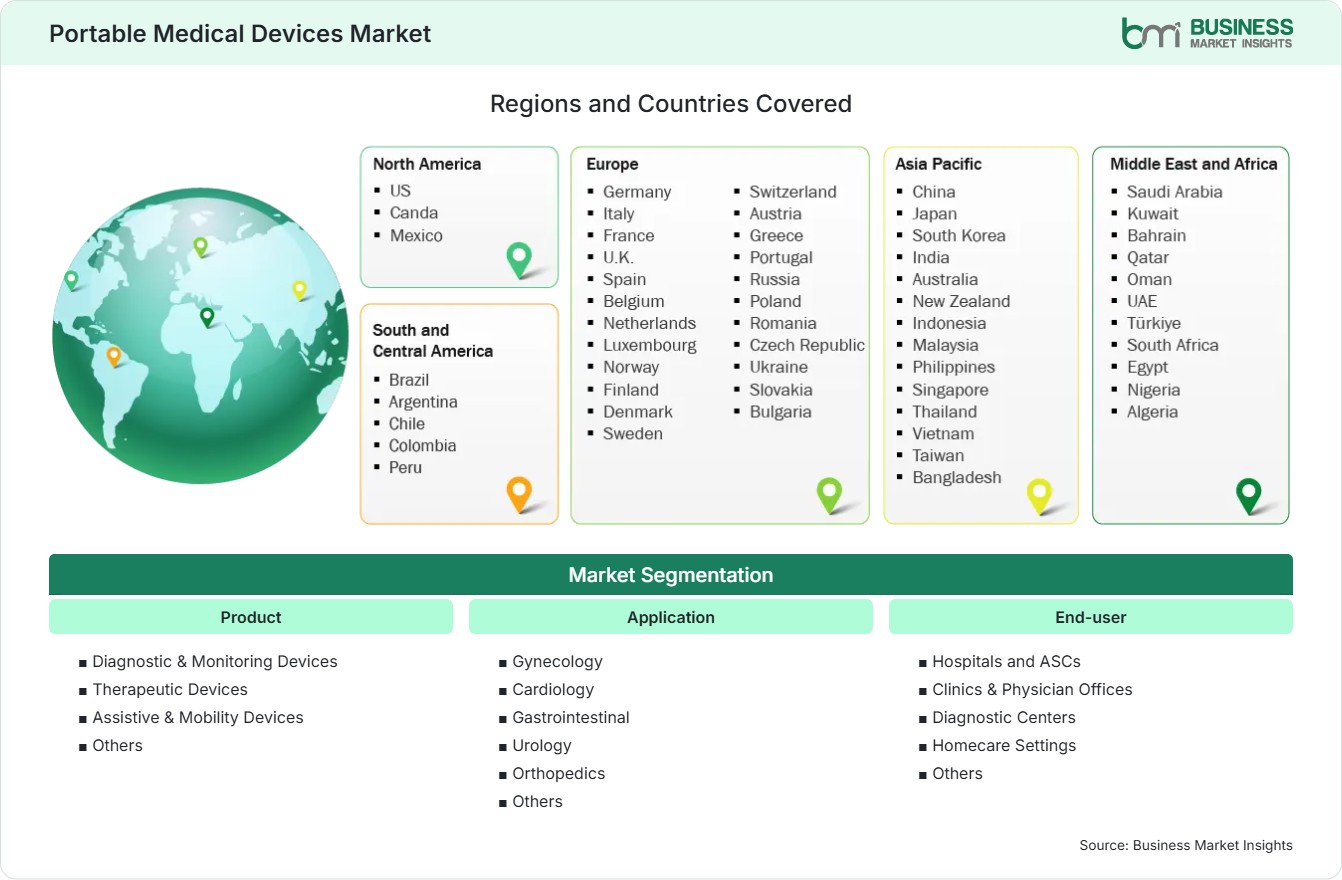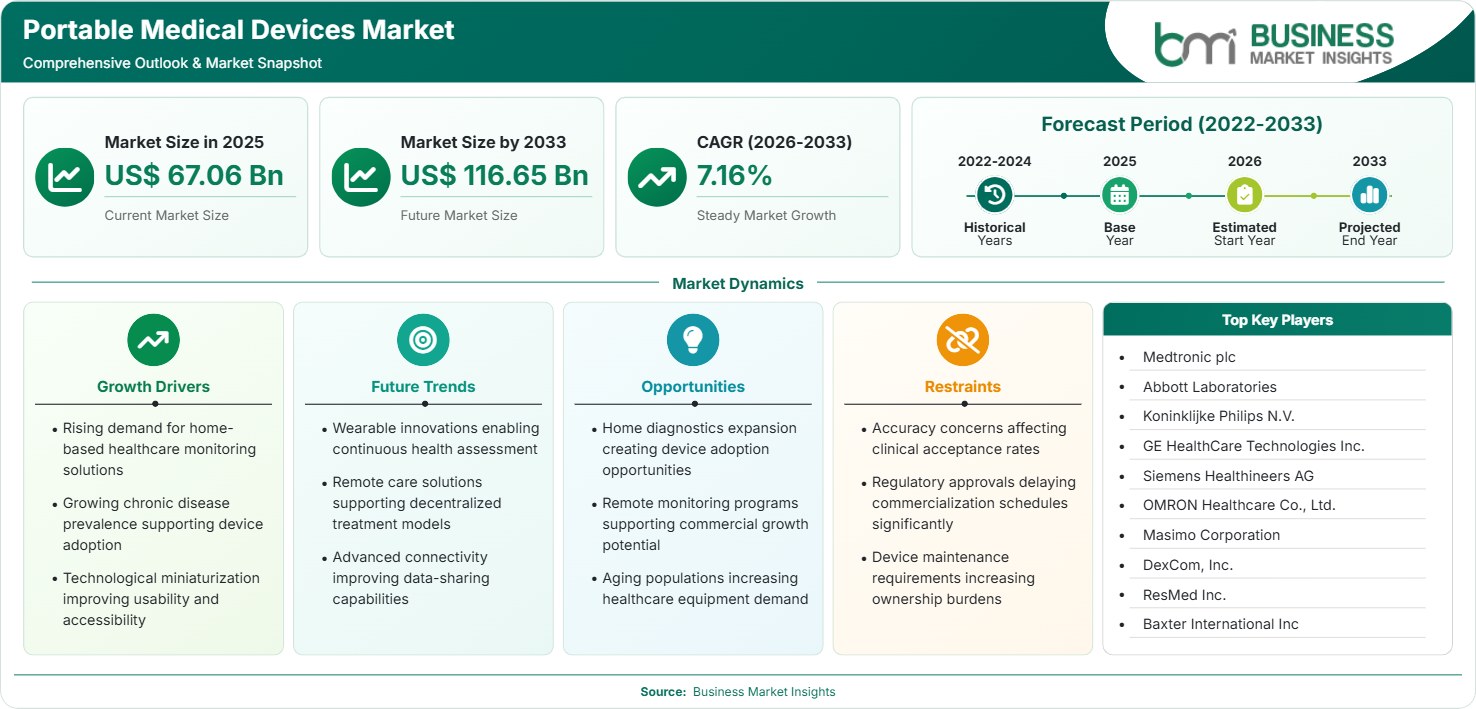
Portable Medical Devices Market Regional Highlights
North America Portable Medical Devices Market
North America holds a 39%–42% share in 2025 and is projected to register a 6.8%–7.4% CAGR from 2026 to 2033. The region benefits from advanced hospitals, established reimbursement structures, high chronic disease prevalence, and strong adoption of connected monitoring. The US remains the principal demand center, while Canada supports expansion through homecare modernization and digital health deployment. Portable Medical Devices Market share remains supported by institutional procurement and increasing migration of monitoring activities toward outpatient and home settings.
- Hospitals are adopting mobile monitoring, handheld ultrasound, portable respiratory equipment, and wireless vital-sign systems to improve workflow flexibility and reduce dependence on fixed infrastructure.
- Chronic disease management supports recurring demand for glucose, cardiac, respiratory, and blood-pressure monitoring technologies, particularly where devices can transmit measurements to clinicians remotely.
- Homecare providers increasingly require connected devices capable of supporting continuous or episodic monitoring while reducing unnecessary hospital visits and improving patient engagement.
- US reimbursement and value-based care models encourage technologies that demonstrate measurable improvements in care coordination, adherence, monitoring frequency, and resource utilization.
US Portable Medical Devices Market
The USA accounts for about 36%–38% of global market share in 2025 and is expected to grow at a CAGR of 6.7%–7.3% from 2024 to 2033. The factors contributing to the growth of the US market include modern healthcare facilities, adoption of medical technologies, an increase in the number of outpatient procedures, and telemonitoring. The US market is driven by innovations in medical devices as well as regulations in the country. Patient awareness of health technologies is expanding beyond hospitals, while provider awareness encompasses integration and security.
- Connected glucose monitoring continues to expand portable device use, illustrated by Abbott's 2025 US-market activity around real-time continuous glucose monitoring technologies.
- Handheld imaging and portable monitoring systems allow clinicians to perform assessments closer to patients, supporting emergency departments, ambulatory facilities, intensive care, and community settings.
- Provider procurement increasingly evaluates cybersecurity, interoperability, battery performance, software usability, and total cost of ownership alongside clinical specifications.
Europe Portable Medical Devices Market
Europe will account for the 25%–28% of the market share in 2025 and is expected to register a 6.5%–7.1% CAGR over the forecast period until 2033. Countries such as Germany, the UK, France, and Italy are important centers of demand due to advanced healthcare infrastructure and medical technology. Germany continues to be a major player in the Portable Medical Devices Market, whereas Spain and the UK present favorable avenues for growth.
- Germany benefits from a sophisticated hospital network and strong medtech manufacturing ecosystem, supporting demand for portable diagnostics, monitoring equipment, and therapeutic technologies.
- The UK is positioned for connected homecare adoption as healthcare systems seek technologies capable of supporting remote observation and reducing pressure on hospital capacity.
- France and Italy provide opportunities for respiratory, cardiovascular, mobility, and homecare devices as aging populations increase demand for decentralized care.
- European manufacturers increasingly prioritize regulatory documentation, software lifecycle management, cybersecurity, and interoperability as connected devices become more clinically embedded.
Asia Pacific Portable Medical Devices Market
Asia-Pacific has a market share of 21% – 24%. It is forecast to grow at a CAGR of 8.1%–8.7% through 2033. In this way, the Asia-Pacific region will continue its growth as one of the most promising markets. China and Japan are sources of income. Opportunities for growth can be found in India, South Korea, and Southeast Asia. Factors contributing to increased demand include improvements in healthcare infrastructure, the development of devices in the local market, rising prevalence of chronic diseases, and investments in digital health.
- China combines a large patient population with expanding domestic medtech capabilities, creating opportunities for portable monitoring, diagnostics, respiratory equipment, and digitally connected devices.
- Japan's aging population supports sustained demand for mobility assistance, respiratory therapy, home monitoring, and compact technologies suitable for elderly patients and caregivers.
- India offers substantial opportunities through expanding private healthcare, diagnostic networks, telemedicine, local manufacturing, and demand for affordable portable equipment.
- South Korea and Southeast Asian markets are increasingly attractive for connected monitoring and compact diagnostic devices as digital health infrastructure improves.
Rest of World Portable Medical Devices Market
Rest of World market segment accounts for 10%-13% in 2025 and is expected to register a growth rate of 7.2%-7.9% CAGR in the Portable Medical Devices Market during 2033. Latin America market segment consists of Brazil and Mexico, while the development of health care facilities supports the Middle East & Africa market segments. Brazil and Saudi Arabia provide key business locations, while the UAE, along with Gulf countries, provides opportunities for premium technology. Cost savings are the priority in the South & Central America region, while the Gulf region offers opportunities in high-end diagnostic technology.
- Brazil benefits from a broad healthcare ecosystem and growing diagnostic requirements, creating opportunities for portable monitoring, glucose management, respiratory devices, and mobility equipment.
- Mexico provides expansion potential through private healthcare networks, outpatient services, diagnostic centers, and increasing interest in portable technologies that improve clinical accessibility.
- Saudi Arabia and the UAE are investing in modern healthcare infrastructure, creating demand for digitally connected monitoring, portable diagnostics, and homecare-enabled medical technologies.
- African markets remain more price-sensitive, favoring durable, battery-efficient, easy-to-maintain equipment suitable for decentralized facilities and areas with inconsistent infrastructure.