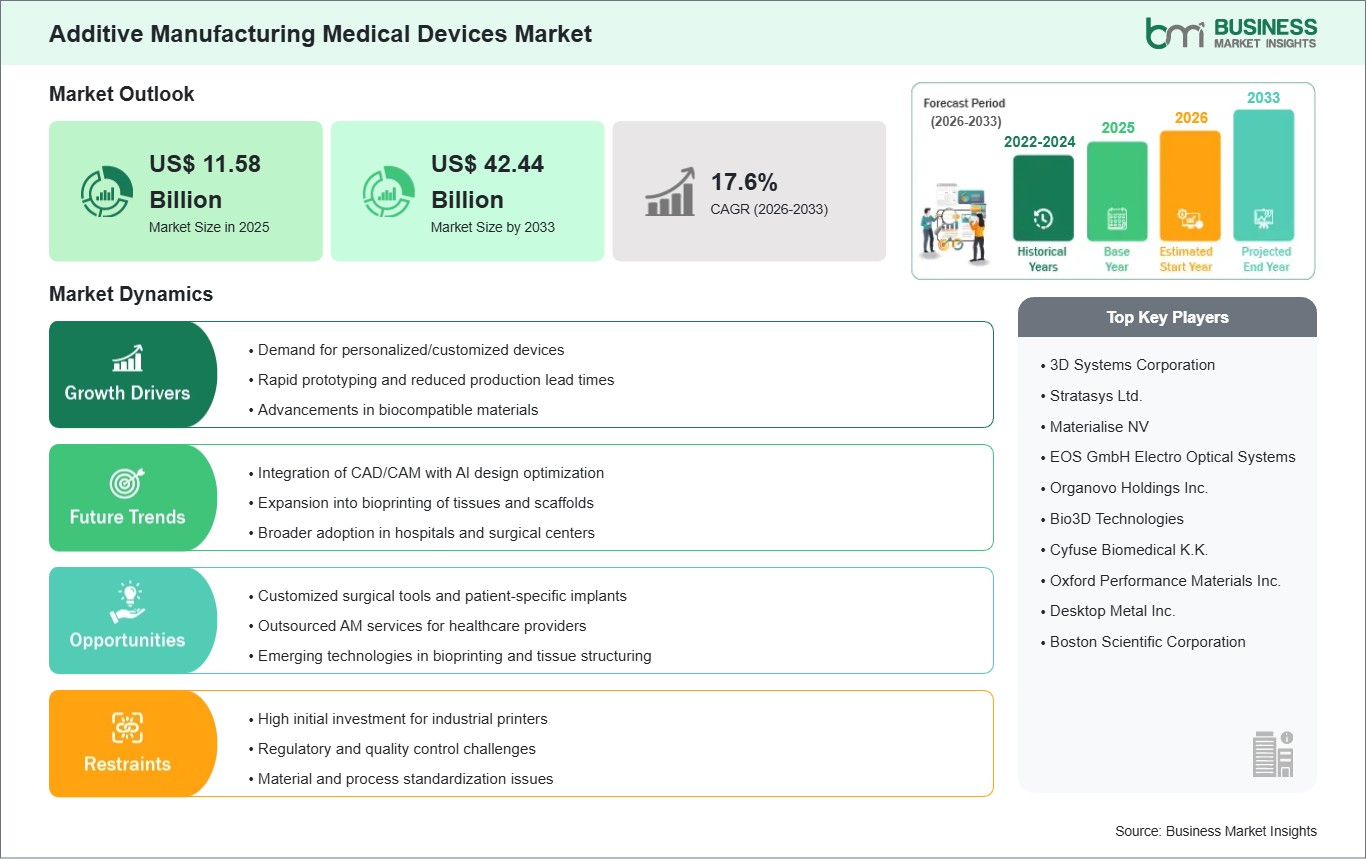
The Additive Manufacturing Medical Devices Market size is expected to reach US$ 42.44 Billion in 2033 from US$ 11.58 Billion in 2025. The market is estimated to record a CAGR of 17.6% from 2026 to 2033.
Additive Manufacturing (AM), commonly known as 3D printing, has been recognized as a groundbreaking technology in the medical device sector, enabling the manufacture of highly individualized, intricate, and patient-centered medical solutions. Among the AM medical devices are implants, prosthetics, orthopedic devices, dental products, surgical instruments, and anatomical models for surgical planning. Their production not only enhances clinical accuracy but also leads to better patient outcomes and less material waste than conventional manufacturing methods.
The global market for additive manufacturing medical devices is rapidly increasing from year to year, mainly due to the growing demand for personalized healthcare solutions and the rising incidence of chronic and orthopedic diseases. The increased number of cases related to trauma, birth defects, and age-related musculoskeletal disorders has greatly contributed to the demand for custom-made implants and prosthetics. Also, the already widely adopted minimally invasive and precision-guided surgeries have further led to the use of 3D-printed surgical guides and instruments tailored to patients' needs.
The introduction of new printing materials such as biocompatible polymers, metals, ceramics, and bioresorbable materials has given rise to devices that not only last longer but are also stronger and safer for use. Besides, the hospitals and manufacturers of medical devices are being encouraged to adopt the technology more widely due to regulatory compliance and resolution, speed, and quality of printing being continuously improved. At the same time, there are still high initial investment costs, regulatory complexities, and a limited number of skilled workers, which are the major challenges. Nevertheless, the trend of healthcare digitalization and the gradual acceptance of personalized medicine are likely to be the major driving forces of worldwide market growth.

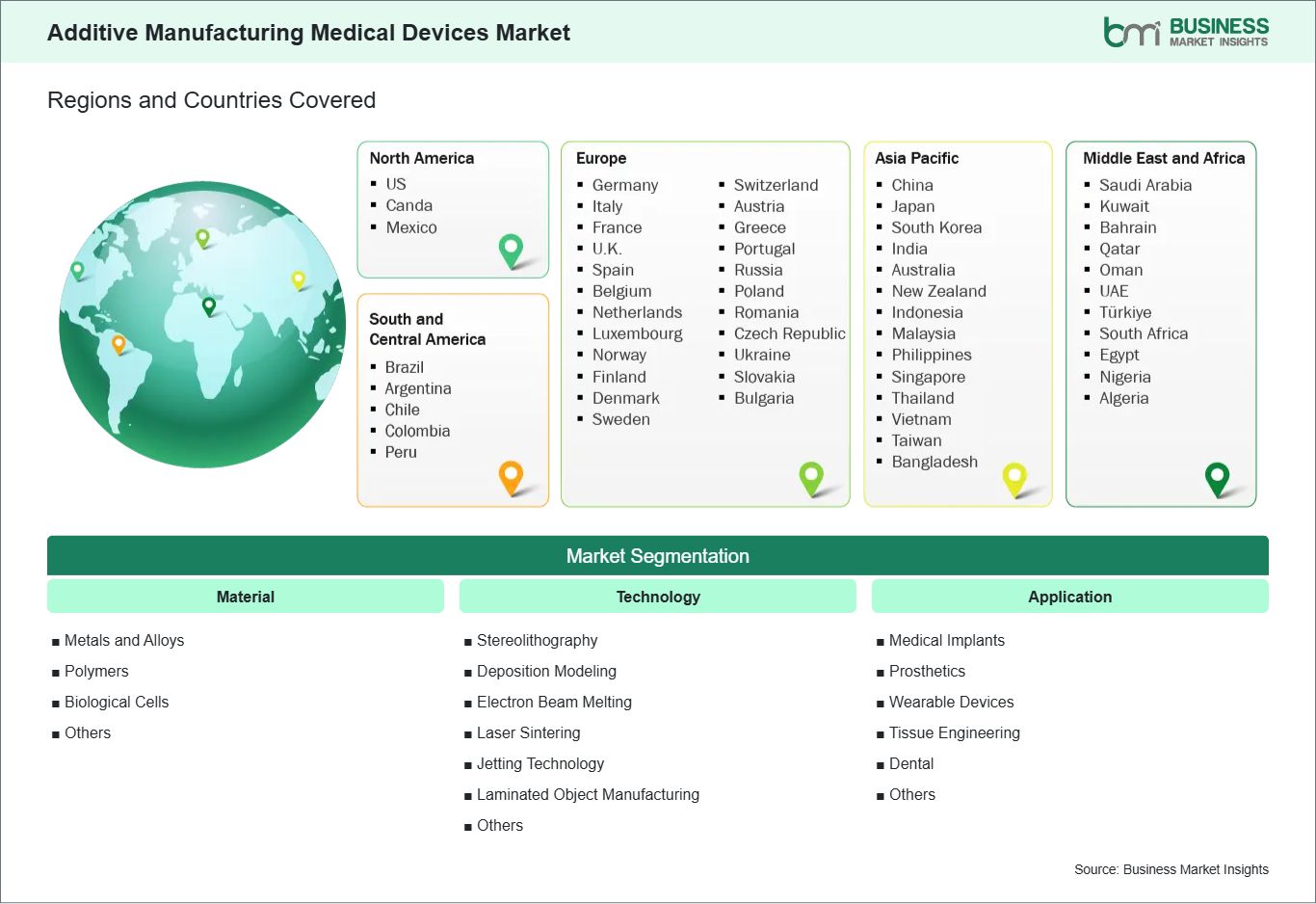
Key segments that contributed to the derivation of the additive manufacturing medical devices market analysis are material, technology, and application.
One of the main factors stimulating the market for 3D printing in the medical device sector is the growing emphasis on personalized medicine. The traditional mass-produced medical devices do not consider patient-specific anatomical variations, but 3D printing does; hence, the production of customized implants, prosthetics, and surgical tools, all tailored to individual patient needs, is possible. This customization not only enhances the fitness of the devices but also their functionality and clinical outcomes, especially in common applications such as orthopedics, dentistry, craniofacial, and spinal.
Moreover, the increase in orthopedic disorders, traumatic injuries, and degenerative diseases has led to a higher demand for both patient-specific implants and prosthetic devices. A higher number of surgeons are using 3D printed anatomical models and surgical guides nowadays to improve preoperative planning and procedural accuracy. Besides that, additive manufacturing's ability to shorten time-to-market and facilitate rapid prototyping is a factor that is gradually supporting its widespread adoption across healthcare systems. As the accuracy-focused care turns into a standard clinical requirement, 3D printing is undoubtedly a key player in the transformation of the medical device industry regarding both development and supply.
The ongoing development of additive manufacturing technology and materials is one of the most important factors behind market growth. The production of biocompatible metals like titanium and cobalt-chromium alloys brought about the creation of long-lasting, lightweight implants that have intricate shapes and the potential for better osseointegration. These same metals and polymers are now used in medical-grade ceramics and other areas related to dental devices, prosthetic parts, and surgical tool applications.
The combination of these factors has resulted in higher-quality and more reliable products. Furthermore, combining digital Imaging technologies such as CT and MRI scans with 3D printing workflows results in a highly accurate reproduction of the patient's anatomy. The combination of technological progress, eventual regulatory clarity, and the establishment of industry standards is making manufacturers and medical practitioners more confident, which is one of the factors driving the acceptance of additive manufacturing in the production of medical devices.
By material, the additive manufacturing medical devices market is bifurcated into metals and alloys, polymers, biological cells, and others. The metals and alloys segment held the largest share of the market in 2025. Their outstanding features, such as strength, biocompatibility, and durability, make them the only choice for load-bearing medical devices. This segment grew strongly due to high demand for custom-made hip and knee implants, and it also benefited from regulatory authorities' acceptance of 3D-printed metal parts.
By technology, the additive manufacturing medical devices market is classified into stereolithography, deposition modeling, electron beam melting, laser sintering, jetting technology, laminated object manufacturing, others. The laser sintering segment dominated the market in 2025. Features such as high precision, complex geometries, and excellent material properties, but at the same time with very little waste. Its ability to work with both metals and polymers, and its stronghold in the medical implants and prosthetics manufacturing sectors, were the key factors behind its widespread use and thus its dominant market share.
By application, the market is segmented into medical implants, prosthetics, wearable devices, tissue engineering, dental, others. The medical implants segment dominated the market in 2025. The segment is growing due to additive manufacturing, which enabled the customization of implants for each patient, resulting in better fitness and function. The increasing need for orthopedic and dental implants, the creation of products in shorter times, and improved clinical outcomes were among the factors that supported this leading application share.
| Report Attribute | Details |
|---|---|
| Market size in 2025 | US$ 11.58 Billion |
| Market Size by 2033 | US$ 42.44 Billion |
| Global CAGR (2026 - 2033) | 17.6% |
| Historical Data | 2022-2024 |
| Forecast period | 2026-2033 |
| Segments Covered | By Material
|
|
Regions and Countries Covered
| |
| North America | US, Canada, Mexico |
| Europe | Belgium, Austria, Finland, Denmark, Greece, Poland, Romania, Russia, Ukraine, Czech Republic, Slovakia, Bulgaria, Italy, Luxembourg, Germany, Switzerland, France, Netherlands, Norway, Portugal, Spain, Sweden, United Kingdom |
| Asia-Pacific | Australia, China, India, Japan, South Korea, Indonesia, Malaysia, Philippines, Singapore, Thailand, Vietnam, Bangladesh, New Zealand, Taiwan |
| South and Central America | Brazil, Argentina, Peru, Chile, Colombia |
| Middle East and Africa | Bahrain, Kuwait, Oman, Qatar, Saudi Arabia, United Arab Emirates, Turkiye, South Africa, Egypt, Algeria, Nigeria |
| Market leaders and key company profiles |
|
The "Additive Manufacturing Medical Devices Market Size and Forecast (2022 - 2033)" report provides a detailed analysis of the market covering below areas:
The geographical scope of the additive manufacturing medical devices market report is divided into five regions: North America, Asia Pacific, Europe, Middle East & Africa, and South & Central America. The additive manufacturing medical devices market in Asia Pacific is expected to grow significantly during the forecast period.
The Asia-Pacific Additive Manufacturing Medical Devices market is segmented into China, Japan, South Korea, India, Australia, New Zealand, Indonesia, Malaysia, the Philippines, Singapore, Thailand, Vietnam, Taiwan, Bangladesh, and the Rest of Asia. The market for additive manufacturing medical devices in the Asia-Pacific region is expected to grow rapidly, driven by the factors mentioned above. The most important of these factors would be increased healthcare infrastructure, the adoption of advanced medical technologies, and, finally, the demand for cheaper and more personalized medical solutions. The investments made by countries like China, India, Japan, South Korea, and Australia in healthcare digitization and related activities, such as R&D and advanced manufacturing, are already substantial and will continue to grow.
In the Asia-Pacific region, China and Japan are the two countries that primarily drive regional growth through strong government support for additive manufacturing technologies and a well-maintained medical device industry. But India is also an excellent future growth market, driven by the patient population, the rise in orthopedic and dental procedures, and the increasing adoption of 3D printing technology in hospitals and research institutions. Furthermore, the region is seeing an increasing number of hospitals in urban areas that employ 3D-printed surgical guides, dental implants, and prosthetics.
The growing preference for less invasive, more precision-based surgical procedures is, in fact, one of the main reasons for the increasing demand for patient-specific medical devices manufactured via additive manufacturing. Asia-Pacific is a region that will not only be impacted by the global adoption of additive manufacturing medical devices during the forecast period but will also be a major contributor to this trend as awareness, affordability, and regulatory frameworks continue to improve

The Additive Manufacturing Medical Devices market is evaluated by gathering qualitative and quantitative data post primary and secondary research, which includes important corporate publications, association data, and databases. A few of the key developments in the additive manufacturing medical devices market are:
The Additive Manufacturing Medical Devices Market is valued at US$ 11.58 Billion in 2025, it is projected to reach US$ 42.44 Billion by 2033.
As per our report Additive Manufacturing Medical Devices Market, the market size is valued at US$ 11.58 Billion in 2025, projecting it to reach US$ 42.44 Billion by 2033. This translates to a CAGR of approximately 17.6% during the forecast period.
The Additive Manufacturing Medical Devices Market report typically cover these key segments-
The historic period, base year, and forecast period can vary slightly depending on the specific market research report. However, for the Additive Manufacturing Medical Devices Market report:
The Additive Manufacturing Medical Devices Market is populated by several key players, each contributing to its growth and innovation. Some of the major players include:
The Additive Manufacturing Medical Devices Market report is valuable for diverse stakeholders, including:
Essentially, anyone involved in or considering involvement in the Additive Manufacturing Medical Devices Market value chain can benefit from the information contained in a comprehensive market report.
Please tell us your area of interest
(Market Segments/ Regions and Countries/ Companies)