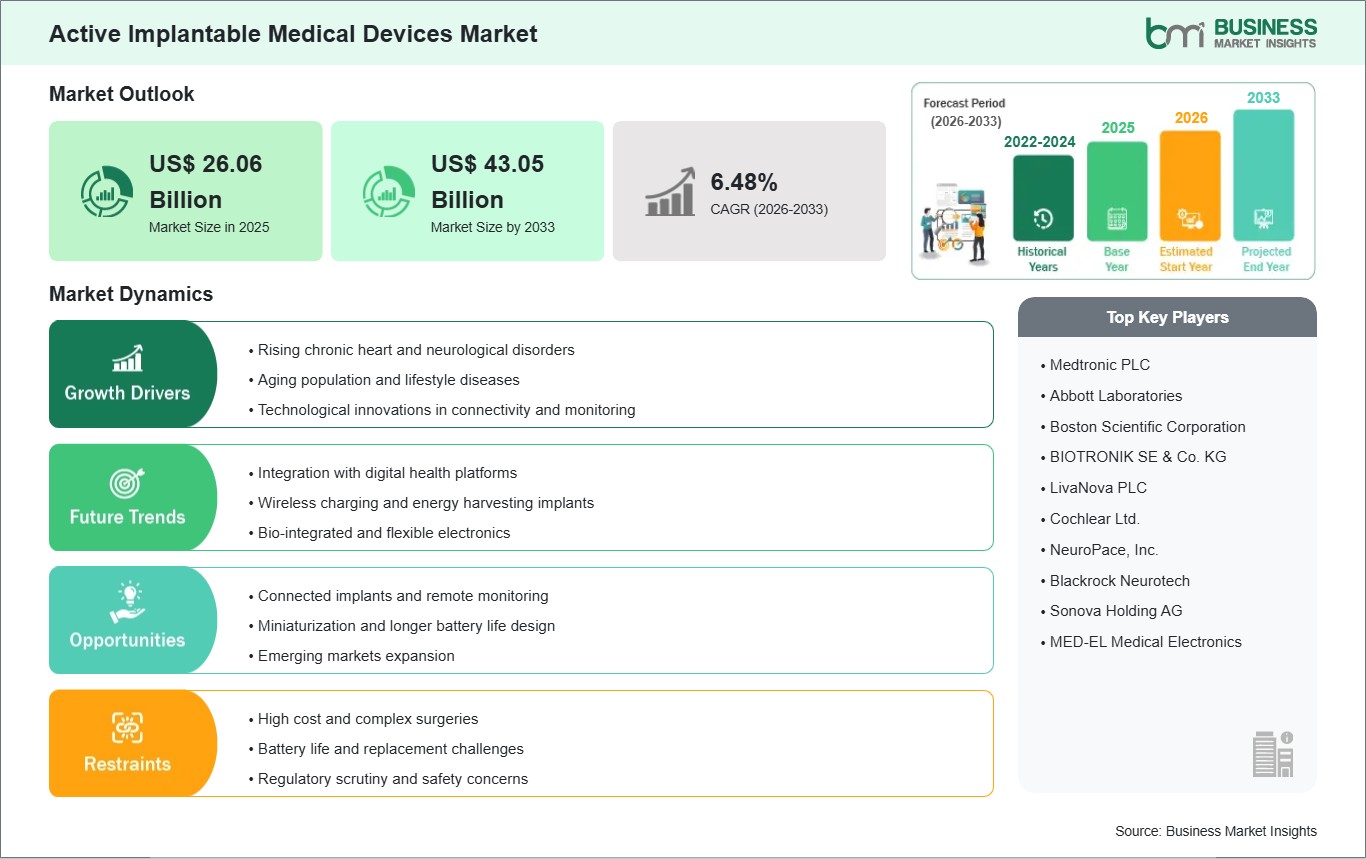
The Active Implantable Medical Devices Market size is expected to reach US$ 43.05 Billion by 2033 from US$ 26.06 Billion in 2025. The market is estimated to record a CAGR of 6.48% from 2026 to 2033.
Active Implantable Medical Devices (AIMDs) are a very important kind of medical devices worldwide, and they are partially or completely placed in the human body and depend on an internal or external power source to perform their therapeutic, diagnostic, or monitoring functions. Cardiac pacemakers, implantable cardioverter-defibrillators (ICDs), neurostimulators, cochlear implants, and drug-delivery systems are the main types of AIMDs. AIMDs are very important in treating chronic and life-threatening conditions, as they restore physiological functions, improve patient mobility, and raise overall quality of life.
The global AIMD market is on a continuous growth path, with the main driving factors being the increase in the number of people suffering from chronic diseases that fall into the categories of cardiovascular disorders, neurological disorders, hearing loss, and movement disorders. Besides, the aging population and higher life expectancy are raising the demand even more since the elderly are more susceptible to chronic conditions that would require drug delivery or similar implantable therapy. Moreover, the advancements in medical technology that involve miniaturization, wireless connectivity, and battery longevity, are all working in unison to offer great performance and better patient outcomes.
The faster acceptance of minimally invasive implantation techniques has also been a factor that has sped up market growth. By adopting these methods, it cuts down on the trauma done to the surgery area, the time the patient has to stay in the hospital is reduced, and the complications that come after surgery are fewer; thus, making AIMDs more tolerable and agreeable to the patients and health care providers. Moreover, the integration of digital health technologies into AIMDs—such as remote monitoring, data analytics, and AI-enabled diagnostics—has not only increased their clinical value but also facilitated their widespread adoption in healthcare systems.
The AIMD market is expected to struggle to grow, despite strong expectations. One of the main reasons for this is the high price of devices and their implantation, lengthy regulatory approval processes, and concerns about device malfunction, cybersecurity, and long-term biocompatibility, which may together hinder market growth. Moreover, there are some regions where reimbursement is limited, and that might also affect the adoption in low- and middle-income countries that do not have access to advanced healthcare infrastructure. However, the global market is expected to keep growing at a steady pace throughout the forecast period because of ongoing investments in healthcare modernization, rising awareness of implantable therapies, and continuous product innovation.

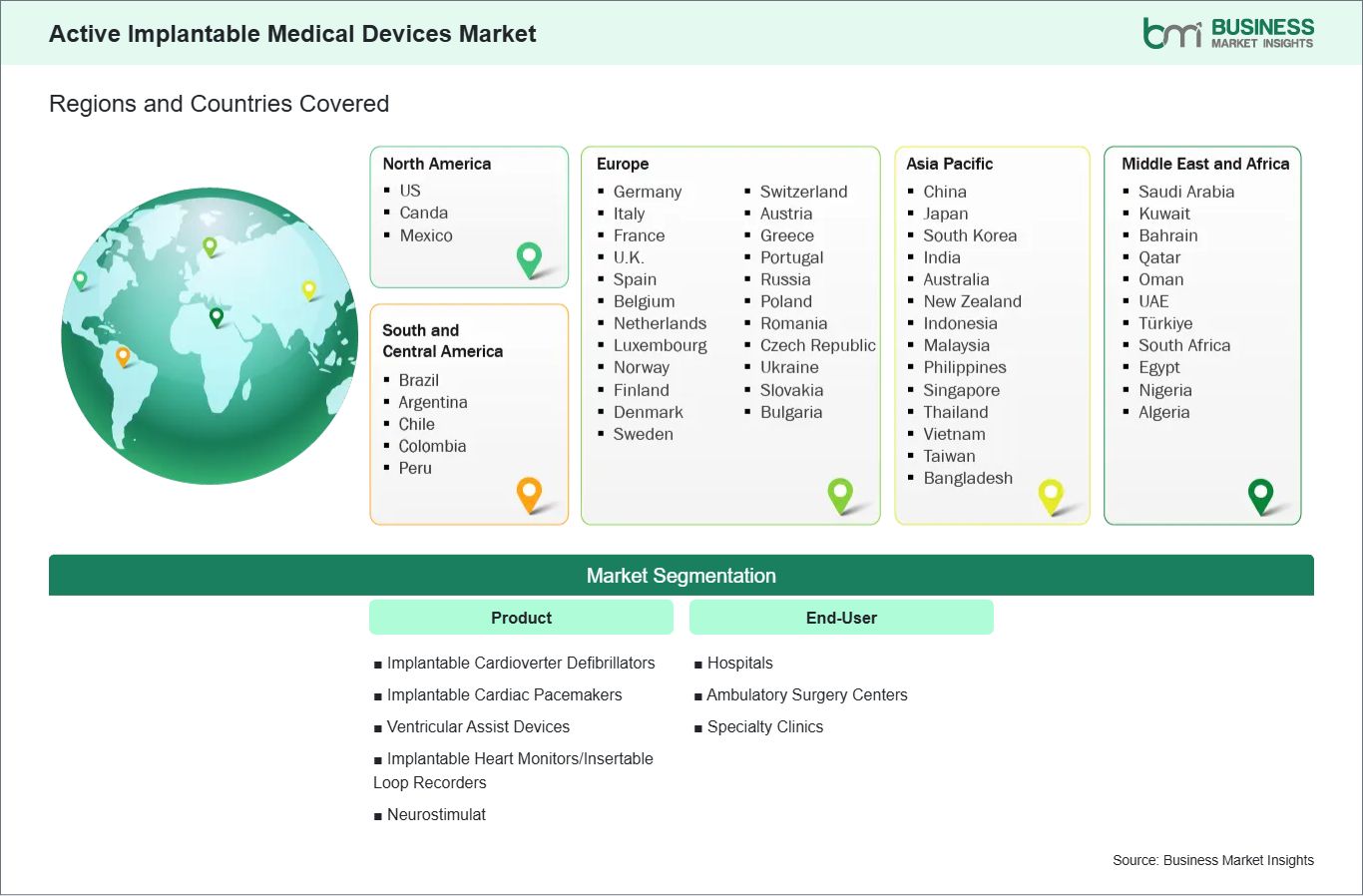
Key segments that contributed to the derivation of the active implantable medical devices market analysis are product and end user.
The market for active implantable medical devices (AIMDs) is mainly influenced by the ever-growing incidence of chronic, long-term medical conditions that require ongoing monitoring or therapeutic intervention. Aging populations, sedentary lifestyles, and increasing incidence of lifestyle-related risk factors have caused an increase in the global prevalence of cardiovascular diseases, neurological disorders, hearing loss, and chronic pain. These conditions very often call for implants such as pacemakers, neurostimulators, and cochlear implants, which makes AIMDs a significant contributor to modern healthcare.
The rapid increase of the elderly population worldwide is another key factor that drives the market. The elderly are more prone to arrhythmias, neurodegenerative diseases, and sensory impairments, and this has led to a considerable increase in demand for implantable devices that are suitable for long-term use. Furthermore, the rise in the number of surgeries and better diagnostic capabilities is allowing the earlier detection of conditions that can be effectively treated with AIMDs.
The rapid development of technology is also a major factor in the market's growth. Newer and better products like small-scale devices, longer-lasting batteries, wireless connections, and implants that are compatible with MRI scans have not only made the doctors' jobs easier but also increased safety for patients. Moreover, the collaboration between telemonitoring and e-health technologies enables healthcare professionals to better manage more patients, resulting in fewer hospital readmissions and more effective treatments. All these things together are still making the worldwide health systems addicted to AIMDs.
The market for active implantable medical devices has the potential to grow enormously due to access to healthcare and technological innovations. The developing countries in Asia-Pacific, Latin America, and the Middle East have considerable areas to explore, given their large patient populations, better health care infrastructure, and the arrival of new investments in advanced medical technologies. Government programs aimed at expanding insurance coverage and strengthening public healthcare will likely lead to wider usage of AIMDs in these areas.
The integration of digital and smart health technologies is yet another major opportunity. The use of AI, big data analytics tools, and remote patient monitoring in AIMDs results in personalized medical care, timely detection of issues, and predictive device maintenance. The resulting improvements in clinical outcomes not only open new ways for healthcare providers and insurers to benefit by lowering the cost of long-term treatment but also give healthcare providers and payers an altogether different reason to buy into innovations.
The product innovations aimed at medical applications are not only offering advantages but also promising high growth in sales. Patient comfort is increased, and the number of patients who are younger and more active is increased by the development of implantable devices that are smaller, less invasive, and rechargeable. Besides that, the use of biocompatible materials and the installation of cybersecurity features are alleviating the worries regarding safety and data protection, thus enhancing the trust of healthcare professionals and patients in the products. Over time, the sales market is likely to grow based on these opportunities as communication about the implantable therapies' benefits increases.

By product, the active implantable medical devices market is bifurcated into implantable cardioverter defibrillators, implantable cardiac pacemakers, ventricular assist devices, implantable heart monitors/insertable loop recorders, neurostimulators, implantable hearing devices. The implantable cardioverter defibrillators segment held the largest share of the market in 2025. The rising prevalence of life-threatening cardiac arrhythmias and sudden cardiac arrest globally. ICDs are widely adopted because of their proven ability to continuously monitor heart rhythms and deliver immediate life-saving therapy.
By end user, the market is segmented into hospitals, ambulatory surgery centers, and specialty clinics. The hospitals segment dominated the market in 2025. The advanced infrastructure and availability of skilled specialists such as cardiologists, electrophysiologists, and neurosurgeons. These settings are well-equipped to perform complex implantation procedures, manage high-risk patients, and handle post-operative complications. Higher patient inflow, integrated diagnostic and surgical facilities, and favorable reimbursement policies for implantable procedures also contributed significantly to hospitals accounting for the largest end-user market share.
| Report Attribute | Details |
|---|---|
| Market size in 2025 | US$ 26.06 Billion |
| Market Size by 2033 | US$ 43.05 Billion |
| Global CAGR (2026 - 2033) | 6.48% |
| Historical Data | 2022-2024 |
| Forecast period | 2026-2033 |
| Segments Covered | By Product
|
|
Regions and Countries Covered
| |
| North America | US, Canada, Mexico |
| Europe | Belgium, Austria, Finland, Denmark, Greece, Poland, Romania, Russia, Ukraine, Czech Republic, Slovakia, Bulgaria, Italy, Luxembourg, Germany, Switzerland, France, Netherlands, Norway, Portugal, Spain, Sweden, United Kingdom |
| Asia-Pacific | Australia, China, India, Japan, South Korea, Indonesia, Malaysia, Philippines, Singapore, Thailand, Vietnam, Bangladesh, New Zealand, Taiwan |
| South and Central America | Brazil, Argentina, Peru, Chile, Colombia |
| Middle East and Africa | Bahrain, Kuwait, Oman, Qatar, Saudi Arabia, United Arab Emirates, Turkiye, South Africa, Egypt, Algeria, Nigeria |
| Market leaders and key company profiles |
|
The "Active Implantable Medical Devices Market Size and Forecast (2022 - 2033)" report provides a detailed analysis of the market covering below areas:
The geographical scope of the Active Implantable Medical Devices market report is divided into five regions: North America, Asia Pacific, Europe, Middle East & Africa, and South & Central America. The Active Implantable Medical Devices market in Asia Pacific is expected to grow significantly during the forecast period.
The Asia-Pacific Active Implantable Medical Devices market is segmented into China, Japan, South Korea, India, Australia, New Zealand, Indonesia, Malaysia, the Philippines, Singapore, Thailand, Vietnam, Taiwan, Bangladesh, and the Rest of Asia. Asia-Pacific, one of the world's largest and most diverse regions, is projected to see rapid growth in the AIMD market in the coming years. This will mainly be due to rising healthcare demand, the growing number of chronic diseases, and the increasing availability of advanced medical technologies. Among others, the most notable countries are China, Japan, India, South Korea, and Australia, whose populations are aging and facing lifestyle-related health issues such as obesity, thereby increasing demand for implantable medical solutions.
China, along with India, is the leading market due to its large patient population, developing healthcare infrastructure, and growing government funding for medical technology and hospital construction. Japan, with its highly sophisticated health care system and a large elderly population, remains a major user of advanced AIMDs, especially in cardiology and neurology.
Besides, the region is also reaping the benefits of increased awareness regarding less invasive surgeries and the establishment of advanced hospitals and surgical centers in city areas. The market is also supported by government policies that aim to expand healthcare coverage and encourage local production of medical devices. The activity of active implantable medical devices in the Asia-Pacific region will gradually increase throughout the forecast period as costs become more affordable and clinicians' skills improve. p>

The Active Implantable Medical Devices market is evaluated by gathering qualitative and quantitative data post primary and secondary research, which includes important corporate publications, association data, and databases. A few of the key developments in the Active Implantable Medical Devices market are:
The Active Implantable Medical Devices Market is valued at US$ 26.06 Billion in 2025, it is projected to reach US$ 43.05 Billion by 2033.
As per our report Active Implantable Medical Devices Market, the market size is valued at US$ 26.06 Billion in 2025, projecting it to reach US$ 43.05 Billion by 2033. This translates to a CAGR of approximately 6.48% during the forecast period.
The Active Implantable Medical Devices Market report typically cover these key segments-
The historic period, base year, and forecast period can vary slightly depending on the specific market research report. However, for the Active Implantable Medical Devices Market report:
The Active Implantable Medical Devices Market is populated by several key players, each contributing to its growth and innovation. Some of the major players include:
The Active Implantable Medical Devices Market report is valuable for diverse stakeholders, including:
Essentially, anyone involved in or considering involvement in the Active Implantable Medical Devices Market value chain can benefit from the information contained in a comprehensive market report.
Please tell us your area of interest
(Market Segments/ Regions and Countries/ Companies)