Plant Based Beverages Market Regional Highlights
North America Plant Based Beverages Market
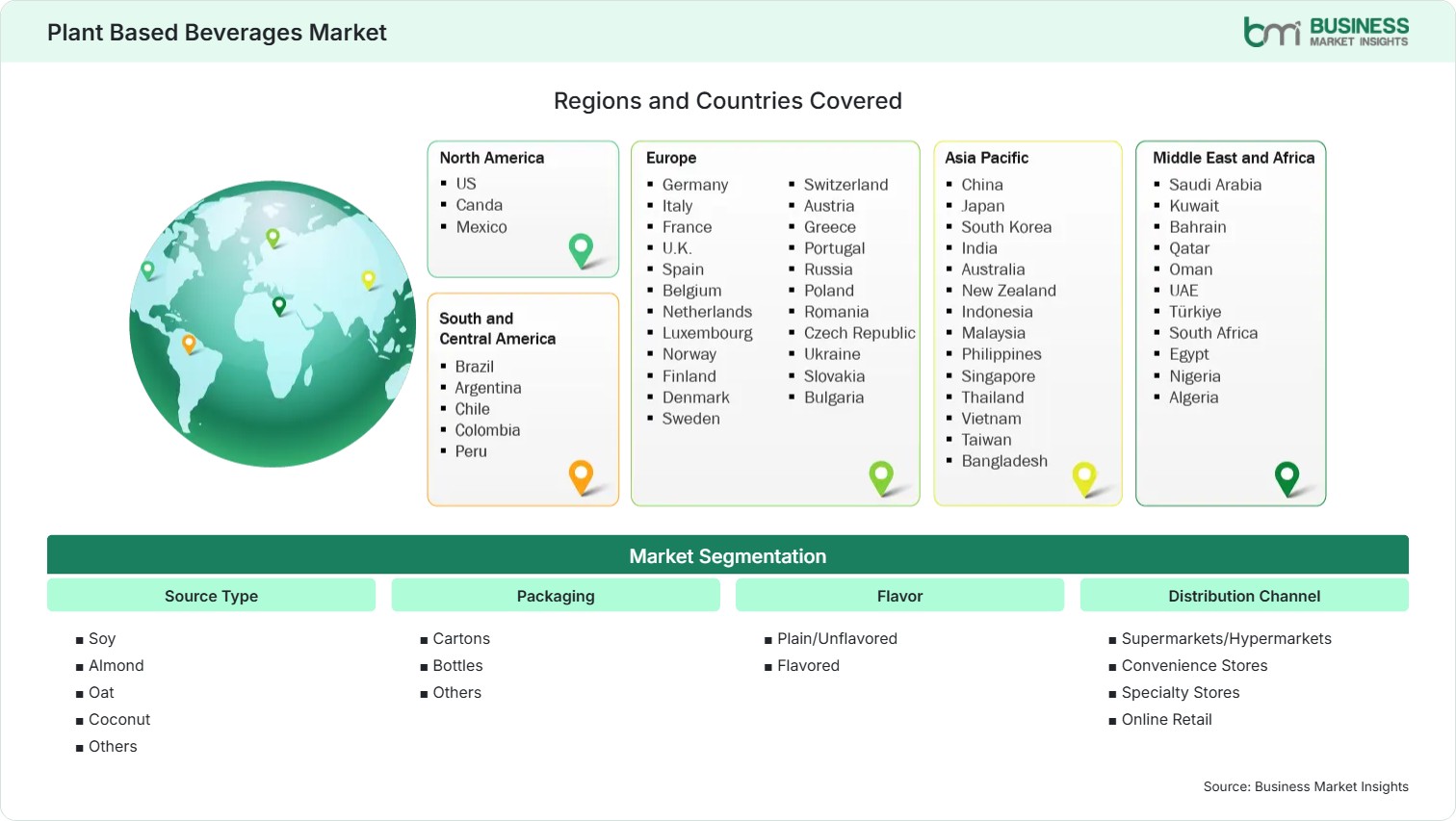
North America accounts for a 34%–38% share in 2025 and records a 7.5%–8.5% CAGR through 2033. The region benefits from mature retail infrastructure, high household awareness, premium product availability, and expanding nutritional positioning. The Plant Based Beverages Market share remains supported by established almond and soy consumption, while oat products gain momentum through coffee and foodservice applications. Canada contributes through specialty and natural-food channels, whereas the US remains the principal demand center. Innovation increasingly emphasizes protein, reduced sugar, fortified nutrition, clean labels, and convenient formats across refrigerated and shelf-stable categories.
- Premium oat beverages are gaining distribution through coffee chains, grocery private labels, and foodservice operators seeking dairy-free alternatives with stronger steaming and foaming performance.
- Protein enrichment is becoming a central competitive lever as manufacturers address consumers seeking satiety, muscle support, and convenient nutrition through breakfast beverages and ready-to-drink formats.
- Online grocery platforms are widening assortment access, particularly for niche formulations, while established supermarket chains continue determining mainstream visibility through private-label and branded shelf allocation.
- Packaging innovation focuses on lighter materials, recycled content, and improved shelf stability, helping producers manage transportation costs while responding to retailer sustainability requirements and consumer expectations.
US Plant Based Beverages Market
The US represents a 26%–29% Plant Based Beverages Market share of North American demand in 2025 and expands at a 7.3%–8.3% CAGR through 2033. The market benefits from broad brand awareness, extensive supermarket coverage, established refrigerated beverage infrastructure, and strong innovation pipelines. The US segment increasingly favors products positioned around protein, fiber, calcium, vitamins, and lower sugar. Danone's Silk portfolio illustrates this nutritional shift, with products spanning soymilk, almondmilk, oatmilk, coconutmilk, and high-protein formulations.
- Major brands are extending beyond traditional milk alternatives into protein shakes, creamers, yogurt alternatives, and coffee applications, increasing beverage occasions and strengthening cross-category consumer engagement.
- Retailers increasingly use private-label offerings to widen affordability, putting pressure on branded companies to differentiate through nutrition, flavor, sourcing, packaging, or specialized functional positioning.
- Foodservice remains important because barista-oriented oat and almond formulations create repeated trial opportunities, particularly among consumers who may not regularly purchase household plant-based milk.
Europe Plant Based Beverages Market
Europe holds a market share of 27%-31% and is growing at a CAGR of 7.8%-8.8%. The Plant Based Beverages market share is driven by a large proportion of flexitarians, the presence of well-established supermarket chains, Alpro's distribution, and consumer awareness of dairy substitutes. France, Germany, the UK, Italy, and Spain are key markets, whereas Germany and the UK have a very deep product offering in the category. Growth is higher in oat, protein-enhanced, and low-sugar products. Regulatory attention to labeling, environmental, and nutritional aspects has led to better formulation and communication practices.
- France combines established plant-based consumption with domestic manufacturing investment. Danone's Villecomtal facility can produce more than 300,000 liters daily, strengthening European oat beverage supply.
- Germany benefits from strong supermarket penetration and extensive private-label participation, creating competition across value, mainstream, organic, and premium plant-based beverage tiers.
- The United Kingdom remains a sophisticated market for barista beverages and alternative milks, with coffee consumption creating strong demand for texture and foaming performance.
- Southern European markets provide incremental growth through almond, oat, and flavored beverages as modern retail, tourism, and café consumption broaden product exposure.
Asia Pacific Plant Based Beverages Market
Asia-Pacific accounts for 22% to 26% in 2025 and is experiencing the fastest regional growth, with a CAGR of 9.5% to 10.5%. China, Japan, South Korea, Australia, and India are key drivers of demand for the segment, while India and Southeast Asia offer better growth prospects. Factors that drive the Plant Based Beverages Market growth include a soy consumption culture, growing awareness of lactose intolerance, urbanization, premium retailing, and the introduction of coffee beverages similar to Western varieties.
- China combines traditional soy beverage familiarity with rapidly developing premium oat and almond categories, creating opportunities for both domestic manufacturers and international brands.
- India offers substantial long-term potential as organized retail, café culture, health awareness, and disposable income expand, although affordability remains important for mass-market adoption.
- Japan and South Korea favor convenient, functional, and premium beverages, with manufacturers emphasizing quality, packaging aesthetics, portion control, and compatibility with coffee and breakfast occasions.
- Australia has mature consumer awareness and strong specialty retail participation, creating opportunities for premium oat, almond, coconut, and barista-oriented products.
Rest of World Plant Based Beverages Market
South/Central America Plant Based Drinks Market is headed by Brazil and Mexico and features an excellent combination of agricultural resources with the growing modern retail network, along with increased consumer preference for healthier drinks. Brazil is the market with the greatest potential, whereas Mexico has good potential in urban retailing. Local flavors of plant-based drinks can also be used. In the Middle East and Africa, the segment will remain small, but there will still be room for growth driven by demand from expatriates, premium grocery shoppers, tourists, and modern retailers. Some important markets include Saudi Arabia, the UAE, and South Africa.
- Brazil provides manufacturing and distribution advantages because of its large consumer base, established beverage industry, and growing interest in reduced-sugar and plant-forward products.
- Mexico offers opportunities through supermarket chains, convenience retail, and coffee-led consumption, although price positioning remains critical outside affluent urban centers.
- Gulf markets favor imported and premium plant-based beverages, with shelf-stable cartons and long-life formulations particularly relevant where cold-chain coverage varies.
- South Africa has established health-oriented retail channels and growing product variety, creating opportunities for almond, oat, soy, and blended plant-based formulations.