
Organic Beverages Market Outlook: Size, Share, Trends, Growth Analysis, Competitive Landscape & Forecast, 2026–2033

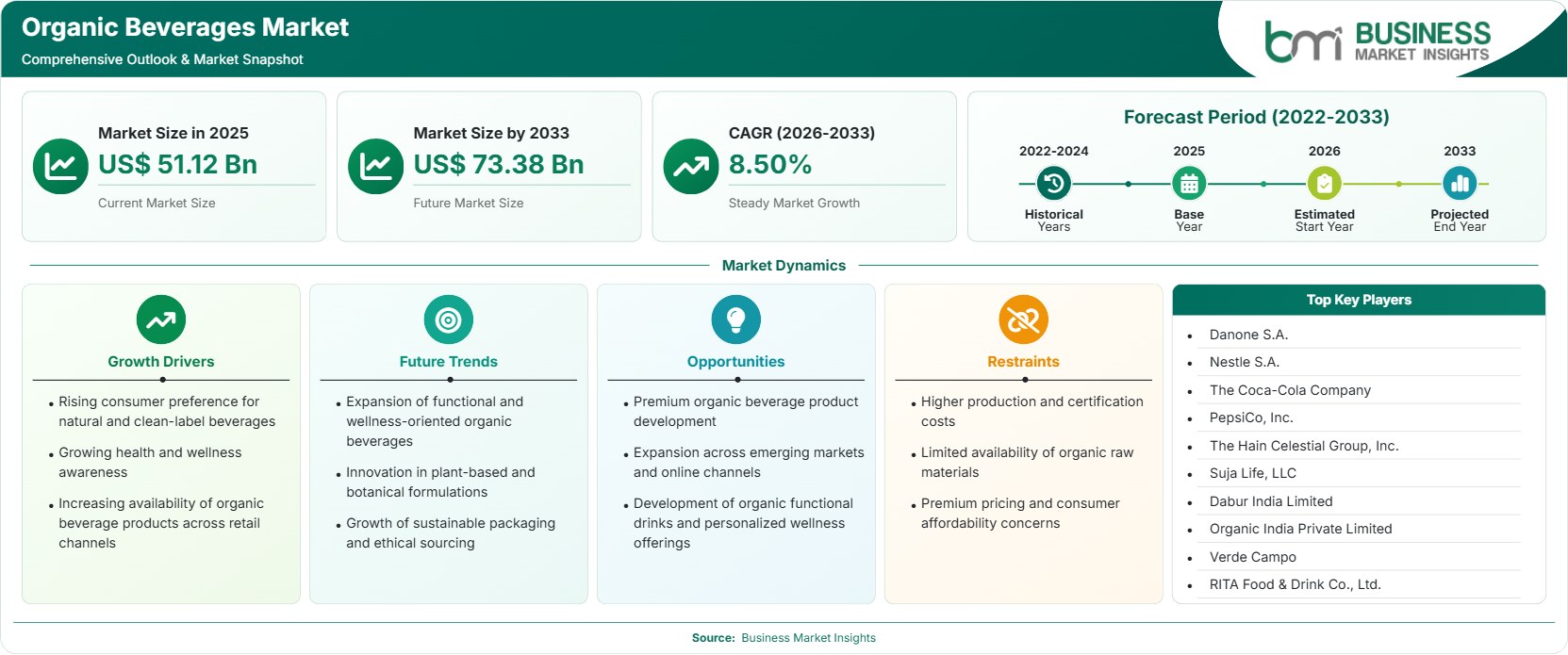
The Organic Beverages Market size was valued at US$ 51.12 Billion in 2025 and is projected to reach US$ 98.16 Billion by 2033, growing at a CAGR of 8.50% during 2026–2033, driven by clean-label demand, functional nutrition, premiumization, digital retail, sustainable packaging, and expanding organic certification.

Report Coverage
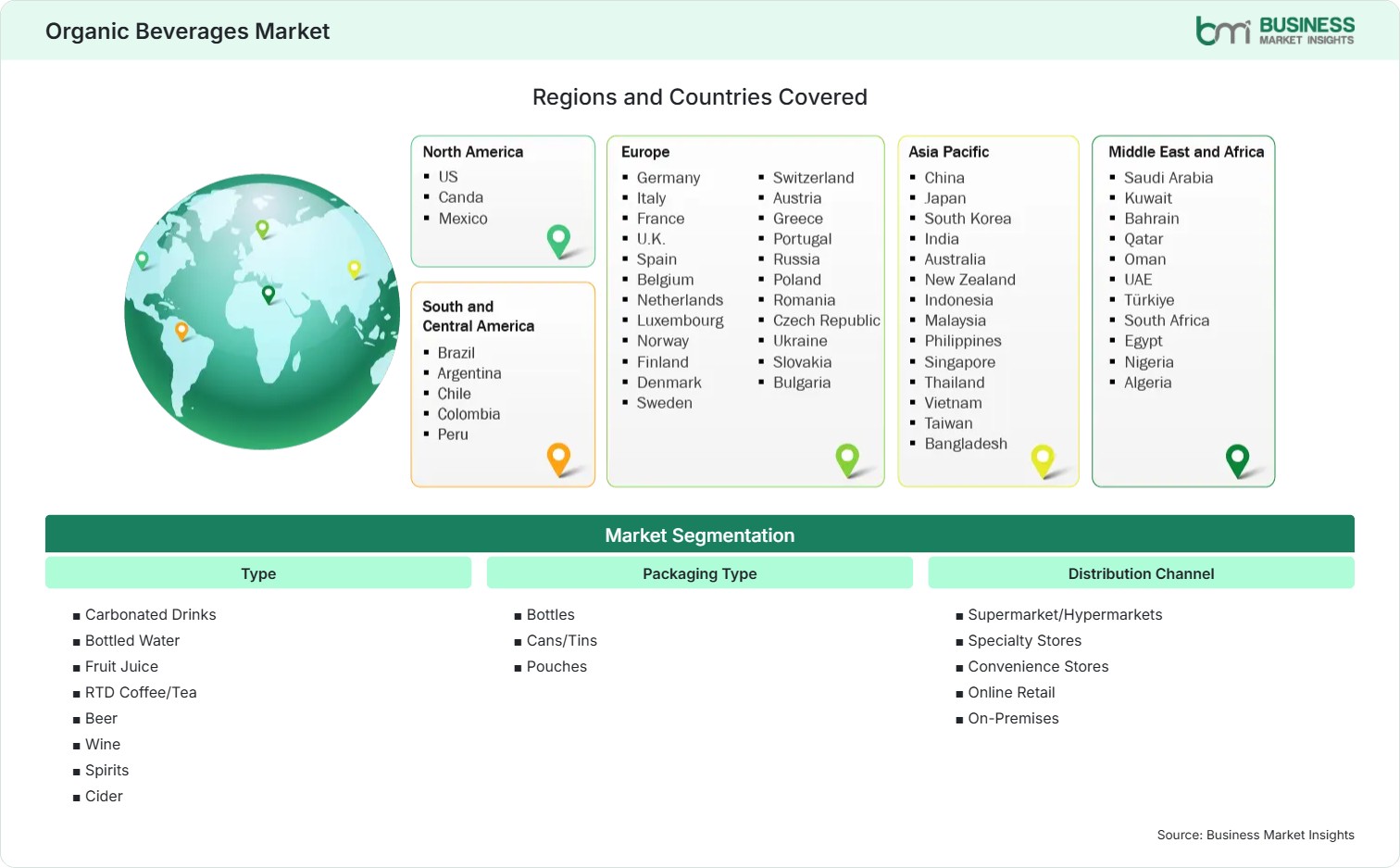
  • Type: Carbonated Drinks, Bottled Water, Fruit Juice, RTD Coffee/Tea, Beer, Wine, Spirits, Cider
  • Packaging Type: Bottles, Cans/Tins, Pouches
  • Distribution Channel: Supermarket/Hypermarkets, Specialty Stores, Convenience Stores, Online Retail, On-Premises
US$ 51.12 Bn Market size in 2025
US$ 73.38 Bn Market Size by 2033
8.50% CAGR, 2026 - 2033
2026-2033 Forecast Period

AI Overview

Organic Beverages Market Summary

  • North America Region: North America holds a market share of 39%–40% in 2025, growing with a CAGR of 12%–15% during 2026–2033, influenced by mature certification, premium wellness products, strong retail infrastructure, functional beverage innovation, and e-commerce. US demand is supported by USDA Organic certification, established specialty retail, functional beverages, and strong consumer awareness, supporting a modeled 12%–14% CAGR during 2026–2033. Published research separately estimates North America's 2025 share at 35.41%.
  • Fastest Growing Region: Asia Pacific holds a market share of 11%–12% in 2025, growing with a CAGR of 7%–8% during 2026–2033, driven by urbanization, rising disposable incomes, health awareness, modern retail expansion, digital commerce, local organic agriculture, and premium imported beverages. External research identifies the region as the fastest-growing geography, while separate 2026–2033 research estimates a 15.28% CAGR.
  • Leading Segment: Non-Alcoholic Beverages holds a 56%–57% share in 2025, growing with a CAGR of 8.01% during 2026–2033, supported by hydration, clean-label consumption, organic juices, bottled water, RTD products, functional formulations, and broader daily-use occasions. Comparable published research identifies non-alcoholic beverages as a major growth category.
  • High Growth Segment: Online Retail holds a modeled 12%–16% share in 2025, growing with a CAGR of 10.10% during 2026–2033, supported by direct-to-consumer launches, subscriptions, digital grocery, broader assortment, targeted marketing, and convenient repeat purchasing. External research identifies online retail as the fastest-growing distribution channel at 10.10%.
  • Key Market Opportunity: The strongest opportunity in Organic Beverages Market is the integration of organic certification with functional benefits, recyclable packaging, traceable sourcing, localized flavors, and digital-first distribution, enabling premium pricing and broader mainstream adoption.
  • Major Market Players: Danone S.A.; Nestlé S.A.; The Coca-Cola Company; PepsiCo, Inc.; The Hain Celestial Group, Inc.; Suja Life, LLC; Dabur India Limited; Organic India Private Limited; Verde Campo Indústria e Comércio de Alimentos Ltda.; RITA Food & Drink Co., Ltd.
Strategic Insights

Organic Beverages Market: Strategic Insights

Organic Beverages Market Strategic Framework
FREE PDF
Request your free sample
Request free sample
Stakeholder View

Key Takeaways

  • Supply-chain control Organic Beverages Market is becoming a competitive advantage as certified agricultural inputs, traceability and supplier reliability influence margins, product claims and international expansion.
  • Functional organic beverages present the best opportunity at the product level within the Organic Beverages Market owing to the fact that digestive wellness, hydration, immunity, energy, and botanicals increase consumption beyond refreshment.
  • Innovation is moving away from simple organic substitutions to multifunctional product developments integrating organic origin with probiotics, botanicals, adaptogens, electrolytes, protein, and naturally sourced sweeteners.
  • Asia Pacific offers a good growth case as low penetration meets urbanization, digital retailing, premiumization, and health-driven consumption.
  • Investment activity increasingly favors scalable wellness platforms. PepsiCo, Inc. completed its US$1.95 billion acquisition of poppi in May 2025, reinforcing strategic interest in functional beverages.
  • Retailers are becoming important innovation partners through private labels, digital merchandising, category management, consumer data and premium shelf positioning.
Geographic Outlook

Organic Beverages Market Regional Highlights

North America Organic Beverages Market

North America held a 39%–40% Organic Beverages Market share in 2025 and is modeled to grow at a 12%–15% CAGR during 2026–2033. The region benefits from mature organic certification, established specialty retail, strong functional beverage innovation and high consumer awareness. Published research also identifies North America as the leading regional market.

  • USDA Organic certification provides a recognized trust mechanism and supports clearer differentiation between certified organic and broader natural claims.
  • Functional sodas, organic juices, wellness shots, RTD tea and organic coffee are broadening consumption occasions.
  • Digital grocery improves assortment access for specialist brands while reducing dependence on national physical shelf coverage.
  • Sustainable packaging and transparent ingredient communication increasingly influence premium purchase decisions.

US Organic Beverages Market

The US represents approximately 87%–89% of North America's 2025 value and is modeled at a 12%–14% CAGR during 2026–2033. USDA certification, organic retail infrastructure and high demands for wellness contribute to maturity of the market. Functional drinks and D2C products provide additional growth opportunities. Existing literature has confirmed that the United States is the largest country market in North America.

  • Functional soda, wellness shots, organic juice and RTD products are creating new consumption occasions.
  • Supermarkets, specialty retailers and online grocery provide complementary routes for scaling emerging brands.
  • Strong consumer familiarity with organic certification reduces education requirements compared with less mature markets.

Europe Organic Beverages Market

Europe represented a 44%–45% share in 2025 and is modeled at a 12%–13% CAGR during 2026–2033. Published research places Europe's 2025 share at 44.55%, making it the leading region in that dataset. Germany leads regional demand, while France and the United Kingdom offer substantial premium opportunities.

  • Germany benefits from mature organic retail, established consumer trust and broad supermarket and specialist distribution.
  • France and the United Kingdom provide opportunities in organic wine, juices, RTD beverages and premium functional products.
  • EU organic rules provide a standardized regulatory foundation, although innovative ingredients can face additional approval requirements.
  • Sustainability, packaging reduction and provenance increasingly complement organic certification as purchase drivers.

Asia Pacific Organic Beverages Market

Asia Pacific held an 11%–12% share in 2025 and is modeled at a 7%–8% CAGR during 2026–2033. External research identifies the region as the fastest-growing market and reports India as its highest-growth country in a comparable 2026–2033 outlook.

  • China offers scale through urbanization, premiumization, digital retail and increasing interest in wellness-oriented products.
  • India combines organic agriculture with botanical and Ayurveda-linked propositions, creating differentiated functional beverage opportunities.
  • Japan rewards quality, provenance, packaging design and functional attributes within premium beverage categories.
  • Australia and Southeast Asia provide opportunities in coconut, fruit, tea, plant-based and functional beverages.

Rest of World Organic Beverages Market

Rest of World represented a modeled 3%–5% share in 2025 and is estimated to grow at a 9%–11% CAGR during 2026–2033. South and Central America benefit from agricultural resources and fruit availability, while Middle Eastern markets offer premium imported beverage opportunities supported by sophisticated retail.

  • Brazil provides opportunities through agricultural resources, beverage manufacturing capability and expanding premium wellness demand.
  • Mexico can leverage North American supply chains while serving a large urban consumer base.
  • UAE and Saudi Arabia offer premium imported beverage opportunities through affluent consumers and modern retail.
  • Import-dependent markets require strong certification, shelf-life management and temperature-controlled logistics.
Global Market Geography
FREE PDF
Request your free sample
Request free sample
Segment Analysis

Organic Beverages Market Segmentation

Type

Non-Alcoholic Beverages represented a 56%–57% share in 2025 and is projected to grow at a CAGR of 8.01% during 2026–2033. Demand benefits from everyday hydration, clean-label consumption, organic juice, RTD formats and functional beverages, while alcoholic products remain premium-led across beer, wine, spirits and cider.

  • Carbonated Drinks: Organic carbonated products increasingly use lower sugar, botanical ingredients and functional positioning to modernize traditional soda consumption.
  • Bottled Water: Premium hydration, provenance and sustainability support organic-positioned bottled water across grocery, hospitality and wellness channels.
  • Fruit Juice: Organic juice benefits from recognizable ingredients, nutritional associations and established household consumption occasions.
  • RTD Coffee/Tea: Organic RTD coffee and tea combine convenience with wellness positioning through cold brew, botanical blends and low-sugar formulations.
  • Beer: Organic beer benefits from certified ingredients, craft positioning, sustainable production and premium consumer interest.
  • Wine: Organic wine gains traction through certified vineyards, provenance, environmental positioning and premiumization.
  • Spirits: Organic spirits remain specialist products supported by certified botanicals, transparent sourcing and premium cocktail applications.
  • Cider: Organic cider benefits from fruit provenance, artisanal positioning and natural fermentation narratives.

Packaging Type

Bottles hold a modeled 48%–52% share in 2025 and are projected to grow at a CAGR of 8.2%–8.8% during 2026–2033. The bottle continues to dominate as the most popular package design, with scientific studies indicating that bottles are among the main classifications of packages. Packaging choices are influenced by considerations such as portability, shelf-life, sustainability, and positioning of the product among others.

  • Bottles: Bottles remain versatile across water, juice, RTD beverages and wine because of established filling infrastructure and premium presentation.
  • Cans/Tins: Cans and tins provide lightweight transportation, long shelf life and strong suitability for RTD beverages and organic beer.
  • Pouches: Pouches support portion control, reduced packaging weight and efficient transportation for selected emerging consumption occasions.

Distribution Channel

Supermarket/Hypermarkets hold a modeled 44%–48% share in 2025 and are projected to grow at a CAGR of 7.8%–8.4% during 2026–2033. Supermarkets/hypermarkets remain an essential channel for reaching the masses, whereas digital marketing offers faster product assortment expansion and direct reach to consumers. Scholarly studies confirm that e-commerce is the fastest growing channel, based on its penetration and organic direct-to-consumer brands.

  • Supermarket/Hypermarkets: Large retailers provide scale, private-label opportunities, promotional visibility and broad consumer reach.
  • Specialty Stores: Specialty outlets remain important for premium discovery, consumer education and niche certified products.
  • Convenience Stores: Convenience locations support single-serve consumption, although premium pricing and limited shelf space remain constraints.
  • Online Retail: Digital channels enable subscriptions, broader assortment, direct engagement and rapid testing of specialist formulations.
  • On-Premises: Restaurants, hotels, cafes and wellness venues strengthen experiential exposure for premium organic beverages.
Market Forces

Organic Beverages Market Dynamics

Key Market Drivers

Clean-Label Certification and Consumer Trust

Consumers are becoming more aware of ingredient labeling and sourcing claims. An organic certification system offers structure for differentiating products and building trust. The consumer base represented by the US organic food market alone is large enough to justify the beverage market transition. Products which combine organic certification with few ingredients and identifiable botanical sources will maintain their premium position. Current Organic Beverages Market trends increasingly favor lower sugar, plant-based formulations, traceability and natural functional ingredients. This support market growth by broadening demand beyond consumers primarily motivated by organic certification. Manufacturers with reliable certified supply chains can convert consumer trust into stronger repeat purchasing and premium shelf positioning.

Functional Formulations Increase Consumption Occasions

Functionalization is expanding the category into digestive health, hydration, immunity, energy and recovery, supporting Organic Beverages Market Growth. Probiotics, botanicals, adaptogens, electrolytes and nutrient-rich formulations allow products to address specific wellness needs rather than generic refreshment. The strategic impact is greater product differentiation and increased potential for premium pricing. Wellness shots, enhanced waters, functional teas and better-for-you carbonated beverages provide additional opportunities for manufacturers. Major beverage companies are also placing greater strategic emphasis on functional propositions, highlighting the growing importance of wellness-focused innovation.

Omnichannel Distribution Expands Market Reach

Retail access is becoming more diversified as supermarkets, specialty stores, convenience outlets, on-premises channels and online platforms serve different consumer occasions. E-commerce plays a crucial role for specialty brands, as online stores offer greater variety, education, and subscription options without requiring nationwide shelf penetration from the start. Mass retailers are still critical for scaling volumes, whereas direct-to-consumer approach offers valuable consumer data. Together, the two channels form an omnichannel growth strategy that allows new brands to build niche demand through digital channels before going retail. As a result, manufacturers need to coordinate product launches, merchandising, sampling and promotions both online and offline.

Key Market Opportunities

Functional Organic Wellness Platforms

Organic certification combined with functional benefits provides a strong product-development opportunity. Probiotic beverages, electrolyte drinks, botanical teas, wellness shots and enhanced waters can address clearly defined consumer needs while supporting premium positioning. Investment priorities are fermentation, natural preservation, ingredient stabilization, and low-temperature processing. Product brands need to focus on well-known ingredients and effectively communicate their benefits. Large established organizations can leverage their distribution channels to make the propositions succeed, whereas niche organizations can pursue wellness niches. The scope is not limited to products promoted solely as organic, since regular product lineups can include organic ingredients and functional propositions.

Asia Pacific Localization and Premiumization

Asia Pacific offers attractive expansion potential through localized formulation and regional manufacturing. Consumer preferences differ materially across China, Japan, India, Australia and Southeast Asia, making local flavor development and sourcing strategically valuable. India offers opportunities for botanical and wellness products, Japan favors quality and provenance, and Southeast Asia provides fruit, coconut and tea opportunities.

Sustainable Packaging and Traceable Sourcing

Packaging innovation can simultaneously address logistics, sustainability and premium positioning. Lightweight cans, recyclable bottles and flexible formats can reduce transportation burdens and improve convenience, while digital traceability can strengthen evidence supporting organic claims. Investment priorities are fermentation, natural preservation, ingredient stabilization, and low-temperature processing. Product brands need to focus on well-known ingredients and effectively communicate their benefits. Large established organizations can leverage their distribution channels to make the propositions succeed, whereas niche organizations can pursue wellness niches. The scope is not limited to products that are promoted only as organic since regular product lineups can include organic ingredients and functionality propositions.

Market Restraints and Challenges

Certified Input Costs and Supply Volatility

Factor: Certified agricultural ingredients can carry higher procurement costs, while crop variability, limited certified supply and geographic concentration increase sourcing complexity. Impact: Manufacturers will have to deal with thin margins or increased retail costs if there is stiff competition from conventional products. Fruit, tea, coffee, herbs and other specialty ingredients could increase their susceptibility to the effects of weather, shipping and currency rate changes. A company could hedge its bets by sourcing across different regions, making commitments with suppliers, forecasting future demand and vertical integration. The problem for smaller manufacturers will be the lack of capital needed to adopt such strategies.

Certification and Cross-Border Regulatory Complexity

Factor: Organic certification, labeling, approved inputs and documentation requirements differ across jurisdictions, while novel functional ingredients may require additional regulatory review. Impact:  Longer timeframes for gaining approval and higher compliance costs pose barriers to launching and expanding into foreign markets. The USDA enforces organic import certification criteria that differ from those of European and other markets. A company operating in several markets must have the necessary regulatory expertise regarding organic certification, ingredient approval, labels, and documentation. Organic Beverages Market participants may find that smaller companies incur relatively higher compliance costs, which impedes internationalization. Regulatory proficiency has become as much a business skill as formulation and manufacturing know-how.

Company Analysis

Competitive Landscape

Organic Beverages Market analysis indicates that competition is shaped by certification credibility, distribution scale, product innovation, functional formulation and supply-chain control. The competitive set combines global beverage leaders with specialists serving organic, natural and wellness-oriented consumers.

Company Name

Overview

Products and Services relevant to this market

Danone S.A.

Global nutrition company with strong health, wellness and plant-based capabilities and expanding APAC exposure.

Plant-based beverages, functional nutrition, health-oriented beverages and wellness platforms.

Nestlé S.A.

Diversified global food and beverage company with substantial water, coffee and premium beverage capabilities.

Bottled water, coffee, premium hydration and beverage innovation.

The Coca-Cola Company

Global beverage leader with extensive distribution and broad product-development capabilities.

Sparkling beverages, water, juices, RTD products and better-for-you beverages.

PepsiCo, Inc.

Global beverage company expanding functional and better-for-you propositions through innovation and acquisitions.

Functional soda, hydration, juices, teas and wellness-oriented beverages.

The Hain Celestial Group, Inc.

Health and wellness company with established natural and organic category expertise.

Organic teas, natural beverages and clean-label wellness products.

Suja Life, LLC

Specialist wellness beverage company focused on organic juices and functional products.

Cold-pressed juices, wellness shots and functional beverages.

Dabur India Limited

Indian consumer products company with strong Ayurveda and wellness expertise.

Fruit juices, beverages and wellness-oriented formulations.

Organic India Private Limited

Organic wellness company focused on certified organic products and botanical propositions.

Organic teas, herbal beverages and wellness formulations.

Verde Campo Indústria e Comércio de Alimentos Ltda.

Brazilian health-focused food company with organic and natural dairy relevance.

Organic dairy beverages, milk products and nutrition propositions.

RITA Food & Drink Co., Ltd.

Vietnamese beverage manufacturer serving branded, private-label and export requirements.

Fruit juice, coconut water, aloe vera, coffee, tea, carbonated beverages and OEM services.

Trust & Transparency

Research Methodology

The market analysis combines proprietary research with secondary data from government agencies, company disclosures, regulatory filings, industry databases and expert interviews. Market estimates are validated through data triangulation, cross-market benchmarking and analyst review.

View Full Research Methodology

Questions Answered

Frequently Asked Questions

What should investors evaluate in an organic beverage company?

The Organic Beverages Market Forecast provides a forward-looking assessment through 2033. Investors should examine certified ingredient availability, margins, repeat purchasing, distribution concentration, innovation speed, regulatory capability and supply-chain reliability.

How can specialist brands compete against multinational beverage companies?

Specialists can focus on differentiated ingredients, narrow wellness propositions, local sourcing, rapid innovation and direct consumer engagement. Digital channels can establish demand before national retail expansion, while certification transparency can reinforce trust and justify premium positioning.

Which packaging format has the strongest opportunity?

Containers remain highly flexible, while cans may gain some share if lighter transport, recycling options, and shelf life are considered important factors. Packs offer certain advantages when portion control and efficient packaging are issues. The most effective form depends on many factors.

Why are functional products important to organic beverage companies?

Functional products create additional consumption occasions and can support premium pricing. Benefits such as hydration, digestive health, energy, immunity and botanical wellness allow organic beverages to compete for consumers seeking specific outcomes rather than simply avoiding conventional ingredients.

What differentiates organic beverages from natural beverages?

Organic beverages market must comply with recognized organic production and certification standards. Natural claims can have different definitions depending on jurisdiction and generally do not provide the same certification framework. Organic certification therefore offers a more structured basis for evaluating sourcing and production practices.

Access the Full Organic Beverages Market Report

Get segment-level forecasts, regional estimates, competitive benchmarking, company profiles and downloadable Excel datasets.

Access the full Organic Beverages Market Report
350 pages PDF & Excel | 2026-09-15
Similar Research

Related Market Reports