
Food & Beverage Additives Market Outlook: Size, Share, Trends, Growth Analysis, Competitive Landscape & Forecast, 2026-2033

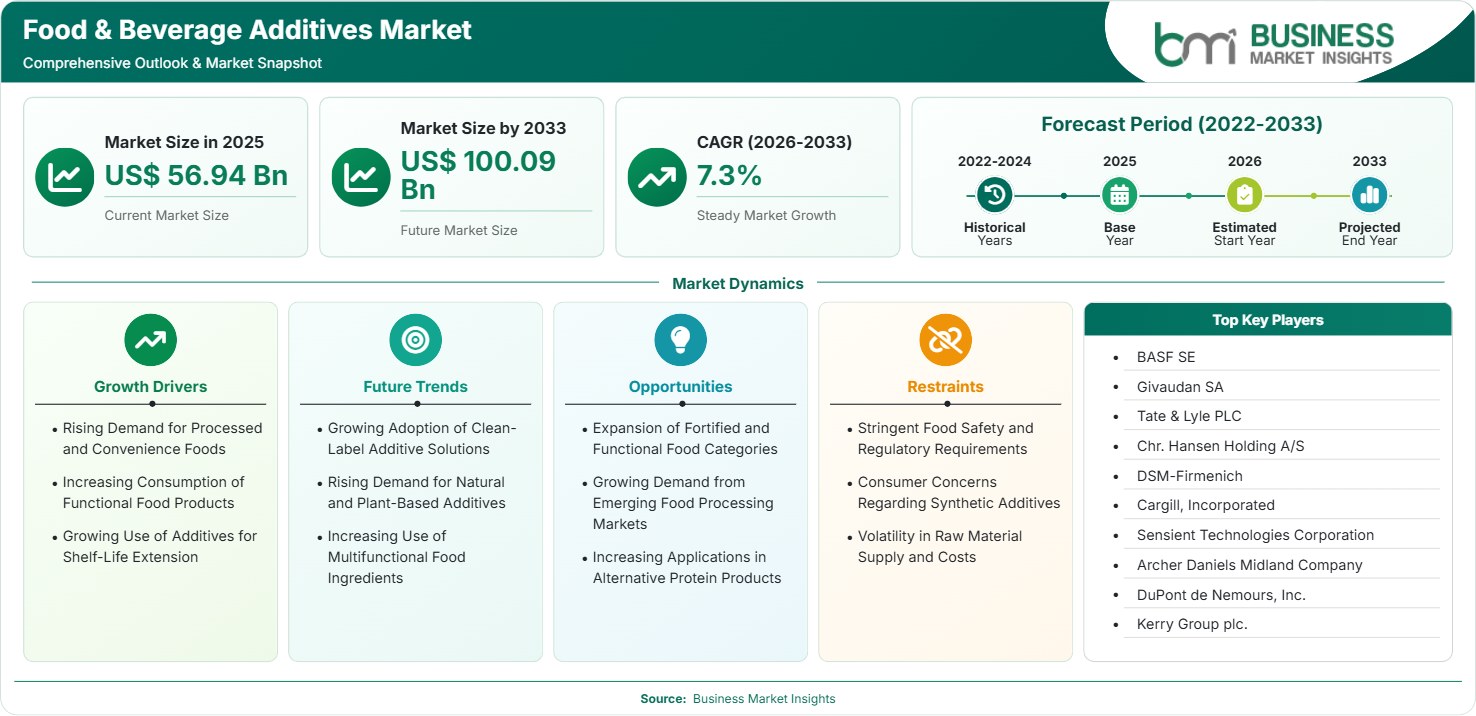
The Food & Beverage Additives Market size was valued at USD 56.94 Billion in 2025 and is projected to reach USD 100.09 Billion by 2033, growing at a CAGR of 7.3% during 2026–2033. Rising demand for processed and convenience foods, increasing preference for clean-label ingredients, and continuous innovation in functional food formulations are driving market growth. Expanding natural ingredient adoption and premium food product development continue creating new opportunities for manufacturers.

Report Coverage
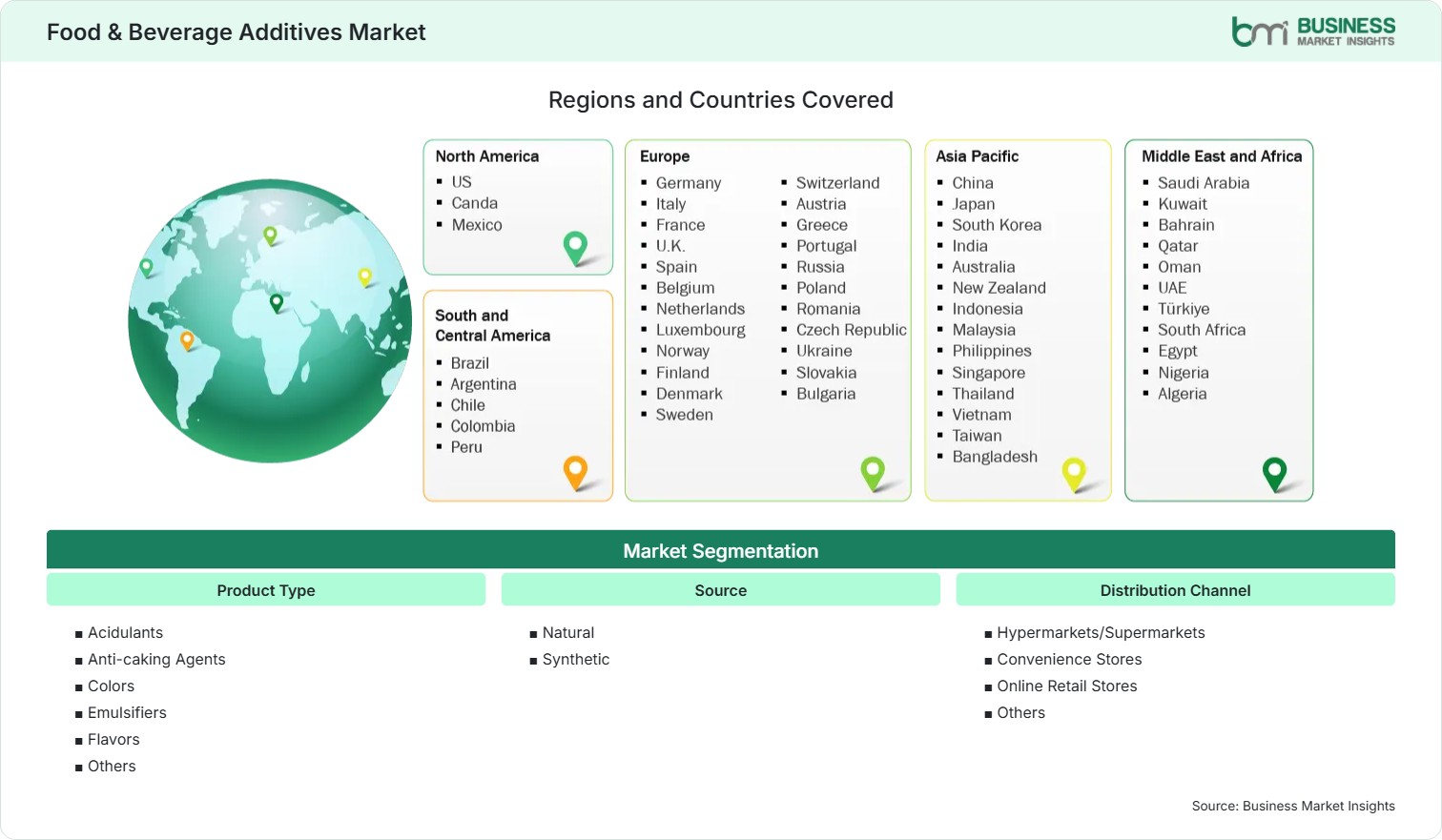
  • Product Type: Acidulants, Anti-caking Agents, Colors, Emulsifiers, Flavors, Others
  • Source: Natural, Synthetic
  • Distribution Channel: Hypermarkets/Supermarkets, Convenience Stores, Online Retail Stores, Others
US$ 56.94 Bn Market size in 2025
US$ 100.09 Bn Market Size by 2033
7.3% CAGR, 2026 - 2033
2026-2033 Forecast Period

01 AI Overview

Food & Beverage Additives Market Summary

  • North America Region: North America holds a market share of 31%–34% in 2025 and is projected to grow at a CAGR of 6.8%–7.2% during 2026–2033. Demand is driven by strong processed food consumption, clean-label product innovation, and increasing investments in functional food ingredients. The US remains the largest regional market, expanding at a CAGR of 6.9%–7.3%.
  • Fastest Growing Region: Asia Pacific accounts for 29%–32% of the market in 2025 and is expected to register the fastest CAGR of 7.8%–8.4% during the forecast period. Rising urbanization, growing packaged food consumption, and expanding food processing industries continue accelerating market demand.
  • Leading Segment: Product Type – Flavors represents 24%–27% of the market in 2025 and is projected to grow at a CAGR of 7.2%–7.7%. Increasing consumer demand for premium taste profiles and product differentiation continues supporting segment leadership.
  • High Growth Segment: Source – Natural accounts for 42%–45% of the market in 2025 while registering a CAGR of 8.3%–8.9%. Consumer preference for clean-label products and naturally sourced ingredients continues driving rapid adoption.
  • Key Market Opportunity: Increasing demand for functional foods, plant-based ingredients, and clean-label formulations is creating significant opportunities for manufacturers developing innovative natural food additive solutions.
  • Major Market Players: BASF SE, Givaudan SA, Tate & Lyle PLC, Chr. Hansen Holding A/S, DSM-Firmenich, Cargill, Incorporated, Sensient Technologies Corporation, Archer Daniels Midland Company, DuPont de Nemours, Inc., and Kerry Group plc.
02 Strategic Insights

Food & Beverage Additives Market: Strategic Insights

Food & Beverage Additives Market Strategic Framework
FREE PDF
Request your free sample
Request free sample
03 Stakeholder View

Key Takeaways

1. The market value chain continues evolving through stronger collaboration between ingredient manufacturers, food processors, distributors, retailers, and research organizations to accelerate innovation and improve global ingredient availability.

2. Natural additives, functional ingredients, and premium flavor solutions continue presenting the strongest commercial opportunities as food manufacturers respond to changing consumer preferences and regulatory developments.

3. Innovation increasingly focuses on clean-label formulations, plant-based ingredients, sugar reduction technologies, natural preservation systems, and advanced flavor development to improve product quality and nutritional value.

4. Asia Pacific remains the most attractive investment destination owing to expanding food manufacturing capacity, growing packaged food consumption, rising disposable incomes, and rapid urbanization across developing economies.

5. Strategic acquisitions, ingredient portfolio expansion, and investments in biotechnology and fermentation technologies continue strengthening competitive positioning among leading global food ingredient suppliers.

6. Sustainability initiatives, transparent ingredient sourcing, and digital product traceability are becoming increasingly important competitive differentiators as consumers demand greater visibility into food ingredient origins and manufacturing practices.

04 Geographic Outlook

Food & Beverage Additives Market Regional Highlights

North America Food & Beverage Additives Market

North America accounts for 31%–34% of the global market in 2025 and is projected to grow at a CAGR of 6.8%–7.2% during 2026–2033. The Food & Beverage Additives Market share in the region is supported by high consumption of processed foods, continuous product innovation, and strong demand for clean-label ingredients. Food manufacturers are increasingly incorporating natural additives, functional ingredients, and specialty flavors to meet evolving consumer preferences and regulatory standards.

  • Growing consumer demand for healthier packaged foods is encouraging manufacturers to incorporate natural preservatives, flavor enhancers, and clean-label additives across multiple food and beverage categories.
  • Continuous innovation in functional foods, protein-enriched products, and sugar-reduced formulations is driving greater utilization of specialty food additives throughout the region.
  • Food safety regulations continue encouraging manufacturers to adopt premium-quality ingredients that improve product stability, shelf life, and nutritional value.
  • Investments in food processing automation and advanced ingredient technologies continue supporting efficient production while improving product consistency and formulation flexibility.
  • Rising demand for plant-based foods and beverages continues creating new opportunities for natural flavors, colors, emulsifiers, and specialty ingredients.

US Food & Beverage Additives Market

The United States represents 25%–28% of the global Food & Beverage Additives market in 2025 and is expected to expand at a CAGR of 6.9%–7.3% through 2033. Strong consumer demand for convenience foods, premium beverages, and functional nutrition products continues driving ingredient innovation. Manufacturers are investing in sustainable ingredient sourcing and clean-label formulations to strengthen product differentiation and meet changing dietary preferences.

  • Clean-label product development continues encouraging greater use of natural colors, flavors, and preservatives across packaged food and beverage manufacturing.
  • Functional nutrition trends are increasing demand for specialty additives that improve nutritional value, texture, stability, and product appeal.
  • Food manufacturers continue investing in biotechnology and fermentation technologies to develop innovative and sustainable ingredient solutions.
  • Expansion of premium food categories is supporting greater utilization of advanced additive technologies that enhance taste, appearance, and shelf stability.

Europe Food & Beverage Additives Market

Europe holds 28%–31% of the market in 2025 and is projected to register a CAGR of 6.9%–7.4% during the forecast period. Strict food safety regulations, high consumer awareness, and strong demand for natural ingredients continue supporting market expansion. Germany remains the leading regional market, while Spain records the fastest growth owing to expanding food processing investments and growing demand for premium food products.

  • Germany continues leading regional demand through its advanced food processing industry and continuous innovation in specialty food ingredients and functional formulations.
  • Spain is projected to record the fastest regional growth as packaged food production, exports, and investments in natural ingredient manufacturing continue expanding.
  • Regulatory emphasis on food safety and ingredient transparency continues encouraging wider adoption of clean-label additive solutions across Europe.
  • Manufacturers are increasingly replacing synthetic ingredients with naturally sourced alternatives to address evolving consumer expectations and sustainability goals.
  • Growing demand for organic, functional, and premium food products continues supporting innovation in flavors, colors, emulsifiers, and specialty additives.

Asia Pacific Food & Beverage Additives Market

Asia Pacific accounts for 29%–32% of the global market in 2025 and is expected to record the fastest CAGR of 7.8%–8.4% during 2026–2033. Rapid urbanization, increasing disposable incomes, and expanding processed food consumption continue driving regional demand. China dominates the regional Food & Beverage Additives market, while India records the fastest growth owing to increasing food manufacturing investments and rising consumption of packaged food products.

  • China continues strengthening food manufacturing capacity while increasing demand for flavors, preservatives, emulsifiers, and specialty food ingredients across diverse product categories.
  • India registers the fastest regional growth driven by expanding packaged food production, rising middle-class consumption, and increasing investments in food processing infrastructure.
  • Japan and South Korea continue investing in premium food innovation, functional nutrition, and advanced ingredient technologies supporting value-added food production.
  • Growing retail modernization and e-commerce expansion continue improving accessibility of packaged foods, thereby increasing additive consumption across the region.
  • Rising consumer preference for healthier foods is encouraging manufacturers to develop products utilizing natural additives and clean-label ingredient solutions.

Rest of World Food & Beverage Additives Market

The Rest of World accounts for 8%–11% of the global market in 2025 and is projected to expand at a CAGR of 7.0%–7.5% during the forecast period.

South & Central America continues witnessing increasing demand for processed foods and beverages supported by expanding food manufacturing activities. Brazil leads the regional market, while Mexico records the fastest growth owing to increasing packaged food consumption and investments in food processing facilities.

The Middle East & Africa continues benefiting from rising urbanization, changing dietary preferences, and increasing investments in food manufacturing. Saudi Arabia remains the leading regional Food & Beverage Additives market, while the United Arab Emirates records the fastest growth driven by premium food demand and modern retail expansion.

  • Brazil continues expanding processed food manufacturing while increasing adoption of advanced food ingredient technologies supporting product quality and shelf-life enhancement.
  • Mexico is witnessing rapid growth as investments in food processing, convenience food production, and retail expansion continue increasing ingredient demand.
  • Saudi Arabia continues strengthening domestic food manufacturing capabilities through investments in food security initiatives and value-added food production.
  • The United Arab Emirates continues expanding premium food imports, food processing investments, and modern retail infrastructure supporting higher additive consumption.
  • Rising demand for packaged foods, beverages, and functional nutrition products continues encouraging wider adoption of innovative food additive technologies across emerging markets.
Global Market Geography
FREE PDF
Request your free sample
Request free sample
05 Segment Analysis

Food & Beverage Additives Market Segmentation

Product Type

Product type plays a critical role in determining functionality, product stability, taste enhancement, and shelf-life across food applications. Flavors account for 24%–27% of the market in 2025, while the segment is projected to grow at a CAGR of 7.2%–7.7% during 2026–2033. The Food & Beverage Additives Market scope continues to expand as manufacturers develop innovative ingredients that improve sensory appeal, nutritional value, and product performance.

  • Acidulants: Acidulants are extensively used to regulate pH, enhance flavor, improve preservation, and maintain product stability across beverages, confectionery, dairy products, and processed foods.
  • Anti-caking Agents: These additives prevent moisture absorption and improve product flowability in powdered food products, seasonings, baking ingredients, and nutritional supplements.
  • Colors: Natural and synthetic food colors are increasingly utilized to enhance product appearance, strengthen brand differentiation, and improve consumer acceptance across packaged food categories.
  • Emulsifiers: Emulsifiers improve texture, consistency, and ingredient stability in bakery products, dairy products, sauces, dressings, beverages, and processed foods.
  • Flavors: Flavor additives dominate the Food & Beverage Additives market owing to increasing consumer preference for premium taste experiences, product innovation, and expanding consumption of processed and convenience foods.
  • Others: Other additives include preservatives, sweeteners, stabilizers, thickeners, enzymes, antioxidants, and specialty ingredients supporting food quality, safety, and functionality.

Source

Source continues to influence purchasing decisions as consumers increasingly prefer naturally derived food ingredients. Natural additives account for 42%–45% of the market in 2025 while the segment is projected to register a CAGR of 8.3%–8.9% during the forecast period. Growing clean-label preferences continue shaping Food & Beverage Additives Market trends across global food manufacturing.

  • Natural: Natural additives continue gaining strong demand because of clean-label preferences, regulatory support, and increasing consumer awareness regarding health, sustainability, and ingredient transparency.
  • Synthetic: Synthetic additives continue maintaining demand where cost efficiency, product consistency, longer shelf life, and large-scale manufacturing remain important commercial considerations.

Distribution Channel

Distribution channels influence product availability and purchasing convenience for food ingredients and additive-based consumer products. Hypermarkets/Supermarkets account for 46%–49% of the market in 2025, while the segment is expected to expand at a CAGR of 6.9%–7.4% through 2033. Expanding retail infrastructure and digital commerce continue strengthening global distribution networks.

  • Hypermarkets/Supermarkets: Large retail chains remain the dominant distribution channel because of extensive product availability, organized retail expansion, and strong consumer preference for one-stop shopping.
  • Convenience Stores: Convenience stores continue supporting market growth by providing easy access to packaged food and beverage products in urban and suburban locations.
  • Online Retail Stores: Online platforms are witnessing rapid adoption owing to expanding e-commerce, digital grocery shopping, broader product availability, and increasing consumer preference for home delivery.
  • Others: Other distribution channels include specialty food retailers, wholesalers, foodservice distributors, and institutional supply networks serving commercial food manufacturers and hospitality businesses.
06 Market Forces

Food & Beverage Additives Market Dynamics

Key Market Drivers

Rising Demand for Processed and Convenience Foods

Growing urbanization, changing lifestyles, and increasing demand for ready-to-eat meals continue driving consumption of processed food products worldwide. Food manufacturers rely on additives to enhance flavor, improve texture, maintain freshness, and extend product shelf life. The Food & Beverage Additives Market growth is supported by expanding packaged food production, rising household incomes, and continuous innovation in convenience food formulations. Manufacturers continue investing in advanced ingredient technologies that improve product quality while meeting evolving consumer expectations for taste, safety, and convenience.

Increasing Consumption of Functional Food Products

Consumers are increasingly seeking foods that provide additional health benefits beyond basic nutrition, driving demand for functional ingredients and specialized food additives. Growing awareness of digestive health, immunity, and overall wellness has encouraged manufacturers to develop fortified foods, beverages, and nutritional products. Functional additives improve nutritional profiles, product stability, and sensory characteristics while supporting innovation across dairy, beverages, bakery, and dietary supplement categories. This trend continues creating sustained demand for advanced food ingredient solutions.

Growing Use of Additives for Shelf-Life Extension

Food manufacturers continue utilizing additives to improve product stability, reduce spoilage, and maintain quality throughout distribution and storage. Preservatives, antioxidants, emulsifiers, and stabilizers help minimize food waste while ensuring consistent taste, texture, and appearance. Increasing global food trade, expanding cold chain networks, and rising packaged food consumption continue strengthening demand for shelf-life extension technologies. Manufacturers are also investing in natural preservation solutions that support clean-label product development while maintaining food safety standards.

Key Market Opportunities

Expansion of Fortified and Functional Food Categories

Growing consumer interest in preventive healthcare and balanced nutrition continues encouraging manufacturers to develop fortified foods containing vitamins, minerals, probiotics, and specialty ingredients. Food & Beverage Additives Market Forecasts indicate increasing opportunities for additive suppliers supporting functional food innovation across beverages, dairy products, bakery, infant nutrition, and dietary supplements. Continued investment in health-focused product development is expected to strengthen long-term ingredient demand.

Growing Demand from Emerging Food Processing Markets

Rapid industrialization, urbanization, and increasing disposable incomes across Asia Pacific, Latin America, and Africa continue supporting expansion of food processing industries. Rising consumption of packaged foods, beverages, and convenience products creates favorable opportunities for additive manufacturers supplying flavors, emulsifiers, preservatives, and specialty ingredients. Companies expanding regional manufacturing capabilities and distribution networks are well positioned to benefit from sustained market growth.

Increasing Applications in Alternative Protein Products

The expanding market for plant-based foods, cultured proteins, and alternative meat products is creating new opportunities for advanced food additives. Manufacturers increasingly utilize flavors, stabilizers, emulsifiers, colorants, and texture-enhancing ingredients to improve taste, appearance, and product functionality. Growing consumer acceptance of sustainable protein sources continues encouraging innovation in ingredient technologies specifically designed for next-generation food products.

Market Restraints and Challenges

Stringent Food Safety and Regulatory Requirements

Factor: Food additives are subject to comprehensive approval processes, ingredient labeling regulations, and strict safety assessments established by food regulatory authorities across global markets. Impact: Compliance requirements increase product development costs, extend commercialization timelines, and require continuous investment in quality assurance, regulatory documentation, and scientific validation. Differences in regional regulatory frameworks also create additional complexity for manufacturers operating across international markets.

Consumer Concerns Regarding Synthetic Additives

Factor: Growing consumer awareness regarding ingredient transparency and potential health impacts has increased preference for naturally sourced additives over synthetic alternatives. Impact: Manufacturers face increasing pressure to reformulate products using clean-label ingredients while maintaining product quality, stability, and affordability. This transition often requires additional research and development investments, supply chain adjustments, and higher production costs associated with natural ingredient sourcing.

07 Company Analysis

Competitive Landscape

The Food & Beverage Additives Market analysis is characterized by strong competition among global ingredient manufacturers focusing on clean-label innovation, natural ingredient development, biotechnology, and sustainable sourcing. Companies are expanding production capacities, strengthening research and development capabilities, and pursuing strategic partnerships to meet increasing demand for functional ingredients, natural flavors, preservatives, and specialty food additives across global food and beverage industries.

Company Name

Overview

Products and Services Relevant to this Market

BASF SE

Global chemical company supplying specialty ingredients and performance solutions for food, nutrition, and industrial applications.

Food ingredients, vitamins, antioxidants, emulsifiers, specialty additives, and nutritional solutions.

Givaudan SA

Global leader in flavors, fragrances, and taste solutions serving food, beverage, and consumer product manufacturers.

Flavors, taste solutions, natural extracts, beverage ingredients, and food formulation technologies.

Tate & Lyle PLC

International ingredient supplier specializing in food and beverage solutions for healthier product development.

Sweeteners, texturants, stabilizers, fibers, starches, and specialty food ingredients.

Chr. Hansen Holding A/S

Global bioscience company focused on natural ingredient solutions for food, beverages, and nutrition industries.

Cultures, probiotics, natural colors, enzymes, fermentation solutions, and food protection ingredients.

DSM-Firmenich

Global nutrition, health, and beauty company providing advanced ingredient solutions for food manufacturers.

Nutritional ingredients, vitamins, flavors, enzymes, food fortification solutions, and specialty additives.

Cargill, Incorporated

Leading global food and agricultural company supplying ingredients and formulation solutions worldwide.

Sweeteners, starches, texturizers, cocoa ingredients, emulsifiers, and specialty food additives.

Sensient Technologies Corporation

Manufacturer of colors, flavors, and specialty ingredients serving global food and beverage industries.

Natural colors, flavors, extracts, specialty ingredients, and food formulation technologies.

Archer Daniels Midland Company

Global agricultural processor and ingredient supplier supporting food, beverage, and nutrition markets.

Plant proteins, flavors, emulsifiers, specialty ingredients, sweeteners, and nutritional solutions.

DuPont de Nemours, Inc.

Technology-based company supplying specialty materials and advanced ingredient solutions for food processing.

Food enzymes, probiotics, cultures, emulsifiers, stabilizers, and specialty ingredient technologies.

Kerry Group plc

Global taste and nutrition company delivering ingredient innovation for food and beverage manufacturers.

Flavors, functional ingredients, nutritional solutions, preservation systems, and clean-label technologies.

08 Industry Activity

Recent Developments

July 2026

AAK announced that it entered into a two-year strategic collaboration with Savor to jointly develop and commercialize specialty fat-based ingredients for dairy alternative and bakery applications, while making an equity investment in Savor to accelerate sustainable food ingredient innovation.

May 2026

IFF announced a definitive agreement to sell its Food Ingredients business to funds advised by CVC Capital Partners for approximately $4.3 billion. This divestiture allows IFF to focus capital and R&D on its core, higher-margin segments, including taste, fragrance, and health and biosciences. Read the full story at IFF.

March 2026

IFF announced the expansion of its Health & Biosciences business in Latin America by establishing a new enzyme production hub in Arroyito, Argentina, and a household care application lab in Sao Paulo, Brazil.

June 2025

Nestlé USA announced that it will eliminate the use of all FD&C synthetic colors across its U.S. food and beverage portfolio by mid-2026, advancing its clean-label strategy and replacing remaining artificial colors with alternative ingredients.

10 Trust & Transparency

Research Methodology

The market analysis combines proprietary research with secondary data from government agencies, company disclosures, regulatory filings, industry databases and expert interviews. Market estimates are validated through data triangulation, cross-market benchmarking and analyst review.

View Full Research Methodology

11 Questions Answered

Frequently Asked Questions

What are the key opportunities for market participants?

Manufacturers can capitalize on expanding functional food categories, increasing demand from emerging food processing markets, growing applications in alternative protein products, and rising consumer preference for natural and clean-label food ingredients.

Who are the major companies operating in the market?

Major companies include BASF SE, Givaudan SA, Tate & Lyle PLC, Chr. Hansen Holding A/S, DSM-Firmenich, Cargill, Incorporated, Sensient Technologies Corporation, Archer Daniels Midland Company, DuPont de Nemours, Inc., and Kerry Group plc.

Which region is expected to witness the fastest growth?

Asia Pacific is projected to register the fastest growth during the forecast period due to expanding food processing industries, rising disposable incomes, rapid urbanization, and increasing consumption of packaged and convenience foods.

Which product type dominates the Food & Beverage Additives Market Report?

Flavors represent the leading product type owing to their essential role in enhancing taste, supporting product differentiation, and meeting evolving consumer preferences across packaged foods and beverages.

What is driving the Food & Beverage Additives Market?

The market is driven by increasing demand for processed and convenience foods, growing consumption of functional food products, rising preference for clean-label ingredients, and continuous innovation in food processing and formulation technologies.

Access the Full Food & Beverage Additives Market Report

Get segment-level forecasts, regional estimates, competitive benchmarking, company profiles and downloadable Excel datasets.

Access the full Food & Beverage Additives Market Report
350 pages PDF & Excel | 2026-07-27