
Food Packaging Equipment Market Outlook: Size, Share, Trends, Growth Analysis, Competitive Landscape & Forecast, 2026-2033

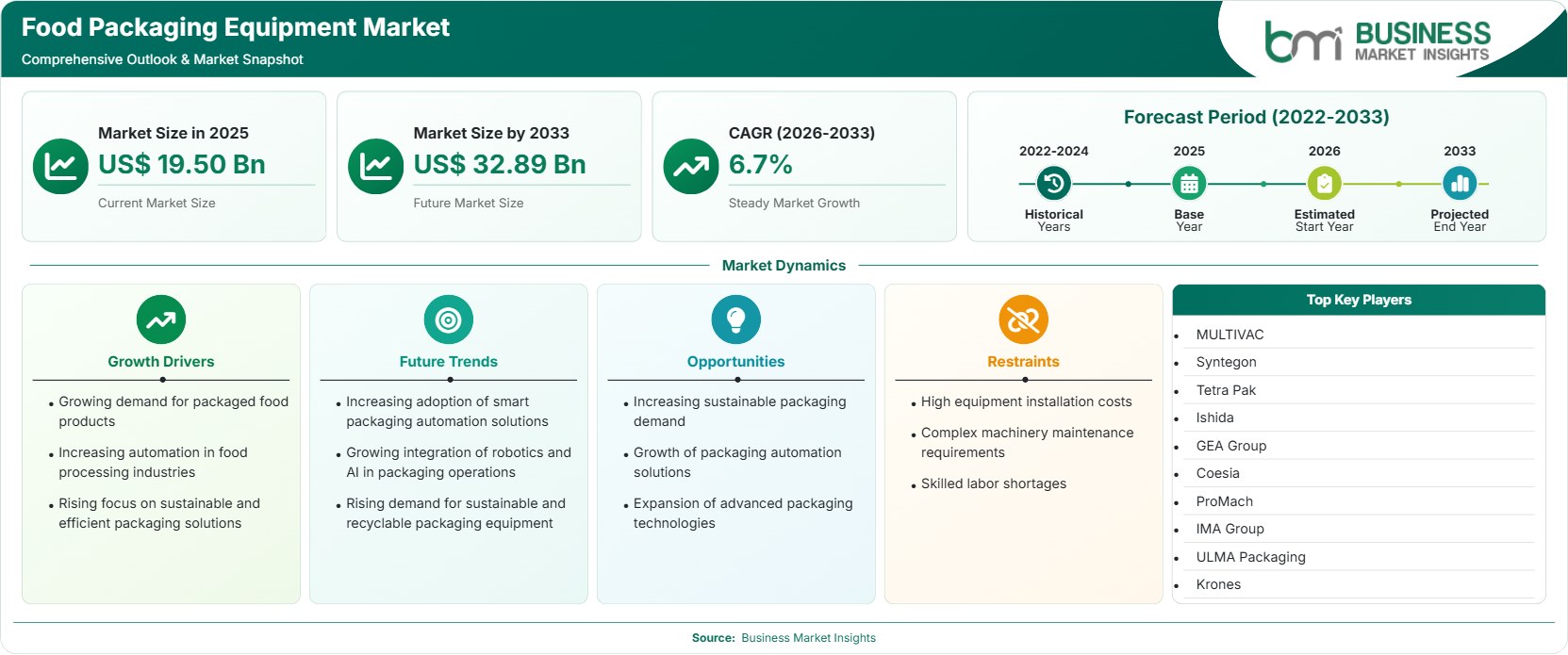
The Food Packaging Equipment Market size was valued at US$ 19.50 billion in 2025 and is projected to reach US$ 32.89 billion by 2033, growing at a CAGR of 6.7% during 2026–2033, driven by rising packaged food consumption, increasing automation adoption, sustainable packaging requirements, and demand for efficient food processing operations.

Report Coverage
  • Equipment Type: Filling, Bottling, Case Cartoning, Labeling and Palletizing
  • Application: Bakery and Confectionery Products, Meat and Poultry Products, Dairy Products, Beverages, Others
US$ 19.50 Bn Market size in 2025
US$ 32.89 Bn Market Size by 2033
6.7% CAGR, 2026 - 2033
2026-2033 Forecast Period

01 AI Overview

Food Packaging Equipment Market Summary

  • North America Region: North America holds a 28%–31% share in 2025 and is projected to grow at a CAGR of 6.2%–6.8% during 2026–2033, supported by advanced food processing industries, automation adoption, sustainability initiatives, and demand for efficient packaging systems. The US market is expected to expand at a 6.4%–7.0% CAGR, driven by packaged food demand, modernization of manufacturing facilities, and technology investments.
  • Fastest Growing Region: Asia Pacific represents a 32%–35% share in 2025 and is forecast to register the fastest CAGR of 7.2%–7.9%, supported by expanding food manufacturing capacity, urbanization, rising processed food consumption, and increasing investments in automated packaging technologies.
  • Leading Segment: Filling equipment accounts for a 28%–31% share in 2025 and is expected to grow at a CAGR of 6.5%–7.1%, supported by beverage, dairy, and processed food applications requiring accurate, hygienic, and high-speed packaging operations.
  • High Growth Segment: Palletizing equipment is projected to grow at a CAGR of 7.5%–8.2%, driven by warehouse automation, labor optimization, improved logistics efficiency, and increasing adoption of robotic packaging systems.
  • Key Market Opportunity: Sustainable packaging technologies, intelligent automation, robotic systems, and digital monitoring solutions are creating opportunities for equipment providers to improve efficiency, reduce waste, and support evolving food industry requirements.
  • Major Market Players: MULTIVAC, Syntegon, Tetra Pak, Ishida, GEA Group, Coesia, ProMach, IMA Group, ULMA Packaging, Krones.
02 Strategic Insights

Food Packaging Equipment Market: Strategic Insights

Food Packaging Equipment Market Strategic Framework
FREE PDF
Request your free sample
Request free sample
03 Stakeholder View

Key Takeaways

  • The market ecosystem is shifting toward integrated packaging lines combining equipment automation, digital controls, robotics, and data-driven production management to improve manufacturing efficiency.
  • High-growth opportunities are emerging in automated palletizing, intelligent filling systems, and sustainable packaging equipment as food companies modernize production facilities.
  • Innovation is focused on robotics, artificial intelligence-enabled monitoring, machine learning-based maintenance, and flexible equipment capable of supporting changing consumer packaging preferences.
  • Asia Pacific presents strong investment potential due to expanding food processing industries, increasing packaged food demand, and manufacturing infrastructure development in emerging economies.
  • Strategic partnerships between equipment manufacturers, food producers, and technology providers are increasing to accelerate automation and sustainable packaging adoption.
  • Companies are pursuing product differentiation through energy-efficient machinery, modular designs, and equipment capable of handling biodegradable and recyclable packaging materials.
04 Geographic Outlook

Food Packaging Equipment Market Regional Highlights

North America Food Packaging Equipment Market

North America accounted for a 28%–31% of the Food Packaging Equipment Market share in 2025 and is projected to grow at a CAGR of 6.2%–6.8% from 2026–2033. The region benefits from mature food processing industries, advanced manufacturing capabilities, high automation penetration, and increasing sustainability requirements. The United States remains the leading contributor due to strong packaged food demand and continuous investment in modern packaging infrastructure.

  • Food manufacturers are upgrading packaging lines to improve efficiency, accuracy, and production capacity.
  • Automation adoption is increasing due to labor shortages and demand for consistent packaging quality.
  • Sustainable packaging regulations are encouraging investment in energy-efficient equipment.
  • Digital monitoring technologies are improving operational visibility and predictive maintenance.
  • Advanced robotic solutions are gaining adoption in high-volume food production facilities.

US Food Packaging Equipment Market

The US accounted for 23%–26% in 2025 and is forecast to grow at a CAGR of 6.4%–7.0% in the Food Packaging Equipment Market forecasts. Market expansion is supported by established food processing industries, increasing demand for convenience foods, and modernization of manufacturing operations. Food producers are adopting automated packaging technologies to improve productivity and meet evolving consumer expectations.

  • Packaged food manufacturers are investing in automated systems for higher production efficiency.
  • Robotics adoption is increasing across filling, palletizing, and material handling applications.
  • Sustainable packaging initiatives are encouraging equipment upgrades.
  • Food safety requirements are supporting demand for advanced packaging machinery.

Europe Food Packaging Equipment Market

Europe held a 27%–30% of the market share in 2025 and is expected to grow at a CAGR of 6.0%–6.6% during 2026–2033. The region benefits from strong food manufacturing capabilities, sustainability regulations, and advanced engineering expertise. Germany, Italy, France, and the United Kingdom are major markets due to high adoption of automated packaging technologies and demand for environmentally efficient solutions.

  • Germany is driving adoption through advanced industrial automation capabilities.
  • Italy supports packaging equipment growth through strong machinery manufacturing expertise.
  • France is investing in sustainable food packaging technologies.
  • The United Kingdom is adopting automation to improve food production efficiency.
  • European regulations are encouraging recyclable packaging and resource-efficient machinery.

Asia Pacific Food Packaging Equipment Market

Asia Pacific represented a 32%–35% share in 2025 and is projected to achieve the fastest CAGR of 7.2%–7.9% through 2033. Regional growth is supported by expanding food processing industries, urbanization, increasing disposable income, and rising packaged food consumption. China, India, Japan, and Southeast Asian countries are contributing significantly to market expansion.

  • China is expanding food manufacturing capacity and adopting automated packaging systems.
  • India is witnessing increased investment in packaged food production infrastructure.
  • Japan continues developing precision-based packaging technologies.
  • Southeast Asia is experiencing rising demand for modern food processing equipment.
  • Regional manufacturers are adopting sustainable and flexible packaging solutions.

Rest of World Food Packaging Equipment Market

Rest of World accounted for 8%–11% of the Food Packaging Equipment Market share in 2025 and is expected to grow at a CAGR of 6.5%–7.3% between 2026–2033. Latin America, the Middle East, and Africa are gradually increasing adoption due to expanding food industries, urbanization, and investments in processing infrastructure. Growing packaged food consumption is encouraging manufacturers to improve production capabilities.

  • Latin America is adopting packaging automation across food and beverage industries.
  • Middle Eastern countries are investing in food processing infrastructure.
  • African markets are improving food packaging capabilities through industrial development.
  • International food manufacturers are expanding production facilities in emerging regions.
  • Modern packaging technologies are improving efficiency and reducing operational waste.
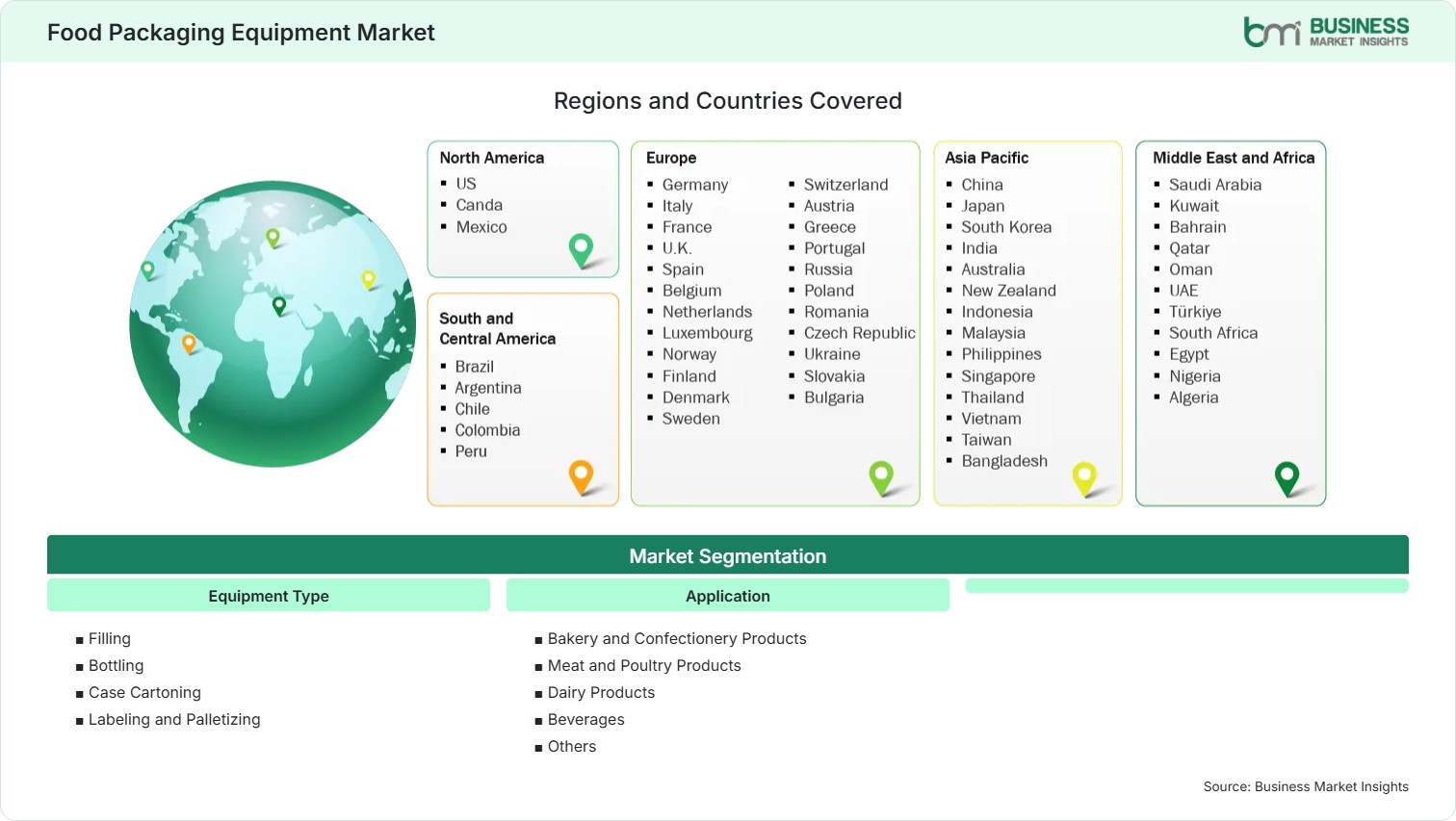
Global Market Geography
FREE PDF
Request your free sample
Request free sample
05 Segment Analysis

Food Packaging Equipment Market Segmentation

Equipment Type

The equipment type segment represents the core machinery categories used across food processing and packaging operations. The segment is expanding as manufacturers adopt automated systems to improve speed, accuracy, hygiene, and production efficiency. The Food Packaging Equipment Market scope is increasing with demand for integrated packaging lines capable of supporting diverse food products and sustainable packaging formats. Equipment manufacturers are focusing on modular designs, digital controls, and energy-efficient technologies to meet evolving industry requirements. The segment is expected to maintain steady growth as food companies modernize facilities and replace conventional packaging processes.

  • Filling: Filling equipment maintains strong adoption due to demand for precise product dispensing across beverages, dairy, sauces, and processed food applications. Automation improves accuracy, hygiene, and production efficiency.
  • Bottling: Bottling equipment supports high-volume packaging operations for beverages and liquid food products. Manufacturers are adopting advanced systems offering faster processing, improved quality control, and reduced material waste.
  • Case Cartoning: Case cartoning equipment is gaining importance for secondary packaging applications requiring efficient product handling, consistent packaging quality, and improved supply chain performance across food industries.
  • Labeling: Labeling equipment supports regulatory compliance, product identification, branding, and traceability requirements. Automated labeling systems improve accuracy and enable efficient packaging line integration.
  • Palletizing: Palletizing equipment is expanding through robotic automation adoption, helping manufacturers optimize warehouse operations, reduce labor dependency, and improve logistics efficiency.

Application

The application segment is influenced by changing consumer preferences, packaged food consumption patterns, and increasing requirements for efficient production systems. Food manufacturers across bakery, meat, dairy, beverage, and other categories are investing in advanced packaging machinery to improve output, maintain hygiene standards, and support sustainable packaging initiatives. Automation adoption is increasing across applications as companies seek flexible equipment capable of handling different product formats and production volumes.

  • Bakery and Confectionery Products: Packaging equipment supports high-speed operations for baked goods and confectionery items through automated wrapping, sealing, labeling, and handling systems.
  • Meat and Poultry Products: Advanced packaging systems improve hygiene, preservation, and processing efficiency for meat and poultry products through automated filling, sealing, and inspection technologies.
  • Dairy Products: Dairy manufacturers adopt packaging equipment to maintain product quality, improve shelf life, and support efficient processing of liquid and solid dairy products.
  • Beverages: Beverage producers use automated packaging machinery for filling, bottling, labeling, and palletizing applications to improve production speed and consistency.
06 Market Forces

Food Packaging Equipment Market Dynamics

Key Market Drivers

Growing Demand for Packaged Food Products

The Food Packaging Equipment Market growth is strongly influenced by increasing consumption of packaged food products driven by urban lifestyles, convenience preferences, and expanding food distribution networks. Consumers are increasingly purchasing ready-to-eat meals, processed foods, beverages, and packaged snacks, creating demand for efficient packaging solutions. Food manufacturers are investing in automated equipment to increase production capacity while maintaining quality and safety standards.

The Food Packaging Equipment Market trends indicate rising adoption of flexible machinery capable of supporting multiple product categories and packaging formats. Manufacturers are focusing on solutions that improve operational efficiency, reduce waste, and support changing consumer demands across global food markets.

Increasing Automation in Food Processing Industries

Automation adoption is accelerating across food processing industries as manufacturers seek improved productivity, reduced labor dependency, and consistent packaging quality. Advanced packaging systems equipped with robotics, sensors, and digital controls enable faster operations and improved accuracy. Companies are integrating automated filling, labeling, cartoning, and palletizing equipment to optimize production workflows.

The increasing complexity of food supply chains is encouraging manufacturers to implement smart packaging technologies that provide real-time monitoring and operational insights. Automation is becoming a strategic priority as food companies aim to improve efficiency, reduce downtime, and maintain competitiveness in a rapidly evolving manufacturing environment.

Rising Focus on Sustainable and Efficient Packaging Solutions

Sustainability initiatives are influencing packaging equipment development as food manufacturers seek solutions compatible with recyclable materials, reduced energy consumption, and minimal packaging waste. Equipment suppliers are designing systems capable of handling lightweight packaging materials, biodegradable options, and optimized material usage. Increasing environmental awareness among consumers and regulatory pressure on packaging waste are encouraging companies to upgrade existing machinery.

Sustainable packaging requirements are driving innovation in equipment design, including improved material handling, energy-efficient operations, and digital optimization. Manufacturers that provide environmentally responsible solutions are gaining opportunities as food companies prioritize sustainability across their production networks.

Key Market Opportunities

Increasing Sustainable Packaging Demand

The growing demand for sustainable packaging creates opportunities for equipment manufacturers developing machinery compatible with recyclable, compostable, and lightweight materials. Food companies are investing in modern packaging systems to reduce environmental impact while maintaining product quality and operational efficiency. Equipment providers can benefit by developing flexible solutions that support emerging packaging materials and changing regulatory requirements.

Sustainability-focused innovation is becoming a competitive advantage as brands seek to improve environmental performance. Companies offering energy-efficient machinery, waste reduction capabilities, and adaptable packaging systems are positioned to capture opportunities from evolving food industry sustainability strategies.

Growth of Packaging Automation Solutions

Packaging automation solutions represent a significant opportunity as food manufacturers increasingly prioritize operational efficiency and production scalability. Automated systems enable faster processing, improved accuracy, reduced labor dependency, and enhanced product consistency. The integration of robotics, artificial intelligence, and digital monitoring technologies is creating advanced packaging environments capable of predictive maintenance and optimized performance.

Automation is also being investigated by small- to medium-sized food processors as automation equipment becomes more affordable. Automation technology providers with scalable and modular systems can cater to the varied needs of customers from various food processing sectors.

Expansion of Advanced Packaging Technologies

Advanced packaging technologies are creating new growth opportunities through intelligent systems, smart sensors, and connected equipment platforms. Food manufacturers are seeking technologies that improve traceability, quality control, and production efficiency. Digital solutions integrated with packaging machinery enable real-time monitoring and data-driven decision-making.

Advanced machines are being developed to enable greater manufacturing flexibility, rapid product switching, and efficient resource use. The rise in smart manufacturing projects in the food industry will increase demand for advanced packaging machinery.

Market Restraints and Challenges

High Equipment Installation Costs

Factor: Food packaging equipment requires significant investment due to advanced machinery components, automation technologies, installation requirements, and facility modifications.

Impact: High initial costs can limit adoption among small and medium-sized food manufacturers with restricted capital availability. Companies may delay equipment upgrades due to concerns regarding investment returns, maintenance expenses, and operational disruptions during installation. Higher cost is associated with integration and training for advanced automation systems. The equipment makers will have to design flexible financing options and scalable solutions to increase the accessibility. Cost is still one of the main concerns, especially in developing countries, where food processing firms are increasingly moving to automation from manual packaging processes.

Complex Machinery Maintenance Requirements

Factor: Modern packaging equipment involves sophisticated mechanical, electronic, and software components requiring specialized maintenance capabilities and technical expertise.

Impact: Complex maintenance requirements can increase operational costs and create downtime risks for food manufacturers. Companies need skilled technicians, regular servicing, and access to replacement components to maintain equipment performance. The absence of technical expertise in the developing world may impact the installation of technologically advanced packaging equipment. The suppliers should enhance their after sales, remote monitoring, and preventive maintenance services to deal with the problem. Maintenance management is very important for the effectiveness of packaging equipment.

07 Company Analysis

Competitive Landscape

The Food Packaging Equipment Market analysis highlights a competitive environment where global equipment manufacturers are focusing on automation, sustainability, digitalization, and flexible packaging solutions. Companies are expanding product portfolios through advanced machinery, integrated production systems, and technologies designed to improve food processing efficiency. Strategic investments in robotics, smart manufacturing, and energy-efficient equipment are shaping competitive positioning across the market.

Company Name

Overview

Products and Services Relevant to this Market

MULTIVAC

Packaging equipment manufacturer serving food industries globally.

Filling, sealing, labeling, automation, processing systems.

Syntegon

Packaging technology provider for food applications.

Filling, cartoning, packaging automation solutions.

Tetra Pak

Food processing and packaging solutions company.

Filling systems, beverage packaging, processing equipment.

Ishida

Precision weighing and packaging technology provider.

Weighing, packing, inspection, automation systems.

GEA Group

Engineering company serving food processing industries.

Packaging equipment, processing systems, automation solutions.

Coesia

Industrial automation technology provider.

Packaging machinery, robotics, integrated systems.

ProMach

Packaging equipment company serving multiple industries.

Filling, labeling, cartoning, automation equipment.

IMA Group

Packaging technology manufacturer.

Processing, filling, packaging, automation solutions.

ULMA Packaging

Packaging machinery supplier focused on food applications.

Flow wrapping, vacuum packaging, automation systems.

Krones

Packaging and bottling technology provider.

Bottling, filling, labeling, production line solutions.

08 Industry Activity

Recent Developments

April 2026

ProMach acquired Evolution BPS, a provider of packaging equipment and engineering services for UK food and beverage manufacturers. The acquisition expanded ProMach’s food and beverage packaging machinery capabilities and strengthened its service presence in the UK and Ireland.

February 2026

Sapal SA acquired SMP, a French company specializing in customized food packaging machines for processed cheese products. The acquisition expanded Sapal’s portfolio of automated packaging lines, including machines for triangular, square, rectangular cheese portions and sliced cheese packaging applications.

September 2025

Sidel introduced new packaging technologies at drinktec 2025, including innovations for PET, can, and glass packaging lines aimed at improving efficiency and sustainability for food and beverage manufacturers.

May 2025

Sidel showcased its Aseptic Combi Predis packaging system and digital production solutions at ProPak Asia 2025, targeting beverage and food producers requiring advanced aseptic packaging equipment.

10 Trust & Transparency

Research Methodology

The market analysis combines proprietary research with secondary data from government agencies, company disclosures, regulatory filings, industry databases and expert interviews. Market estimates are validated through data triangulation, cross-market benchmarking and analyst review.

View Full Research Methodology

11 Questions Answered

Frequently Asked Questions

What challenges affect adoption of advanced packaging equipment?

High installation costs, complex maintenance requirements, skilled labor shortages, and integration challenges can restrict adoption, particularly among smaller food processing companies with limited investment capabilities.

What sustainability trends are influencing packaging equipment development?

Manufacturers are developing equipment compatible with recyclable materials, lightweight packaging formats, and energy-efficient operations. Sustainable machinery designs are helping food companies reduce environmental impact while meeting changing consumer and regulatory expectations.

How is automation transforming food packaging operations?

Automation is improving packaging efficiency through robotics, digital monitoring, predictive maintenance, and integrated production lines. These technologies help manufacturers reduce labor dependency, improve consistency, and increase production capacity.

Which equipment type holds a leading position in the Food Packaging Equipment Market?

Filling equipment maintains a leading position due to widespread application across beverages, dairy products, sauces, and processed foods where accurate dispensing, hygiene control, and high-speed operations are essential.

What factors are driving the Food Packaging Equipment Market Report demand?

The Food Packaging Equipment Report demand is influenced by increasing packaged food consumption, automation adoption, sustainability requirements, food safety regulations, and manufacturers’ need for efficient production systems that reduce waste and improve operational performance.

Access the Full Food Packaging Equipment Market Report

Get segment-level forecasts, regional estimates, competitive benchmarking, company profiles and downloadable Excel datasets.

Access the full Food Packaging Equipment Market Report
350 pages PDF & Excel | 2026-07-28