
Food Enzymes Market Outlook: Size, Share, Trends, Growth Analysis, Competitive Landscape & Forecast, 2026–2033

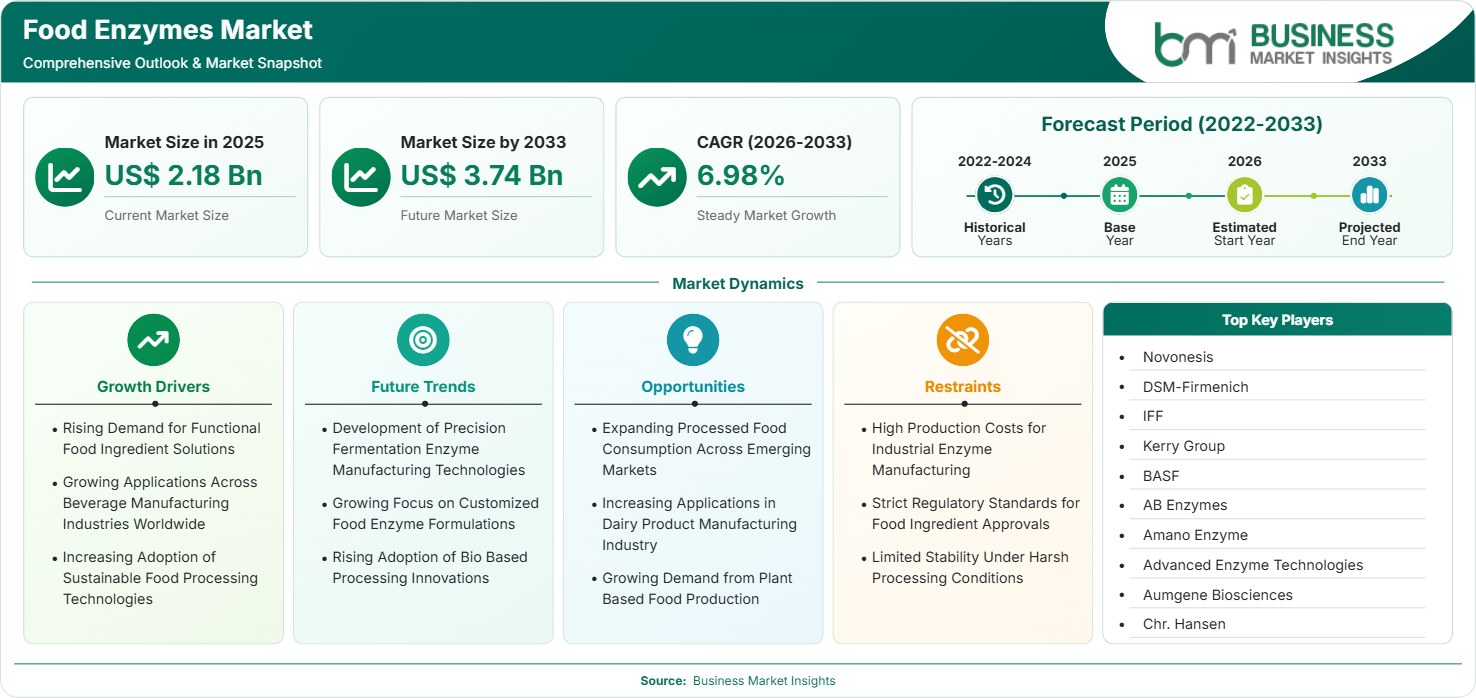
The Food Enzymes Market size was valued at US$ 2.18 billion in 2025 and is projected to reach US$ 3.74 billion by 2033, growing at a CAGR of 6.98% during 2026–2033. Growth is driven by clean-label food demand, sustainable processing adoption, enzyme innovation, and rising applications across bakery, dairy, beverages, and functional food manufacturing.

Report Coverage
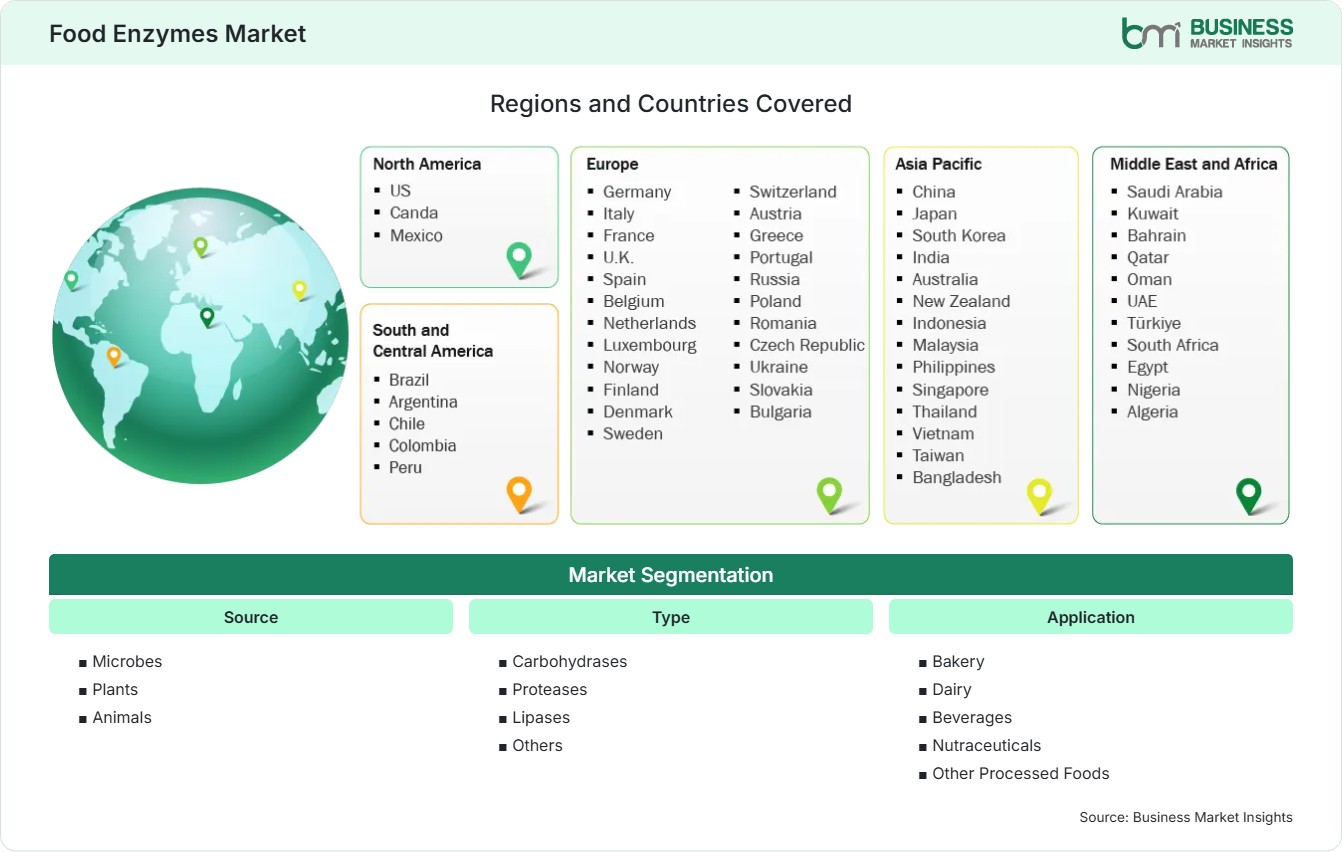
  • Source: Microbes, Plants, Animals
  • Type: Carbohydrases, Proteases, Lipases, Others
  • Application: Bakery , Dairy , Beverages , Nutraceuticals, Other Processed Foods
US$ 2.18 Bn Market size in 2025
US$ 3.74 Bn Market Size by 2033
6.98% CAGR, 2026 - 2033
2026-2033 Forecast Period

AI Overview

Food Enzymes Market Summary

  • North America Region: North America holds a 34%–37% share in 2025 and is projected to grow at a 6.3%–6.7% CAGR during 2026–2033. Growth is supported by advanced food manufacturing, biotechnology innovation, clean-label product demand, and sustainable processing adoption. The U.S. market benefits from strong research capabilities, established food processing industries, and increasing enzyme integration across bakery, dairy, and beverage applications.
  • Fastest Growing Region: Asia Pacific represents a 24%–27% share in 2025 and is expected to expand at a 7.8%–8.3% CAGR during 2026–2033. Growth is driven by expanding processed food consumption, rising disposable incomes, food manufacturing investments, and increasing biotechnology adoption across China, India, Japan, and Southeast Asian markets.
  • Leading Segment: Carbohydrases account for a 46%–49% share in 2025 and are projected to grow at a 7.0%–7.4% CAGR during 2026–2033. Adoption is supported by extensive use in bakery, beverage processing, starch conversion, and food manufacturing applications requiring improved efficiency and product consistency.
  • High Growth Segment: Dairy applications represent a 51%–54% share in 2025 and are expected to grow at a 7.5%–7.9% CAGR during 2026–2033. Expansion is supported by increasing demand for lactose management solutions, cultured dairy products, premium formulations, and functional nutrition products.
  • Key Market Opportunity: Growing demand for plant-based foods, functional ingredients, clean-label products, and sustainable manufacturing solutions is creating opportunities for enzyme producers developing specialized formulations for diverse food processing applications.
  • Major Market Players: Novonesis, DSM-Firmenich, International Flavors & Fragrances Inc., Kerry Group plc, BASF SE, AB Enzymes GmbH, Amano Enzyme Inc., Advanced Enzyme Technologies Limited, Aumgene Biosciences Private Limited, and Chr. Hansen Holding A/S.
Strategic Insights

Food Enzymes Market: Strategic Insights

Food Enzymes Market Strategic Framework
FREE PDF
Request your free sample
Request free sample
Stakeholder View

Key Takeaways

  • Food enzyme manufacturers are strengthening ecosystem partnerships across biotechnology research, ingredient production, and food processing industries to improve innovation capabilities and application-specific solutions.
  • Bakery, dairy, beverage, and plant-based food categories represent high-potential areas as manufacturers seek improved product quality, processing efficiency, and sustainable production methods.
  • Enzyme development is increasingly focused on precision fermentation, microbial optimization, and advanced formulation techniques that improve functionality across diverse food manufacturing processes.
  • Asia Pacific provides attractive investment potential due to expanding food processing infrastructure, increasing consumer demand, and growing adoption of biotechnology-based ingredients.
  • Strategic collaborations, technology partnerships, and research investments are becoming important competitive strategies among leading enzyme companies seeking broader market penetration.
  • Companies focusing on sustainable manufacturing, customized enzyme solutions, and application-focused innovation are better positioned to address evolving food industry requirements.
Geographic Outlook

Food Enzymes Market Regional Highlights

North America Food Enzymes Market

North America accounted for a 34%–37% share in 2025 and is expected to grow at a 6.3%–6.7% CAGR during 2026–2033. The region benefits from established food manufacturing infrastructure, strong biotechnology research, and high adoption of advanced processing solutions. Increasing demand for premium foods, sustainable ingredients, and clean-label formulations continues supporting regional expansion. Increasing demand for premium foods, sustainable ingredients, and clean-label formulations continues supporting Food Enzymes Market share across regional food processing industries.

  • The United States remains the dominant contributor due to advanced research capabilities, strong food processing industries, and increasing enzyme adoption across commercial applications.
  • Canada supports regional growth through expanding food innovation initiatives, sustainable manufacturing practices, and growing demand for specialty food ingredients.
  • Food manufacturers are increasingly integrating enzymes to improve efficiency, reduce waste, and enhance product consistency across large-scale production facilities.
  • Biotechnology investments continue encouraging development of advanced enzyme formulations designed for specific food processing requirements.

US Food Enzymes Market

The United States represented a 72%–75% share of North America in 2025 and is projected to expand at a 6.4%–6.8% CAGR during 2026–2033. Strong biotechnology capabilities, established food processing companies, and increasing demand for functional food solutions support domestic market advancement.

  • Rising adoption of clean-label ingredients encourages manufacturers to utilize enzymes for improving food quality and processing performance.
  • Research collaborations between biotechnology firms and food companies support development of innovative enzyme-based solutions.
  • Growing demand for healthier packaged foods continues expanding enzyme applications across bakery, dairy, and beverage industries.

Europe Food Enzymes Market

Europe accounted for a 29%–32% Food Enzymes Market share in 2025 and is anticipated to grow at a 6.1%–6.5% CAGR during 2026–2033. Strong regulatory frameworks, biotechnology expertise, and sustainability initiatives support enzyme adoption. Germany leads regional demand, while Poland demonstrates increasing growth potential through expanding food manufacturing capabilities.

  • European manufacturers emphasize sustainable processing technologies to improve resource efficiency and reduce production impact.
  • Demand for clean-label and natural food products continues encouraging enzyme innovation across multiple applications.
  • Advanced research capabilities support development of customized solutions for specialized food processing requirements.
  • Strategic partnerships between ingredient companies and food producers strengthen regional commercialization opportunities.

Asia Pacific Food Enzymes Market

Asia Pacific represented a 24%–27% share in 2025 and is projected to achieve the highest growth rate of 7.8%–8.3% CAGR during 2026–2033. Expanding food production, rising urbanization, and increasing biotechnology investments support regional development. China leads the Food Enzymes Market, while India demonstrates strong expansion potential.

  • Increasing processed food consumption is encouraging manufacturers to adopt enzyme technologies for improved production efficiency.
  • Growing investments in food processing infrastructure create opportunities for enzyme suppliers across emerging economies.
  • Regional biotechnology initiatives support development of localized enzyme manufacturing capabilities.
  • International companies are strengthening partnerships to expand distribution and customer support networks.

Rest of World Food Enzymes Market

Rest of World accounted for a 10%–13% share in 2025 and is expected to grow at a 6.6%–7.1% CAGR during 2026–2033. South and Central America are supported by expanding processed food industries, while Middle East and Africa markets benefit from investments in food production modernization.

  • Brazil continues increasing enzyme adoption through expanding bakery, beverage, and processed food manufacturing activities.
  • Middle Eastern countries are investing in domestic food production capabilities, encouraging advanced ingredient adoption.
  • South Africa demonstrates rising demand for efficient food processing technologies and biotechnology solutions.
  • International suppliers are improving regional accessibility through partnerships and localized distribution strategies.
Global Market Geography
FREE PDF
Request your free sample
Request free sample
Segment Analysis

Food Enzymes Market Segmentation

Source

The Source segment plays a critical role in determining enzyme functionality, production scalability, and application suitability across food processing industries. The segment accounted for approximately 44%–47% Food Enzymes Market share in 2025 and is projected to expand at a 7.2%–7.6% CAGR during 2026–2033. Advancements in biotechnology continue improving enzyme production efficiency and commercial availability.

  • Microbes: Microbial sources dominate commercial enzyme production due to scalable fermentation processes, consistent quality, and extensive application across bakery, dairy, beverages, and processed food industries.
  • Plants: Plant-based enzyme sources are gaining attention due to rising demand for natural ingredients, clean-label formulations, and specialized food processing applications.
  • Animals: Animal-derived enzymes continue supporting selected food applications where established functionality, processing reliability, and product quality remain important considerations.

Type

The Type segment reflects increasing diversification of enzyme applications across food manufacturing operations. It accounted for approximately 46%–49% share in 2025 and is expected to grow at a 7.0%–7.4% CAGR during 2026–2033. Manufacturers are investing in specialized enzymes to improve processing efficiency, product consistency, and formulation performance. The Food Enzymes Market scope continues expanding through broader adoption across diverse food manufacturing categories.

  • Carbohydrases: Carbohydrases represent a leading enzyme category due to extensive usage in bakery, beverages, starch processing, and applications requiring improved carbohydrate conversion efficiency.
  • Proteases: Proteases support protein modification, texture improvement, flavor enhancement, and digestibility improvements across dairy, nutritional products, and processed food manufacturing.
  • Lipases: Lipases enable fat modification, flavor development, and texture enhancement, supporting innovation across bakery, dairy, and premium food applications.
  • Others: Other enzyme categories address specialized processing requirements, ingredient optimization, and emerging applications requiring customized functionality.

Application

The Application segment remains a major growth contributor as food manufacturers increasingly adopt enzymes to improve quality, efficiency, and product differentiation. The segment represented approximately 51%–54% share in 2025 and is projected to grow at a 7.5%–7.9% CAGR during 2026–2033. The Food Enzymes Market forecast remains positive as broader adoption across bakery, dairy, beverages, nutraceuticals, and processed food categories continues expanding.

  • Bakery: Bakery manufacturers utilize enzymes to improve dough performance, texture, freshness, processing efficiency, and consistency across commercial baked products.
  • Dairy: Dairy producers increasingly apply enzymes to support fermentation, lactose management, texture optimization, and development of innovative dairy formulations.
  • Beverages: Beverage manufacturers use enzymes to improve extraction efficiency, fermentation performance, clarification, and quality consistency across multiple beverage categories.
  • Nutraceuticals: Nutraceutical producers adopt enzyme technologies to improve ingredient functionality, nutritional value, and development of health-oriented food products.
  • Other Processed Foods: Processed food manufacturers integrate enzyme solutions to enhance production efficiency, improve ingredient utilization, and strengthen product quality across various categories.
Market Forces

Food Enzymes Market Dynamics

Key Market Drivers

Rising Demand for Functional Food Ingredient Solutions

The growing consumer awareness of healthy food options is motivating manufacturers to develop nutritionally rich food products. Enzymes help food processors increase the efficiency of their production processes, enhance ingredient performance, and develop cleaner-label food products. The rising popularity of premium, nutritious, and naturally processed food items and ingredients is shaping the Food Enzymes Market trends across the global food industry. Manufacturers are targeting the use of enzymes to develop application-specific food products of higher quality and to support efficient manufacturing processes. Food processors are also adopting enzyme technologies to develop differentiated food products and address the rising demand for health-enriched food products.

Growing Applications Across Beverage Manufacturing Industries Worldwide

Beverage makers are resorting to enzymes to improve their fermentation and extraction processes and enhance product uniformity. The rising demand for fruit-based, functional, and fermented beverages prompts beverage companies to use sophisticated enzyme technology in their operations. With the help of such enzyme technology, beverage makers can develop effective production systems and new product formulations tailored to consumer preferences. The reason enzymes are gaining popularity in the beverage industry is that they help achieve better clarity, improved flavor, and more efficient ingredient use.

Increasing Adoption of Sustainable Food Processing Technologies

The desire to be sustainable has driven food processors to develop technologies that help them conserve energy and operate more efficiently during processing. The use of enzymes ensures energy conservation during processing, efficient use of ingredients, and low processing waste. An increased focus on responsible production processes has made it easier for food manufacturers to implement technologies that help them achieve their sustainability targets while meeting food quality requirements. More companies are beginning to consider enzyme technology as part of their processes to ensure sustainable production cycles. Enzymes' potential to maximize efficiency in raw materials and processing conditions is increasing demand from responsible manufacturers.

Key Market Opportunities

Expanding Processed Food Consumption Across Emerging Markets

The trends of rising urbanization, increased disposable income, and shifts in dietary preferences are driving the demand for processed foods in the developing economies. Food producers are upgrading their manufacturing systems to meet the growing demand for convenience and high-quality food products. All these trends open avenues for enzyme producers to develop customized solutions for manufacturing and food-processing needs. There is also an increase in the availability of modern distribution and packaged foods in developing economies, which motivates food producers to enhance their production systems by using innovative ingredients.

Increasing Applications in Dairy Product Manufacturing Industry

In this regard, dairy producers are using enzymes in their processes to formulate new products with better nutritional quality, improved texture, and more efficient production. There are various demands for products such as lactose-free and cultured dairy products, which create scope for advanced enzymes. The development of advanced enzymes for customized dairy products is encouraged by international innovations in the dairy manufacturing sector. Moreover, the increased use of functional dairy products is prompting dairy producers to explore advanced enzyme applications to make their products more attractive and digestible.

Growing Demand from Plant Based Food Production

The growth of plant-based food segments is creating many new opportunities for enzyme development. Enzymes are currently being employed by food manufacturers to enhance the functionality, texture, and sensory properties of plant-based foods. The growing consumer interest in alternative proteins and sustainable food sources has prompted increased investment in enzyme-based solutions for future food formulations. More and more manufacturers of plant-based foods are seeking innovative enzyme-based technologies to address formulation issues related to taste, texture, and ingredient functionality.

Market Restraints and Challenges

High Production Costs for Industrial Enzyme Manufacturing

Factor: The production of industrial enzymes entails sophisticated biotechnology, fermentation process, research, and a stringent quality control system. Impact: This makes production more expensive and could hinder the application by small-scale food processors with limited capacity to invest. High production costs may affect companies' pricing policies, as it is difficult for them to focus on cost-effective ingredients rather than sophisticated processing technologies. In addition, consistent production of enzymes requires sustained investment in research, production, and facilities. Small firms find it difficult to compete with large firms that have better production facilities and technology.

Strict Regulatory Standards for Food Ingredient Approvals

Factor: Food enzymes manufacturers should adhere to complex regulations regarding safety assessment, ingredient approval, labeling, and food standards globally. Effect: The complexity of regulations could delay the commercialization process of food enzymes, making it costly and difficult to enter the market. Companies will have to implement elaborate validation processes and possess regulatory knowledge to successfully launch innovative enzyme formulations across various geographic markets. Variations in the approval process across geographic locations can be another challenge for companies venturing into new markets.

Company Analysis

Competitive Landscape

The Food Enzymes Market analysis highlights increasing competition among biotechnology companies, ingredient manufacturers, and food technology providers. Market leaders are focusing on enzyme innovation, sustainable production methods, strategic partnerships, and customized solutions to strengthen their position across bakery, dairy, beverage, and processed food applications.

Company Name

Overview

Products and Services relevant to this market

Novonesis

Novonesis develops biotechnology solutions focused on enzymes, microbial technologies, and sustainable food applications globally.

Provides food enzymes supporting bakery, dairy, beverages, fermentation, and food processing efficiency.

DSM-Firmenich

DSM-Firmenich delivers nutrition, health, and ingredient solutions for global food and beverage industries.

Offers enzyme solutions for baking, dairy processing, fermentation, and food innovation applications.

International Flavors & Fragrances Inc.

International Flavors & Fragrances Inc. develops specialty ingredients and bioscience solutions for food manufacturers.

Provides enzyme technologies supporting food processing, flavor enhancement, and nutritional applications.

Kerry Group plc

Kerry Group plc supplies taste, nutrition, and ingredient solutions for food and beverage producers.

Offers integrated enzyme and ingredient solutions supporting bakery, dairy, and beverage manufacturing.

BASF SE

BASF SE develops science-based solutions across industrial and consumer markets.

Provides biotechnology-related solutions supporting food processing efficiency and ingredient functionality.

AB Enzymes GmbH

AB Enzymes GmbH specializes in industrial enzyme development and biotechnology solutions.

Supplies food enzymes for baking, beverages, cereals, and food processing applications.

Amano Enzyme Inc.

Amano Enzyme Inc. develops enzyme solutions for food and industrial applications.

Provides specialized enzymes supporting food quality, processing performance, and nutritional applications.

Advanced Enzyme Technologies Limited

Advanced Enzyme Technologies Limited focuses on biotechnology-based enzyme development and manufacturing.

Supplies enzyme solutions supporting food processing, nutrition enhancement, and ingredient functionality.

Aumgene Biosciences Private Limited

Aumgene Biosciences Private Limited develops biotechnology solutions and enzyme products.

Provides customized enzyme solutions for food processing and fermentation applications.

Chr. Hansen Holding A/S

Chr. Hansen Holding A/S develops bioscience solutions for food quality and fermentation.

Offers enzyme and biotechnology solutions supporting dairy and food processing applications.

Trust & Transparency

Research Methodology

The market analysis combines proprietary research with secondary data from government agencies, company disclosures, regulatory filings, industry databases and expert interviews. Market estimates are validated through data triangulation, cross-market benchmarking and analyst review.

View Full Research Methodology

Questions Answered

Frequently Asked Questions

What does the Food Enzymes Market report indicate about future competition?

The report indicates that future competition will focus on biotechnology innovation, customized enzyme development, manufacturing scalability, and strategic partnerships. Companies strengthening research capabilities, expanding application-focused solutions, and improving sustainability performance are expected to enhance their competitive positioning.

Why are sustainable food processing methods creating new opportunities for enzyme solutions?

Sustainable processing approaches are encouraging manufacturers to adopt enzyme technologies that reduce resource consumption, improve ingredient utilization, and support environmentally responsible production. Enzymes help companies optimize manufacturing efficiency while meeting increasing demand for naturally processed, high-quality, and sustainable food products.

How are biotechnology advancements influencing Food Enzymes Market adoption?

Advanced biotechnology developments are improving enzyme performance through microbial engineering, fermentation optimization, and customized formulation approaches. These innovations allow manufacturers to achieve better processing outcomes, improve sustainability, and develop application-specific enzyme solutions that address evolving food industry requirements.

Which applications present the strongest opportunity in the market?

Bakery, dairy, beverages, nutraceuticals, and plant-based food production represent strong opportunities due to rising demand for functional ingredients, improved food quality, and efficient manufacturing processes. These applications require advanced enzyme solutions to enhance texture, nutritional value, processing performance, and product differentiation.

What factors are improving return on investment in the market?

Increasing adoption of sustainable processing methods, improved manufacturing efficiency, reduced ingredient waste, and growing demand for clean-label solutions are improving return on investment. Enzyme technologies enable food manufacturers to optimize production processes, enhance product consistency, and develop innovative formulations across bakery, dairy, beverage, and processed food categories.

Access the Full Food Enzymes Market Report

Get segment-level forecasts, regional estimates, competitive benchmarking, company profiles and downloadable Excel datasets.

Access the full Food Enzymes Market Report
350 pages PDF & Excel | 2026-08-25
Similar Research

Related Market Reports