
Food Intolerance Products Market Outlook: Size, Share, Trends, Growth Analysis, Competitive Landscape & Forecast, 2026-2033

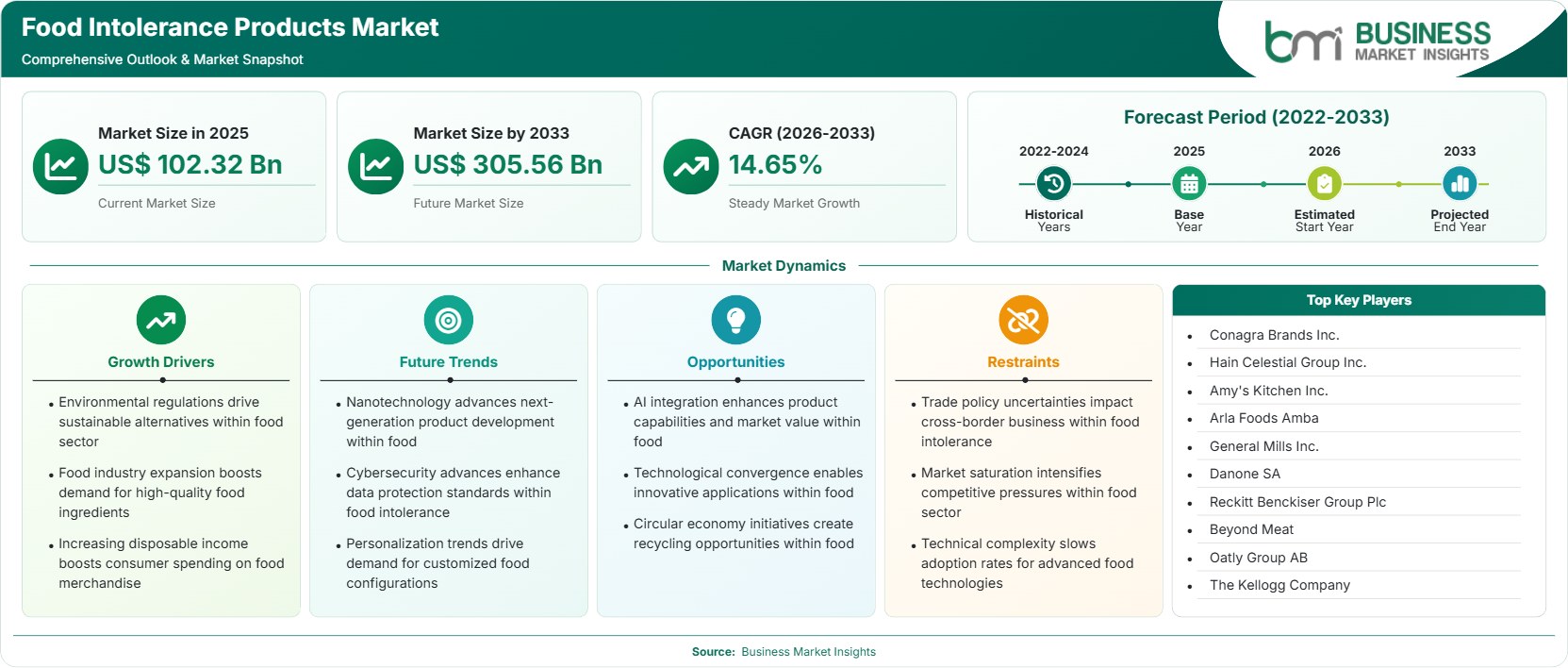
The Food Intolerance Products Market size was valued at US$ 102.32 Billion in 2025 and is projected to reach US$ 305.56 Billion by 2033, growing at a CAGR of 14.65% during 2026–2033. Rising diagnosis of food sensitivities, growing consumer preference for specialized nutrition, expanding plant-based innovation, and increasing retail penetration of allergen-free products continue to create substantial growth opportunities across global consumer markets.

Report Coverage
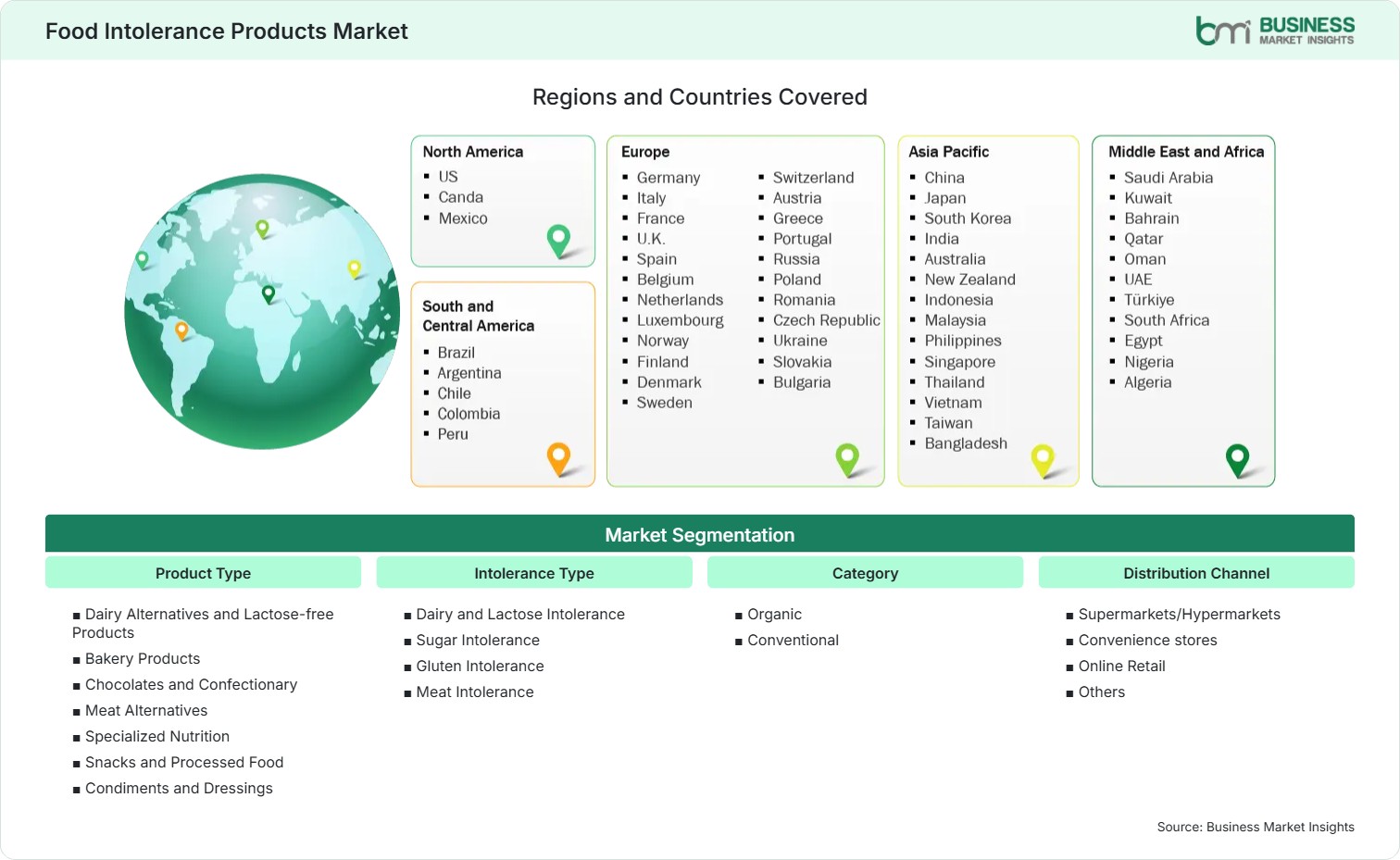
  • Product Type: Dairy Alternatives and Lactose-free Products, Bakery Products, Chocolates and Confectionary, Meat Alternatives, Specialized Nutrition, Snacks and Processed Food, Condiments and Dressings
  • Intolerance Type: Dairy and Lactose Intolerance, Sugar Intolerance, Gluten Intolerance, Meat Intolerance
  • Category (Organic , Conventional),
  • Distribution Channel: Supermarkets/Hypermarkets, Convenience stores, Online Retail, Others
US$ 102.32 Bn Market size in 2025
US$ 305.56 Bn Market Size by 2033
14.65% CAGR, 2026 - 2033
2026-2033 Forecast Period

AI Overview

Food Intolerance Products Market Summary

  • North America Region: North America holds a market share of 34%–37% in 2025, growing with a CAGR of 13.0%–14.0% during 2026–2033. Growth is supported by high awareness of dietary sensitivities, premium product adoption, advanced retail infrastructure, stronger labeling regulations, and expanding lactose-free and gluten-free product portfolios across mainstream channels. The U.S. market remains dominant, supported by widespread functional food adoption and a projected CAGR of 13.5%–14.5% through 2033.
  • Fastest Growing Region: Asia Pacific accounts for 24%–27% share in 2025 and is expected to expand at a CAGR of 16.5%–18.0% during 2026–2033. Rising disposable incomes, urban dietary shifts, growing digestive health awareness, expanding e-commerce penetration, and increasing availability of specialized nutritional products are accelerating regional demand.
  • Leading Segment: Dairy Alternatives and Lactose-free Products command 30%–33% share in 2025 and are projected to grow at 14.0%–15.0% CAGR during 2026–2033. Increasing lactose intolerance prevalence, broader plant-based consumption, retail shelf expansion, and continuous product innovation support sustained category leadership globally.
  • High Growth Segment: Meat Alternatives represent 12%–15% share in 2025 and are forecast to grow at 17.0%–19.0% CAGR during 2026–2033. Consumer interest in sustainable nutrition, allergen-conscious diets, product quality improvements, and investments in alternative protein technologies continue driving category expansion.
  • Key Market Opportunity: Expansion of personalized nutrition platforms integrating digestive health diagnostics, digital dietary recommendations, and specialized food formulations offers significant opportunities for manufacturers targeting highly customized intolerance management solutions globally.
  • Major Market Players: Conagra Brands, Inc.; The Hain Celestial Group, Inc.; Amy's Kitchen, Inc.; Arla Foods amba; General Mills, Inc.; Danone S.A.; Reckitt Benckiser Group plc; Beyond Meat, Inc.; Oatly Group AB; Kellanova.
Strategic Insights

Food Intolerance Products Market: Strategic Insights

Food Intolerance Products Market Strategic Framework
FREE PDF
Request your free sample
Request free sample
Stakeholder View

Key Takeaways

  • The value chain is increasingly integrated, with ingredient suppliers, diagnostic providers, food manufacturers, and retailers collaborating to improve specialized nutrition accessibility and product traceability.
  • Dairy-free, lactose-free, and alternative protein categories offer the highest commercial upside due to broad consumer acceptance and recurring consumption patterns.
  • Innovation is shifting toward clean-label formulations, microbiome-supportive ingredients, enhanced protein functionality, and personalized dietary solutions.
  • Asia Pacific presents one of the strongest investment cases due to rising health awareness, growing middle-class populations, and expanding modern retail infrastructure.
  • Strategic acquisitions are increasingly targeting plant-based brands, specialty nutrition firms, and ingredient technology companies to accelerate portfolio diversification.
  • E-commerce platforms are becoming critical growth channels, enabling brands to educate consumers and efficiently reach niche dietary segments.
Geographic Outlook

Food Intolerance Products Market Regional Highlights

North America Food Intolerance Products Market

North America accounts for 34%–37% share in 2025 and is projected to expand at a 13.0%–14.0% CAGR during 2026–2033. Strong healthcare awareness, mature retail ecosystems, and favorable product labeling frameworks support demand. The region maintains the highest Food Intolerance Products Market share, driven by premium product adoption and extensive availability across supermarkets, specialty stores, and digital channels.

  • Growing prevalence of lactose sensitivity continues encouraging manufacturers to launch innovative dairy-free beverages, yogurts, and nutritional products across multiple consumer demographics.
  • Regulatory emphasis on ingredient disclosure strengthens consumer trust and promotes adoption of specialized dietary products throughout mainstream retail networks.
  • Premiumization trends support higher spending on organic, allergen-free, and functional nutrition offerings among health-conscious households.
  • Retailers continue expanding dedicated shelf space for specialty nutrition products, improving product visibility and consumer accessibility.
  • Investment in alternative protein technologies supports long-term category development and portfolio diversification.

US Food Intolerance Products Market

The U.S. represents 74%–78% of North American revenue in 2025 and is forecast to grow at a 13.5%–14.5% CAGR through 2033. Strong consumer education, widespread healthcare engagement, and expanding plant-based food adoption continue supporting robust demand. Innovation pipelines remain highly active across lactose-free dairy, gluten-free foods, and specialized nutrition categories.

  • Large-scale food manufacturers increasingly invest in allergen-free formulations to meet evolving dietary preferences and regulatory expectations.
  • Direct-to-consumer distribution channels improve market reach and strengthen consumer engagement with specialized dietary solutions.
  • Functional nutrition products targeting digestive wellness gain increasing traction among health-focused consumers.
  • Retail partnerships accelerate commercialization of emerging product categories and improve nationwide accessibility.

Europe Food Intolerance Products Market

Europe captures 28%–31% share in 2025 and is anticipated to grow at a 13.5%–14.5% CAGR during 2026–2033. Strong food labeling regulations, rising demand for clean-label products, and established plant-based food ecosystems support expansion. Germany remains the largest market, while Spain and Poland emerge among the fastest-growing countries with estimated growth rates exceeding regional averages.

  • Plant-based dairy alternatives continue gaining widespread acceptance across both mainstream and specialty retail channels.
  • Regulatory frameworks encouraging transparent ingredient disclosure strengthen confidence among consumers managing food sensitivities.
  • Organic specialized nutrition products experience strong demand growth across Western European markets.
  • Investments in sustainable food production enhance product differentiation and brand positioning.
  • Innovation in functional ingredients supports premium product development across multiple categories.

Asia Pacific Food Intolerance Products Market

Asia Pacific holds 24%–27% share in 2025 and is expected to record a 16.5%–18.0% CAGR during 2026–2033, making it the fastest-growing regional market. Rapid urbanization, increasing disposable incomes, and greater awareness of digestive health support expansion. China remains the largest regional market, while India and Southeast Asian economies exhibit the strongest growth momentum.

  • E-commerce penetration significantly improves accessibility of specialty dietary products across urban and semi-urban populations.
  • Rising healthcare awareness encourages greater adoption of lactose-free and gluten-free nutritional solutions.
  • Local manufacturers increasingly introduce culturally relevant formulations tailored to regional dietary preferences.
  • Growing middle-class populations support higher spending on premium health and wellness products.
  • Expansion of modern retail infrastructure improves distribution efficiency and product visibility.

Rest of World Food Intolerance Products Market

Rest of World contributes 9%–12% share in 2025 and is projected to expand at a 14.0%–15.5% CAGR through 2033. South & Central America benefits from improving consumer awareness and retail modernization. Middle East & Africa growth is supported by rising healthcare engagement and increasing demand for premium nutritional products.

  • Brazil remains the leading South & Central American market, supported by growing health-conscious consumer populations.
  • Mexico demonstrates strong category expansion through increasing retail penetration and product availability.
  • GCC countries exhibit rising demand for premium imported specialized nutrition products.
  • South Africa continues attracting investments in health-oriented food manufacturing and distribution.
  • Digital commerce platforms support broader regional accessibility and consumer education initiatives.
Global Market Geography
FREE PDF
Request your free sample
Request free sample
Segment Analysis

Food Intolerance Products Market Segmentation

Product Type

This segment accounts for the largest revenue contribution, with Dairy Alternatives and Lactose-free Products leading adoption. The category collectively represents approximately 30%–33% share in 2025 and is expected to expand at 14.0%–15.0% CAGR. The Food Intolerance Products Market scope continues broadening through innovation in plant-based ingredients, functional nutrition, and allergen-free formulations.

  • Dairy Alternatives and Lactose-free Products: Rising lactose sensitivity awareness and plant-based consumption patterns support sustained product demand across diverse demographic groups.
  • Bakery Products: Gluten-free and allergen-conscious bakery innovations continue expanding consumer choice while improving taste and nutritional profiles.
  • Chocolates and Confectionary: Manufacturers increasingly utilize alternative ingredients to develop indulgent products suitable for intolerance-sensitive consumers.
  • Meat Alternatives: Alternative protein technologies support expanding adoption among consumers seeking digestive-friendly and sustainable dietary solutions.
  • Specialized Nutrition: Personalized nutritional formulations address specific dietary restrictions while supporting overall wellness objectives.
  • Snacks and Processed Food: Convenient intolerance-friendly snack formats gain popularity among busy consumers seeking healthier dietary options.
  • Condiments and Dressings: Reformulated products reduce allergen exposure while maintaining flavor profiles preferred by mainstream consumers.

Intolerance Type

Dairy and Lactose Intolerance remains the dominant Food Intolerance Products Market category, representing approximately 38%–42% share in 2025 and advancing at 14.0%–15.0% CAGR. Growing diagnosis rates and widespread consumer awareness support category expansion, while manufacturers continue diversifying product offerings to meet evolving dietary requirements.

  • Dairy and Lactose Intolerance: Strong demand for lactose-free milk, yogurt, and nutritional beverages supports sustained category leadership.
  • Sugar Intolerance: Reduced-sugar and alternative sweetener innovations create new opportunities for specialized food manufacturers.
  • Gluten Intolerance: Growing awareness of gluten-related sensitivities continues driving product innovation and retail expansion.
  • Meat Intolerance: Increasing interest in alternative protein consumption supports growth across plant-based nutritional categories.

Category

Conventional products maintain leadership with approximately 68%–72% share in 2025, while organic offerings demonstrate stronger growth potential. The segment is projected to expand at 13.5%–15.0% CAGR, supported by broader consumer acceptance and increasing availability across multiple retail channels.

  • Organic: Consumer preference for clean-label ingredients supports rising adoption of premium specialized nutrition products.
  • Conventional: Large-scale production capabilities and wider affordability continue supporting mainstream market penetration.

Distribution Channel

Supermarkets and hypermarkets account for approximately 42%–46% Food Intolerance Products Market share in 2025 and are projected to grow at 13.5%–14.5% CAGR. Retail expansion, merchandising improvements, and stronger consumer education initiatives continue supporting category growth and accessibility.

  • Supermarkets/Hypermarkets: Extensive product assortments and strong consumer visibility support category leadership across global markets.
  • Convenience Stores: Increasing availability of specialized nutrition products enhances impulse purchasing opportunities and accessibility.
  • Online Retail: The Food Intolerance Products Market trends increasingly favor digital channels due to convenience and broader product selection.
Market Forces

Food Intolerance Products Market Dynamics

Key Market Drivers

Increasing Global Prevalence of Food Sensitivities

Growing diagnoses of lactose intolerance, gluten sensitivity, and digestive disorders continue to support category demand. WHO's dietary health initiatives and expanding healthcare awareness programs encourage consumers to adopt specialized nutrition solutions. Research shows that lactose malabsorption is common worldwide, especially in Asia. The industry has reacted by developing varied product offerings that make their products available and affordable. More diagnostic capability is another factor contributing to the earlier detection of intolerance conditions, increasing the need for customized foods. Increased consumer awareness about digestive health has been a key factor.

Expansion of Plant-Based Ingredient Innovation

Ingredient technology advancements continue transforming specialized nutrition manufacturing. Alternative ingredient investments, such as oats, almonds, peas, and soy, among others, enhance both functional and sensory aspects of products. The dual nature of sustainable practices and nutritional requirements helps with the adoption of these alternatives. Firms rely more on research collaboration to come up with better formulations that not only enhance taste but are also nutritionally rich. This way, consumers are able to accept the products while at the same time increasing their usage areas.

Growing Retail and E-Commerce Penetration

Retail modernization significantly improves product visibility and accessibility. Shelf space for products that are tolerance-friendly is increasingly being allocated by supermarkets, and online channels help in creating wider distribution networks. Online channels provide an opportunity for education regarding products, ingredients, and suggestions. Greater customer engagement helps in increasing conversion rates and repurchases. An omnichannel strategy makes it even easier for consumers. Expansion of distribution infrastructure in developing nations is helping in making products accessible, which is aiding in their development.

Key Market Opportunities

Personalized Nutrition and Diagnostic Integration

Advances in health analytics create opportunities for personalized dietary management solutions. There is increased use of diagnosis and nutrition recommendation systems, which enable personalized food choices. Manufacturers have the ability to utilize such technologies to design personalized products according to their intolerance levels. Increasing consumer interest in the prevention of diseases will encourage the personalization of nutrition. Cooperation between healthcare organizations, technology companies, and food manufacturers will lead to innovations in this field. There is potential value that may be created by such an ecosystem.

Expansion Across Emerging Consumer Markets

Urbanization and disposable incomes grow in the Asia Pacific, Latin America, and the Middle East markets, which provide many opportunities for growth. Health education programs and an improved distribution network help to extend the product category. Multinational companies increasingly develop localized formulas in line with regional tastes and eating habits. Strategic investments in production facilities and distribution networks strengthen competitiveness. These dynamics create favorable conditions for long-term revenue generation while enhancing accessibility for previously underserved consumer groups.

Alternative Protein Commercialization

Alternative protein technology development creates attractive investment prospects. Continued product improvement in taste, texture, and nutrition further boosts acceptance by consumers. There is venture capital financing and company investment for the commercialization of products in various markets. The Food Intolerance Products Market Forecasts remain favorable as manufacturers increasingly diversify portfolios with innovative protein solutions. Expanding foodservice adoption further strengthens demand prospects. These developments position alternative proteins as a significant future growth avenue within specialized nutrition ecosystems.

Market Restraints and Challenges

Higher Product Pricing Compared with Conventional Foods

Factor: Specialized ingredients, dedicated manufacturing processes, and certification requirements increase production costs.

Impact: High retail prices may impede adoption among consumers who are price-sensitive especially those from developing countries. The cost pressures caused by inflation in the costs of production and transport pose another threat to profitability. There is a need for balancing cost with product quality. This becomes even more difficult in certain products because of the lack of economies of scale.

Complex Regulatory and Labeling Compliance Requirements

Factor: Diverse regulatory standards governing allergen claims, ingredient disclosure, and product certification create compliance complexity. Impact: Operating costs rise and development of products is done at a slower pace. Cross-border marketing is made difficult due to regional differences. Compliances require continual spending on quality testing and other related processes. Inconsistencies in regulation may also slow down innovation and the introduction of products. Compliance thus becomes an essential tool for remaining competitive and achieving international expansion goals.

Company Analysis

Competitive Landscape

The Food Intolerance Products Market analysis highlights strong competition among multinational food manufacturers and specialized nutrition providers focused on innovation, clean-label development, and expansion of intolerance-friendly product portfolios.

Company Name

Overview

Products and Services relevant to this market

Conagra Brands, Inc.

Major packaged food manufacturer with broad retail presence and expanding specialty nutrition portfolio.

Gluten-free meals, allergen-conscious foods, plant-based offerings, and packaged nutrition solutions.

The Hain Celestial Group, Inc.

Natural and organic food specialist serving health-conscious consumer segments globally.

Organic snacks, dairy-free products, specialty nutrition foods, and clean-label offerings.

Amy's Kitchen, Inc.

Pioneer in organic convenience foods with strong focus on dietary inclusivity.

Gluten-free meals, dairy-free products, soups, frozen foods, and snacks.

Arla Foods amba

Global dairy cooperative investing heavily in lactose-free and functional nutrition categories.

Lactose-free milk, dairy alternatives, nutritional beverages, and digestive wellness products.

General Mills, Inc.

Diversified food company with significant investments in specialty dietary categories.

Gluten-free cereals, snacks, nutritional products, and plant-based food offerings.

Danone S.A.

Global nutrition leader focused on health-oriented food and beverage innovation.

Dairy alternatives, specialized nutrition products, plant-based beverages, and functional foods.

Reckitt Benckiser Group plc

Consumer health company with growing nutrition and wellness portfolio.

Infant nutrition, digestive health products, and specialized nutritional solutions.

Beyond Meat, Inc.

Alternative protein specialist focused on plant-based meat innovation.

Plant-based meat products and protein solutions addressing dietary restrictions.

Oatly Group AB

Leading oat-based nutrition company with expanding international footprint.

Oat milk, dairy alternatives, nutritional beverages, and plant-based food products.

Kellanova

Global snacking company expanding presence in specialty dietary categories.

Gluten-free snacks, cereals, convenience foods, and specialized nutrition offerings.

Trust & Transparency

Research Methodology

The market analysis combines proprietary research with secondary data from government agencies, company disclosures, regulatory filings, industry databases and expert interviews. Market estimates are validated through data triangulation, cross-market benchmarking and analyst review.

View Full Research Methodology

Questions Answered

Frequently Asked Questions

What does a Food Intolerance Products Market Report typically evaluate?

A Food Intolerance Products Market Report generally examines industry structure, competitive positioning, regional demand patterns, emerging technologies, regulatory developments, and long-term growth opportunities.

What role does innovation play in market development?

Innovation improves product taste, texture, nutritional quality, and affordability, enabling wider adoption across diverse consumer demographics and dietary requirements.

Which region is growing the fastest?

Asia Pacific is projected to be the fastest-growing region, supported by urbanization, rising incomes, expanding e-commerce penetration, and increasing healthcare awareness.

Which product category dominates the market?

Dairy alternatives and lactose-free products currently represent the largest category due to widespread lactose intolerance prevalence and strong consumer acceptance.

What is driving demand for food intolerance products?

Growing diagnosis of lactose intolerance, gluten sensitivity, and digestive disorders, combined with increasing health awareness and improved product availability, are key factors supporting demand.

Access the Full Food Intolerance Products Market Report

Get segment-level forecasts, regional estimates, competitive benchmarking, company profiles and downloadable Excel datasets.

Access the full Food Intolerance Products Market Report
350 pages PDF & Excel | 2026-08-17
Similar Research

Related Market Reports