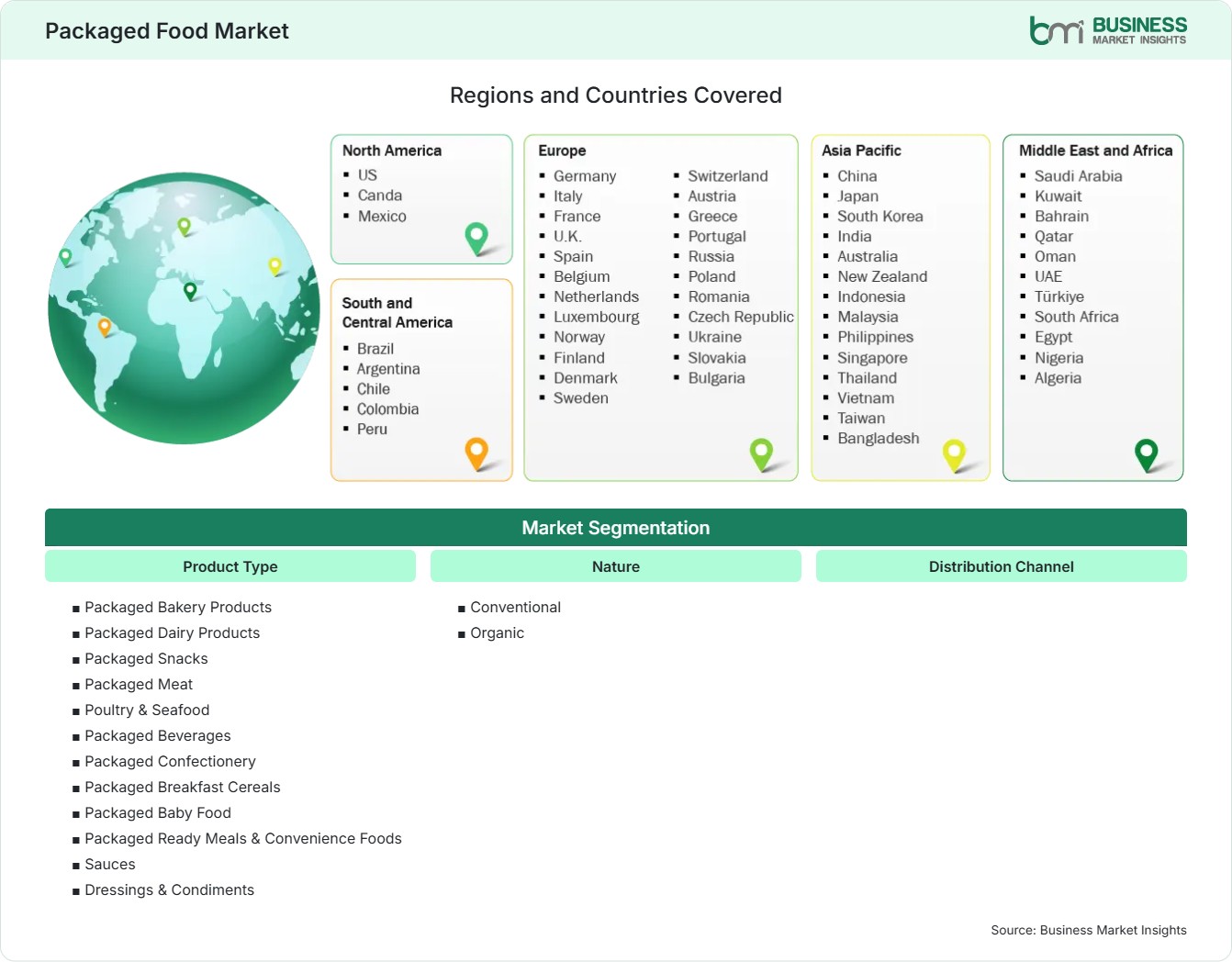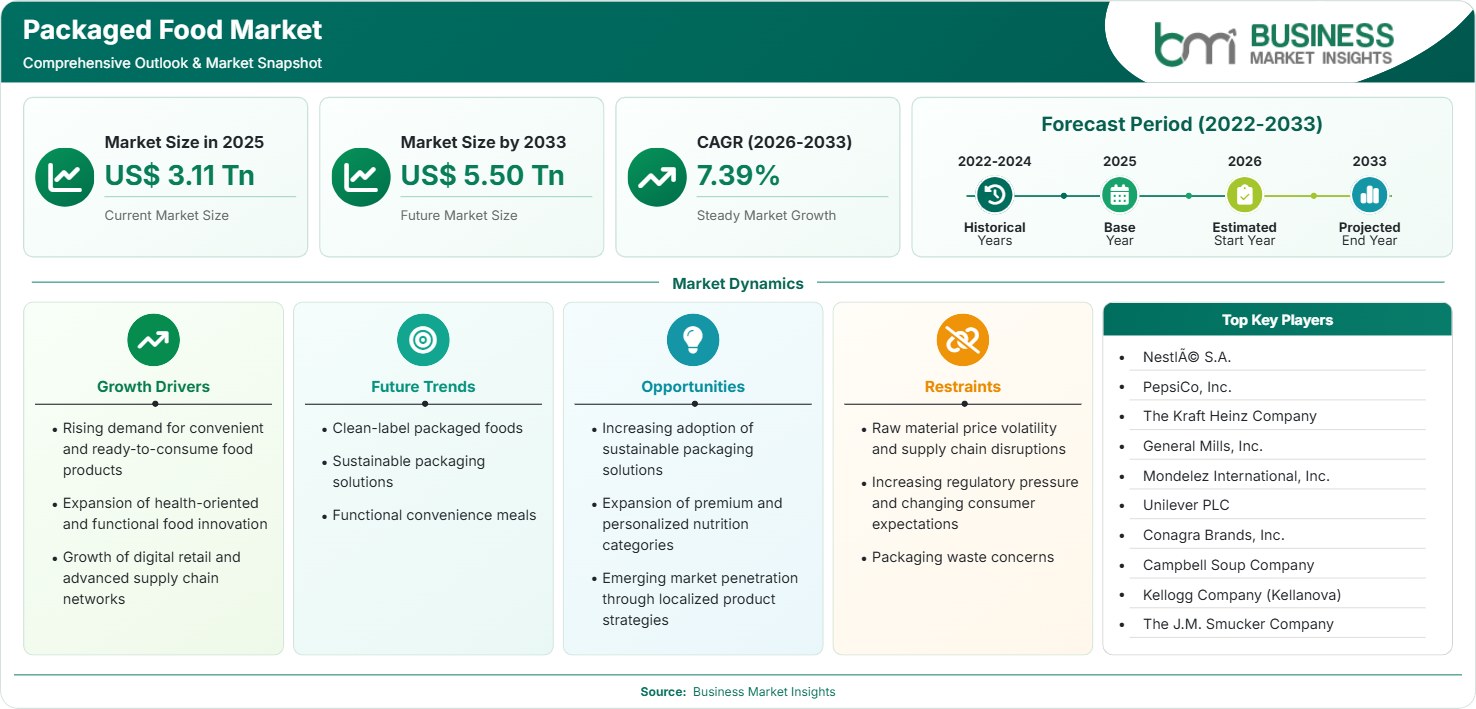
Packaged Food Market Regional Highlights
North America Packaged Food Market
North America represented approximately 33%–36% of the global market in 2025, supported by mature retail networks, strong brand presence, and high consumer acceptance of convenient packaged products. The region is projected to expand at a 6.2%–6.8% CAGR during 2026–2033. The Packaged Food Market share remains concentrated among established manufacturers.
- Consumer preference for functional foods, protein-enriched snacks, and reduced-sugar products is reshaping category strategies among manufacturers across the United States and Canada.
- Advanced retail infrastructure, including supermarkets, warehouse clubs, and digital grocery platforms, improves packaged food accessibility and strengthens omnichannel sales opportunities.
- Sustainability initiatives focused on recyclable materials, food waste reduction, and responsible sourcing are influencing packaging investments throughout the regional supply chain.
- Product reformulation programs addressing nutrition labeling requirements and changing dietary preferences continue supporting innovation across bakery, dairy, snacks, and ready meal categories.
US Packaged Food Market
The United States accounted for approximately 28%–31% of the global market in 2025 and is expected to grow at a 6.3%–6.9% CAGR between 2026 and 2033. The country remains the largest national market due to strong consumer purchasing power, extensive food manufacturing capabilities, and high adoption of convenience-oriented products. The Packaged Food Market growth in the US is supported by premiumization, and increasing demand for healthier alternatives.
- Large-scale food manufacturers continue investing in automated facilities, digital supply chains, and innovation centers to improve production efficiency and product differentiation.
- Consumers increasingly seek clean-label, organic, and functional products, encouraging manufacturers to reformulate traditional categories with improved nutritional profiles.
- Grocery delivery platforms and direct-to-consumer models are expanding product reach while enabling brands to collect consumer insights and optimize offerings.
Europe Packaged Food Market
Europe accounted for nearly 24%–27% of global revenue in 2025 and is projected to register a 5.8%–6.4% CAGR through 2033. Germany, the United Kingdom, France, and Italy remain major contributors due to developed food processing industries and strong retail ecosystems. Germany is expected to expand at 5.9%–6.5% CAGR, while the United Kingdom demonstrates growth of approximately 6.1%–6.7% CAGR driven by convenience products and sustainable food innovation.
- European manufacturers are accelerating clean-label product launches due to stricter consumer expectations around ingredients, transparency, and nutritional quality.
- Sustainability regulations are encouraging investments in recyclable packaging, lower-carbon production methods, and circular economy initiatives across food companies.
- Premium organic packaged products continue gaining traction as consumers prioritize environmentally responsible and ethically sourced food options.
- Germany maintains a strong manufacturing base, while the United Kingdom and France continue expanding innovative convenience food categories.
Asia Pacific Packaged Food Market
Asia Pacific held approximately 27%–30% of global revenue in 2025 and represents the fastest-growing regional market with a projected 8.3%–8.9% CAGR during 2026–2033. China, India, Japan, South Korea, and Southeast Asian economies are driving demand of packaged food market through urbanization, rising household incomes, and modern retail expansion. China is estimated to grow at 8.0%–8.6% CAGR, while India is projected to achieve approximately 9.0%–9.7% CAGR due to strong consumption growth.
- Expanding middle-class populations are increasing demand for packaged snacks, beverages, breakfast products, and convenient meal solutions.
- E-commerce platforms and quick-commerce services are rapidly improving packaged food availability across urban and semi-urban markets.
- Local manufacturers are introducing region-specific flavors, affordable product formats, and innovative packaging to capture diverse consumer segments.
- Rising investments in food processing infrastructure are strengthening domestic production capabilities across emerging Asian economies.
- Japan and South Korea continue influencing premium packaged food innovation through advanced processing technologies and health-focused product development.
Rest of World Packaged Food Market
Latin America, the Middle East, and Africa collectively represented approximately 10%–13% of the global market in 2025 and are expected to expand at a 7.0%–7.7% CAGR between 2026 and 2033. Brazil, Mexico, the United Arab Emirates, Saudi Arabia, and South Africa remain important growth markets due to retail modernization, and increasing packaged food adoption.
- Brazil and Mexico benefit from expanding food processing industries, growing supermarkets, and increasing consumption of packaged staples.
- Middle Eastern markets are witnessing stronger demand for halal-certified packaged foods, premium snacks, and imported food brands.
- African markets are gaining attention due to urban population growth, improving retail infrastructure, and increasing investments in local manufacturing.
- Latin American manufacturers are focusing on affordable product innovation to address diverse income groups and changing consumer preferences.
- Saudi Arabia, the UAE, and South Africa are emerging as strategic hubs for food processing investment and regional distribution.