Fresh Food Packaging Market Regional Highlights
North America Fresh Food Packaging Market
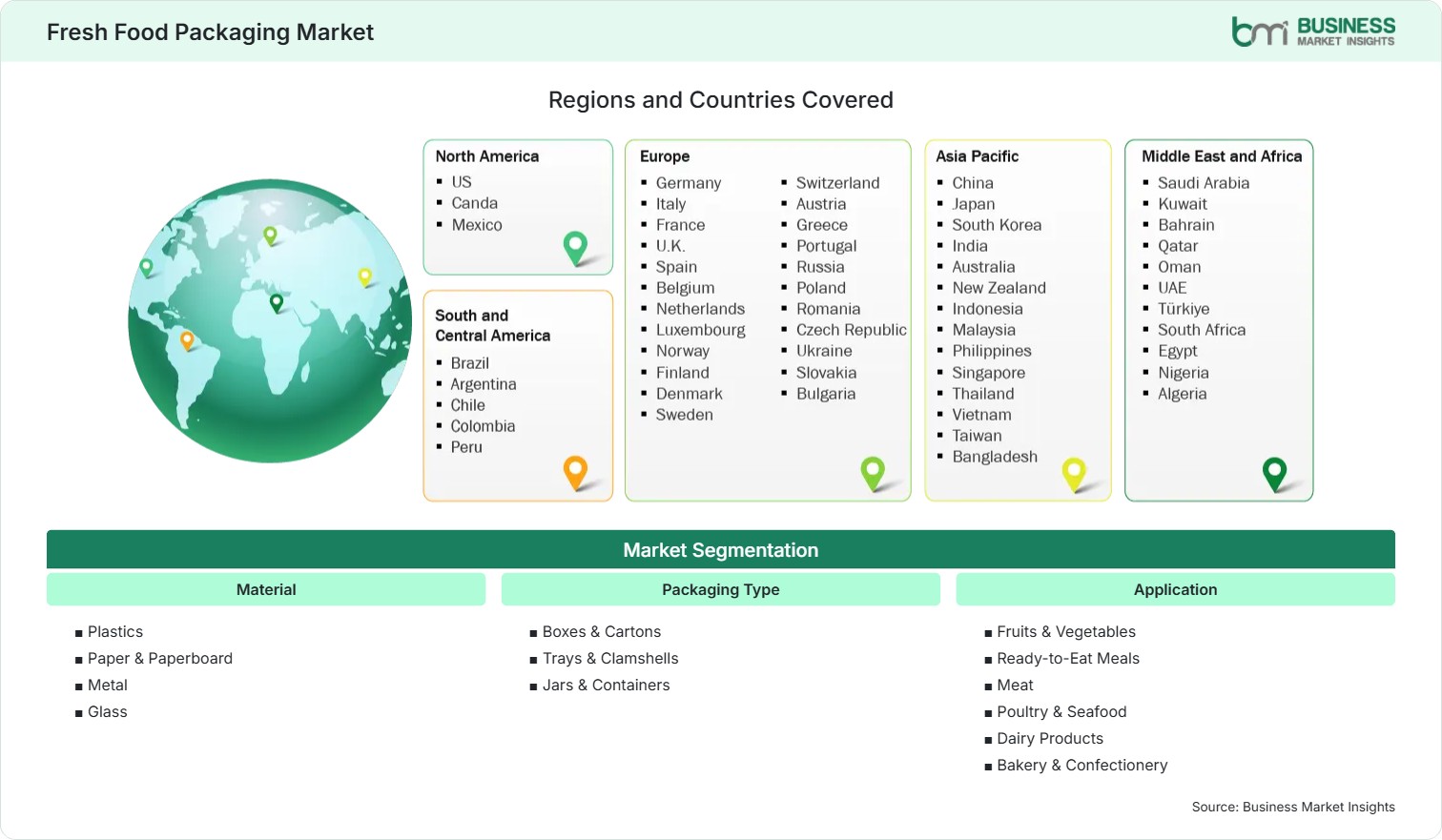
The North American Fresh Food Packaging Market held a 28%–31% share in 2025 and is expected to grow at a 6.3%–6.8% CAGR until 2033. The growth is attributed to fresh produce, meat, dairy products, ready meals, private-label supermarket products, and advanced cold-chain logistics. Packaging is more inclined towards recyclable materials, anti-leakage properties, tamper-proof and resealable features, and machine compatibility. Food contact is important because packaging materials that migrate into food products require appropriate approval in the US.
- Retail consolidation encourages standardized packaging platforms that can serve multiple product categories while reducing changeover requirements and inventory complexity.
- Fresh meat and seafood applications increasingly favor high-barrier trays and modified atmosphere structures that maintain product appearance and extend refrigerated shelf life.
- Food-to-go consumption supports lightweight wraps, fibre containers, resealable packs, and microwave-compatible formats across convenience retail and prepared-food channels.
- Sustainability commitments are accelerating downgauging, post-consumer recycled content, recyclable films, and fibre substitution where functional requirements permit.
US Fresh Food Packaging Market
The U.S. is predicted to hold a 22%-25% market share in the global market in 2025 and is forecast to have a CAGR of 6.2%-6.7% through 2033. Grocery retailers, food services, food processors, and private label manufacturers drive volume sales. Today's packaging requirements include barrier properties, recyclability, visual, merchandising, and anti-counterfeiting technology. FDA requirements mandate that the assessment of migration and approval be considered vital considerations for food-contact materials due to the development of new coatings, additives, and recycled materials.
- Prepared meals and convenience foods are increasing demand for microwaveable, resealable, portion-controlled, and high-visibility packaging formats.
- Fresh meat and poultry producers are adopting lightweight trays, high-barrier films, and modified atmosphere systems to balance product appearance with shelf-life requirements.
- Retailers increasingly evaluate packaging suppliers through sustainability metrics alongside cost, throughput, food safety, and supply reliability.
Europe Fresh Food Packaging Market
Europe accounted for 25%–28% of the market in 2025 and is anticipated to grow at a 6.5%–7.0% CAGR for the Fresh Food Packaging Market through 2033. Countries such as Germany, France, Italy, the UK, and Spain continue to be the main centers of demand, while Poland, along with other heavily manufacturing Central European countries, offers faster growth opportunities. Growing regulatory influence on recyclable, lighter, fiber-based, and mono-material packages is being observed. The European Commission has set August 12, 2026, as the general applicability date of PPWR provisions.
- Germany and France remain important markets for fresh produce, dairy, meat, and prepared-food packaging because of sophisticated retail and processing ecosystems.
- Poland is emerging as a higher-growth manufacturing and converting base, supported by food-processing investment and regional export activity.
- Fibre substitution is expanding, although wet, oily, and high-barrier foods still require technical coatings to maintain performance.
- European packaging suppliers increasingly develop recyclable formats that can operate on existing production machinery, limiting conversion costs for food manufacturers.
Asia Pacific Fresh Food Packaging Market
The Asia Pacific accounted for 31%-34% of market share in 2025 and is expected to grow at a CAGR of 8.0%-8.6% between 2026-2033, becoming the fastest-growing regional market. Leading regions driving demand include China, Japan, India, South Korea, and Australia, while India, Indonesia, and Vietnam offer growth opportunities. Factors contributing to growth include urbanization, organized retail, food delivery services, increased disposable income, and the development of cold chain facilities.
- China combines large food-processing capacity with advanced flexible packaging production, supporting rapid adoption of high-barrier films and modified atmosphere formats.
- India offers strong volume potential as organized grocery, quick commerce, packaged fresh foods, and modern cold-chain logistics expand across major cities.
- Japan and South Korea emphasize high-performance, compact, portion-controlled, and visually differentiated packaging for fresh meals, seafood, dairy, and convenience foods.
- Southeast Asian markets increasingly require moisture-resistant, lightweight, and transport-efficient formats because longer distribution networks increase packaging-performance requirements.
Rest of World Fresh Food Packaging Market
South America and Central America accounted for 8%-10% of total demand in 2025 and are projected to grow at a 6.8%-7.4% CAGR from 2025 to 2033. Brazil and Mexico lead the Fresh Food Packaging Market, whereas Chile and Colombia present good growth prospects. Exports of fresh fruits and vegetables, meat processing, the development of supermarkets, and the food service sector are creating demand for trays, films, cartons, and containers. Cold chain investments are upgrading performance requirements for packaging through longer domestic and export supply chains.
The Middle East and Africa accounted for around 6%-8% of total demand in 2025 and will witness a 7.1%-7.8% CAGR. Saudi Arabia, the UAE, South Africa, and Egypt are among the major markets for Fresh Food Packaging, and investment in food security and modern retail across Gulf countries will boost adoption of premium packaging solutions.
- Brazil and Mexico benefit from large food-processing industries and increasing modern retail penetration, supporting higher demand for standardized protective packaging.
- Chile and Colombia provide opportunities in export-oriented produce and seafood applications requiring transport durability and shelf-life control.
- Gulf countries are investing in food-security systems, refrigerated logistics, and modern retail, creating demand for reliable packaging suited to extended distribution.
- South Africa remains an important regional processing and retail hub, with opportunities for flexible, rigid, and fibre-based fresh-food packaging solutions.