
Fresh Yeast Market Outlook: Size, Share, Trends, Growth Analysis, Competitive Landscape & Forecast, 2026-2033

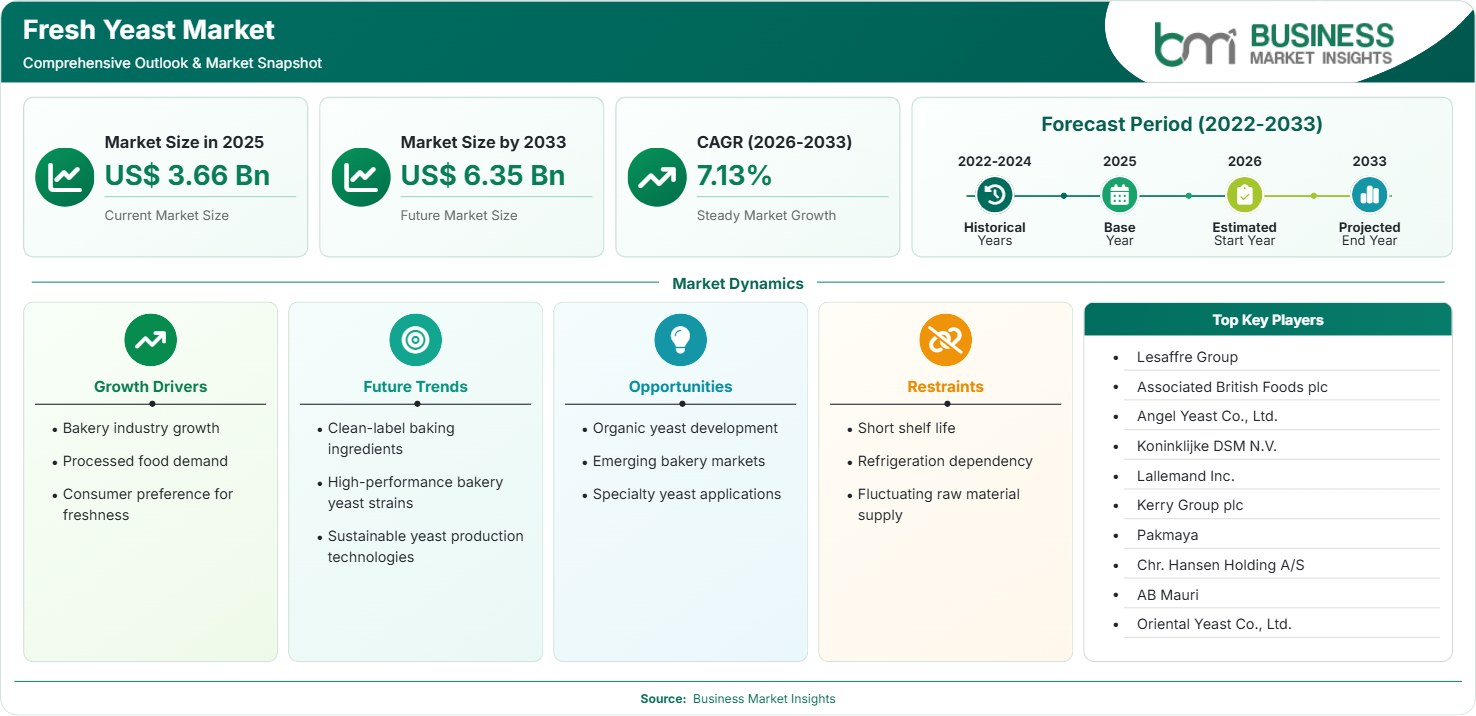
The Fresh Yeast Market size was valued at US$ 3.66 billion in 2025 and is projected to reach US$ 6.35 billion by 2033, growing at a CAGR of 7.13% during 2026–2033. Expanding bakery production, increasing processed food consumption, rising demand for naturally fermented products, and opportunities in organic and specialty yeast applications are supporting market development.

Report Coverage
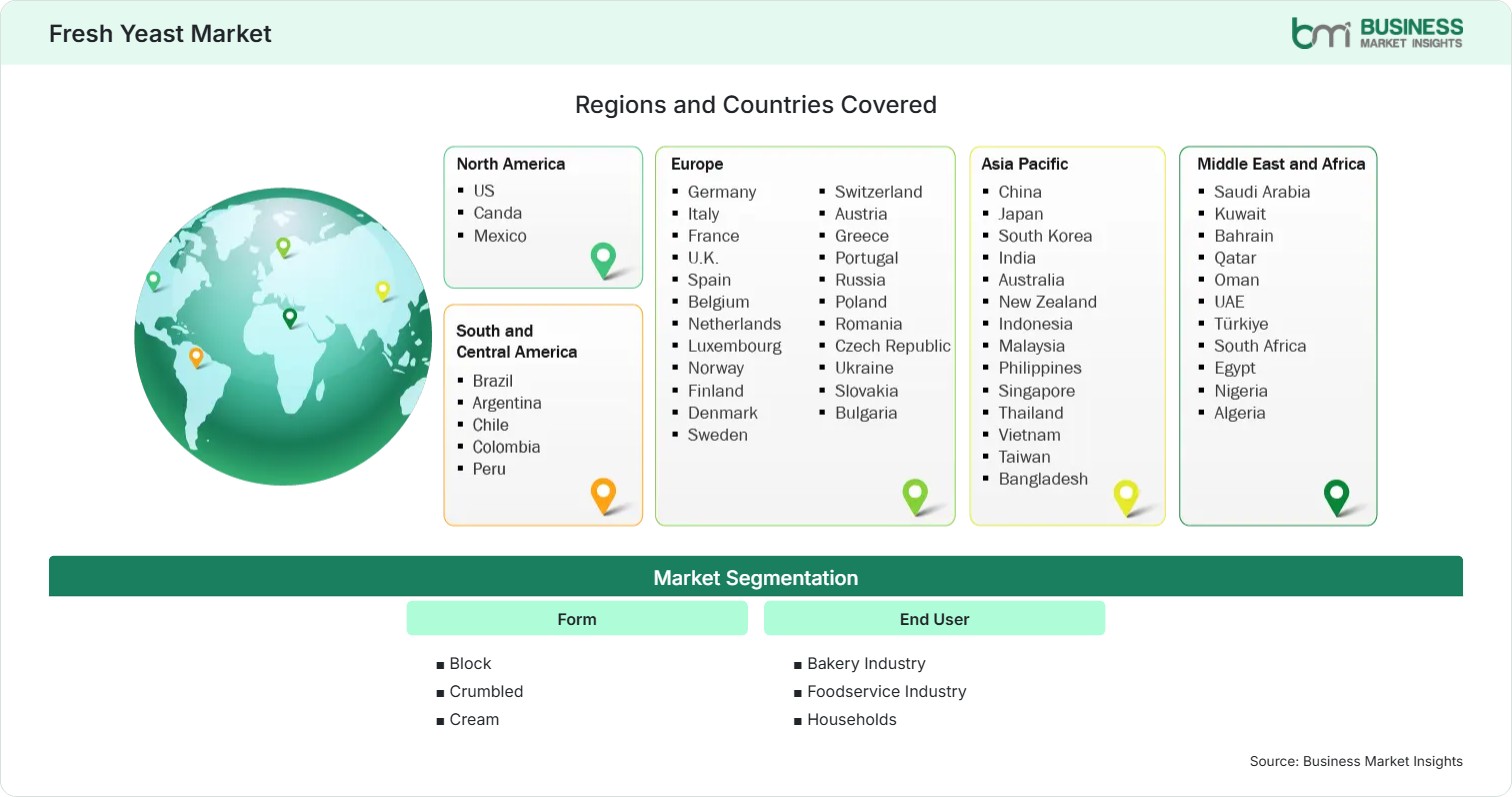
  • Form: Block, Crumbled, Cream
  • End User: Bakery Industry, Foodservice Industry, Households
US$ 3.66 Bn Market size in 2025
US$ 6.35 Bn Market Size by 2033
7.13% CAGR, 2026 - 2033
2026-2033 Forecast Period

01 AI Overview

Fresh Yeast Market Summary

  • North America Region: North America accounts for approximately 27%–30% market share in 2025 and is projected to grow at a CAGR of 6.8%–7.2% during 2026–2033. The region benefits from established bakery industries, strong foodservice demand, increasing consumption of artisanal products, and rising preference for clean-label ingredients. The United States remains the largest contributor due to advanced bakery manufacturing, commercial baking expansion, and consumer interest in fresh baked products, with an estimated 6.9%–7.3% CAGR through 2033.
  • Fastest Growing Region: Asia Pacific represents approximately 33%–36% market share in 2025 and is expected to expand at a CAGR of 7.8%–8.3% during 2026–2033. Growth is supported by rising bakery consumption, urbanization, expanding foodservice channels, processed food demand, and increasing adoption of Western-style baked products across China, India, Southeast Asia, and other emerging markets.
  • Leading Segment: Block form accounts for approximately 55%–59% market share in 2025 and is forecast to grow at a CAGR of 6.9%–7.3% during 2026–2033. The segment benefits from widespread bakery adoption, strong fermentation performance, traditional baking practices, and suitability for large-scale commercial bread production.
  • High Growth Segment: Cream form represents approximately 12%–16% market share in 2025 and is projected to grow at a CAGR of 8.0%–8.5% during the forecast period. Growth is supported by automated bakery systems, liquid handling advantages, industrial fermentation applications, and demand for consistent production processes.
  • Key Market Opportunity: Organic yeast development, specialty fermentation solutions, emerging bakery markets, and customized yeast formulations are creating opportunities for manufacturers to address premium food products and evolving consumer preferences.
  • Major Market Players: Lesaffre Group, Associated British Foods plc, Angel Yeast Co., Ltd., Koninklijke DSM N.V., Lallemand Inc., Kerry Group plc, Pakmaya, Chr. Hansen Holding A/S, AB Mauri, and Oriental Yeast Co., Ltd.
02 Strategic Insights

Fresh Yeast Market: Strategic Insights

Fresh Yeast Market Strategic Framework
FREE PDF
Request your free sample
Request free sample
03 Stakeholder View

Key Takeaways

  • The market ecosystem is shaped by yeast manufacturers, ingredient suppliers, bakery producers, foodservice operators, and distribution networks focused on maintaining product quality and fermentation consistency.
  • Commercial bakery applications represent the largest opportunity area due to increasing bread production, industrial baking expansion, and demand for reliable fermentation ingredients.
  • Product innovation is shifting toward organic yeast, specialty strains, and customized formulations designed for clean-label products, premium bakery items, and functional food applications.
  • Asia Pacific offers strong investment potential due to rising bakery consumption, expanding urban populations, foodservice growth, and increasing acceptance of packaged baked products.
  • Strategic partnerships, production capacity expansion, and distribution improvements are becoming important competitive approaches as companies strengthen regional presence.
  • Cold-chain optimization and improved manufacturing processes are gaining importance as producers seek to enhance freshness, reduce losses, and improve supply reliability.
04 Geographic Outlook

Fresh Yeast Market Regional Highlights

North America Fresh Yeast Market

North America accounted for approximately 27%–30% of global market revenue in 2025 and is expected to expand at a CAGR of 6.8%–7.2% through 2033. The Fresh Yeast Market share in the region is supported by mature bakery industries, strong foodservice networks, rising artisanal baking trends, and consumer demand for high-quality fermented products. The United States represents the leading regional contributor, supported by large-scale bakery manufacturing, premium bread consumption, and established refrigerated ingredient distribution systems.

  • Commercial bakeries are increasing fresh yeast utilization due to demand for consistent fermentation performance and high-quality baked products.
  • Foodservice expansion across restaurants, cafes, and bakery chains is supporting increased consumption of yeast-based dough products.
  • Premium and artisanal bakery trends are encouraging manufacturers to develop specialized fresh yeast solutions.
  • Advanced cold-chain infrastructure supports reliable storage and distribution of temperature-sensitive yeast products.
  • Clean-label food preferences are encouraging demand for naturally fermented bakery ingredients across consumer segments.

US Fresh Yeast Market

The United States held approximately 23%–26% market share of the Fresh Yeast Market in 2025 and is projected to grow at a CAGR of 6.9%–7.3% during 2026–2033. The country maintains a strong position due to a developed bakery sector, extensive foodservice industry, and rising demand for fresh bread and premium baked products. Increasing consumer interest in natural fermentation and specialty bakery items is encouraging manufacturers to expand fresh yeast offerings across commercial and retail channels.

  • Industrial bakeries are adopting fresh yeast for improved dough performance, fermentation reliability, and product consistency.
  • Artisan bakery growth is increasing demand for traditional fermentation methods and premium-quality yeast ingredients.
  • Food manufacturers are expanding refrigerated ingredient distribution networks to improve fresh yeast accessibility.
  • Consumer preference for freshly prepared bakery products is supporting steady market expansion.

Europe Fresh Yeast Market

Europe represented approximately 30%–33% market share in 2025 and is forecast to grow at a CAGR of 6.5%–6.9% through 2033. The region benefits from strong bakery traditions, established yeast manufacturing capabilities, and high consumption of bread and fermented products. Germany, France, and Italy represent major markets, while Poland and Spain demonstrate growth potential due to expanding bakery production and foodservice activities. The region also supports innovation in organic and specialty yeast formulations.

  • European bakery traditions continue supporting stable demand for fresh yeast products across household and commercial applications.
  • Germany maintains strong adoption due to industrial bakery production and advanced food manufacturing infrastructure.
  • France and Italy are supporting premium bakery growth through artisanal bread and specialty product demand.
  • Organic ingredient preferences are encouraging development of natural and specialty yeast formulations.
  • Foodservice expansion is creating additional demand for fresh fermentation solutions across restaurants and bakery chains.

Asia Pacific Fresh Yeast Market

Asia Pacific accounted for approximately 33%–36% market share of the Fresh Yeast Market in 2025 and is projected to achieve the fastest growth with a CAGR of 7.8%–8.3% during 2026–2033. The region benefits from increasing bakery consumption, urbanization, rising disposable income, and expanding foodservice networks. China represents the largest market, while India, Japan, and Southeast Asian countries are experiencing rapid adoption due to growing bakery chains, packaged foods, and changing consumer preferences.

  • Rising urban populations are increasing demand for packaged bakery products and convenient food options.
  • China is expanding bakery production through commercial manufacturing and growing consumer acceptance of Western-style baked goods.
  • India is witnessing increased bakery consumption through organized retail, cafes, and foodservice expansion.
  • Southeast Asian markets are adopting fresh yeast products due to increasing bakery industry development.
  • Local manufacturers are improving production capacity and distribution networks to meet regional demand.

Rest of World Fresh Yeast Market

The Rest of World region accounted for approximately 7%–10% market share in 2025 and is expected to grow at a CAGR of 7.0%–7.5% through 2033. Latin America, the Middle East, and Africa are experiencing rising bakery consumption, expanding foodservice industries, and increasing demand for processed foods. Brazil, Mexico, Saudi Arabia, and South Africa represent important markets due to urban development, changing dietary patterns, and increasing bakery product availability.

Latin America benefits from established bread consumption patterns and expanding commercial bakery operations. Middle Eastern and African markets are developing through foodservice growth, imported bakery products, and investments in local food manufacturing capabilities.

  • Brazil and Mexico are supporting regional growth through bakery expansion and rising packaged food consumption.
  • Middle Eastern countries are increasing bakery investments through hospitality and foodservice sector development.
  • African markets are adopting fresh yeast through urbanization and expanding retail bakery channels.
  • Local food manufacturers are improving refrigerated distribution networks to support yeast availability.
  • International yeast producers are strengthening regional presence through partnerships and production expansion initiatives.
Global Market Geography
FREE PDF
Request your free sample
Request free sample
05 Segment Analysis

Fresh Yeast Market Segmentation

Form

The Form segment includes block, crumbled, and cream yeast formats used across bakery, foodservice, and household applications. The segment accounted for approximately 100% of market revenue in 2025 and is projected to grow at a CAGR of 7.0%–7.5% during 2026–2033. Increasing bakery production, demand for reliable fermentation performance, and preference for fresh ingredients are supporting adoption. Block yeast maintains leadership due to widespread commercial bakery usage, while cream yeast is gaining momentum through automated production systems requiring liquid yeast handling.

  • Block: Block yeast dominates commercial bakery applications due to strong fermentation activity, traditional acceptance, convenient portioning, and widespread usage in bread manufacturing operations.
  • Crumbled: Crumbled yeast is gaining adoption among industrial bakeries because of improved handling efficiency, reduced preparation requirements, and suitability for automated dough production processes.
  • Cream: Cream yeast is increasingly used in high-volume bakery operations due to liquid consistency, automated dispensing compatibility, and improved process control during large-scale production.

End-User

The End-user segment covers bakery industry, foodservice industry, and households utilizing fresh yeast for fermentation and baking applications. The segment accounted for approximately 100% of market revenue in 2025 and is anticipated to expand at a CAGR of 7.1%–7.6% through 2033. Growing bakery consumption, increasing foodservice penetration, and rising household interest in home baking are supporting demand. Commercial bakeries remain the largest consumer group due to continuous requirements for bread, pastries, and other yeast-based products.

  • Bakery Industry: The bakery industry represents the leading end-user due to high fresh yeast consumption for bread, biscuits, cookies, cakes, pastries, and dough-based product manufacturing.
    • Breads: Bread production remains the primary application due to fresh yeast’s fermentation efficiency, texture enhancement capabilities, and widespread use in industrial and artisan bakeries.
    • Biscuits: Biscuit manufacturers utilize specialized yeast solutions to improve product characteristics, processing efficiency, and formulation performance in selected baked products.
    • Cookies & Crackers: Cookies and crackers applications benefit from controlled fermentation requirements, improved dough properties, and increasing demand for diverse bakery product offerings.
    • Cakes: Cake manufacturers are exploring yeast-based formulations for specialty products requiring unique textures, fermentation characteristics, and premium product differentiation.
    • Pastries & Doughnuts: Pastry and doughnut producers rely on fresh yeast for consistent dough expansion, product softness, and quality attributes demanded by consumers.
  • Foodservice Industry: Foodservice operators utilize fresh yeast for restaurants, cafes, bakeries, and hospitality businesses requiring fresh dough preparation and consistent baking outcomes.
  • Households: Household usage is supported by increasing interest in home baking, cooking activities, and demand for freshly prepared bread and bakery products.
06 Market Forces

Fresh Yeast Market Dynamics

Key Market Drivers

Expansion of bakery industry increasing yeast consumption

The global bakery industry continues to expand due to changing consumer lifestyles, increasing urbanization, and rising demand for convenient food products. Fresh yeast remains an essential ingredient for commercial bakeries because of its strong fermentation performance, dough quality improvement, and ability to deliver traditional bakery characteristics. The Fresh Yeast Market growth is supported by increasing production of bread, pastries, cakes, and other fermented bakery products across developed and emerging economies. Industrial bakeries are investing in efficient production systems that require consistent yeast performance and reliable supply. Growth of bakery chains, cafes, and foodservice outlets is further increasing demand for fresh yeast solutions. Manufacturers are also focusing on improved yeast strains to enhance product quality and production efficiency.

Rising processed food demand supporting yeast applications

Increasing consumption of processed and convenience foods is creating additional demand for bakery products that rely on fresh yeast fermentation. Consumers are seeking ready-to-eat and packaged food options, encouraging food manufacturers to expand production capacities for bread, snacks, and other baked goods. Fresh yeast provides functional benefits including improved texture, flavor development, and fermentation control, making it valuable for large-scale food processing operations. Expanding retail networks and organized food distribution channels are supporting greater availability of yeast-based products. Emerging markets are experiencing stronger demand due to rising incomes and changing dietary preferences. Food manufacturers are increasingly adopting reliable yeast supply systems to maintain production consistency and meet growing consumer expectations.

Consumer preference for freshness and natural fermentation

Growing consumer interest in fresh, minimally processed, and naturally fermented foods is supporting demand for fresh yeast products. Many consumers associate traditional fermentation methods with improved taste, texture, and product authenticity, particularly in bread and specialty bakery categories. The Fresh Yeast Market trends indicate increasing interest in clean-label ingredients and bakery products positioned around freshness and natural preparation methods. Artisan bakeries and premium food brands are adopting fresh yeast to differentiate products and meet consumer expectations for quality. Manufacturers are responding by developing specialty yeast solutions that support diverse formulations and premium applications. This shift toward natural food experiences is strengthening opportunities for fresh yeast producers across retail and commercial channels.

Key Market Opportunities

Growth of organic yeast product development

Organic yeast development represents a significant opportunity as consumers increasingly seek natural and sustainable food ingredients. Food manufacturers are expanding premium product portfolios by incorporating organic-certified ingredients into bakery formulations. Yeast producers are investing in specialized cultivation methods, certification processes, and sustainable production practices to address this demand. Organic bakery products are gaining popularity across developed markets where consumers prioritize clean-label and environmentally responsible food choices. Companies developing organic fresh yeast solutions can capture opportunities in premium bakery, household baking, and specialty food segments, according to the Fresh Yeast Market forecast. Expansion of organic agriculture and sustainable food supply chains is expected to further support demand for differentiated yeast products during the forecast period.

Expansion of emerging bakery markets

Emerging bakery markets are creating opportunities for fresh yeast manufacturers through increasing urban populations, rising disposable incomes, and growing acceptance of packaged bakery products. Countries across Asia Pacific, Latin America, and Africa are experiencing expansion of commercial bakeries, cafes, and foodservice businesses. As bakery consumption increases, demand for reliable fermentation ingredients is also rising. Companies investing in regional production facilities, distribution networks, and technical support services can strengthen market penetration, as highlighted in the Fresh Yeast Market analysis. Localized product development addressing regional bakery preferences can further improve adoption. Expanding bakery infrastructure in developing markets provides long-term growth opportunities for fresh yeast suppliers seeking geographic diversification.

Increasing demand for specialty yeast applications

Specialty yeast applications are creating new opportunities beyond traditional bakery uses by enabling customized fermentation characteristics and improved product performance. Food manufacturers are exploring yeast solutions designed for specific bakery requirements, nutritional enhancement, and premium product development. Specialty formulations could be used in applications that require better flavor, improved processing, and a unique customer experience. Functional food and novel bakery product development trends are prompting scientists to develop advanced yeast strains. Companies that offer customized solutions and technical assistance can build strong relationships with their industrial bakery clients. More specialty applications should mean more income for yeast manufacturers, aside from regular fresh yeast sales.

Fresh Yeast Market Restraints and Challenges

Short shelf life limiting distribution efficiency

Factor: Fresh yeast contains high moisture content and remains biologically active, resulting in limited shelf life compared with dry yeast alternatives.

Impact: Short storage periods can create challenges for manufacturers, distributors, retailers, and consumers by increasing inventory management requirements and reducing product flexibility. The industry must ensure an effective planning process for production, refrigerated transportation, and distribution to maintain yeast integrity. Inefficiency in shelf life may limit growth in markets that lack well-developed cold chain processes. Product loss may increase if demand and supply forecasting are not optimized. Improvements are being made in packaging and regional product manufacturing.

Refrigeration dependency increasing operational costs

Factor: Fresh yeast requires continuous temperature-controlled storage and transportation to maintain activity, quality, and performance characteristics.

Impact: The need for refrigeration will add to the complexity of logistics, energy use, and costs across the entire supply chain. Developing countries with limited cold chains will face difficulties in increasing the availability of fresh yeast. To maintain consistent temperature throughout the manufacturing process and up to the end user, special storage systems and distribution channels must be used. This may result in higher costs than shelf-stable yeast and affect small bakeries' choices.

07 Company Analysis

Competitive Landscape

The competitive environment includes global yeast manufacturers, fermentation technology providers, ingredient companies, and specialized bakery solution suppliers competing through production expansion, innovative yeast formulations, distribution capabilities, and technical support services. The Fresh Yeast Market analysis indicates that companies are strengthening their positions through improved fermentation technologies, sustainable production practices, regional manufacturing facilities, and customized yeast solutions designed for commercial bakeries, foodservice operators, and specialty food producers.

Company Name

Overview

Products and Services relevant to this market

Lesaffre Group

Global yeast and fermentation company serving bakery and food industries worldwide.

Fresh yeast, baking solutions, fermentation ingredients, specialty yeast products, and technical bakery support.

Associated British Foods plc

Diversified international food company with yeast manufacturing operations through AB Mauri.

Fresh yeast, bakery ingredients, fermentation solutions, and industrial baking products.

Angel Yeast Co., Ltd.

Chinese biotechnology company specializing in yeast products and fermentation solutions.

Fresh yeast, baking yeast, specialty fermentation products, and yeast-based ingredients.

Koninklijke DSM N.V.

Global nutrition and biotechnology company developing food and fermentation solutions.

Yeast ingredients, fermentation technologies, nutritional solutions, and specialty food applications.

Lallemand Inc.

Canadian fermentation company producing yeast and microbial solutions.

Fresh yeast, baking yeast products, fermentation expertise, and specialty yeast applications.

Kerry Group plc

Global food ingredients company providing solutions for food manufacturers.

Yeast-based ingredients, bakery solutions, fermentation technologies, and food application support.

Pakmaya

Turkish yeast manufacturer supplying bakery and fermentation products globally.

Fresh yeast, dry yeast, bakery ingredients, and professional baking solutions.

Chr. Hansen Holding A/S

Biotechnology company focused on microbial and food ingredient solutions.

Fermentation cultures, microbial solutions, specialty ingredients, and food innovation services.

AB Mauri

Global yeast and bakery ingredient supplier serving commercial baking customers.

Fresh yeast, bakery ingredients, technical services, and fermentation solutions.

Oriental Yeast Co., Ltd.

Japanese fermentation company providing yeast and biotechnology products.

Fresh yeast, baking ingredients, fermentation products, and specialized yeast solutions.

08 Industry Activity

Recent Developments

April 2026

Asahi Group Foods completed the acquisition of German yeast extract specialist Leiber GmbH, strengthening its European functional yeast extract portfolio. The transaction reflects a growing strategic focus by Japanese food companies on savory ingredients and B2B fermentation.

March 2026

Pureture obtained self-affirmed GRAS status to use its yeast-derived protein in food and beverage products in the US.

November 2025

Angel Yeast Co., Ltd. initiated trial production at its new specialty yeast facility in Baiyang Biotechnology Park, marking a major scale-up in its advanced fermentation capabilities. The plant, which began material feeding on August 31, is set to reach an annual output of 8,500 tons once fully operational.

February 2025

Lesaffre Group inaugurated its new yeast production facility in Malang, East Java, built across 9.8 hectares to strengthen its presence in Asia Pacific. The plant marks a major step in bringing advanced yeast solutions closer to regional customers.

10 Trust & Transparency

Research Methodology

The market analysis combines proprietary research with secondary data from government agencies, company disclosures, regulatory filings, industry databases and expert interviews. Market estimates are validated through data triangulation, cross-market benchmarking and analyst review.

View Full Research Methodology

11 Questions Answered

Frequently Asked Questions

What challenges affect fresh yeast adoption?

Short shelf life, refrigeration requirements, transportation complexity, and cold-chain infrastructure limitations can increase operational costs and restrict distribution efficiency in some markets.

What opportunities exist beyond traditional bakery applications?

Opportunities include organic yeast development, specialty fermentation solutions, functional food applications, premium bakery products, and customized yeast formulations for specific manufacturing requirements.

Why is Asia Pacific becoming an important market?

Asia Pacific is expanding due to urbanization, rising bakery consumption, increasing disposable incomes, growing foodservice industries, and wider adoption of packaged bakery products.

Which form of fresh yeast holds the largest market share?

Block yeast holds the largest share due to widespread commercial bakery adoption, strong fermentation performance, established handling practices, and suitability for large-scale bread production.

What is driving the market growth?

The Fresh Yeast Market report highlights that the market is driven by bakery industry expansion, rising processed food demand, increasing preference for fresh fermented products, growth of foodservice channels, and adoption of specialty yeast applications.

Access the Full Fresh Yeast Market Report

Get segment-level forecasts, regional estimates, competitive benchmarking, company profiles and downloadable Excel datasets.

Access the full Fresh Yeast Market Report
350 pages PDF & Excel | 2026-07-27