
Lactose Market Outlook: Size, Share, Trends, Growth Analysis, Competitive Landscape & Forecast, 2026-2033

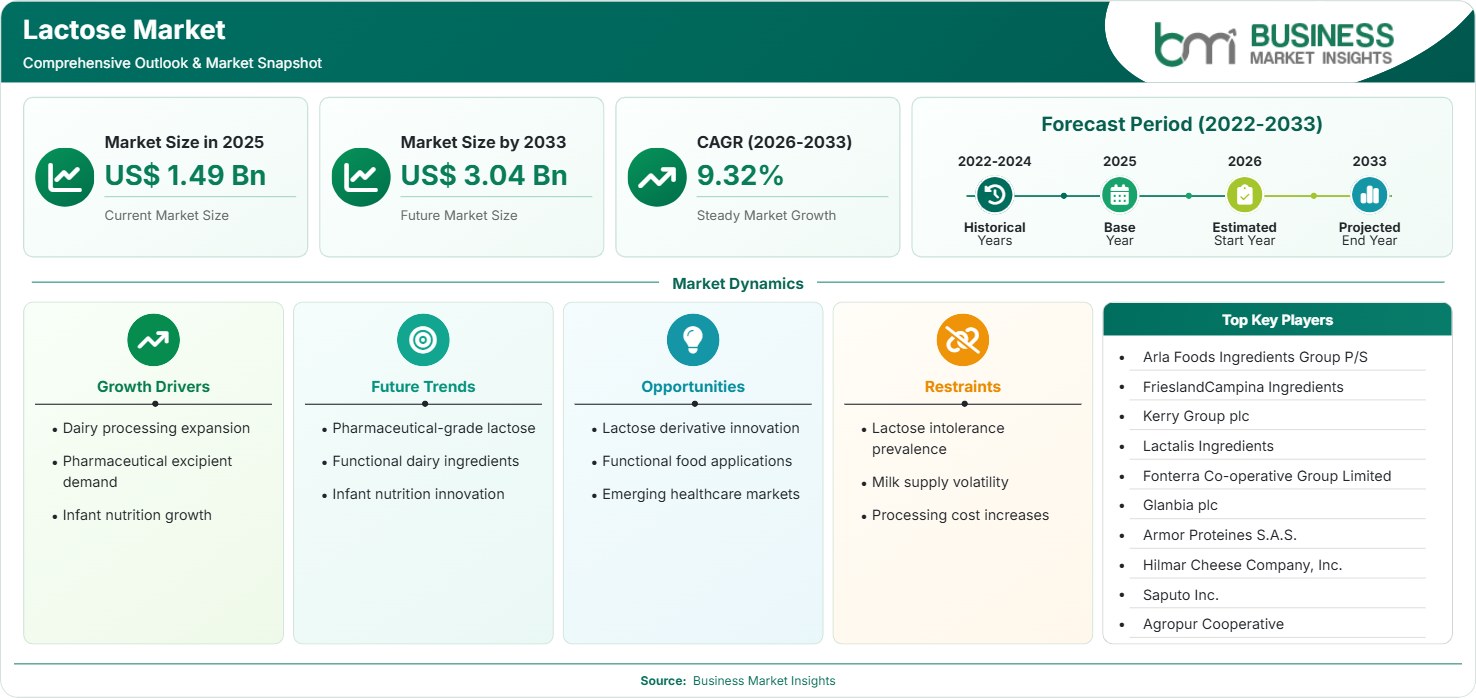
The Lactose Market size was valued at US$ 1.49 billion in 2025 and is projected to reach US$ 3.04 billion by 2033, growing at a CAGR of 9.32% during 2026–2033. Growth is driven by dairy processing expansion, pharmaceutical excipient demand, infant nutrition growth, lactose derivative innovation, functional food applications, and emerging healthcare markets.

Report Coverage
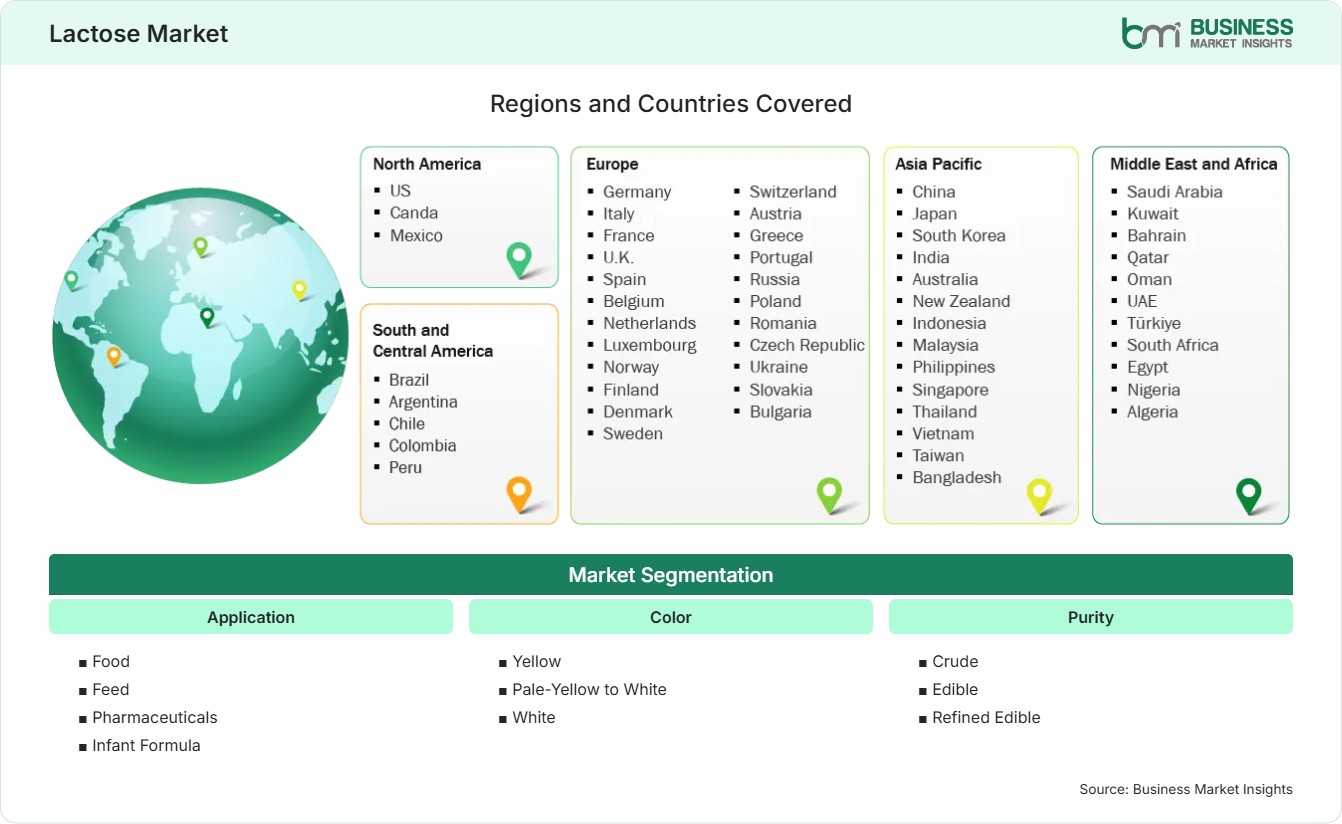
  • Application: Food, Feed, Pharmaceuticals, Infant Formula
  • Color: Yellow, Pale-Yellow to White, White
  • Purity: Crude, Edible, Refined Edible
US$ 1.49 Bn Market size in 2025
US$ 3.04 Bn Market Size by 2033
9.32% CAGR, 2026 - 2033
2026-2033 Forecast Period

01 AI Overview

Lactose Market Summary

  • North America Region: North America holds an estimated 26%–30% share in 2025, growing at 8.7%–9.3% CAGR during 2026–2033. Growth is supported by demand for pharmaceutical formulations, infant nutrition production, dairy ingredient innovation, and functional food applications. The US market remains the largest contributor, growing at an estimated 8.9%–9.5% CAGR through 2033, driven by advanced dairy processing capabilities and healthcare applications.
  • Fastest Growing Region: Asia Pacific accounts for an estimated 32%–36% share in 2025, expanding at a 9.8%–10.5% CAGR during 2026–2033. Growth is driven by increasing infant formula consumption, expanding dairy processing infrastructure, pharmaceutical manufacturing growth, and rising healthcare investments across developing economies.
  • Leading Segment: Food applications account for an estimated 38%–42% share in 2025, growing at a 8.8%–9.4% CAGR during 2026–2033. Growth is influenced by increasing demand for dairy ingredients, bakery applications, confectionery products, and nutritional formulations.
  • High Growth Segment: Infant formula applications represent an estimated 18%–22% share in 2025, expanding at a 10.2%–11.0% CAGR during 2026–2033. Growth is supported by rising infant nutrition demand, premium formula development, and increasing adoption of specialized nutritional ingredients.
  • Key Market Opportunity: Lactose derivatives, functional food formulations, and healthcare applications are creating opportunities for manufacturers developing specialized lactose ingredients with improved nutritional and pharmaceutical value.
  • Major Market Players: Arla Foods Ingredients Group P/S, FrieslandCampina Ingredients, Kerry Group plc, Lactalis Ingredients, Fonterra Co-operative Group Limited, Glanbia plc, Armor Proteines S.A.S., Hilmar Cheese Company, Inc., Saputo Inc., Agropur Cooperative.
02 Strategic Insights

Lactose Market: Strategic Insights

Lactose Market Strategic Framework
FREE PDF
Request your free sample
Request free sample
03 Stakeholder View

Key Takeaways

  • The lactose value chain includes dairy processors, ingredient manufacturers, pharmaceutical suppliers, nutrition companies, and food producers developing specialized ingredient solutions.
  • Pharmaceutical and infant nutrition applications provide strong growth opportunities due to increasing demand for high-quality lactose grades and specialized formulations.
  • Innovation is shifting toward lactose derivatives, improved purification technologies, customized nutritional ingredients, and advanced processing methods.
  • Asia Pacific represents a major investment opportunity due to expanding dairy industries, rising healthcare expenditure, and growing infant nutrition demand.
  • Companies are strengthening market positions through capacity expansion, strategic partnerships, ingredient portfolio diversification, and advanced processing capabilities.
  • Growing demand for functional foods and healthcare-oriented nutrition products is encouraging manufacturers to develop application-specific lactose solutions.
04 Geographic Outlook

Lactose Market Regional Highlights

North America Lactose Market

North America accounts for an estimated 26%–30% share in 2025, supported by established dairy processing infrastructure, pharmaceutical manufacturing capabilities, and strong demand for nutritional ingredients. The region is projected to grow at a 8.7%–9.3% CAGR during 2026–2033. The United States remains the leading contributor due to advanced ingredient production, healthcare applications, and demand for infant nutrition.

  • The US supports lactose demand through pharmaceutical and nutritional ingredient manufacturing.
  • Dairy processors are investing in high-purity lactose production technologies.
  • Functional food development increases demand for specialized lactose ingredients.
  • Healthcare applications continue supporting pharmaceutical-grade lactose adoption.

US Lactose Market

The US represents an estimated 85%–89% share of North America's Lactose Market in 2025 and is expected to expand at a 8.9%–9.5% CAGR through 2033. Growth is supported by pharmaceutical excipient demand, infant formula production, advanced dairy processing, and increasing adoption of nutritional ingredients in food applications.

  • Pharmaceutical manufacturers utilize lactose as a widely accepted formulation excipient.
  • Infant nutrition companies increase demand for premium lactose ingredients.
  • Food manufacturers adopt lactose for texture and functional properties.

Europe Lactose Market

Europe represents an estimated 28%–32% share in 2025, growing at a 8.9%–9.6% CAGR during 2026–2033. The region benefits from strong dairy production, established ingredient manufacturers, and pharmaceutical applications. Germany, the Netherlands, France, Ireland, and Denmark are leading contributors due to advanced dairy processing infrastructure and ingredient export capabilities.

  • Germany supports lactose demand through the pharmaceutical and food ingredient industries.
  • The Netherlands benefits from strong dairy ingredient processing capabilities.
  • France expands lactose production through established dairy manufacturing networks.
  • Denmark and Ireland strengthen exports of specialty dairy ingredients.

Asia Pacific Lactose Market

Asia Pacific is estimated to account for 32%–36% in 2025 and records the fastest growth, at a 9.8%–10.5% CAGR during 2026–2033. China, India, Japan, and Southeast Asian markets are driving expansion through rising infant formula consumption, healthcare investments, and dairy industry development. Regional manufacturers are increasing processing capacity to meet growing demand for nutritional ingredients.

  • China leads demand through infant formula and pharmaceutical applications.
  • India expands lactose consumption with growing dairy processing industries.
  • Japan supports high-value pharmaceutical and nutritional ingredient applications.
  • Southeast Asia experiences increasing demand for infant nutrition products.
  • Regional dairy investments improve local lactose production capabilities.

Rest of World Lactose Market

Latin America, the Middle East, and Africa collectively account for an estimated 6%–10% share in 2025, expanding at a 9.0%–9.8% CAGR through 2033. Growth is supported by dairy industry development, nutrition programs, healthcare expansion, and increasing processed food consumption. Brazil, Mexico, Saudi Arabia, the UAE, and South Africa represent emerging markets for lactose applications.

  • Brazil supports lactose demand through expanding dairy processing industries.
  • Mexico benefits from increasing nutritional ingredient consumption.
  • Middle Eastern markets invest in infant nutrition and healthcare products.
  • South Africa develops food ingredient applications through dairy expansion.
  • Regional healthcare growth supports pharmaceutical-grade lactose demand.
Global Market Geography
FREE PDF
Request your free sample
Request free sample
05 Segment Analysis

Lactose Market Segmentation

Application

The Application segment represents the core structure of the market, accounting for an estimated 95%–98% share in 2025 and expanding at a 9.1%–9.7% CAGR during 2026–2033. Growth is supported by broad utilization across food manufacturing, pharmaceutical formulations, animal nutrition, and infant formula production. Increasing demand for high-quality nutritional ingredients, pharmaceutical excipients, and specialized dairy-based products is encouraging manufacturers to develop application-specific lactose grades, as noted in lactose market forecasts. The market continues to expand as companies diversify applications beyond conventional dairy uses into the healthcare and functional nutrition sectors.

  • Food: Food applications utilize lactose for sweetness adjustment, texture enhancement, and formulation support across bakery, confectionery, dairy products, and processed food categories.
  • Feed: Feed applications use lactose as a nutritional ingredient supporting young animal diets, especially in livestock and specialty feed formulations requiring digestible carbohydrates.
  • Pharmaceuticals: Pharmaceutical applications rely on lactose as an excipient for tablet production, improving formulation consistency, compressibility, and drug delivery performance.
  • Infant Formula: Infant formula applications require high-quality lactose ingredients supporting nutritional formulations, with increasing demand for premium products and specialized infant nutrition solutions.
    • Dry-blend: Dry-blend formulations use lactose powders for convenient mixing, improved stability, and efficient production of infant nutrition products.
    • Wet-blend: Wet-blend formulations incorporate lactose during liquid processing stages, enabling uniform ingredient distribution and controlled nutritional composition.

Color

The Color segment accounts for an estimated 92%–96% share in 2025 and is projected to grow at 8.8%–9.5% CAGR through 2033. Color classification reflects purity levels, processing methods, and end-use requirements across food, pharmaceutical, and nutritional applications. White lactose remains preferred for premium applications due to appearance and quality expectations, while pale-yellow and yellow variants serve applications where appearance specifications are less restrictive. Growing demand for refined ingredients is influencing processing investments across lactose manufacturers.

  • Yellow: Yellow lactose is primarily used in applications where color specifications are flexible, supporting cost-effective ingredient utilization.
  • Pale-Yellow to White: Pale-yellow to white lactose serves diverse food and nutrition applications requiring balanced quality, functionality, and processing efficiency.
  • White: White lactose is preferred in pharmaceutical and premium nutritional applications due to high purity, visual quality, and consistent formulation performance.

Purity

The Purity segment is estimated to account for 96%–99% of the market in 2025 and is expected to grow at a 9.0%–9.6% CAGR during 2026–2033. Increasing demand for pharmaceutical-grade and premium nutritional ingredients is strengthening the adoption of refined lactose products. Edible and refined edible grades are gaining importance as manufacturers prioritize quality standards, regulatory compliance, and application-specific performance. Rising demand for healthcare applications and infant nutrition is encouraging producers to enhance purification capabilities and develop specialized lactose solutions.

  • Crude: Crude lactose supports industrial applications where lower processing requirements and cost efficiency are primary purchasing considerations.
  • Edible: Edible lactose is utilized in food and nutrition products requiring controlled quality standards and suitable functional characteristics.
  • Refined Edible: Refined edible lactose supports pharmaceutical, infant nutrition, and premium food applications requiring high purity and consistent performance.
06 Market Forces

Lactose Market Dynamics

Key Market Drivers

Dairy processing expansion increases lactose availability

The expansion of global dairy processing capacity is boosting lactose production by increasing the supply of whey and other dairy-based raw materials. Dairy manufacturers are developing technologies to improve lactose extraction during processing. The increase in the consumption of dairy products, nutritional ingredients, and value-added dairy products is driving the supply chains. The factors affecting the Lactose Market include the rising demand of the food, pharmaceutical, and infant nutrition sectors for quality ingredients. The trends of the market show increasing emphasis on efficient processing and high-quality lactose production.

Pharmaceutical excipient demand supports market expansion

Lactose is widely used in pharmaceutical preparations as an excipient for its compressibility, stability, and compatibility. An increase in the number of oral solid dosage medicines will drive the demand for pharmaceutical-grade lactose. Because of its regulatory approval and ease of processing, lactose is preferred as a component of tablets and capsules. Health care advancement, increased drug usage, and the manufacturing of pharmaceuticals in developing countries are also driving the demand. Ongoing investments in the production of high-purity lactose drive market growth.

Infant nutrition growth drives premium lactose demand

The growing demand for infant nutrition products is driving up consumption of high-quality lactose ingredients designed to mimic the carbohydrate composition of human milk. Lactose-based solutions for infant formula applications that are more nutritious and easier to process are being developed by producers. Urbanization, increased awareness of child nutrition, and the growth of premium formulas are driving market development. The Lactose Market trends show increased focus on modern technology, quality certification, and formulation of custom lactose solutions. Producers aim to develop stable supply chains to meet the quality demands of infant nutrition manufacturers.

Key Market Opportunities

Lactose derivative innovation creates specialized applications

Innovation in lactose derivatives is creating opportunities for manufacturers to develop value-added products in their respective fields. With technological advancements in processing, it is possible to create customized lactose-based products with higher solubility and purity than traditional products. The use of derivative products can allow lactose to be used in more advanced areas of formulation and healthcare through innovative processes. Companies involved in innovation in research and processing, along with application-focused services, will have a chance to create more value from their customers' needs.

Functional food applications expand ingredient demand

The rise in consumption of functional foods has created new opportunities for lactose producers, driven by growing consumer interest in products with additional nutritional benefits. Lactose-containing ingredients are being used to develop new specialized foods, sports nutrition products, and fortified foods in which functional carbohydrates are required. Companies within the food industry are coming up with new formulations involving dairy-based ingredients and health-based positioning of the product, promoting lactose market growth. The growing consumer interest in premium nutrition products and clean-label ingredients has been driving lactose producers to develop application-specific lactose solutions.

Emerging healthcare markets offer expansion potential

The increasing market penetration of the healthcare sector in developing economies presents a good opportunity for lactose manufacturers offering pharmaceutical-grade lactose. Factors such as increased healthcare delivery, growth in pharmaceutical manufacturing, and the growing need for medications are contributing to increased use of pharmaceutical excipients. Investment in pharmaceutical infrastructure and raw materials in Asia, Latin America, and the Middle East has been increasing due to the region's emerging nature. Lactose manufacturers with robust quality assurance and distribution systems need to capitalize on new market opportunities in the healthcare sector.

Market Restraints and Challenges

Lactose intolerance prevalence limits consumption growth

Factor: Increasing awareness and prevalence of lactose intolerance influence consumer preferences and reduce demand for conventional lactose-containing food products among sensitive populations.

Impact: This factor can restrict direct consumption growth in certain food categories and encourage manufacturers to develop lactose-free alternatives. Companies are required to balance opportunities related to lactose ingredients with changing dietary preferences and evolving consumer health considerations.

Milk supply volatility affects production stability

Factor: Fluctuations in milk production due to climate conditions, livestock challenges, and changing dairy economics affect the availability of lactose as a raw material.

Impact: Supply variability can increase production costs, create pricing uncertainty, and affect long-term ingredient supply planning. Manufacturers are focusing on efficient sourcing strategies, supply diversification, and processing optimization to reduce raw material risks.

07 Company Analysis

Competitive Landscape

The competitive landscape is characterized by large international manufacturers of dairy ingredients and nutrition firms, as well as lactose specialists focused on high-purity ingredients, pharmaceutical-grade products, and nutritional applications. Companies are improving their production capacity through new processing technologies, certifications, and specialized products. Competitive Environment of the Lactose Market analysis reveals that competition is increasingly dependent on supply stability, product purity, innovation in lactose derivatives, and applications in the pharmaceutical, infant, and functional food sectors.

Company Name

Overview

Products and Services relevant to this market

Arla Foods Ingredients Group P/S

Dairy ingredient specialist providing advanced nutritional solutions globally.

Lactose ingredients, infant nutrition ingredients, whey-based solutions, specialized dairy products.

FrieslandCampina Ingredients

Global dairy ingredient supplier focused on nutrition and health applications.

Lactose powders, infant nutrition ingredients, and pharmaceutical lactose solutions.

Kerry Group plc

International ingredient company developing food and nutrition solutions.

Functional ingredients, nutritional solutions, lactose-based food applications.

Lactalis Ingredients

Dairy ingredient producer supplying global food and nutrition markets.

Lactose ingredients, dairy powders, nutritional dairy solutions.

Fonterra Co-operative Group Limited

Global dairy cooperative producing specialty dairy ingredients.

Lactose ingredients, dairy nutrition solutions, functional dairy components.

Glanbia plc

Nutrition company focused on value-added ingredient solutions.

Dairy ingredients, nutritional powders, specialty lactose applications.

Armor Proteines S.A.S.

Dairy ingredient manufacturer specializing in milk-derived products.

Lactose powders, dairy proteins, customized ingredient solutions.

Hilmar Cheese Company, Inc.

Dairy producer specializing in cheese and whey-derived ingredients.

Lactose ingredients, whey derivatives, food, and nutrition solutions.

Saputo Inc.

Global dairy company producing consumer and ingredient dairy products.

Dairy ingredients, lactose products, nutritional dairy solutions.

Agropur Cooperative

Dairy cooperative supplying ingredients and dairy products worldwide.

Lactose ingredients, whey products, and dairy-based nutritional ingredients.

08 Industry Activity

Recent Developments

June 2026

Azelis and Lactalis entered into a distribution partnership for the Pharmaceuticals & Healthcare market in India, under which Azelis will distribute the Lactalpha pharmaceutical lactose range, including milled and sieved low-nitrite lactose products compliant with Ph. Eur., USP-NF, and JP standards.

March 2026

Sooro Renner Nutrição S/A secured R$197.6 million in financing from Brazil's National Bank for Economic and Social Development (BNDES) to expand lactose and whey protein production at its Francisco Beltrão facility, supporting the production of Infant Formula Grade lactose in Brazil.

February 2026

Lactose (India) Limited reported a 140.91% year-over-year increase in standalone net profit to ₹0.53 crore for the quarter ended December 2025, while sales increased 28.03% to ₹36.77 crore.

January 2026

Lactose (India) Limited announced a ₹15 crore investment in plant and machinery to establish a specialized pharmaceutical excipients business and launched four value-added lactose products: Spray Dried Lactose, Anhydrous Lactose, Homeopathic Grade Lactose, and Inhalation Grade Lactose.

10 Trust & Transparency

Research Methodology

The market analysis combines proprietary research with secondary data from government agencies, company disclosures, regulatory filings, industry databases and expert interviews. Market estimates are validated through data triangulation, cross-market benchmarking and analyst review.

View Full Research Methodology

11 Questions Answered

Frequently Asked Questions

What factors influence lactose pricing?

Milk supply conditions, dairy processing capacity, raw material availability, energy costs, and global demand from food and healthcare industries influence lactose pricing.

How are lactose manufacturers addressing market challenges?

Manufacturers are improving supply chain resilience, investing in purification technologies, developing specialized lactose grades, and expanding into higher-value applications.

Which region has the strongest lactose growth potential?

Asia Pacific demonstrates strong growth potential due to expanding dairy industries, increasing demand for infant nutrition, growth in pharmaceutical manufacturing, and rising healthcare investments.

Why is pharmaceutical-grade lactose important?

In the lactose market report, pharmaceutical-grade lactose is noted for its excellent compressibility, stability, and consistency, making it a preferred excipient for tablet and capsule manufacturing in pharmaceutical applications.

What are the primary applications of lactose?

Lactose is widely used in food products, animal feed, pharmaceutical formulations, and infant nutrition due to its functional properties, nutritional value, and compatibility with multiple manufacturing processes.

Access the Full Lactose Market Report

Get segment-level forecasts, regional estimates, competitive benchmarking, company profiles and downloadable Excel datasets.

Access the full Lactose Market Report
350 pages PDF & Excel | 2026-07-31