
Hops Market Outlook: Size, Share, Trends, Growth Analysis, Competitive Landscape & Forecast, 2026-2033

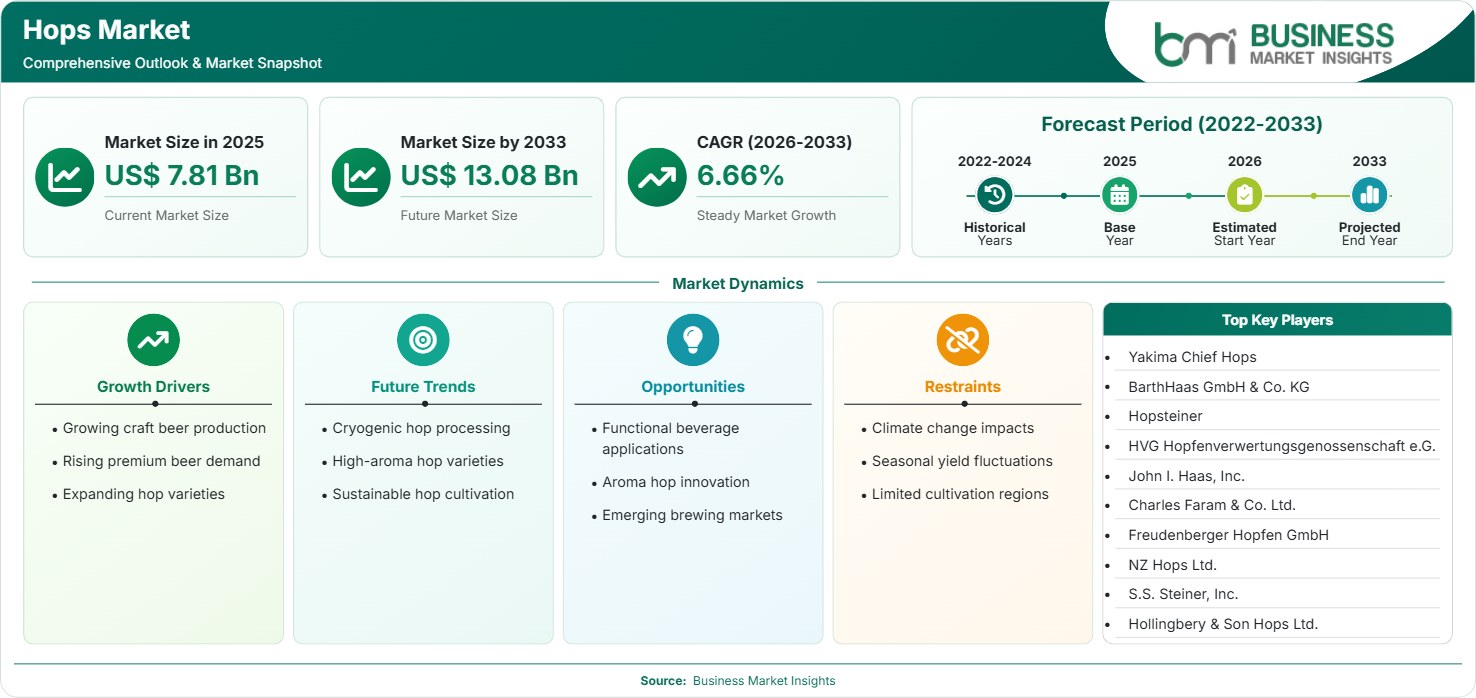
The Hops Market size was valued at US$ 7.81 billion in 2025 and is projected to reach US$ 13.08 billion by 2033, growing at a CAGR of 6.66% during the Hops Market forecast period, driven by craft beer expansion, premium beverage consumption, diversified hop varieties, functional beverage innovation, and emerging brewing markets.

Report Coverage
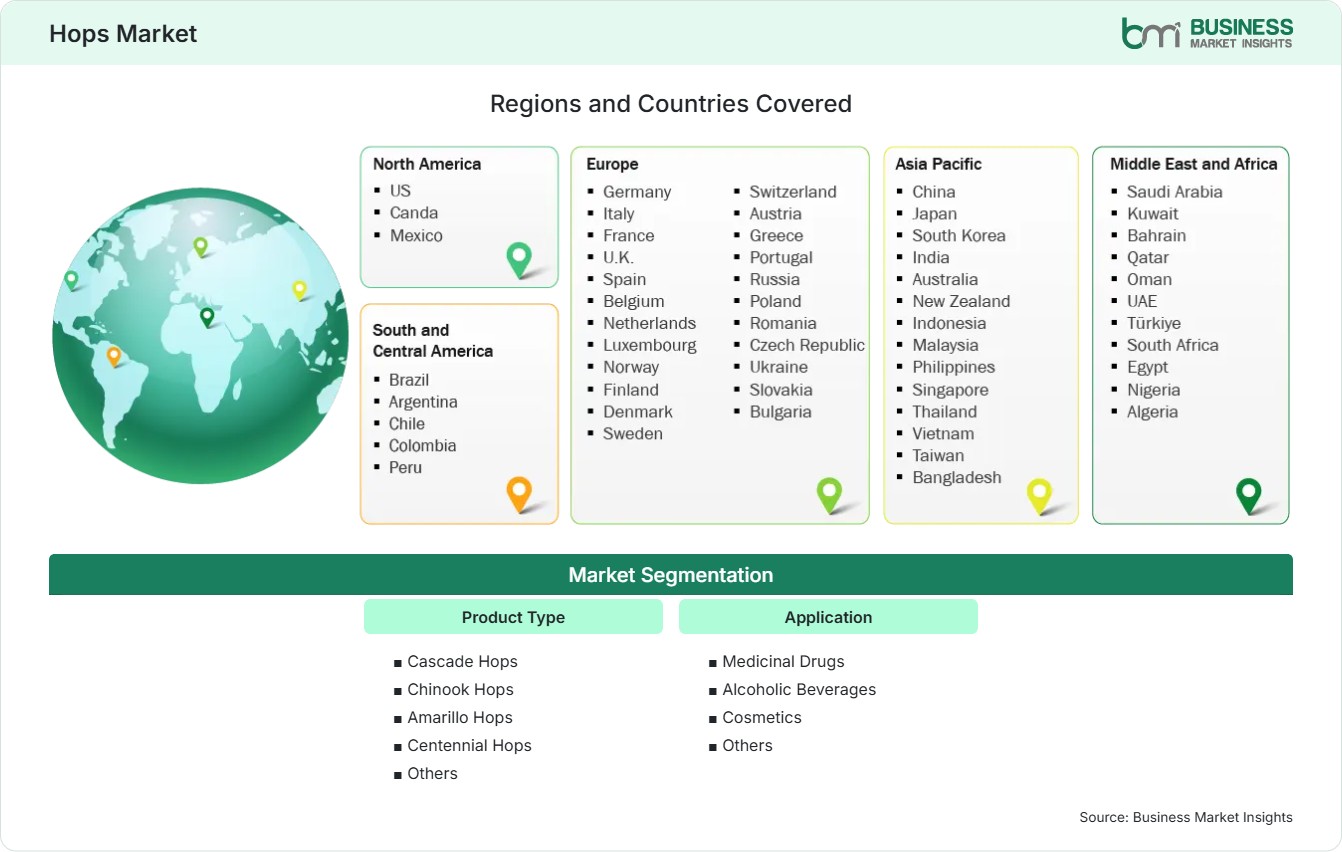
  • Product Type: Cascade Hops, Chinook Hops, Amarillo Hops, Centennial Hops, Others
  • Application: Medicinal Drugs, Alcoholic Beverages, Cosmetics, Others
US$ 7.81 Bn Market size in 2025
US$ 13.08 Bn Market Size by 2033
6.66% CAGR, 2026 - 2033
2026-2033 Forecast Period

AI Overview

Hops Market Summary

  • North America Region: North America accounts for an estimated 38%–42% share in 2025 and is projected to grow at a CAGR of 6.2%–6.8% during 2026–2033. Craft brewing expansion, premium beer consumption, specialty hop cultivation, and brewery innovation create opportunities. The U.S. market remains a major contributor with a CAGR of 6.3%–6.9%, supported by established craft breweries and demand for aroma-focused varieties.
  • Fastest Growing Region: Asia Pacific holds approximately 18%–22% share in 2025 and is expected to expand at a CAGR of 7.2%–7.8% through 2033. Rising beer consumption, expanding brewing industries, increasing disposable income, and adoption of premium beverage categories support regional growth opportunities.
  • Leading Segment: Alcoholic Beverages represents around 72%–76% share in 2025 and is expected to grow at a CAGR of 6.4%–6.9%. Growing craft beer production, premium lager demand, and consumer preference for differentiated flavors continue supporting hop utilization.
  • High Growth Segment: Medicinal Drugs accounts for approximately 8%–12% share in 2025 and is projected to expand at a CAGR of 7.5%–8.2%. Research into hop-derived compounds and functional health applications is supporting emerging opportunities.
  • Key Market Opportunity: Increasing adoption of aroma hops, functional beverages, innovative brewing techniques, and expansion into emerging beer markets create new opportunities for growers, suppliers, and beverage manufacturers.
  • Major Market Players: Yakima Chief Hops, BarthHaas GmbH & Co. KG, Hopsteiner, HVG Hopfenverwertungsgenossenschaft e.G., John I. Haas, Inc., Charles Faram & Co. Ltd., Freudenberger Hopfen GmbH, NZ Hops Ltd., S.S. Steiner, Inc., Hollingbery & Son Hops Ltd.
Strategic Insights

Hops Market: Strategic Insights

Hops Market Strategic Framework
FREE PDF
Request your free sample
Request free sample
Stakeholder View

Key Takeaways

  • The hop supply chain is becoming more specialized, with growers, processors, and distributors focusing on premium aroma varieties, quality consistency, and direct partnerships with breweries.
  • Craft beer producers represent a major growth avenue as consumers increasingly seek differentiated flavors, regional brewing identities, and specialty beverage experiences.
  • Innovation in hop breeding, extraction technologies, and flavor development is expanding applications beyond traditional brewing into functional beverages and wellness products.
  • North America remains a strategic investment hub due to established hop-growing regions, advanced brewing ecosystems, and strong demand for premium beer categories.
  • Companies are increasingly pursuing partnerships, cultivation expansion, and supply agreements to secure high-quality hop varieties and manage agricultural supply risks.
Geographic Outlook

Hops Market Regional Highlights

North America Hops Market

North America represented approximately 38%–42% of the global market in 2025 and is projected to expand at a CAGR of 6.2%–6.8% during 2026–2033. The region benefits from a mature craft brewing industry, advanced hop cultivation practices, and strong demand for premium beer products. The Hops Market share remains significant due to established production clusters in the United States and increasing brewer preference for specialty aroma varieties.

  • The United States remains the largest regional contributor due to extensive craft brewery networks, advanced hop farms, and strong demand for specialty varieties.
  • Washington State continues to dominate hop cultivation through favorable agricultural conditions and established processing infrastructure supporting global supply.
  • Brewers are increasing adoption of experimental hop varieties to create differentiated flavors and premium beverage offerings.
  • Sustainable cultivation practices are gaining importance as producers address environmental pressures and changing consumer expectations.

US Hops Market

The United States accounted for approximately 34%–38% of global revenue in 2025 and is expected to register a CAGR of 6.3%–6.9% through 2033. The country remains a global hub for hop cultivation and craft brewing innovation, supported by strong demand for aroma-rich varieties. The Hops Market growth is influenced by brewery experimentation, premium beer trends, and increasing interest in locally sourced ingredients.

  • Washington, Oregon, and Idaho remain key production regions due to suitable climates and established hop farming expertise.
  • Craft breweries continue driving demand for specialty varieties including Cascade, Centennial, and Amarillo hops.
  • Producers are investing in improved cultivation techniques to enhance yield stability and quality consistency.

Europe Hops Market

Europe held an estimated 28%–32% share in 2025 and is forecast to grow at a CAGR of 5.8%–6.4% between 2026 and 2033. The region benefits from strong brewing traditions, established hop-growing areas, and demand for premium beer products. Germany, the Czech Republic, and the United Kingdom remain important markets, with Germany maintaining leadership in hop production and specialty brewing applications.

  • Germany remains a leading European market due to extensive hop cultivation, advanced processing capabilities, and strong brewing heritage.
  • The Czech Republic supports demand through traditional hop varieties used in premium lager production.
  • The United Kingdom continues expanding craft beer production and experimentation with specialty hop profiles.
  • European growers are adopting sustainable farming methods to improve resilience against climate-related challenges.

Asia Pacific Hops Market

Asia Pacific accounted for approximately 18%–22% of the market in 2025 and is expected to achieve the fastest growth with a CAGR of 7.2%–7.8% through 2033. Increasing beer consumption, urbanization, expanding middle-class populations, and growing interest in craft beverages are supporting regional demand. China, Japan, Australia, and India represent important growth markets for premium brewing ingredients.

  • China is expanding its craft beer sector, increasing demand for imported and locally cultivated hop varieties.
  • Australia supports regional growth through specialty hop production and premium craft brewing development.
  • Japan demonstrates demand for innovative beer products using distinctive aroma and flavor profiles.
  • India represents an emerging opportunity due to rising interest in craft breweries and premium alcoholic beverages.

Rest of World Hops Market

The Rest of World region accounted for approximately 8%–12% share in 2025 and is projected to grow at a CAGR of 6.0%–6.7% during the forecast period. Latin America, the Middle East, and Africa are experiencing gradual growth due to expanding beverage industries, tourism, and changing consumer preferences. Regional opportunities are supported by increasing brewery investments and premium product development.

  • Latin America is witnessing craft brewery expansion, particularly in Brazil, Mexico, and Argentina, supporting specialty hop demand.
  • Brazil represents a growing market through increasing craft beer production and premium beverage consumption.
  • Africa offers emerging opportunities as urbanization and hospitality sector growth support beverage industry development.
  • Middle Eastern markets are exploring specialty beverage categories despite regulatory limitations in certain countries.
  • Regional brewers are increasingly sourcing differentiated hop varieties to create unique beverage offerings.
Global Market Geography
FREE PDF
Request your free sample
Request free sample
Segment Analysis

Hops Market Segmentation

Product Type

The Product Type segment accounted for approximately 86%–90% of the Hops Market revenue in 2025 and is projected to grow at a CAGR of 6.3%–6.8% during 2026–2033. Demand is primarily influenced by brewing preferences, flavor innovation, and increasing adoption of specialized hop varieties. Brewers are focusing on unique aroma profiles, improved bitterness control, and differentiated beer experiences, encouraging investment in premium hop cultivation and processing technologies.

  • Cascade Hops: Cascade hops remain widely preferred due to their citrus aroma, balanced bitterness, and extensive use in craft beer styles requiring distinctive flavor characteristics.
  • Chinook Hops: Chinook hops are valued for strong bittering properties, pine-like aroma profiles, and suitability for ales, IPAs, and specialty brewing applications.
  • Amarillo Hops: Amarillo hops are increasingly adopted for their floral, citrus, and tropical notes, supporting premium craft beer production and innovative beverage development.
  • Centennial Hops: Centennial hops provide balanced bitterness and aromatic qualities, making them popular among brewers producing pale ales, IPAs, and specialty beer varieties.
  • Others: Other hop varieties include emerging cultivars developed for unique aroma, flavor, and brewing characteristics, supporting diversification among craft and commercial breweries.

Application

The Application segment represented approximately 92%–96% of the Hops Market in 2025 and is expected to expand at a CAGR of 6.4%–6.9% through 2033. Traditional brewing remains the primary application area, while emerging uses in health products, cosmetics, and functional beverages are creating additional demand opportunities. Increasing consumer interest in natural ingredients is encouraging broader utilization of hop-derived compounds.

  • Medicinal Drugs: Hop extracts are gaining research interest due to bioactive compounds associated with potential health applications, supporting pharmaceutical and nutraceutical exploration.
  • Alcoholic Beverages: Alcoholic beverages represent the dominant application due to extensive use of hops in beer production for bitterness, aroma, flavor enhancement, and product differentiation.
  • Cosmetics: Cosmetic applications are expanding through interest in botanical ingredients, natural extracts, and potential antioxidant properties of hop-derived compounds.
Market Forces

Hops Market Dynamics

Key Market Drivers

Growing Craft Beer Production

The growth of craft breweries all around the world is a key reason driving the demand for specialty varieties of hops. People are increasingly preferring unique taste and quality ingredients in beer along with locally differentiated products, which encourages breweries to use different types of hops. The use of hops, particularly aromatic types, by craft breweries in producing unique beers in different IPA, pale ale, and specialty products is considerable. This trend is supporting Hops Market growth as suppliers develop new cultivars, improve processing capabilities, and establish direct relationships with brewers. The continued premiumization of beer consumption is also encouraging investment in specialty hop cultivation.

Rising Premium Beer Demand

Growing consumer demand for premium alcoholic drinks is prompting an increase in the demand for premium hops suitable for the production of beer that will distinguish itself among others. Brewers are concentrating on providing their customers with premium beverages in terms of taste and aroma as well as positioning. Special hops are required for the production of premium beers. Growth in disposable income, urban lifestyles, and interest in artisanal beverages is supporting premium beer expansion across developed and emerging markets. Producers are responding by expanding cultivation of aroma hops and investing in advanced breeding programs. These Hops Market trends reflect a broader shift toward quality-focused beverage consumption rather than volume-based production.

Expanding Hop Variety Development

Innovations in breeding and farming practices for hops have led to the increase in hop varieties with better aroma, yield attributes, and climatic adaptability. The hop varieties that breeders are developing cater to the changing tastes of the brewers and include those with better aroma, disease resistance, and agricultural performance. The new hop varieties help beer manufacturers in producing distinctive beers while at the same time assisting farmers in overcoming their production difficulties. As climate variability affects traditional growing regions, innovation in hop development is becoming increasingly important for maintaining consistent quality and availability across global markets.

Key Market Opportunities

Functional Beverage Applications

Growing consumer interest in wellness-oriented beverages is creating opportunities for hop-derived ingredients beyond traditional beer applications. Research into hop compounds has increased interest in functional beverages, nutraceutical formulations, and botanical products incorporating natural extracts. Beverage companies are looking into the possibility of adding hops to their beverages due to consumer interest in natural product formulations. Such an expansion is beneficial because it could diversify income sources for hop producers and reduce their reliance on traditional beer consumption. There are various opportunities in health beverages that companies interested in extraction technologies and applications can exploit.

Aroma Hop Innovation

Innovation in aroma-focused hop varieties presents significant opportunities as brewers seek unique flavor profiles and premium product differentiation. Advanced breeding programs are producing hops with enhanced tropical, citrus, floral, and specialty aromas tailored to evolving consumer preferences. Beer makers are increasingly relying on aromatic hops in order to develop special editions and build their brands in a very competitive environment. The producers who invest in developing new varieties of hops, improving their quality and cultivating in a sustainable way can take advantage of increasing demands for high-quality materials. The increasing demand for craft beers that require strong aroma will stimulate cooperation between suppliers and producers.

Expansion into Emerging Brewing Markets

Developing brewing industries across Asia Pacific, Latin America, and other emerging regions provide growth opportunities for hop producers and suppliers. Rising urbanization, changing consumer preferences, and increasing disposable incomes are supporting demand for premium alcoholic beverages. New brewery entrants into these markets need guaranteed supply of good quality hop varieties along with brewing assistance. Suppliers can take advantage of forming regional partnerships, enhancing their distribution channels, and providing special products tailored to the local tastes. As developing markets begin to evolve their craft beer environment, there will be growing demand for both imported and locally grown specialty hops.

Market Restraints and Challenges

Climate Change Impacts on Hop Cultivation

Factor: Changing temperatures, irregular rainfall patterns, water availability issues, and extreme weather events are affecting traditional hop-growing regions.

Impact: Climate-related challenges can reduce crop productivity, affect alpha acid content, and create quality variations in harvested hops. Producers may face higher cultivation costs due to irrigation requirements, climate adaptation measures, and changing agricultural practices. Supply uncertainty can influence pricing and availability for breweries relying on consistent hop characteristics. Growers are increasingly investing in resilient varieties, improved farming techniques, and sustainable resource management to mitigate climate-related production risks.

Seasonal Yield Fluctuations

Factor: Hop production depends on seasonal agricultural cycles, weather conditions, disease management, and regional farming practices.

Impact: Variations in annual yields can create supply imbalances, pricing volatility, and challenges for breweries requiring consistent ingredient availability. Poor harvest conditions may affect specialty hop availability and increase procurement complexity for craft brewers. Companies are addressing these challenges through inventory management, contract farming, diversified sourcing strategies, and improved cultivation technologies. Seasonal uncertainty remains a key consideration for maintaining stable supply chains across the global hop industry.

Company Analysis

Competitive Landscape

The competitive landscape is shaped by hop cultivation expertise, varietal innovation, supply chain capabilities, and strategic partnerships with breweries worldwide. The Hops Market analysis highlights increasing focus among key producers on developing premium aroma varieties, improving agricultural sustainability, expanding processing capabilities, and securing reliable supply networks to support craft breweries and large-scale beverage manufacturers.

Company Name

Overview

Products and Services relevant to this market

Yakima Chief Hops

Farmer-owned hop supplier specializing in premium hop products for craft and commercial breweries globally.

Aroma hops, hop pellets, hop extracts, brewing solutions, hop breeding programs, and grower partnerships.

BarthHaas GmbH & Co. KG

German hop company with global expertise in cultivation, processing, and hop innovation.

Hop pellets, extracts, aroma varieties, brewing ingredients, hop products, and brewing research services.

Hopsteiner

Family-owned hop supplier providing premium hops and brewing ingredients internationally.

Hop varieties, hop pellets, extracts, specialty aroma hops, brewing products, and cultivation expertise.

HVG Hopfenverwertungsgenossenschaft e.G.

German hop cooperative supporting growers through processing, marketing, and global distribution.

Hop processing, aroma hops, bitter hops, hop pellets, extracts, and supply chain solutions.

John I. Haas, Inc.

Global hop supplier specializing in innovative hop products and brewing solutions.

Hop pellets, hop extracts, specialty varieties, brewing ingredients, and hop research services.

Charles Faram & Co. Ltd.

UK-based hop supplier serving breweries with diverse hop products and technical expertise.

Brewing hops, hop pellets, hop extracts, specialty varieties, and brewing consultancy services.

Freudenberger Hopfen GmbH

German hop producer focused on cultivation, processing, and distribution of quality hop products.

Hop varieties, processed hops, aroma hops, bittering hops, and brewery supply solutions.

NZ Hops Ltd.

New Zealand hop supplier known for distinctive aroma varieties and premium hop cultivation.

New Zealand aroma hops, hop pellets, specialty cultivars, sustainable farming, and export supply services.

S.S. Steiner, Inc.

Established hop company providing global brewing ingredients and hop innovations.

Hop pellets, extracts, aroma varieties, brewing solutions, and hop product development.

Hollingbery & Son Hops Ltd.

American hop supplier focused on premium hop varieties and brewer partnerships.

Hop products, specialty aroma hops, brewing ingredients, contract supply, and hop cultivation services.

Industry Activity

Recent Developments

May 2026

Hop Products Australia (HPA) successfully completed the 2026 hop harvest, picking 519 hectares across Victoria and Tasmania and yielding 1,296 tonnes of hops. The company commercialised Luna, a new proprietary variety distinguished by lush mango, dark berry, and spicy citrus characteristics, with unprecedented demand in its debut season. HPA also processed the entire crop through its Hop Central facility in a record time of 45 days.

May 2026

BarthHaas launched a new campaign dedicated to non-alcoholic beer, reflecting the strong global growth of the category and the increasing demand for high-quality alcohol-free brewing solutions.

March 2026

Constellation Brands signed a definitive agreement to acquire the remaining interest in HOPWTR, a fast-growing non-alcoholic brand crafted with hops, adaptogens, and nootropics. HOPWTR has been part of Constellation’s Venture portfolio since 2021, and the acquisition aligns with the company's commitment to meeting evolving consumer preferences in the no- and low-alcohol segment.

February 2026

BarthHaas reaffirmed their commitment to a sustainable future of high-quality beer and beyond. The world’s leading supplier of hops, innovative hop products and hop-related services has joined a global community of more than 11,000 companies that are taking meaningful action on climate change. They have committed to set a near‑term science‑based targets aligned with the 1.5°C pathway, the most ambitious level defined by the Science Based Targets initiative (SBTi) to keep global warming below catastrophic levels.

Trust & Transparency

Research Methodology

The market analysis combines proprietary research with secondary data from government agencies, company disclosures, regulatory filings, industry databases and expert interviews. Market estimates are validated through data triangulation, cross-market benchmarking and analyst review.

View Full Research Methodology

Questions Answered

Frequently Asked Questions

What does the Hops Market Report cover?

The report analyzes market size, segmentation, regional trends, competitive landscape, growth drivers, opportunities, challenges, and strategic developments shaping the industry through 2033.

How are climate challenges affecting hop production?

Climate variability affects cultivation conditions, yield consistency, and quality characteristics, encouraging producers to invest in resilient varieties, improved farming practices, and sustainable cultivation methods.

Which region has the strongest growth potential?

Asia Pacific offers significant growth potential due to expanding brewing industries, rising disposable incomes, urbanization, and increasing consumer interest in premium beverages.

Which application dominates hop consumption?

Alcoholic beverages represent the leading application segment due to extensive use of hops in beer production for bitterness, aroma enhancement, and flavor differentiation.

What factors are driving the Hops Market growth?

The market is driven by increasing craft beer production, premium beer consumption, expansion of specialty hops varieties, brewery innovation, and growing demand for unique flavor profiles.

Access the Full Hops Market Report

Get segment-level forecasts, regional estimates, competitive benchmarking, company profiles and downloadable Excel datasets.

Access the full Hops Market Report
350 pages PDF & Excel | 2026-07-29