
Aquaculture Market Outlook: Size, Share, Trends, Growth Analysis, Competitive Landscape & Forecast, 2026-2033

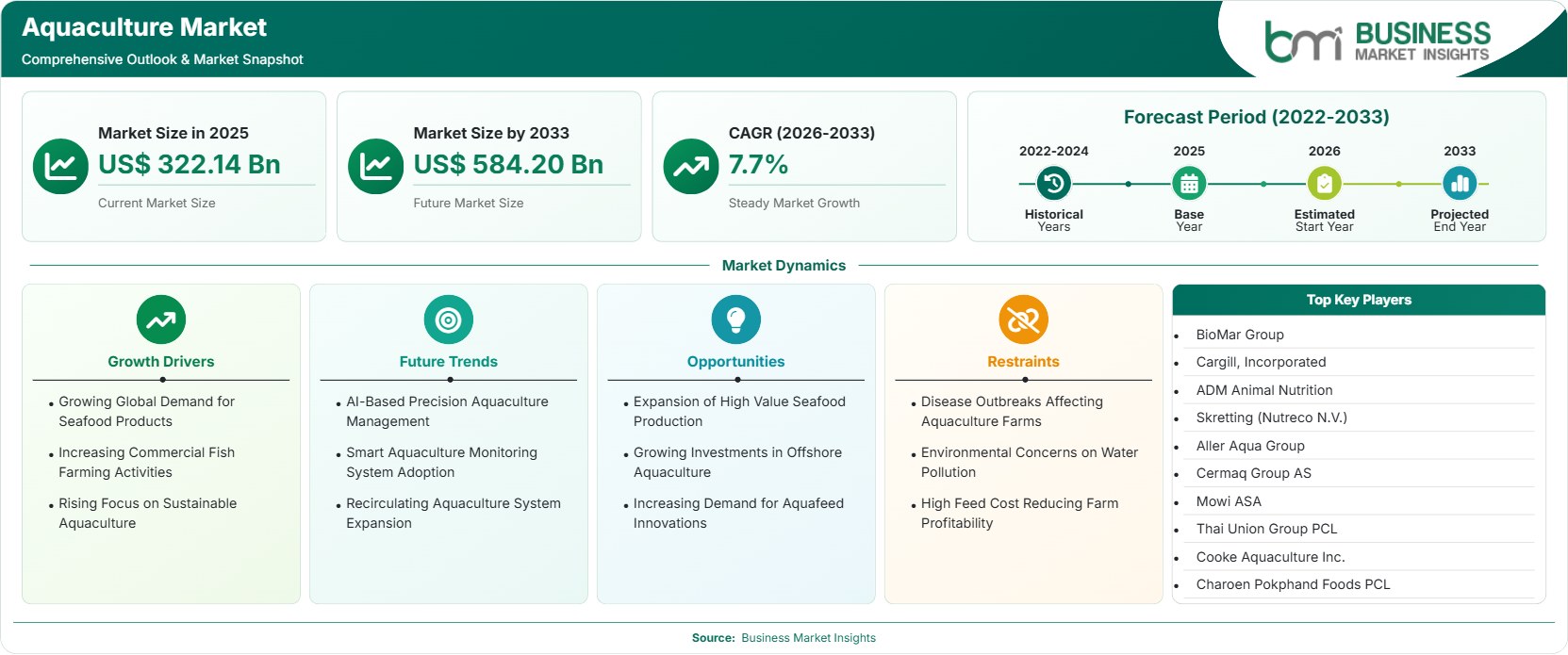
The Aquaculture Market size was valued at US$ 322.14 billion in 2025 and is projected to reach US$ 584.20 billion by 2033, growing at a CAGR of 7.7% from 2026 to 2033. Rising seafood consumption, expanding commercial fish farming, sustainable food production initiatives, and technological advancements in aquaculture systems are driving market expansion while creating opportunities across marine farming, aquafeed innovation, and high-value seafood production.

Report Coverage
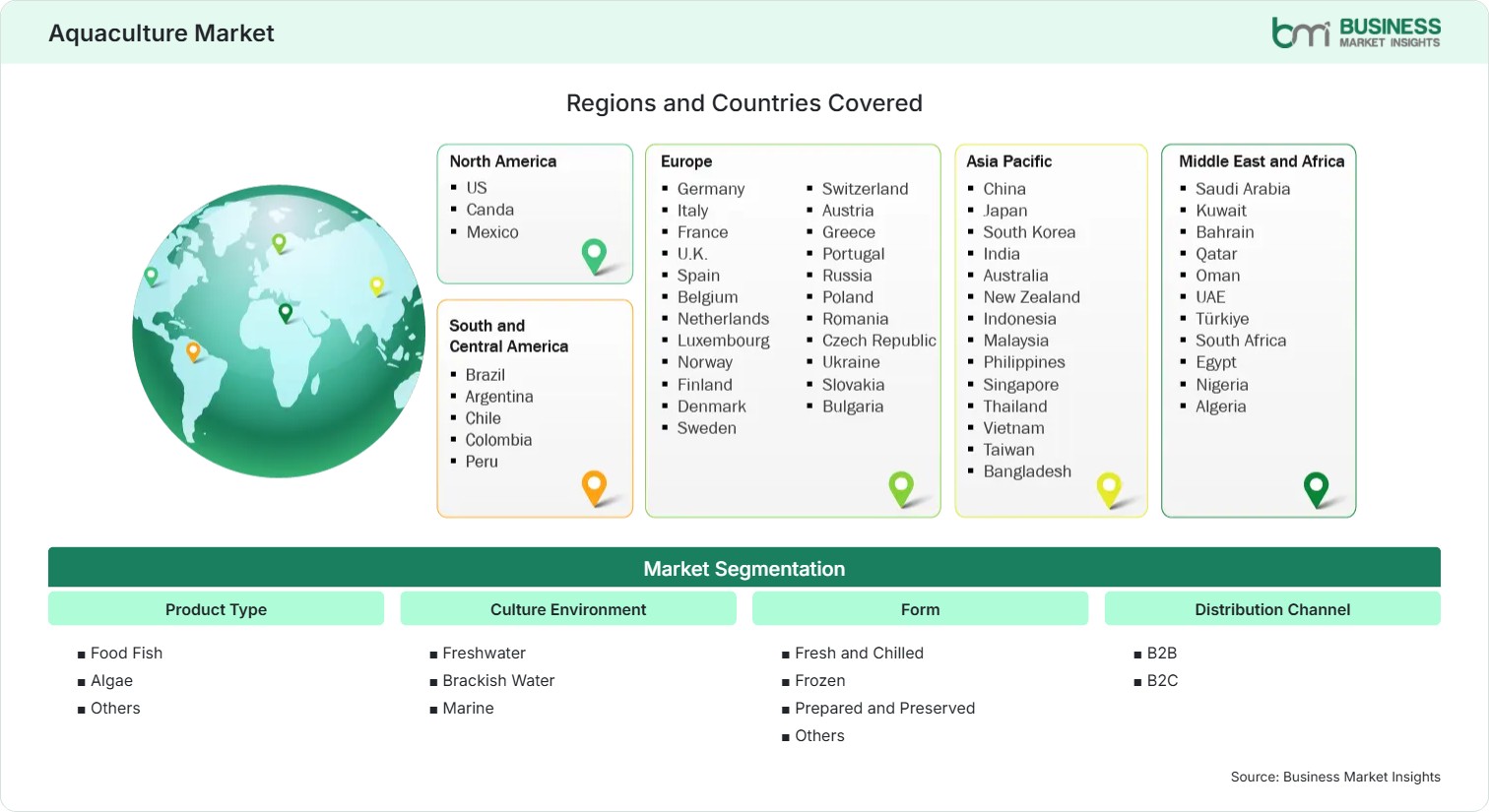
  • Product Type: Food Fish, Algae, Others
  • Culture Environment: Freshwater, Brackish Water, Marine
  • Form: Fresh and Chilled, Frozen, Prepared and Preserved, Others
  • Distribution Channel: B2B, B2C
US$ 322.14 Bn Market size in 2025
US$ 584.20 Bn Market Size by 2033
7.7% CAGR, 2026 - 2033
2026-2033 Forecast Period

01 AI Overview

Aquaculture Market Summary

  • North America Region: North America holds approximately 18%–21% market share in 2025 and is projected to grow at a CAGR of 6.8%–7.4% from 2026–2033, supported by sustainable seafood demand, advanced farming technologies, aquaculture investments, and regulatory support for domestic seafood production. The US market benefits from increasing shellfish farming, recirculating aquaculture system adoption, and seafood supply diversification, supporting a CAGR of 7.0%–7.5% during the forecast period.
  • Fastest Growing Region: Asia Pacific accounts for approximately 55%–58% market share in 2025 and is projected to expand at a CAGR of 8.0%–8.5% from 2026–2033, driven by rising seafood consumption, established aquaculture production networks, population growth, and increasing investments in sustainable farming practices.
  • Leading Segment: Food Fish represents approximately 82%–85% market share in 2025 and is expected to grow at a CAGR of 7.5%–7.9% from 2026–2033, supported by increasing protein demand, commercial fish farming expansion, and consumer preference for seafood-based nutrition.
  • High Growth Segment: Algae represents approximately 5%–8% market share in 2025 and is projected to grow at a CAGR of 9.0%–10.0% from 2026–2033, driven by demand for alternative proteins, nutritional ingredients, bio-based products, and sustainable feed applications.
  • Key Market Opportunity: Expansion of offshore aquaculture, increasing production of premium seafood species, and development of advanced aquafeed technologies are creating opportunities for companies investing in sustainable and scalable farming solutions.
  • Major Market Players: BioMar Group; Cargill, Incorporated; ADM Animal Nutrition; Skretting (Nutreco N.V.); Aller Aqua Group; Cermaq Group AS; Mowi ASA; Thai Union Group PCL; Cooke Aquaculture Inc.; Charoen Pokphand Foods PCL.
02 Strategic Insights

Aquaculture Market: Strategic Insights

Aquaculture Market Strategic Framework
FREE PDF
Request your free sample
Request free sample
03 Stakeholder View

Key Takeaways

  • The market ecosystem is becoming increasingly integrated, connecting hatcheries, feed manufacturers, farming operators, processing companies, logistics providers, and seafood distributors. Companies with strong value chain coordination are improving production efficiency, traceability, and supply reliability.
  • High-value seafood species, algae cultivation, and premium aquaculture products represent attractive growth opportunities as consumers seek nutritious protein sources and sustainable seafood alternatives. Producers are focusing on species diversification and value-added seafood offerings.
  • Innovation is shifting toward precision aquaculture technologies, automated feeding systems, water monitoring platforms, genetic improvement programs, and advanced aquafeed formulations. These solutions are helping operators improve productivity while reducing resource consumption.
  • Asia Pacific remains the most attractive regional investment destination due to established aquaculture infrastructure, strong seafood consumption patterns, and expanding production capacity. Countries including China, India, Vietnam, and Indonesia are strengthening their roles in global seafood supply chains.
  • Strategic investments and consolidation activities are increasing as seafood producers, feed manufacturers, and technology providers pursue capacity expansion, sustainable production capabilities, and international market access.
  • Sustainability-focused production models are becoming central to industry competitiveness as regulators, retailers, and consumers increasingly prioritize responsible seafood sourcing, environmental management, and transparent supply chains.
04 Geographic Outlook

Aquaculture Market Regional Highlights

North America Aquaculture Market

North America accounts for approximately 18%–21% of the global Aquaculture Market share in 2025 and is projected to grow at a CAGR of 6.8%–7.4% from 2026–2033. The region is supported by increasing seafood consumption, domestic production initiatives, technological adoption, and demand for sustainable seafood sources. The United States and Canada are investing in shellfish farming, land-based systems, and improved aquaculture infrastructure to reduce reliance on imports.

  • The United States is expanding domestic aquaculture production through investments in sustainable fish farming technologies and alternative seafood supply models.
  • Canada maintains strong aquaculture activity through salmon farming operations, advanced production systems, and export-oriented seafood businesses.
  • Adoption of recirculating aquaculture systems is increasing due to improved resource efficiency and controlled production environments.
  • Sustainable seafood certification programs are encouraging producers to implement responsible farming practices and enhance consumer confidence.

US Aquaculture Market

The US Aquaculture Market represents approximately 12%–15% of global demand in 2025 and is expected to grow at a CAGR of 7.0%–7.5% from 2026–2033. Growth is supported by rising seafood consumption, government initiatives supporting domestic production, and increasing investment in innovative farming technologies. The country continues expanding shellfish, finfish, and land-based aquaculture operations to strengthen seafood supply resilience.

  • Shellfish farming contributes significantly to US aquaculture production through oysters, mussels, and other sustainable seafood products.
  • Land-based aquaculture systems are gaining investment due to controlled production advantages and reduced environmental impact.
  • Food service demand is increasing consumption opportunities for domestically produced seafood products.
  • Technology providers are supporting farms through automation, monitoring systems, and operational efficiency solutions.

Europe Aquaculture Market

Europe holds approximately 15%–18% market share in 2025 and is projected to grow at a CAGR of 6.5%–7.2% from 2026–2033. The region benefits from established seafood industries, strong sustainability standards, and increasing demand for responsibly produced seafood. Norway, Spain, Greece, and the United Kingdom are major contributors, with salmon, shellfish, and marine farming activities supporting regional expansion.

  • Norway remains a leading aquaculture country through advanced salmon farming capabilities and global seafood exports.
  • Spain and Greece are expanding marine aquaculture operations through fish farming and Mediterranean seafood production.
  • European sustainability regulations are encouraging environmentally responsible farming practices and improved traceability.
  • Increasing demand for premium seafood products is supporting investment in advanced aquaculture technologies.
  • Research institutions and producers are developing solutions to improve disease management and production efficiency.

Asia Pacific Aquaculture Market

Asia Pacific dominates the Aquaculture Market with approximately 55%–58% share in 2025 and is projected to grow at a CAGR of 8.0%–8.5% from 2026–2033. The region benefits from large-scale production capabilities, strong seafood consumption, favorable climatic conditions, and established farming communities. China, India, Vietnam, Indonesia, and Thailand remain important markets supporting global seafood supply chains.

  • China maintains the largest aquaculture production base through extensive freshwater and marine farming operations.
  • India is expanding shrimp and fish farming activities due to export demand and rising domestic seafood consumption.
  • Vietnam continues strengthening aquaculture exports through shrimp farming, processing capabilities, and international trade networks.
  • Indonesia is increasing investment in sustainable marine and freshwater aquaculture development.
  • Regional producers are adopting improved feed technologies and farm management systems to increase productivity.

Rest of World Aquaculture Market

Rest of World contributes approximately 8%–11% of the global Aquaculture Market share in 2025 and is projected to grow at a CAGR of 6.8%–7.5% from 2026–2033. Latin America, Middle East, and Africa are witnessing increased aquaculture investment due to food security needs, seafood export opportunities, and resource availability. Brazil, Chile, Egypt, and selected African markets are developing production capabilities.

  • Latin America is expanding aquaculture activities through shrimp and salmon production supported by export opportunities.
  • Chile remains an important seafood producer with strong salmon farming infrastructure and international market presence.
  • Middle Eastern countries are investing in aquaculture technologies to improve domestic seafood availability.
  • Egypt is developing freshwater fish farming systems to support regional food supply requirements.
  • African markets are adopting aquaculture solutions to improve protein availability and strengthen rural economic opportunities.
Global Market Geography
FREE PDF
Request your free sample
Request free sample
05 Segment Analysis

Aquaculture Market Segmentation

Product Type

Product Type segmentation includes Food Fish, Algae, and Others, representing diverse applications across seafood consumption, nutritional products, and industrial uses. Food Fish accounts for approximately 82%–85% market share in 2025 and is projected to grow at a CAGR of 7.5%–7.9% from 2026–2034, supported by rising seafood consumption, expanding fish farming activities, and increasing protein demand. The Aquaculture Market scope is expanding as producers diversify species portfolios and invest in sustainable cultivation practices to improve production efficiency and meet global food requirements.

  • Food Fish: Food fish remains the dominant product category due to increasing consumer demand for seafood protein, commercial farming expansion, and rising investments in efficient fish production systems across freshwater and marine environments.
  • Algae: Algae cultivation is gaining momentum due to applications in nutritional ingredients, animal feed, bio-based products, and alternative protein solutions. Growing sustainability initiatives are encouraging investments in algae production technologies.

Culture Environment

The Culture Environment Segmentation includes Freshwater, Brackish Water, and Marine farming systems owing to diverse environments and differing production requirements. The segment of Freshwater farming accounts for around 45%–48% of the market share in 2025 and is estimated to grow at a CAGR of 7.3%–7.8% between 2026 and 2034, driven by the availability of infrastructure for fish farming and regional demand for food production. Marine and brackish water systems continue expanding through commercial seafood production, coastal farming, and export-oriented aquaculture operations.

  • Freshwater: Freshwater aquaculture is widely adopted due to established farming practices, availability of inland resources, and strong production of species such as carp and tilapia for domestic and international markets.
  • Brackish Water: Brackish water farming is expanding through shrimp and specialty seafood production. Coastal regions are investing in improved farming techniques to increase productivity and support seafood export opportunities.
  • Marine: Marine aquaculture is gaining importance through offshore farming, advanced production systems, and increasing cultivation of high-value species. Investments in marine infrastructure are supporting long-term industry development.

Form

Form segmentation includes Fresh and Chilled, Frozen, Prepared and Preserved, and Others. The Frozen segment accounts for around 42%–45% of the market size in 2025 and is forecast to grow at a CAGR of 7.6%–8.0% during 2026–2034, owing to increased global seafood trade, longer shelf life, and enhanced cold chain networks. Aquaculture Market Trends are impacted by consumption trends and seafood formats.

  • Fresh and Chilled: Fresh and chilled aquaculture products are preferred in local markets, restaurants, and premium seafood channels. Demand is supported by consumer preference for quality, freshness, and minimally processed seafood.
  • Frozen: Frozen aquaculture products are widely adopted due to extended shelf life, efficient transportation, and global seafood distribution networks. Improvements in freezing technologies are enhancing product quality and market accessibility.
  • Prepared and Preserved: Prepared and preserved seafood products are growing through convenience food demand, ready-to-eat trends, and expanding retail seafood offerings. Manufacturers are developing value-added products to improve consumer convenience.

Distribution Channel

Distribution Channel segmentation includes B2B and B2C channels, reflecting different routes through which aquaculture products reach end users. B2B channels account for approximately 65%–68% market share in 2025 and are projected to grow at a CAGR of 7.2%–7.7% from 2026–2034, supported by seafood processors, restaurants, retailers, and institutional buyers. The segment continues benefiting from expanding commercial seafood supply chains and international trade networks.

  • B2B: B2B distribution remains dominant due to bulk seafood procurement by processors, restaurants, retailers, and food service companies. Strong supplier relationships and efficient logistics networks support continued channel expansion.
  • B2C: B2C channels are growing through online seafood platforms, direct-to-consumer models, and increasing consumer access to packaged seafood products. Digital commerce is improving product availability and customer engagement.
06 Market Forces

Aquaculture Market Dynamics

Key Market Drivers

Growing Global Demand for Seafood Products

Increased global demand for seafood is a key driver of aquaculture growth, as there is a greater need for rich sources of protein and nutrition. According to the Food and Agriculture Organization (FAO), demand for aquatic products continues to rise due to population growth, dietary shifts, and growing recognition of the nutritional value of seafood. Aquaculture is becoming increasingly important due to fisheries' inability to meet demand. Farmers have been producing more fish, shrimp, and algae to meet growing demand. The Aquaculture Market growth is supported by increasing seafood trade, improved farming efficiency, and investments in production technologies.

Increasing Commercial Fish Farming Activities

Expansion of commercial fish farming activities is accelerating market development through increased production capacity, improved farm management, and adoption of advanced cultivation technologies. Farmers are investing in hatchery improvements, automated feeding systems, water monitoring solutions, and optimized breeding techniques to enhance productivity. Rising demand for species such as salmon, tilapia, shrimp, and carp is encouraging producers to establish large-scale farming operations. Government programs focused on food security and aquaculture production are contributing to growth in the industry in developing countries. There is a trend among commercial aquaculture producers to use data-driven management to solve problems and meet market demands.

Rising Focus on Sustainable Aquaculture

Growing awareness regarding sustainable fish production is fostering environmentally friendly aquaculture practices. Farmers have started using higher-quality feed formulas, improved waste disposal methods, renewable energy sources, and responsible farming standards to ensure a low environmental impact. Retailer sustainability certifications and standards are shaping production processes in the global seafood supply chain. Organizations have begun using technologies that improve water management, reduce feed waste, and provide traceability on farms. The importance attached to sustainable production processes is helping to boost consumer trust and aid sustainable development in the industry.

Key Market Opportunities

Expansion of High Value Seafood Production

Increasing production of premium seafood species is creating opportunities for aquaculture companies to improve profitability and diversify product portfolios. The demand for high-value species such as salmon, prawns, oysters, and exotic fish has been growing in both domestic and foreign seafood markets. Producers are making heavy investments in new breeding technology, environmental-control farms, and quality-enhancement programs. Developing nations with disposable income will continue to drive demand for premium seafood. Companies focused on cost efficiency and quality control can tap into this market opportunity.

Growing Investments in Offshore Aquaculture

Offshore aquaculture is emerging as a significant opportunity due to increasing demand for scalable seafood production and limited availability of suitable coastal farming areas. Companies are exploring offshore farming facilities that incorporate state-of-the-art cages and monitoring equipment, as well as automated operational systems, to boost production capabilities. More and more investments are being made in offshore farms as governments and investors seek sustainable solutions to improve seafood logistics. Offshore farms offer an opportunity to develop farming areas while increasing production efficiency, which is expected to aid future offshore aquaculture market forecasts.

Increasing Demand for Aquafeed Innovations

Growing demand for efficient and sustainable aquafeed solutions is creating opportunities for feed manufacturers to develop advanced nutritional products. Innovation in aquafeed technology includes the use of alternative protein sources, improved feed conversion ratios, the use of additives, and consideration of the nutritional requirements of different species. Companies are looking for ways to develop feeds that increase growth efficiency while minimizing environmental impacts and operational costs. Companies are researching how to replace traditional ingredient sources with more sustainable alternatives, such as algae- and plant-based ingredients. The expansion of intensive aquaculture farming systems is increasing the importance of high-quality feed technologies that support healthier stocks and improved production efficiency.

Market Restraints and Challenges

Disease Outbreaks Affecting Aquaculture Farms

Disease outbreaks remain a major challenge for aquaculture operators by affecting productivity, profitability, and supply stability. Factor: Increased farming density, changing environmental conditions, pathogen transmission, and limited disease prevention capabilities can increase vulnerability across aquaculture facilities. Impact: Disease incidents can result in production losses, higher operational costs, reduced farmer profitability, and supply disruptions for seafood markets. Companies are addressing these risks through improved biosecurity measures, vaccination programs, genetic selection, and advanced monitoring systems. However, disease management remains a critical operational challenge as farms expand production capacity and adopt intensive cultivation methods.

Environmental Concerns on Water Pollution

Environmental concerns related to water pollution create challenges for aquaculture expansion by increasing regulatory pressure and operational requirements. Factor: Excess feed usage, organic waste accumulation, chemical discharge, and nutrient loading from intensive farming activities can affect surrounding aquatic ecosystems. Impact: Environmental impacts may result in stricter regulations, increased compliance costs, and limitations on farming expansion in sensitive regions. Producers are responding through improved waste management systems, sustainable feed practices, water treatment technologies, and responsible farm management approaches. Maintaining environmental balance while increasing production capacity remains essential for long-term aquaculture development and industry acceptance.

07 Company Analysis

Competitive Landscape

The Aquaculture Market analysis shows that the key players are focusing on sustainable production systems, advanced nutritional solutions, diversification of species, and expanding their global supply chains.

Company Name

Overview

Products and Services relevant to this market

BioMar Group

A global aquafeed manufacturer specializing in nutrition solutions for sustainable aquaculture production.

Provides fish feed, shrimp feed, nutritional solutions, feed additives, and species-specific aquaculture nutrition products.

Cargill, Incorporated

A global food and agriculture company providing aquaculture nutrition and supply chain solutions.

Offers aquafeed products, animal nutrition solutions, sustainable sourcing programs, and farm support services.

ADM Animal Nutrition

A nutrition solutions provider supporting livestock and aquaculture industries through advanced feed technologies.

Supplies aquafeed ingredients, nutritional formulations, feed additives, and sustainable ingredient solutions.

Skretting (Nutreco N.V.)

A leading aquafeed company focused on innovative nutrition solutions for fish and shrimp farming.

Provides aquaculture feed, functional diets, hatchery nutrition, and farming support technologies.

Aller Aqua Group

An international aquafeed producer specializing in feed solutions for freshwater and marine species.

Manufactures fish feed, customized nutrition programs, and feed products for commercial aquaculture farms.

Cermaq Group AS

A global aquaculture company focused on responsible salmon farming and seafood production.

Produces farmed salmon, operates aquaculture facilities, and develops sustainable seafood production practices.

Mowi ASA

A leading seafood company specializing in salmon farming, processing, and global seafood distribution.

Provides farmed salmon products, aquaculture operations, seafood processing, and sustainable farming solutions.

Thai Union Group PCL

A global seafood company involved in aquaculture, processing, and seafood product distribution.

Offers seafood products, aquaculture-related operations, processed seafood, and international distribution services.

Cooke Aquaculture Inc.

A seafood farming company specializing in sustainable marine aquaculture production.

Produces farmed salmon and seafood products while providing aquaculture farming and processing capabilities.

Charoen Pokphand Foods PCL

A global food company involved in integrated aquaculture production and seafood supply chains.

Provides shrimp farming solutions, aquaculture products, animal feed, and processed seafood offerings.

08 Industry Activity

Recent Developments

June 2026:

NOAA announced the University of New Hampshire as host institution for the new NOAA Cooperative Institute Fostering Aquaculture Research and Markets (CIFARM) to expand NOAA’s impact and strengthen efforts to boost American seafood competitiveness.

January 2026:

Farm Forward launched a new campaign focused on the global aquaculture industry in partnership with the Aquaculture Accountability Project (AAP).

December 2025:

Skretting and Longyang Fresh, China’s largest trout producer, have officially signed an upgraded strategic cooperation agreement, advancing sustainable aquaculture practices for trout farmed on the Qinghai-Tibet Plateau.

October 2025:

The Asian Institute of Technology (AIT) has launched a transformative new initiative to accelerate sustainable aquaculture development in Africa, leveraging cutting-edge science, capacity building, and policy innovation.

10 Trust & Transparency

Research Methodology

The market analysis combines proprietary research with secondary data from government agencies, company disclosures, regulatory filings, industry databases and expert interviews. Market estimates are validated through data triangulation, cross-market benchmarking and analyst review.

View Full Research Methodology

11 Questions Answered

Frequently Asked Questions

What does the Aquaculture Market Report cover?

The Market Report covers market size, segmentation, regional outlook, competitive analysis, growth drivers, opportunities, restraints, industry developments, and future market trends from 2026 to 2033.

What opportunities exist in offshore aquaculture?

Offshore aquaculture provides opportunities for expanding production capacity, utilizing new farming locations, improving seafood supply security, and supporting sustainable large-scale cultivation systems.

How is technology transforming aquaculture production?

Technologies such as automated feeding systems, digital farm monitoring, improved breeding methods, and water quality management solutions are helping producers improve productivity and sustainability.

Which product type dominates the Market?

Food Fish represents the leading product category due to high global seafood consumption, established farming infrastructure, and increasing demand for protein-rich aquatic food products.

What is driving growth in the Aquaculture Market?

Growth is driven by rising seafood consumption, increasing commercial fish farming activities, sustainable food production initiatives, advanced aquafeed technologies, and growing investments in efficient aquaculture systems.

Access the Full Aquaculture Market Report

Get segment-level forecasts, regional estimates, competitive benchmarking, company profiles and downloadable Excel datasets.

Access the full Aquaculture Market Report
350 pages PDF & Excel | 2026-07-28