
Aquaculture Fertilizer Market Outlook: Size, Share, Trends, Growth Analysis, Competitive Landscape & Forecast, 2026–2033

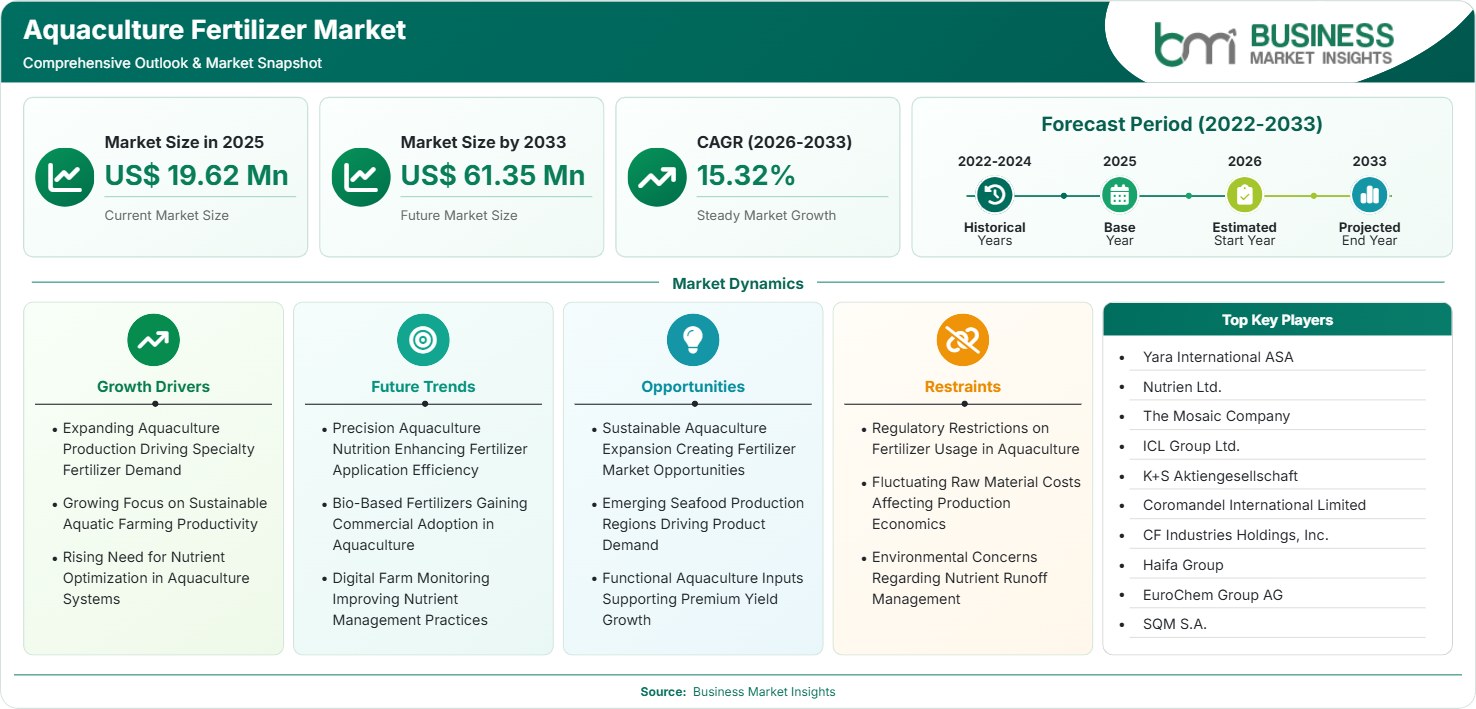
The Aquaculture Fertilizer Market size was valued at US$ 19.62 Million in 2025 and is projected to reach US$ 61.35 Million by 2033, growing at a CAGR of 15.32% during 2026–2033, driven by expanding aquaculture production, sustainable nutrient management, rising seafood consumption, and demand for productivity-enhancing fertilizer formulations.

Report Coverage
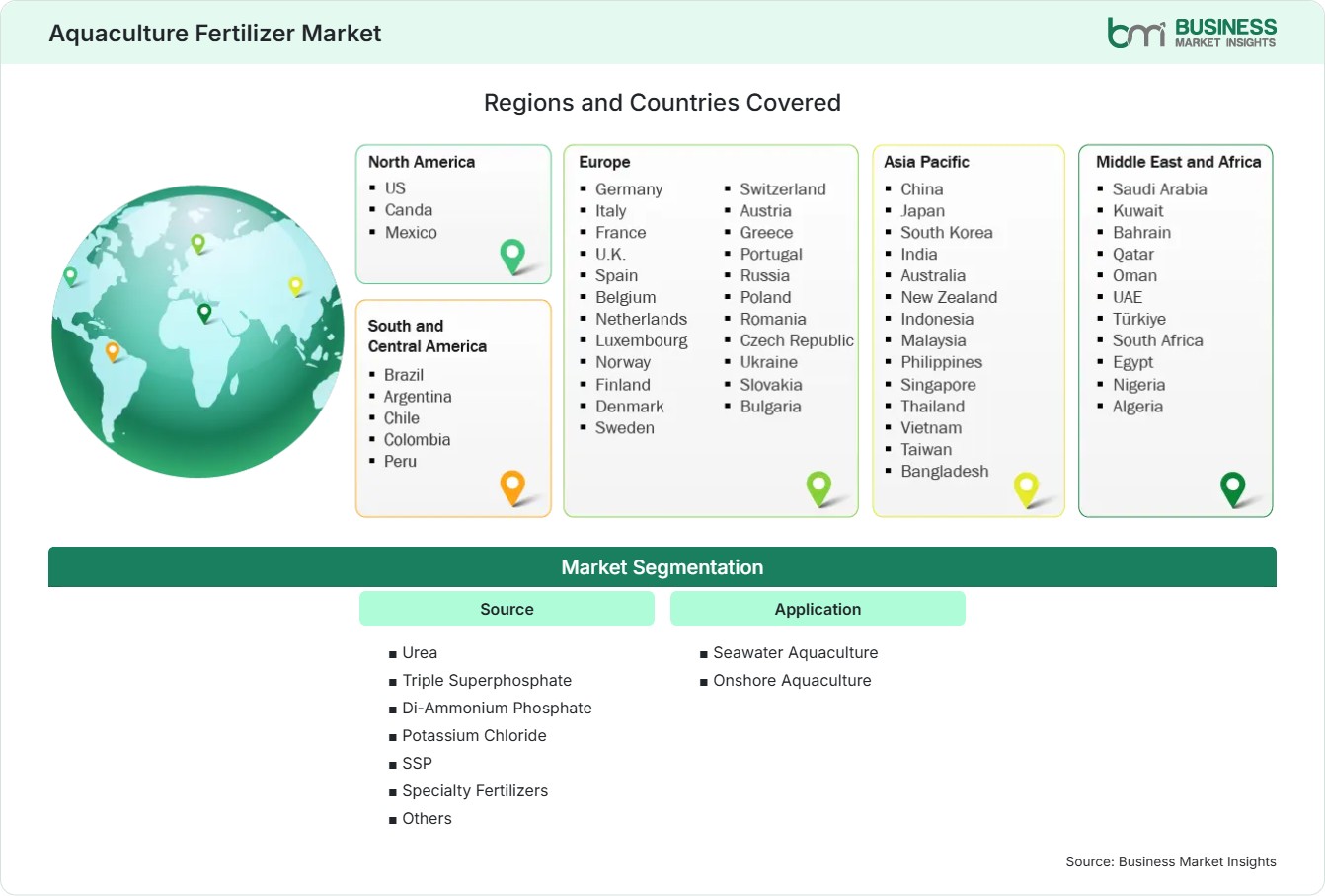
  • Source: Urea, Triple Superphosphate, Di-Ammonium Phosphate, Potassium Chloride, SSP, Specialty Fertilizers, Others
  • Application: Seawater Aquaculture, Onshore Aquaculture
US$ 19.62 Mn Market size in 2025
US$ 61.35 Mn Market Size by 2033
15.32% CAGR, 2026 - 2033
2026-2033 Forecast Period

AI Overview

Aquaculture Fertilizer Market Summary

  • North America Region: North America holds 14%–17% share in 2025, growing with a CAGR of 13.80%–14.40% influenced by intensifying aquaculture operations, nutrient management, sustainable production practices, and investment in controlled farming systems. The US market expands at 14.00%–14.60% CAGR during 2026–2033, supported by commercial aquaculture modernization.
  • Fastest Growing Region: Asia Pacific accounts for 55%–59% share in 2025, expanding at a CAGR of 16.10%–16.80% supported by large aquaculture production volumes, expanding seafood consumption, intensification of farming systems, and increasing adoption of nutrient management practices.
  • Leading Segment: Urea represents 27%–30% share in 2025, registering a CAGR of 14.80%–15.40% due to broad availability, comparatively accessible pricing, established fertilizer distribution networks, and widespread use in nutrient management across aquaculture systems.
  • High Growth Segment: Specialty Fertilizers represent a high-growth source category with a CAGR of 17.00%–17.60% during 2026–2033, supported by precision nutrient management, customized formulations, improved productivity requirements, and increasing focus on sustainable aquaculture operations.
  • Key Market Opportunity: Sustainable aquaculture expansion is creating opportunities for specialized nutrient formulations, precision application technologies, and region-specific fertilizer solutions that improve productivity while supporting water quality management.
  • Major Market Players: Yara International ASA, Nutrien Ltd., The Mosaic Company, ICL Group Ltd., K+S Aktiengesellschaft, Coromandel International Limited, CF Industries Holdings, Inc., Haifa Group, EuroChem Group AG, SQM S.A.
Strategic Insights

Aquaculture Fertilizer Market: Strategic Insights

Aquaculture Fertilizer Market Strategic Framework
FREE PDF
Request your free sample
Request free sample
Stakeholder View

Key Takeaways

  • Aquaculture fertilizer demand is strengthening as producers intensify farming operations and seek improved pond productivity, nutrient availability, and aquatic biomass development.
  • Specialty fertilizers provide attractive growth potential because producers require formulations tailored to specific water conditions and cultivation environments.
  • Product innovation is shifting toward precision nutrient delivery, balanced nutrient formulations, and inputs designed to reduce unnecessary nutrient accumulation.
  • Asia Pacific offers the strongest investment opportunity because of its large aquaculture production base and expanding commercial farming infrastructure.
  • Competition is increasingly influenced by formulation performance, technical support, distribution networks, and sustainable nutrient-management capabilities.
  • Sustainable aquaculture practices are creating new opportunities for efficient fertilizer solutions that support productivity without compromising water quality.
Geographic Outlook

Aquaculture Fertilizer Market Regional Highlights

North America Aquaculture Fertilizer Market

North America accounted for 14%–17% share in 2025 and is projected to grow at a CAGR of 13.80%–14.40% during 2026–2033. The region benefits from commercial aquaculture modernization, controlled farming practices, and increasing emphasis on sustainable production. The Aquaculture Fertilizer Market share is supported by demand for efficient nutrient management and improved productivity across onshore and seawater operations.

  • The United States represents the leading regional market due to expanding commercial aquaculture activity, technology adoption, and increasing interest in sustainable seafood production.
  • Canada contributes through marine aquaculture operations, particularly salmon farming, where nutrient and water management practices support productivity.
  • Producers are increasingly evaluating application-specific fertilizers to improve nutrient utilization and reduce excessive nutrient accumulation within farming environments.
  • Investment in recirculating and controlled aquaculture systems is encouraging demand for more precisely managed nutrient inputs.

US Aquaculture Fertilizer Market

The US Aquaculture Fertilizer Market represented 11%–14% share of global demand in 2025 and is expected to register a CAGR of 14.00%–14.60% from 2026–2033. Commercial aquaculture development, seafood demand, and investments in sustainable production systems are supporting growth. Producers increasingly prioritize controlled nutrient application, water quality management, and productivity improvements across domestic farming operations.

  • Commercial producers are adopting more structured nutrient-management practices to support productivity while maintaining water quality within intensive farming environments.
  • Growth in land-based aquaculture is creating opportunities for specialized nutrient solutions designed around controlled production conditions.
  • Sustainability initiatives are encouraging farmers to evaluate fertilizer efficiency, application timing, and nutrient balance rather than relying solely on conventional inputs.

Europe Aquaculture Fertilizer Market

Europe accounted for 18%–21% share in 2025 and Europe Aquaculture Fertilizer Market forecast to expand at a CAGR of 13.20%–13.80% during 2026–2033. The region is influenced by sustainable aquaculture policies, environmental monitoring, and increasing focus on resource-efficient seafood production. Norway, Spain, France, and Greece are important markets, while Poland and selected Mediterranean countries provide additional growth potential. The Market growth is increasingly linked to controlled nutrient management.

  • Norway remains an important aquaculture market because of its large salmon farming industry and advanced production infrastructure.
  • Spain and Greece support demand through established marine farming industries and increasing emphasis on efficient production practices.
  • European producers are increasingly focused on reducing environmental impacts associated with nutrient management and aquaculture operations.
  • Regulatory frameworks encouraging sustainable seafood production are supporting adoption of more controlled and efficient production inputs.

Asia Pacific Aquaculture Fertilizer Market

Asia Pacific represented 55%–59% share in 2025 and is projected to achieve a CAGR of 16.10%–16.80% during 2026–2033. The region benefits from extensive aquaculture production, rising seafood consumption, expanding farming infrastructure, and increasing commercialization. China, India, Indonesia, and Vietnam are major markets, while Thailand and the Philippines provide additional growth opportunities. The Aquaculture Fertilizer Market trend remains closely connected to regional aquaculture expansion.

  • China leads regional demand because of its extensive aquaculture production base and large-scale adoption of pond-based farming systems.
  • India offers strong potential through expanding inland and coastal aquaculture, rising seafood production, and increasing commercial farming investments.
  • Indonesia and Vietnam are important markets due to shrimp, fish, and other aquatic species production across diverse farming environments.
  • Southeast Asian producers are increasingly focusing on productivity optimization and sustainable nutrient-management practices.

Rest of World Aquaculture Fertilizer Market

Rest of World accounted for 7%–10% share in 2025 and is expected to grow at a CAGR of 13.00%–13.70% during 2026–2033. South and Central America are benefiting from expanding shrimp and fish production, particularly in Brazil, Ecuador, and Mexico. Middle Eastern and African markets are developing through aquaculture investments, food security initiatives, and growing interest in domestic seafood production.

  • Brazil and Ecuador are important markets because expanding shrimp and fish farming operations require improved productivity and nutrient-management solutions.
  • Mexico is developing commercial aquaculture capacity, creating additional demand for farm inputs supporting intensive and semi-intensive production systems.
  • Egypt and Saudi Arabia provide emerging opportunities as governments and private investors increase aquaculture capacity to strengthen domestic seafood supply.
  • African markets offer longer-term potential as infrastructure, technical capabilities, and commercial aquaculture investment continue developing.
Global Market Geography
FREE PDF
Request your free sample
Request free sample
Segment Analysis

Aquaculture Fertilizer Market Segmentation

Source

Source segment accounted for 27%–30% share in 2025 and is projected to grow at a CAGR of 14.80%–15.40% between 2026–2033. Demand is shaped by nutrient requirements, fertilizer availability, farm economics, and water conditions. Specialty formulations are gaining importance as producers increasingly seek targeted nutrient management and improved application efficiency across commercial aquaculture systems.

  • Urea: Urea remains widely used as an accessible nitrogen source for pond fertilization. Its established availability and cost familiarity support adoption where nitrogen supplementation is required.
  • Triple Superphosphate: Triple Superphosphate provides concentrated phosphorus for aquaculture fertilization. Demand is supported by applications requiring phosphorus supplementation to stimulate biological productivity.
  • Di-Ammonium Phosphate: Di-Ammonium Phosphate supplies nitrogen and phosphorus simultaneously, supporting balanced nutrient management. Its dual-nutrient profile can simplify fertilizer application in pond systems.
  • Potassium Chloride: Potassium Chloride addresses potassium requirements in selected aquaculture environments. Adoption is influenced by water chemistry, soil conditions, and farm-specific nutrient deficiencies.
  • SSP: SSP provides phosphorus alongside calcium and sulfur, supporting nutrient availability in selected pond environments. Its application depends on local water and soil characteristics.
  • Specialty Fertilizers: Specialty fertilizers are gaining attention through customized nutrient combinations and application-specific formulations. Precision-oriented products support producers seeking improved efficiency and sustainability.

Application

Application segment is expanding as producers adopt differentiated nutrient-management approaches across seawater and onshore farming environments. The segment is projected to register a CAGR of 15.00%–15.60% during 2026–2033. Application conditions influence fertilizer selection because salinity, water exchange, pond characteristics, species requirements, and farming intensity can alter nutrient requirements across production systems.

  • Seawater Aquaculture: Seawater aquaculture requires nutrient management adapted to saline conditions and marine species. Fertilizer use supports biological productivity in selected pond and coastal farming systems.
  • Onshore Aquaculture: Onshore aquaculture is increasing through pond and controlled farming systems requiring managed nutrient inputs. Fertilizer solutions can support productivity while maintaining appropriate water-quality conditions.
Market Forces

Aquaculture Fertilizer Market Dynamics

Key Market Drivers

Expanding Aquaculture Production Driving Specialty Fertilizer Demand

Expansion of commercial aquaculture production is increasing demand for fertilizers that support nutrient availability and biological productivity within farming environments. Rising production of shrimp, fish, and other aquatic species requires producers to optimize pond conditions and maintain suitable nutrient balances. Specialty fertilizers are gaining attention where conventional products cannot adequately address specific farm conditions. This shift toward application-specific inputs is strengthening the Aquaculture Fertilizer Market growth by increasing demand for products capable of supporting productivity while improving nutrient-use efficiency.

Growing Focus on Sustainable Aquatic Farming Productivity

Increasing emphasis on sustainable aquaculture is encouraging producers to improve productivity while controlling environmental impacts associated with farming operations. Nutrient management is becoming an important component of sustainable production because excessive or poorly timed fertilizer application can contribute to water-quality problems. Producers are therefore seeking formulations and application practices that provide nutrients more efficiently. Fertilizer manufacturers have an opportunity to develop products supported by application guidance, nutrient-balancing tools, and farm-specific recommendations. These developments are reinforcing demand for solutions that improve productivity without increasing unnecessary nutrient losses.

Rising Need for Nutrient Optimization in Aquaculture Systems

Increasing adoption of intensive and semi-intensive farming systems is creating greater demand for precise nutrient management. Producers must balance nitrogen, phosphorus, potassium, and other nutrients according to species requirements, water characteristics, stocking density, and farming conditions. Poor nutrient balance can reduce biological productivity or create undesirable water-quality conditions, making accurate application increasingly important. Technical support from suppliers is also becoming more valuable as producers seek guidance on dosage, timing, and formulation selection.

Key Market Opportunities

Sustainable Aquaculture Expansion Creating Fertilizer Market Opportunities

Expansion of sustainable aquaculture practices is creating opportunities for fertilizer manufacturers to develop products aligned with resource-efficient farming models. Producers increasingly need nutrient solutions that support productivity while helping manage water quality and reduce unnecessary nutrient inputs. Suppliers can also strengthen market positions by providing technical services covering nutrient assessment, application timing, and farm management. As sustainability becomes increasingly important to seafood producers and buyers, fertilizer companies capable of demonstrating efficient nutrient utilization can gain competitive advantages across developing aquaculture markets.

Emerging Seafood Production Regions Driving Product Demand

Expansion of seafood production in emerging regions is opening new opportunities for fertilizer suppliers. Countries increasing aquaculture capacity require reliable access to farm inputs, technical expertise, and distribution infrastructure. Latin America, South Asia, Southeast Asia, the Middle East, and Africa offer opportunities where governments and private investors are developing domestic aquaculture to strengthen food security and reduce dependence on seafood import. Early investment in emerging production regions can provide suppliers with stronger relationships and distribution positions as commercial aquaculture expands.

Functional Aquaculture Inputs Supporting Premium Yield Growth

Demand for functional aquaculture inputs is creating opportunities for higher-value fertilizer products designed to address specific production objectives. Producers increasingly seek solutions that combine nutrient efficiency with improved pond productivity, water management, or compatibility with intensive farming practices. Manufacturers can differentiate through controlled nutrient release, customized nutrient ratios, micronutrient enrichment, and farm-specific formulations. Integration with digital monitoring and precision aquaculture technologies can further improve application accuracy.

Market Restraints and Challenges

Regulatory Restrictions on Fertilizer Usage in Aquaculture

Factor: The increasing environmental regulation of aquaculture facilities could lead to limitations regarding nutrient use, discharge, water quality, and fertilizer use in the aquatic environment. Impact: Fertilizer application might be limited by producers who have to monitor their processes or opt for fertilizers with nutrient delivery control. Fertilizer companies would face different regulatory requirements depending on countries or production facilities where they operate internationally.

Fluctuating Raw Material Costs Affecting Production Economics

Factor: Volatility in prices for nitrogen, phosphate, potash, energy, and other fertilizer feedstocks can increase manufacturing costs and create uncertainty across the aquaculture fertilizer supply chain. Impact: Higher production expenses can raise product prices, reduce farmer affordability, and pressure supplier margins, particularly in price-sensitive emerging markets. Commodity fertilizer manufacturers are exposed to global energy and raw material market movements that can rapidly change production economics.

Company Analysis

Competitive Landscape

The Aquaculture Fertilizer Market analysis indicated that the growth is driven by the international fertilizer companies that have strong competencies in nitrogen, phosphates, potash, specialized nutrients, and distribution. The competition is increasingly affected by formulating competencies, nutrient use efficiencies, sustainability positioning, technical support, and competencies to tailor conventional fertilizers for aquaculture.

Company Name

Overview

Products and Services relevant to this market

Yara International ASA

Global crop nutrition company with broad nitrogen, phosphate, potassium, and specialty fertilizer capabilities.

Provides nitrogen, NPK, specialty nutrient, water-soluble, and efficiency-focused fertilizer technologies adaptable to aquatic nutrient management.

Nutrien Ltd.

Major global fertilizer producer with integrated nitrogen, phosphate, and potash production and extensive distribution capabilities.

Supplies nitrogen, phosphate, potash, specialty nutrient products, and technical stewardship capabilities relevant to aquaculture inputs.

The Mosaic Company

Major producer of phosphate and potash fertilizers with vertically integrated mineral resource and processing operations.

Provides phosphate and potash-based fertilizer products that can support nutrient supplementation applications in aquaculture.

ICL Group Ltd.

Global specialty minerals and fertilizer producer focused on innovative nutrient technologies and efficiency-enhancing solutions.

Offers phosphate, potash, specialty fertilizers, water-soluble products, and advanced nutrient-management solutions.

K+S Aktiengesellschaft

International supplier specializing in potassium and magnesium products with extensive fertilizer manufacturing capabilities.

Provides potassium-based and specialty mineral fertilizers relevant to nutrient-balancing requirements in aquatic production systems.

Coromandel International Limited

Indian agri-solutions company with strong fertilizer manufacturing and distribution capabilities across domestic markets.

Produces nitrogen, phosphate, complex, specialty, and water-soluble fertilizers supporting diversified nutrient-management applications.

CF Industries Holdings, Inc.

Major nitrogen fertilizer producer with extensive ammonia, urea, and nitrogen solution manufacturing infrastructure.

Supplies nitrogen products including ammonia, urea, and related fertilizers applicable to nutrient supplementation requirements.

Haifa Group

Specialty fertilizer company recognized for water-soluble fertilizers and precision-oriented plant nutrition technologies.

Offers soluble NPK, potassium, phosphate, and specialty fertilizers that can support controlled nutrient-management applications.

EuroChem Group AG

Global fertilizer producer with integrated nitrogen, phosphate, and potash operations across international markets.

Provides nitrogen, phosphate, potash, and complex fertilizer products relevant to aquatic nutrient applications.

SQM S.A.

Global producer of specialty plant nutrients, potassium products, and iodine-based industrial materials.

Supplies potassium nitrate, specialty plant nutrition products, and water-soluble nutrient solutions supporting specialized applications.

Trust & Transparency

Research Methodology

The market analysis combines proprietary research with secondary data from government agencies, company disclosures, regulatory filings, industry databases and expert interviews. Market estimates are validated through data triangulation, cross-market benchmarking and analyst review.

View Full Research Methodology

Questions Answered

Frequently Asked Questions

What sustainability factors are influencing Aquaculture Fertilizer Market report?

Sustainability is encouraging development of efficient nutrient formulations, controlled application approaches, and products designed to reduce unnecessary nutrient losses while supporting aquaculture productivity and responsible water management.

How can fertilizer companies differentiate in aquaculture applications?

Companies can differentiate through specialized formulations, application guidance, technical services, nutrient-use efficiency, localized products, and solutions designed around specific species, water conditions, and production systems.

Which aquaculture applications offer the strongest fertilizer opportunities?

Onshore and pond-based systems provide strong opportunities because producers can exercise greater control over nutrient inputs, while expanding seawater farming creates additional demand for application-specific nutrient solutions.

How does aquaculture intensification affect fertilizer demand?

Higher stocking densities and increased production intensity can create greater requirements for controlled nutrient management, encouraging producers to use fertilizers that support biological productivity while maintaining appropriate water conditions.

Why is specialty fertilizer gaining importance in aquaculture?

Specialty fertilizers can provide targeted nutrient combinations suited to specific water conditions, species requirements, and farming intensities, enabling producers to improve nutrient management beyond conventional fertilizer applications.

Access the Full Aquaculture Fertilizer Market Report

Get segment-level forecasts, regional estimates, competitive benchmarking, company profiles and downloadable Excel datasets.

Access the full Aquaculture Fertilizer Market Report
350 pages PDF & Excel | 2026-08-20
Similar Research

Related Market Reports