
Wasabi Market Outlook: Size, Share, Trends, Growth Analysis, Competitive Landscape & Forecast, 2026-2033

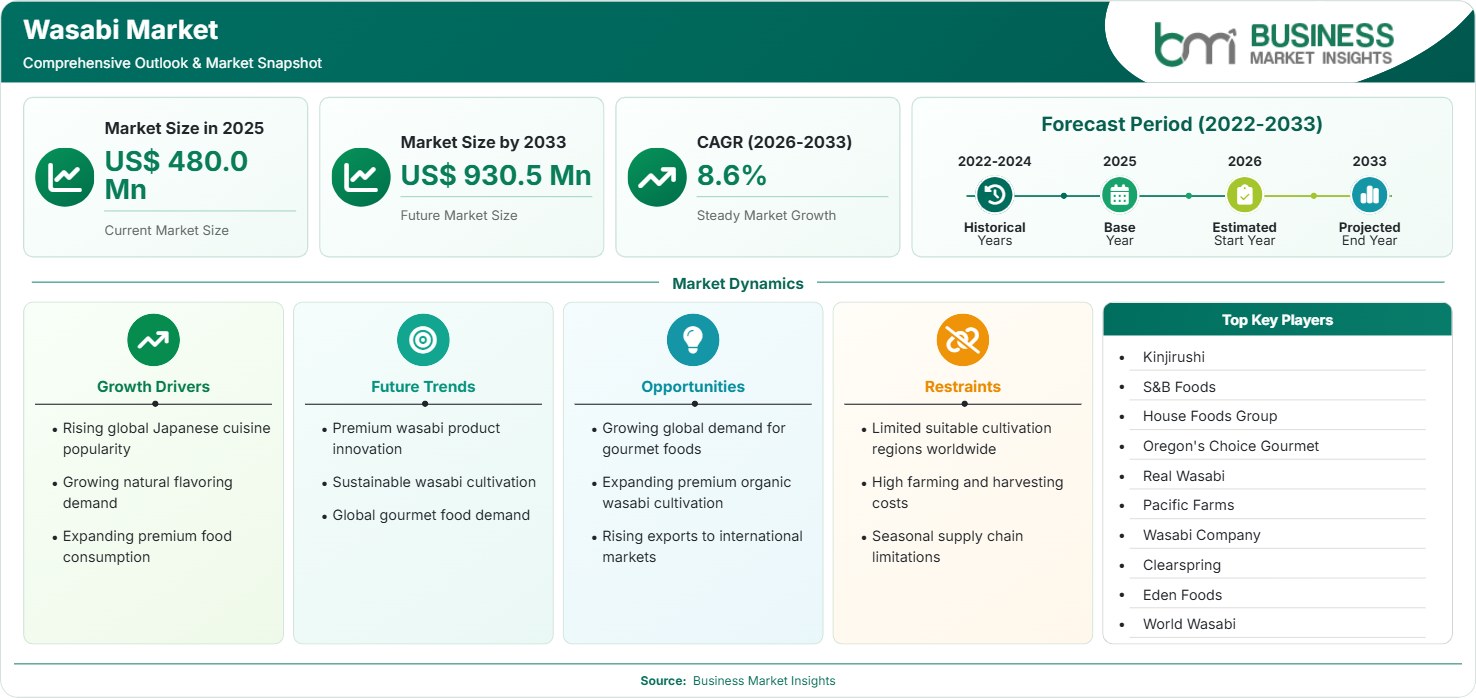
The Wasabi Market size was valued at US$ 480.0 Million in 2025 and is projected to reach US$ 930.5 Million by 2033, growing at a CAGR of 8.62% during 2026–2033. Market expansion is supported by rising Japanese cuisine popularity, growing demand for natural flavoring ingredients, increasing premium food consumption, expansion of organic cultivation, and rising international exports.

Report Coverage
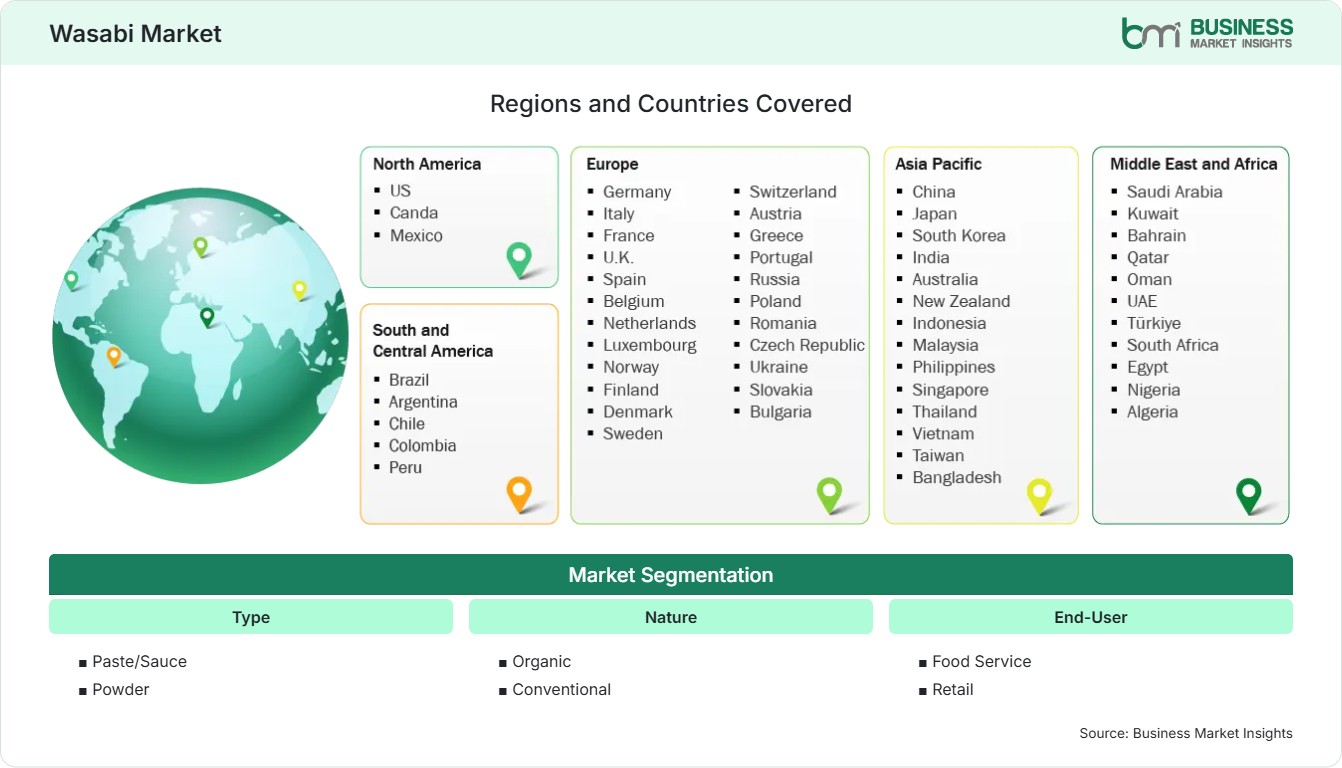
  • Type: Paste/Sauce, Powder
  • Nature: Organic, Conventional
  • End-User: Food Service, Retail
US$ 480.0 Mn Market size in 2025
US$ 930.5 Mn Market Size by 2033
8.6% CAGR, 2026 - 2033
2026-2033 Forecast Period

AI Overview

Wasabi Market Summary

  • North America Region: North America holds 28%–31% market share in 2025 and is projected to grow at a CAGR of 8.1%–8.6% during 2026–2033, supported by increasing Japanese restaurant penetration, premium condiment demand, and consumer preference for authentic ingredients. The United States market is expected to expand at a 8.2%–8.7% CAGR due to rising sushi consumption, specialty food retail expansion, and gourmet ingredient adoption.
  • Fastest Growing Region: Asia Pacific accounts for 42%–45% share in 2025 and is projected to expand at a CAGR of 9.1%–9.7%, driven by traditional consumption, expanding food exports, premium agricultural practices, and increasing demand from Japan, China, and other Asian markets.
  • Leading Segment: Paste/Sauce represents 64%–67% market share in 2025 and is expected to grow at a CAGR of 8.3%–8.8%, supported by widespread food service usage, convenience demand, and established applications in Japanese cuisine.
  • High Growth Segment: Organic wasabi represents 22%–25% share in 2025 and is projected to register a CAGR of 10.2%–10.8%, driven by clean-label trends, premium pricing opportunities, and increasing consumer preference for sustainably cultivated ingredients.
  • Key Market Opportunity: Expansion of gourmet food markets, organic cultivation projects, premium condiment exports, and international culinary adoption are creating attractive opportunities for producers and specialty food companies.
  • Major Market Players: Kinjirushi, S&B Foods, House Foods Group Inc., Oregon’s Choice Gourmet, Real Wasabi, Pacific Farms, The Wasabi Company, Clearspring, Eden Foods, World Wasabi.
Strategic Insights

Wasabi Market: Strategic Insights

Wasabi Market Strategic Framework
FREE PDF
Request your free sample
Request free sample
Stakeholder View

Key Takeaways

  • Authentic wasabi production remains concentrated in limited geographic regions, creating opportunities for controlled cultivation technologies and specialized agricultural investments.
  • Food service applications represent the primary demand generator as restaurants, sushi chains, and premium dining establishments expand globally.
  • Organic and sustainably cultivated wasabi products are gaining consumer attention due to clean-label preferences and premium food purchasing trends.
  • Asia Pacific maintains strategic importance because of traditional consumption, established cultivation expertise, and expanding regional food exports.
  • Companies are exploring partnerships, international distribution channels, and specialty food collaborations to increase global market penetration.
  • Product diversification into sauces, powders, snacks, and ready-to-use culinary formats is expanding revenue opportunities beyond traditional applications.
Geographic Outlook

Wasabi Market Regional Highlights

North America Wasabi Market

North America accounted for 28%–31% of global revenue in 2025 and is projected to expand at a CAGR of 8.1%–8.6% through 2033. The Wasabi Market share in the region is supported by growing Japanese cuisine adoption, increasing sushi restaurant numbers, premium condiment demand, and consumer interest in authentic international flavors. Retail availability of specialty food products and expansion of gourmet dining experiences continue strengthening regional growth.

  • The United States remains the largest regional market due to expanding Japanese restaurants and growing demand for premium culinary ingredients.
  • Specialty grocery retailers are increasing availability of authentic wasabi products to meet consumer interest in global cuisines.
  • Food manufacturers are introducing wasabi-flavored snacks, sauces, and seasonings to diversify product portfolios.
  • Premium restaurants continue increasing demand for high-quality fresh and processed wasabi products.

US Wasabi Market

The United States represented 24%–27% of global revenue in 2025 and is forecast to grow at a CAGR of 8.2%–8.7% during 2026–2033. Growing sushi consumption, increasing restaurant diversification, premium food trends, and expanding specialty food distribution channels support market expansion. Demand is also benefiting from consumer preference for authentic ingredients and interest in unique flavor experiences.

  • Sushi restaurant expansion continues driving demand for processed and fresh wasabi products.
  • Gourmet food retailers are increasing shelf presence of premium Japanese condiments and organic flavor products.
  • Food companies are incorporating wasabi flavors into snacks, sauces, and fusion cuisine products.
  • Online specialty food platforms are improving accessibility of authentic wasabi products.

Europe Wasabi Market

Europe accounted for 16%–19% market share during 2025 and is projected to expand at a CAGR of 8.4%–8.9% through 2033. Rising interest in Japanese cuisine, premium dining experiences, and natural ingredients is supporting regional demand. The United Kingdom, Germany, and France represent key wasabi markets due to expanding Asian food consumption and growing specialty food retail channels.

  • The United Kingdom benefits from strong restaurant adoption and increasing consumer interest in Asian cuisine.
  • Germany continues expanding premium food imports through specialty retailers and culinary businesses.
  • France demonstrates increasing demand for gourmet ingredients and innovative international flavors.
  • European food manufacturers are exploring wasabi applications in premium sauces and snack products.

Asia Pacific Wasabi Market

Asia Pacific represented 42%–45% of global revenue in 2025 and is expected to register the highest growth rate at a CAGR of 9.1%–9.7% through 2033. The Wasabi Market growth is driven by traditional consumption patterns, established cultivation expertise, expanding food exports, and increasing premium food demand. Japan remains the dominant producer and consumer, while China and other Asian economies are developing commercial cultivation opportunities.

  • Japan maintains leadership through traditional cultivation regions, premium-quality production, and established culinary applications.
  • China is increasing investment in controlled cultivation methods to expand domestic production capabilities.
  • South Korea and Southeast Asian countries are experiencing rising demand through Japanese restaurant expansion.
  • Regional exporters are strengthening international supply chains for processed wasabi products.
  • Agricultural technology adoption is improving cultivation efficiency in challenging growing environments.

Rest of World Wasabi Market

The Rest of World region accounted for 6%–8% market share in 2025 and is expected to grow at a CAGR of 8.5%–9.0% during 2026–2033. Latin America, the Middle East, and Africa are witnessing gradual adoption due to expanding international cuisines, premium food consumption, and growth of hospitality sectors. Limited cultivation conditions continue encouraging reliance on imports and processed products.

  • Brazil and Mexico are increasing demand through expanding Japanese restaurants and premium food channels.
  • Middle Eastern markets are adopting specialty ingredients through luxury hospitality and culinary sectors.
  • African urban centers are experiencing gradual growth in international cuisine consumption.
  • Importers are strengthening distribution networks to improve availability of authentic wasabi products.
  • Premium food retailers are creating new opportunities for specialty condiment suppliers.
Global Market Geography
FREE PDF
Request your free sample
Request free sample
Segment Analysis

Wasabi Market Segmentation

Type

The type segment represents the primary product differentiation category, with processed formats driving broader global availability and consumer adoption. Paste/Sauce accounted for 64%–67% market share in 2025 and is projected to grow at a CAGR of 8.3%–8.8% through 2033. The Wasabi Market scope continues expanding as food service operators, retailers, and packaged food manufacturers increasingly adopt convenient wasabi formats that provide consistent flavor, longer shelf life, and easier preparation compared with fresh root products.

  • Paste/Sauce: Remains the dominant format due to widespread use in sushi restaurants, food service operations, ready-to-eat meals, sauces, dressings, and retail condiment categories.
  • Powder: Gains demand among food manufacturers, restaurants, and consumers seeking longer shelf life, flexible preparation options, and convenient storage characteristics.

Nature

The nature segment reflects changing consumer preferences toward sustainable agriculture, clean-label ingredients, and premium food products. Conventional wasabi remains the largest category due to established production systems and broader availability, while organic products are gaining momentum through increasing demand for environmentally responsible and naturally produced ingredients.

  • Organic: Experiences accelerated adoption as consumers increasingly seek chemical-free ingredients, sustainable cultivation practices, and premium-quality specialty food products.
  • Conventional: Maintains strong market presence due to established farming practices, greater production availability, and cost advantages compared with organically cultivated alternatives.

End User

The end-user segment is shaped by increasing global adoption of Japanese cuisine, premium dining experiences, and expanding specialty food distribution. Food service remains the leading consumer category due to high-volume usage in restaurants and hospitality establishments, while retail channels are gaining importance through packaged product availability.

  • Food Service: Represents the largest application area as restaurants, sushi chains, hotels, and culinary establishments require consistent wasabi supply for diverse menu offerings.
  • Retail: Expands through supermarkets, specialty food stores, online platforms, and consumer packaged products offering convenient home preparation options.
Market Forces

Wasabi Market Dynamics

Key Market Drivers

Rising Global Japanese Cuisine Popularity

The rising popularity of Japanese food worldwide is a leading factor driving the growing use of wasabi in restaurants, retail operations, and the food processing industry. Sushi, sashimi, ramen, and dishes that combine Japanese flavors with those of other cuisines have gained popularity in many countries and contributed to the growing demand for flavoring ingredients. Restaurants and hospitality establishments are increasingly incorporating Japanese cuisine to appeal to a wide range of consumers. There is increasing demand for processed wasabi due to its convenience and longer shelf life.

Growing Natural Flavouring Demand

Growing preference for natural and easily identifiable ingredients is leading to the search by food manufacturers for genuine flavouring options like wasabi. Growing knowledge about artificial ingredients and alternatives to synthetic flavours is causing a rise in the demand for plant-based specialty ingredients. Natural wasabi flavouring is being incorporated by food manufacturers in various food types like sauces, snacks, seasoning, and ready-to-eat foods to meet the changing needs of consumers. The unique flavour profile of the ingredient creates an opportunity to position products in a premium segment within different types of foods. The factors mentioned above are making wasabi a premium natural flavoured ingredient option for food manufacturers.

Expanding Premium Food Consumption

Rising consumer spending on premium foods, gourmet ingredients, and specialty culinary products is creating favorable conditions for wasabi market trends expansion. Consumers who can afford to spend more money are looking for distinctive tastes, authentic ingredients, and restaurant-like experiences from their home kitchens. Premium grocery stores and e-commerce websites specialized in gourmet foods are making available premium and imported wasabi products easier to get. Premium brands are now capitalizing on wasabi in premium food items including snacks, sauces, condiments, and fusion cuisine. The rise in luxury hospitality, fine dining, and gourmet foods consumption is adding more value to this trend.

Key Market Opportunities

Growing Global Demand for Gourmet Foods

The expansion of gourmet food consumption provides significant opportunities for wasabi producers, distributors, and specialty food companies. Consumers are increasingly exploring premium ingredients associated with authenticity, culinary uniqueness, and international cuisine experiences. Wasabi is benefiting from this trend as restaurants and households seek distinctive flavors beyond conventional condiments. Premium supermarkets, online food platforms, and specialty retailers are expanding product availability, improving consumer access across new markets. Manufacturers can capitalize on this opportunity by developing innovative product formats, including premium pastes, ready-to-use sauces, flavored seasonings, and specialty culinary products. Increasing interest in restaurant-inspired home cooking is expected to further strengthen Wasabi Market forecasts for gourmet wasabi products.

Expanding Premium Organic Wasabi Cultivation

Organic wasabi cultivation presents a valuable opportunity as consumers increasingly prioritize sustainably produced and clean-label food ingredients. Producers are exploring controlled cultivation environments, advanced agricultural technologies, and sustainable farming methods to overcome traditional growing limitations. Premium organic wasabi commands higher pricing due to limited availability and specialized production requirements. Investments in greenhouse cultivation, hydroponic systems, and improved agricultural practices can support greater supply consistency while reducing dependence on geographically restricted growing regions. As demand for organic specialty foods continues increasing, commercially scalable organic wasabi production could create new opportunities for farmers, exporters, and premium food brands.

Rising Exports to International Markets

International export expansion represents a significant opportunity as demand for Japanese culinary ingredients continues increasing globally. Producers are strengthening supply chains, improving processing capabilities, and developing shelf-stable formats to reach overseas markets. Growth in sushi restaurants, premium food retailers, and online specialty marketplaces is creating new distribution opportunities across North America, Europe, and emerging economies. Export-oriented strategies focused on quality certification, sustainable sourcing, and reliable logistics can help suppliers expand market presence. Increasing global appreciation for authentic Japanese flavors provides long-term potential for producers capable of meeting international quality standards and maintaining consistent product availability.

Market Restraints and Challenges

Limited Suitable Cultivation Regions Worldwide

Factor: Wasabi requires specific environmental conditions including clean running water, controlled temperatures, shade, and suitable soil characteristics, limiting cultivation locations globally. Impact: Restricted growing regions create supply constraints, increase dependency on specialized farming areas, and limit large-scale production expansion. Traditional wasabi cultivation requires significant expertise and long maturation periods, making rapid supply increases difficult. Producers outside established growing regions face challenges related to climate adaptation, infrastructure investment, and cultivation knowledge. These limitations contribute to premium pricing and supply volatility. Development of controlled farming technologies may reduce geographical limitations, but cultivation complexity remains a significant challenge for market expansion.

High Farming and Harvesting Costs

Factor: Wasabi production requires intensive labor, specialized cultivation methods, long growth cycles, and careful harvesting processes. Impact: High production expenses increase retail prices and restrict accessibility among price-sensitive consumers and food service operators. Farmers must manage significant operational costs related to water management, climate control, maintenance, and quality preservation. Unlike conventional crops, wasabi requires specialized handling and expertise, limiting scalability. Rising labor costs and agricultural investment requirements further challenge producers seeking commercial expansion. Companies are focusing on cultivation automation, controlled environments, and improved farming techniques to enhance productivity and reduce cost pressures while maintaining product quality.

Company Analysis

Competitive Landscape

The competitive environment of the Wasabi Market analysis is influenced by product authenticity, cultivation expertise, processing capabilities, distribution expansion, and innovation in premium food applications. Leading companies are focusing on improving cultivation methods, expanding processed product portfolios, strengthening international supply chains, and meeting increasing demand for authentic Japanese flavor ingredients across food service and retail channels.

Company Name

Overview

Products and Services Relevant to this Market

Kinjirushi

Japanese food manufacturer specializing in wasabi products and traditional flavor ingredients.

Wasabi pastes, sauces, processed wasabi products, food service solutions, specialty condiments.

S&B Foods

Global Japanese food company offering spices, seasonings, and culinary products.

Wasabi pastes, powder products, seasonings, sauces, packaged Japanese food ingredients.

House Foods Group Inc.

Japanese food company with strong presence in processed foods and flavor products.

Wasabi condiments, seasonings, processed food products, culinary ingredient solutions.

Oregon’s Choice Gourmet

Specialty food company focused on premium gourmet and natural food products.

Fresh wasabi products, gourmet sauces, specialty culinary ingredients.

Real Wasabi

Supplier specializing in authentic fresh wasabi and premium wasabi products.

Fresh wasabi roots, prepared wasabi products, culinary-grade ingredients.

Pacific Farms

Agricultural company focused on cultivating premium fresh wasabi products.

Fresh-grown wasabi, specialty agricultural products, premium food ingredients.

The Wasabi Company

European supplier specializing in authentic wasabi products and cultivation expertise.

Fresh wasabi, wasabi pastes, culinary products, premium ingredient distribution.

Clearspring

Organic food company offering natural Japanese-inspired food products.

Organic wasabi products, Japanese condiments, natural specialty foods.

Eden Foods

Organic food producer offering natural and specialty food products.

Organic condiments, Japanese food ingredients, natural packaged foods.

World Wasabi

Specialty producer focused on global wasabi cultivation and product distribution.

Fresh wasabi, processed products, cultivation solutions, international supply services.

Industry Activity

Recent Developments

November 2025

Dutch Wasabi highlighted the expansion of its locally grown fresh wasabi business in the Netherlands, promoting greenhouse cultivation of real wasabi for chefs, foodservice customers, and consumers in Europe. The development supports increased availability of authentic wasabi products outside traditional growing regions.

January 2025

Macnica announced an event highlighting its collaboration with NEXTAGE to develop an automated container-based wasabi cultivation module. The technology enables controlled-environment cultivation of premium “Mazuma wasabi,” addressing supply challenges caused by the crop’s difficult growing requirements and supporting future commercial wasabi production.

August 2024

DJRS Hospitality launched Soi Wasabi, a new Asian cuisine cloud kitchen in Mumbai featuring Japanese-inspired dishes, expanding consumer access to wasabi-based food offerings in the Indian market.

March 2024

Macnica and NEXTAGE installed a container-based wasabi cultivation module near its headquarters to support controlled-environment farming of wasabi. The system uses sensors, environmental controls, and hydroponic technology to enable cultivation independent of traditional climate limitations, supporting future wasabi supply expansion.

Trust & Transparency

Research Methodology

The market analysis combines proprietary research with secondary data from government agencies, company disclosures, regulatory filings, industry databases and expert interviews. Market estimates are validated through data triangulation, cross-market benchmarking and analyst review.

View Full Research Methodology

Questions Answered

Frequently Asked Questions

What are the major challenges affecting wasabi production?

Limited suitable cultivation regions, specialized farming requirements, long growth cycles, labour-intensive harvesting, and high production costs continue restricting large-scale wasabi supply expansion.

Which region represents the largest wasabi market opportunity?

Asia Pacific remains the largest regional market due to traditional consumption patterns, established cultivation expertise, Japanese cuisine influence, and expanding food export activities.

Why is organic wasabi gaining popularity?

Organic wasabi is gaining attention due to increasing consumer preference for sustainable farming practices, clean-label ingredients, environmentally responsible production, and premium specialty foods.

Which product type dominates the market?

Paste and sauce products dominate because they provide convenience, longer shelf life, consistent flavor, and widespread usability across restaurants, food manufacturers, and household consumers.

What is driving growth in the wasabi market report?

Growth is supported by increasing popularity of Japanese cuisine, rising demand for natural flavor ingredients, premium food consumption, expanding restaurant applications, and growing international availability of authentic wasabi products.

Access the Full Wasabi Market Report

Get segment-level forecasts, regional estimates, competitive benchmarking, company profiles and downloadable Excel datasets.

Access the full Wasabi Market Report
350 pages PDF & Excel | 2026-07-31