
Fresh Meat Packaging Market Outlook: Size, Share, Trends, Growth Analysis, Competitive Landscape & Forecast, 2026-2033

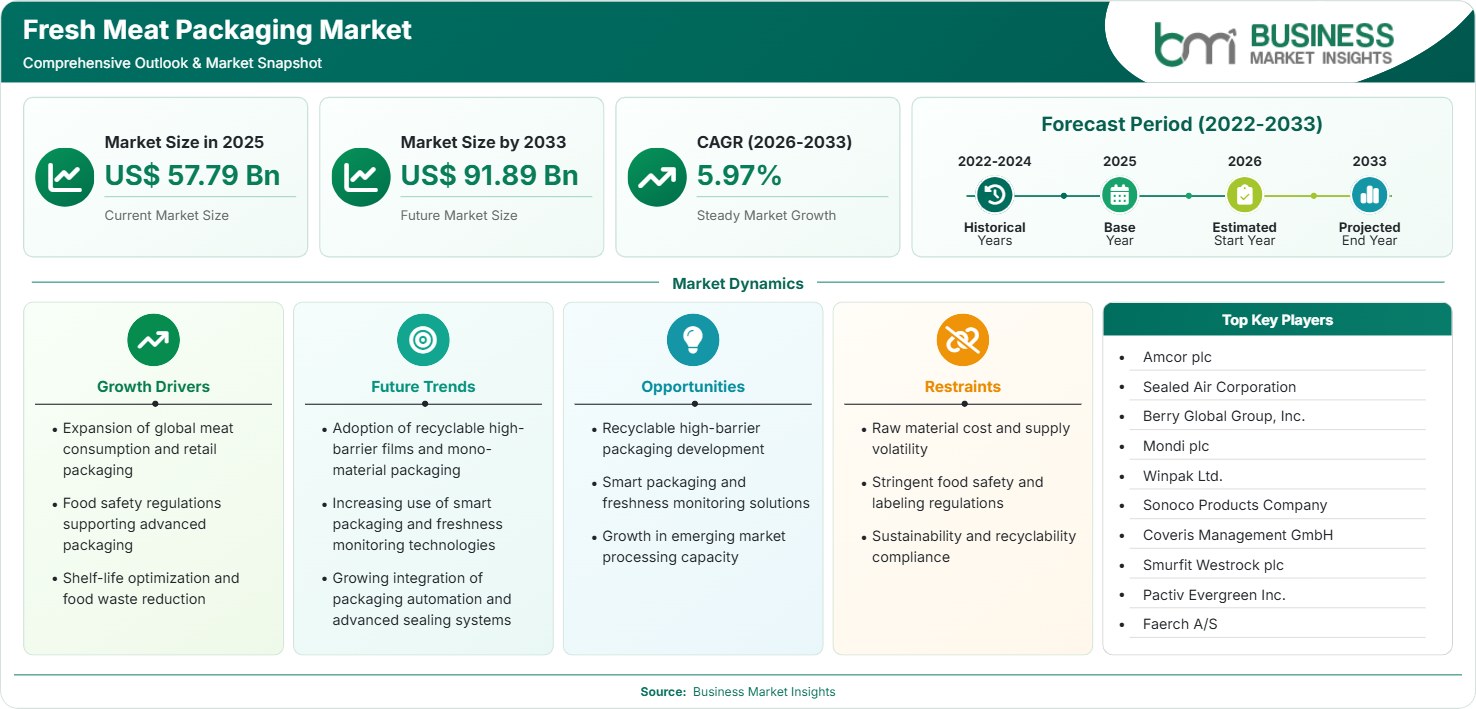
The Fresh Meat Packaging Market size was valued at US$ 57.79 Billion in 2025 and is projected to reach US$ 91.89 Billion by 2033, growing at a CAGR of 5.97% during 2026–2033. Growth is supported by rising meat consumption, adoption of modified atmosphere packaging, food waste reduction initiatives, sustainability targets, retail modernization, and demand for longer shelf-life solutions.

Report Coverage
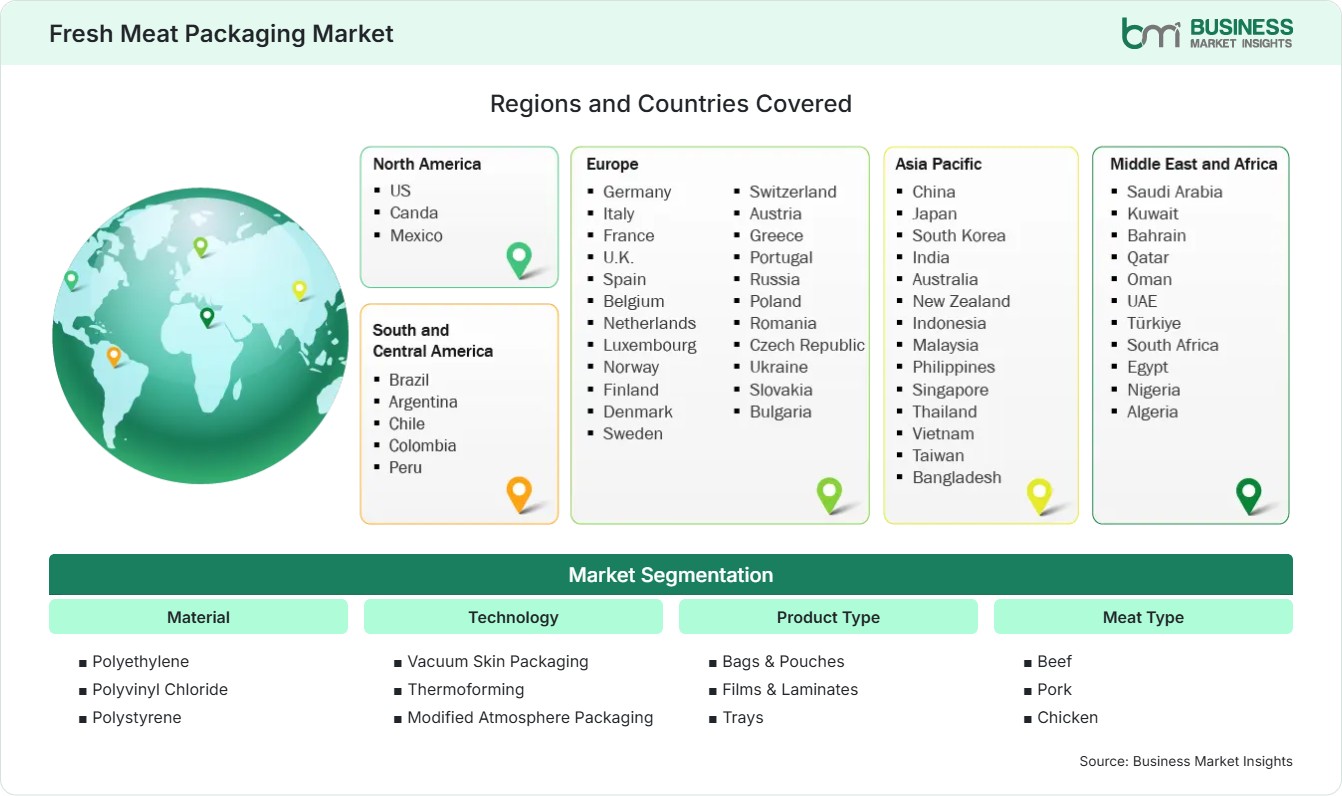
  • Material: Polyethylene, Polyvinyl Chloride, Polystyrene
  • Technology: Vacuum Skin Packaging, Thermoforming, Modified Atmosphere Packaging
  • Product Type: Bags & Pouches, Films & Laminates, Trays
  • Meat Type: Beef, Pork, Chicken
US$ 57.79 Bn Market size in 2025
US$ 91.89 Bn Market Size by 2033
5.97% CAGR, 2026 - 2033
2026-2033 Forecast Period

AI Overview

Fresh Meat Packaging Market Summary

  • North America Region: Holds 34%–37% share in 2025, growing at a 5.1%–5.4% CAGR. Strong cold-chain infrastructure, retail-ready meat formats, packaging automation, sustainability initiatives, and premium protein consumption drive adoption while advanced barrier materials create opportunities for value-added packaging solutions. US market remains the regional anchor, supported by packaged fresh protein demand and a projected CAGR of 5.2%–5.5%.
  • Fastest Growing Region: Asia Pacific holds 27%–30% share in 2025, expanding at a 7.1%–7.5% CAGR. Urbanization, organized retail expansion, protein-rich diets, export-oriented meat processing, and investment in food safety infrastructure are accelerating uptake of advanced packaging technologies.
  • Leading Segment: Plastic accounts for 58%–62% share in 2025 and advances at a 5.4%–5.8% CAGR. Superior barrier performance, sealing efficiency, product visibility, and compatibility with vacuum and modified atmosphere systems sustain widespread commercial acceptance globally.
  • High Growth Segment: Modified Atmosphere Packaging represents 28%–32% share in 2025 and records 7.0%–7.4% CAGR. Shelf-life extension, waste reduction, retail merchandising benefits, and improved freshness preservation support stronger adoption across modern meat distribution networks.
  • Key Market Opportunity: Transition toward recyclable mono-material films, intelligent freshness indicators, and premium retail packaging formats creates opportunities for processors and retailers seeking sustainability compliance, operational efficiency, and differentiated consumer experiences.
  • Major Market Players: Amcor plc, Sealed Air Corporation, Berry Global Group, Inc., Mondi plc, Winpak Ltd., Sonoco Products Company, Coveris Management GmbH, Smurfit Westrock plc, Pactiv Evergreen Inc., Faerch A/S.
Strategic Insights

Fresh Meat Packaging Market: Strategic Insights

Fresh Meat Packaging Market Strategic Framework
FREE PDF
Request your free sample
Request free sample
Stakeholder View

Key Takeaways

  • The market ecosystem increasingly integrates resin suppliers, film producers, packaging converters, equipment manufacturers, meat processors, retailers, and logistics firms, making supply-chain coordination a major competitive differentiator.
  • Modified atmosphere packaging and premium protein retail applications present the strongest upside owing to growing shelf-life requirements and organized retail expansion.
  • Innovation is shifting toward recyclable high-barrier films, smart freshness monitoring technologies, and lightweight packaging designs that reduce material consumption without compromising performance.
  • Asia Pacific offers the most attractive medium-term investment case due to rapid urbanization, expanding meat processing capacity, and strengthening food safety standards.
  • Consolidation activity continues as major packaging firms pursue scale, material science expertise, and sustainability capabilities through acquisitions and strategic partnerships.
  • Companies able to balance recyclability, regulatory compliance, and shelf-life performance are positioned to capture premium market opportunities.
Geographic Outlook

Fresh Meat Packaging Market Regional Highlights

North America Fresh Meat Packaging Market

North America accounts for 34%–37% Fresh Meat Packaging Market share in 2025 and is anticipated to grow at 5.1%–5.4% CAGR through 2033. Strong supermarket penetration, advanced processing facilities, and broad deployment of MAP and vacuum packaging technologies underpin demand. The region benefits from extensive cold-chain infrastructure and high packaged meat consumption. Sustainability commitments encourage adoption of recyclable structures while automation investments strengthen manufacturing efficiency. Retailers increasingly prioritize premium presentation and waste reduction, supporting continued technology upgrades.

  • US and Canada remain leaders in automated packaging deployment and premium retail meat merchandising.
  • Food safety compliance requirements encourage adoption of high-barrier solutions and advanced sealing technologies.
  • Demand for convenience-ready protein products supports investments in thermoforming and vacuum skin packaging.
  • Sustainability goals are accelerating interest in recyclable films and circular packaging systems.

US Fresh Meat Packaging Market

The US represents 74%–78% of North American Fresh Meat Packaging Market demand and is projected to expand at 5.2%–5.5% CAGR. Large-scale protein processing operations, established retail chains, and widespread use of MAP technology support market leadership. Rising consumer preference for visually appealing fresh meat products enhances demand for premium trays, laminates, and multilayer structures. Investments in automation and food traceability systems further strengthen market competitiveness.

  • Large poultry and beef industries sustain substantial packaging consumption across retail channels.
  • Processor investments increasingly target packaging efficiency and labor optimization.
  • Retailers emphasize packaging formats that reduce product shrink and food waste.
  • Sustainability commitments drive development of recyclable packaging alternatives.

Europe Fresh Meat Packaging Market

Europe holds 24%–27% Fresh Meat Packaging Market share in 2025 and is forecast to grow at 5.4%–5.8% CAGR. Strict food safety standards, sustainability regulations, and widespread adoption of advanced packaging technologies characterize regional demand. Germany remains the largest country market, while Poland shows higher growth potential at approximately 6.5%–6.9% CAGR due to expanding meat processing activities. Circular-economy policies are encouraging packaging redesign initiatives.

  • Regulatory pressure promotes recyclable and reduced-material packaging formats.
  • Germany leads regional consumption through advanced food processing operations.
  • Poland and Eastern Europe benefit from processing capacity expansion.
  • Premium meat retailing supports demand for enhanced shelf-life solutions.
  • Investments focus on mono-material and lower-carbon packaging innovations.

Asia Pacific Fresh Meat Packaging Market

Asia Pacific captures 27%–30% share in 2025 and records the fastest expansion at 7.1%–7.5% CAGR. Rising protein consumption, urbanization, and organized retail development stimulate advanced packaging adoption. China leads regional demand, while India demonstrates stronger momentum with CAGR near 8.0%–8.5%. Government attention to food safety and cold-chain modernization continues supporting investment in modern packaging systems and materials.

  • China remains the largest market owing to extensive meat consumption volumes.
  • India benefits from rapid retail modernization and food processing investment.
  • Southeast Asian exporters increasingly adopt high-performance packaging technologies.
  • Shelf-life enhancement remains a primary purchasing criterion among processors.
  • Growing middle-class populations reinforce demand for packaged fresh protein.

Rest of World Fresh Meat Packaging Market

Rest of World contributes 11%–13% share and advances at 6.0%–6.4% CAGR. South and Central America benefit from strong meat production and export activities, particularly in Brazil. In the Middle East and Africa, investments in food security and modern retail infrastructure stimulate packaging demand. Export competitiveness and shelf-life management remain central adoption drivers throughout these markets.

  • Brazil leads regional opportunities through substantial beef and poultry exports.
  • GCC countries expand cold-chain and food distribution infrastructure.
  • Export-oriented processors prioritize packaging technologies that preserve freshness.
  • Retail modernization supports transition from conventional to advanced packaging.
  • Sustainability and food security initiatives encourage packaging innovation.
Global Market Geography
FREE PDF
Request your free sample
Request free sample
Segment Analysis

Fresh Meat Packaging Market Segmentation

Material

Material segment accounts for the largest revenue pool, with plastics holding 58%–62% share in 2025 and growing at 5.4%–5.8% CAGR. The Fresh Meat Packaging Market scope within materials is driven by barrier performance, seal integrity, transparency, and compatibility with automated systems. Sustainability efforts are gradually increasing adoption of recyclable and fiber-based alternatives.

  • Polyethylene (PE): Widely used for flexible packaging due to sealing efficiency, moisture resistance, durability, and compatibility with vacuum and thermoforming applications.
  • Polyvinyl Chloride (PVC): Maintains strong presence in overwrap applications where product visibility, retail presentation, and cost-effectiveness remain critical purchasing priorities.
  • Polystyrene (PS): Commonly utilized in trays for fresh meat merchandising, offering rigidity, product protection, and compatibility with absorbent pad systems.

Technology

Technology adoption increasingly focuses on shelf-life optimization and food safety performance. The segment is supported by expanding packaged protein demand and regulatory compliance requirements. Modified atmosphere packaging demonstrates the highest growth profile with 28%–32% share and 7.0%–7.4% CAGR, reflecting evolving Fresh Meat Packaging Market trends.

  • Vacuum Skin Packaging: Enhances product appearance, minimizes drip loss, and supports premium retail presentation while improving shelf-life performance.
  • Thermoforming: Enables high-speed production efficiency, material optimization, and strong sealing characteristics across industrial meat processing environments.
  • Modified Atmosphere Packaging: Extends freshness through controlled gas mixtures, reducing spoilage and supporting broader distribution networks.

Product Type

Product innovation increasingly emphasizes convenience, sustainability, and merchandising performance. Trays and flexible formats remain important across retail channels, while advanced laminates continue gaining acceptance among processors seeking product protection and operational efficiency.

  • Bags & Pouches: Support flexible distribution models through lightweight design, storage efficiency, and compatibility with vacuum packaging applications.
  • Films & Laminates: Deliver barrier protection, sealing performance, and shelf-life enhancement across multiple fresh protein categories.
  • Trays: Maintain strong retail relevance due to product visibility, handling convenience, and compatibility with overwrap and MAP systems.

Meat Type

Demand patterns vary according to regional consumption preferences and processing structures. Chicken represents the broadest consumption base, while beef and pork maintain substantial packaging requirements across developed and emerging markets.

  • Beef: Requires high-performance packaging solutions to maintain color stability, freshness, and premium product positioning throughout distribution.
  • Pork: Benefits from packaging formats designed to manage moisture, preserve quality, and improve merchandising effectiveness.
  • Chicken: Generates strong packaging demand through high consumption volumes and growing preference for portion-controlled retail products.
Market Forces

Fresh Meat Packaging Market Dynamics

Key Market Drivers

Expansion of Global Meat Consumption and Retail Packaging

The global consumption of protein keeps growing along with population and urbanization. The FAO and OECD projections show that there will be ongoing demand for poultry and meat products, thus requiring better means of transportation and presentation at retail. Modern packaging allows producers to avoid spoilage losses while observing food safety guidelines. Fresh Meat Packaging Market growth is increasingly linked to retail-ready packaging solutions that improve product visibility and distribution efficiency. Processors are replacing conventional methods with higher-performance technologies to reduce product waste, enhance product quality consistency, and meet evolving consumer purchasing preferences.

Food Safety Regulations Supporting Advanced Packaging

Regulatory agencies across North America, Europe, and Asia are strengthening standards related to contamination prevention, traceability, and food quality preservation. These regulations favor the adoption of vacuum skin packages, modified atmosphere packaging techniques, and high barrier packaging. Packaging is now considered to be a process control factor as opposed to just a form of containment by the processors. The effectiveness of seals and tamper resistance ensures that the processor meets the compliance goals as well as building consumer confidence.

Shelf-Life Optimization and Food Waste Reduction

Minimizing food waste is still a key strategy in all food distribution networks around the world. Groups like the UN stress the reduction of losses in food from production to retail levels. Packaging has been improved to allow more time for freshness and transport. Fresh Meat Packaging Market trends increasingly favor solutions capable of balancing sustainability goals with commercial performance. Retail chains value improved product turnover and reduced shrink rates, while processors benefit from broader geographic reach. These advantages create a compelling business case for continued modernization of meat packaging systems.

Key Market Opportunities

Recyclable High-Barrier Packaging Development

The demand for recyclable material will fuel investments in mono-material and circular packaging platforms. There is a need for an alternative that can provide the same level of protection and meet the sustainable needs of the brands. The development of material science has ensured that recyclable materials do not compromise on performance parameters. Fresh Meat Packaging Market Forecasts increasingly reflect growing adoption of sustainable packaging structures. Vendors that successfully combine recyclability, strength, and shelf-life performance can gain competitive advantages and premium pricing opportunities.

Smart Packaging and Freshness Monitoring Solutions

Digital indicators, QR-enabled traceability, and freshness monitoring technologies represent emerging value creation areas. Modern retailers are more interested in finding technology-based solutions that increase visibility and interaction with consumers. Smart packaging can provide both increased transparency in the supply chain and reduce the amount of waste. The incorporation of sensing capabilities in meat packaging will help to provide a differentiation of premium products and better quality assurance.

Growth in Emerging Market Processing Capacity

Investment in meat processing facilities across Asia, Latin America, and parts of Africa is creating new demand for sophisticated packaging formats. Processors in the export trade must adhere to internationally recognized quality standards and shelf life requirements. Advanced packaging technology helps in logistical efficiency and access to better markets. Expansion projects in these regions offer growth opportunities for equipment suppliers, converters, and material producers catering to the meat industry.

Market Restraints and Challenges

Resin Price Volatility and Margin Pressure

Factor: Plastic resin markets remain exposed to feedstock cost fluctuations, energy price movements, and supply-chain disruptions. Impact: The packaging industry frequently finds itself squeezed due to increased raw material prices without any contractual changes to accommodate this increase. It is difficult to plan for raw materials with constantly fluctuating prices. Large companies may have advantages due to economies of scale, but small converters will be more exposed. Profitability combined with the need to invest in sustainability is another factor adding stress to this issue.

Sustainability Compliance and Higher Transition Costs

Factor: Environmental regulations and corporate sustainability commitments are reshaping product design requirements. Impact: The shift to recyclable packaging may require new equipment, material testing processes, and supply chain modifications. Certain trade-offs could emerge in the process of redesigning products. Enterprises have to balance their goals of recyclability against their needs to maintain freshness. Compliance costs and the expenses related to technology development might slow down implementation.

Company Analysis

Competitive Landscape

Fresh Meat Packaging Market analysis indicates a competitive environment characterized by material innovation, sustainability investments, and advanced preservation technologies.

Company Name

Overview

Products and Services relevant to this market

Amcor plc

Global packaging leader with extensive flexible and rigid packaging operations.

High-barrier films, MAP solutions, recyclable packaging, meat packaging systems.

Sealed Air Corporation

Pioneer in protective and food packaging technologies.

Cryovac solutions, vacuum packaging, barrier films, automation platforms.

Berry Global Group, Inc.

Large packaging manufacturer focused on engineered materials.

Meat trays, films, laminates, sustainable packaging solutions.

Mondi plc

International packaging and paper group.

Flexible packaging, recyclable structures, barrier materials.

Winpak Ltd.

Specialist in food packaging technologies.

Vacuum packaging films, thermoforming materials, lidding solutions.

Sonoco Products Company

Diversified packaging supplier serving food industries.

Rigid and flexible food packaging products.

Coveris Management GmbH

European packaging specialist emphasizing sustainability.

High-performance films, thermoform materials, recyclable solutions.

Smurfit Westrock plc

Global packaging provider with broad materials expertise.

Food packaging systems, fiber-based packaging solutions.

Pactiv Evergreen Inc.

Significant foodservice and food packaging producer.

Fresh meat trays, absorbent packaging systems, containers.

Faerch A/S

Developer of circular food packaging products.

Recyclable trays, meat packaging formats, rPET solutions.

Trust & Transparency

Research Methodology

The market analysis combines proprietary research with secondary data from government agencies, company disclosures, regulatory filings, industry databases and expert interviews. Market estimates are validated through data triangulation, cross-market benchmarking and analyst review.

View Full Research Methodology

Questions Answered

Frequently Asked Questions

What does a Fresh Meat Packaging Market Report typically evaluate?

It analyzes market size, technology adoption, competitive positioning, regional demand patterns, regulatory influences, and future investment opportunities.

How do smart packaging technologies create value?

They improve traceability, support inventory management, enhance quality monitoring, and provide consumers with product transparency information.

Which region offers the strongest growth potential?

Asia Pacific presents the strongest growth outlook due to urbanization, retail modernization, expanding cold chains, and rising meat consumption.

How does sustainability influence packaging decisions?

Manufacturers increasingly prioritize recyclable materials, reduced plastic usage, and circular-economy compatibility to comply with regulations and corporate environmental commitments.

What makes modified atmosphere packaging attractive for meat processors?

Modified atmosphere packaging extends shelf life, improves freshness retention, reduces spoilage, and supports wider product distribution while maintaining product appearance.

Access the Full Fresh Meat Packaging Market Report

Get segment-level forecasts, regional estimates, competitive benchmarking, company profiles and downloadable Excel datasets.

Access the full Fresh Meat Packaging Market Report
350 pages PDF & Excel | 2026-08-27