
Processed Meat Market Outlook: Size, Share, Trends, Growth Analysis, Competitive Landscape & Forecast, 2026-2033

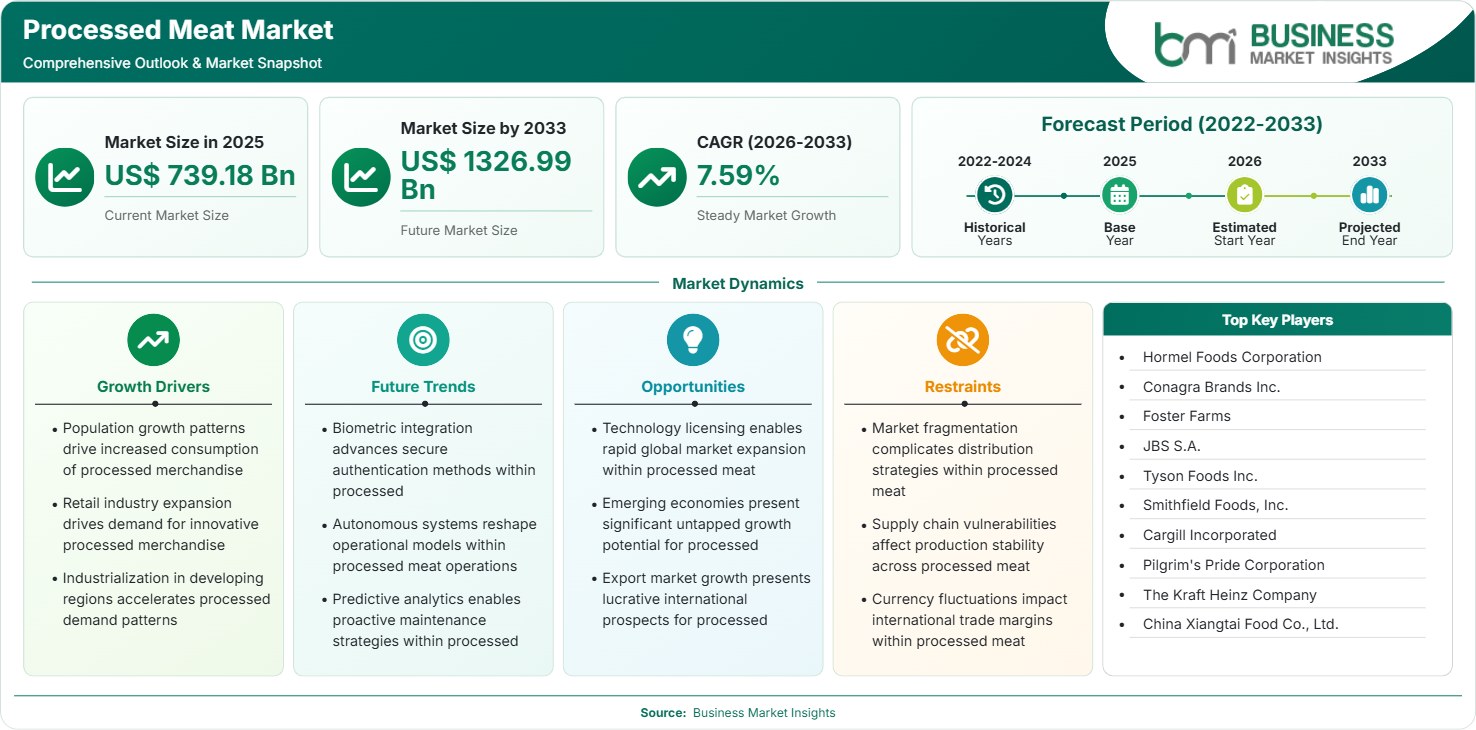
The Processed Meat Market size was valued at US$ 739.18 billion in 2025 and is projected to reach US$ 1326.99 billion by 2033, growing at a CAGR of 7.59% during 2026–2033. Rising demand for convenient protein-rich foods, expanding cold chain infrastructure, product innovation in clean-label formulations, increasing retail penetration, and growing investments in premium processed meat offerings continue to create attractive opportunities across developed and emerging economies.

Report Coverage
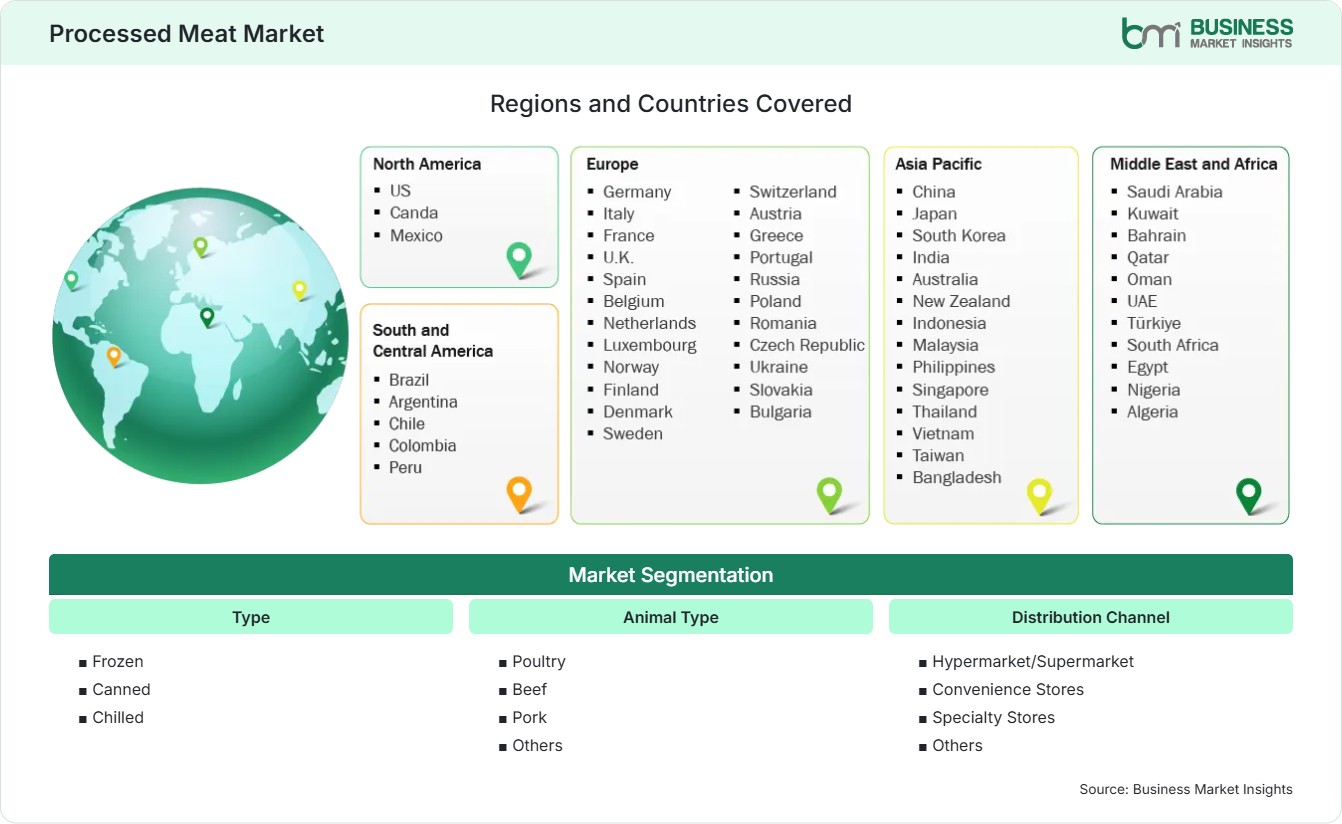
  • Type: Frozen, Canned, Chilled
  • Animal Type: Poultry, Beef, Pork, Others
  • Distribution Channel: Hypermarket/Supermarket, Convenience Stores, Specialty Stores, Others
US$ 739.18 Bn Market size in 2025
US$ 1326.99 Bn Market Size by 2033
7.59% CAGR, 2026 - 2033
2026-2033 Forecast Period

AI Overview

Processed Meat Market Summary

  • North America Region: North America holds 34%–37% share in 2025, growing with a 6.6%–7.0% CAGR during 2026–2033. Strong retail infrastructure, advanced meat processing technologies, premium product innovation, expanding convenience food consumption, and automation investments continue strengthening regional competitiveness and export capabilities. The U.S. market benefits from strong packaged food demand, automation investments, and premium protein consumption, advancing at an estimated CAGR of 6.8%–7.2% during 2026–2033.
  • Fastest Growing Region: Asia Pacific accounts for 26%–29% market share in 2025 while expanding at a 9.2%–9.8% CAGR through 2026–2033. Urbanization, rising disposable income, organized retail expansion, improved refrigeration infrastructure, and westernized dietary preferences continue to accelerate processed meat consumption throughout developing economies.
  • Leading Segment: Poultry represents 39%–42% market share in 2025 with a 7.8%–8.2% CAGR during 2026–2033. Competitive pricing, broad consumer acceptance, healthier protein perception, expanding quick-service restaurant demand, and efficient production systems continue supporting sustained adoption across multiple foodservice channels.
  • High Growth Segment: Frozen products account for 35%–38% market share in 2025 while registering a 8.4%–8.9% CAGR through 2026–2033. Longer shelf life, reduced food waste, expanding frozen food retail space, improved logistics efficiency, and increasing consumer preference for convenient meal solutions sustain rapid expansion.
  • Key Market Opportunity: Growing investments in premium, clean-label, high-protein, low-sodium, antibiotic-free, and value-added processed meat products enable manufacturers to strengthen profitability while addressing changing nutritional preferences, food safety expectations, and premium retail demand across emerging economies.
  • Major Market Players: Hormel Foods Corporation, Conagra Brands, Inc., Foster Farms, JBS S.A., Tyson Foods, Inc., Smithfield Foods, Inc., Cargill, Incorporated, Pilgrim's Pride Corporation, The Kraft Heinz Company, China Xiangtai Food Co., Ltd.
Strategic Insights

Processed Meat Market: Strategic Insights

Processed Meat Market Strategic Framework
FREE PDF
Request your free sample
Request free sample
Stakeholder View

Key Takeaways

  • The industry value chain is becoming increasingly integrated as processors strengthen partnerships with livestock suppliers, cold-chain logistics providers, packaging companies, and organized retailers to improve operational resilience and product consistency.
  • Premium poultry products, frozen convenience foods, and value-added processed protein categories continue presenting the strongest commercial opportunities due to evolving consumer lifestyles and expanding modern retail infrastructure.
  • Artificial intelligence, automated quality inspection, digital traceability platforms, robotics, and smart packaging technologies are reshaping production efficiency while improving food safety monitoring, operational productivity, and regulatory compliance.
  • Asia Pacific offers one of the most attractive long-term investment environments as urbanization, organized retail expansion, rising disposable income, and refrigeration infrastructure accelerate packaged protein consumption across multiple consumer segments.
  • Strategic acquisitions, regional manufacturing expansion, and investments in premium branded portfolios remain important competitive strategies as leading companies strengthen distribution capabilities and expand geographical presence.
  • Sustainability initiatives focusing on recyclable packaging, energy-efficient processing facilities, responsible sourcing, and carbon footprint reduction are increasingly influencing procurement decisions among retailers, institutional buyers, and environmentally conscious consumers.
Geographic Outlook

Processed Meat Market Regional Highlights

North America Processed Meat Market

North America accounted for 34%–37% of the global market share in 2025 and is projected to expand at a 6.6%–7.0% CAGR during 2026–2033. The region benefits from advanced meat processing facilities, extensive refrigerated logistics, high per capita protein consumption, and strong penetration of organized retail chains. Manufacturers continue investing in automation, digital quality monitoring, and premium product innovation to improve operational efficiency. Rising demand for convenient, ready-to-cook products and clean-label offerings further strengthens the Processed Meat Market share across both retail and foodservice channels.

  • Strong investments in automated processing equipment, robotics, and AI-enabled quality inspection improve production consistency, labor productivity, and food safety while reducing operational costs across large-scale manufacturing facilities.
  • Expanding demand for premium sausages, deli meats, smoked meats, and frozen ready-to-cook products supports higher value creation across supermarkets, warehouse clubs, and online grocery platforms.
  • Major manufacturers continue expanding production capacity and sustainable packaging initiatives while improving traceability systems to comply with evolving USDA food safety regulations and retailer quality standards.
  • Increasing consumer preference for high-protein diets, convenience foods, and value-added meat products supports consistent purchasing across household, institutional, and quick-service restaurant segments.
  • Cold-chain investments and advanced logistics networks minimize spoilage while enabling broader distribution of premium processed products throughout the United States and Canada.

US Processed Meat Market

The United States represents approximately 82%–85% of North America's regional market in 2025 and is anticipated to register a 6.8%–7.2% CAGR through 2026–2033. Strong consumer spending, advanced livestock production, vertically integrated supply chains, and continuous product innovation maintain market leadership. Demand remains supported by expanding convenience food consumption, premium protein preferences, digital retail channels, and continuous investments in sustainable processing technologies.

  • Growing demand for protein-rich breakfast products, ready-to-eat snacks, and premium deli meats continues encouraging manufacturers to introduce healthier formulations with reduced sodium and clean-label ingredients.
  • Automation, AI-powered quality assurance, and predictive maintenance systems improve operational efficiency while reducing waste and strengthening food safety compliance throughout processing operations.
  • Foodservice recovery and expanding quick-service restaurant chains continue supporting higher procurement of processed poultry, pork, and beef products across commercial kitchens nationwide.
  • Investments in environmentally efficient manufacturing facilities and recyclable packaging improve sustainability performance while strengthening long-term competitiveness among leading producers.

Europe Processed Meat Market

Europe captured approximately 27%–30% of global revenue in 2025 and is expected to expand at a 6.3%–6.8% CAGR through 2026–2033. Mature food manufacturing infrastructure, stringent food safety regulations, and premium processed meat consumption sustain regional demand. Germany accounts for the largest regional contribution, while Poland is projected to record the fastest expansion with an estimated 7.2%–7.7% CAGR, supported by increasing processing investments and export competitiveness.

  • Consumer demand for premium cured meats, traditional sausages, and artisanal processed products continues supporting product differentiation across both domestic and export markets.
  • Sustainable livestock management, recyclable packaging, and carbon reduction initiatives increasingly influence procurement decisions among retailers and institutional food buyers.
  • Manufacturers continue introducing reduced-fat, reduced-salt, and preservative-optimized products to align with evolving nutritional preferences and regulatory requirements.
  • Digital traceability systems and advanced processing automation improve transparency, operational efficiency, and compliance with European food safety regulations.
  • Expanding private-label portfolios within supermarkets strengthen competition while offering consumers affordable premium-quality processed meat alternatives.

Asia Pacific Processed Meat Market

Asia Pacific accounted for 26%–29% of the global market in 2025 and is forecast to achieve the fastest regional expansion at a 9.2%–9.8% CAGR during 2026–2033. China remains the largest regional market due to its vast consumer base and expanding food manufacturing industry, while India is projected to record the highest growth at approximately 10.4%–10.9% CAGR. Rapid urbanization, organized retail development, and rising disposable incomes continue to accelerate the Processed Meat Market growth throughout the region.

  • Increasing household income encourages higher consumption of packaged protein products, frozen meals, and ready-to-cook meat products across urban populations.
  • Investments in refrigeration infrastructure and modern logistics networks improve product availability while reducing food losses across expanding retail channels.
  • International manufacturers continue establishing regional production facilities to strengthen local supply chains and address rising domestic demand efficiently.
  • Growth of supermarkets, hypermarkets, and online grocery platforms significantly expands accessibility of premium and branded processed meat products.
  • Western dietary influences and expanding quick-service restaurant networks continue supporting long-term demand for poultry, beef, and pork-based processed foods.

Rest of World Processed Meat Market

The Rest of World region accounted for approximately 8%–10% of global revenue in 2025 and is projected to register a 7.3%–7.8% CAGR during 2026–2033.

South & Central America benefits from abundant livestock resources, expanding meat exports, and increasing investments in processing technologies. Brazil continues leading regional production, while Mexico demonstrates strong demand growth driven by organized retail expansion.

The Middle East & Africa experiences increasing consumption of packaged halal meat products, improving cold-chain infrastructure, and rising foodservice activity. Saudi Arabia remains a leading Processed Meat Market, whereas the United Arab Emirates records one of the fastest regional growth rates due to premium retail expansion and tourism-related food demand.

  • Export-oriented investments strengthen production capacity throughout South America while supporting higher-quality processed meat manufacturing for international markets.
  • Rising supermarket penetration and refrigeration infrastructure improve availability of packaged meat products across emerging economies.
  • Premium halal-certified processed products continue creating significant commercial opportunities across Gulf Cooperation Council countries.
  • Government support for food manufacturing investments and domestic food security initiatives encourages expansion of regional processing facilities.
  • Growing tourism, hospitality development, and restaurant chains increase demand for convenient processed meat products across commercial foodservice operations.
Global Market Geography
FREE PDF
Request your free sample
Request free sample
Segment Analysis

Processed Meat Market Segmentation

Type

The Type segment accounted for the largest revenue contribution across the industry, supported by increasing consumer demand for convenient, long-shelf-life, and value-added protein products. Frozen products dominated with approximately 35%–38% market share in 2025 and are projected to expand at a CAGR of 8.4%–8.9% during 2026–2033. The Processed Meat Market scope continues expanding through innovations in preservation technologies, premium product development, and efficient cold-chain distribution across both retail and foodservice sectors.

  • Frozen: Frozen processed meat products remain highly preferred due to their extended shelf life, convenience, reduced food waste, and increasing availability through supermarkets, online grocery platforms, and quick-service restaurant supply chains.
  • Canned: Canned meat products continue witnessing stable demand because of excellent storage stability, emergency food applications, military procurement, and growing household preference for ready-to-eat protein sources with minimal preparation requirements.
  • Chilled: Chilled processed meat products gain popularity through premium quality perception, superior freshness, expanding delicatessen offerings, and increasing consumer demand for minimally processed packaged meat products across organized retail outlets.

Animal Type

Animal Type remains a fundamental market classification as manufacturers diversify protein portfolios to address regional dietary preferences and commercial demand. Poultry maintained the leading position with approximately 39%–42% market share in 2025 and is expected to register a 7.8%–8.2% CAGR during the forecast period. Competitive pricing, efficient production cycles, favorable nutritional perception, and broad foodservice adoption continue strengthening the Processed Meat Market share across global protein categories.

  • Poultry: Poultry products benefit from affordability, healthier consumer perception, expanding fast-food demand, and efficient commercial production, making them the most widely consumed processed meat category across developed and emerging economies.
  • Beef: Beef processed products maintain premium positioning through burgers, sausages, cured meats, and delicatessen applications, supported by premiumization trends and expanding demand from restaurants and hospitality establishments.
  • Pork: Pork-based processed products continue generating strong revenues in Europe, North America, and East Asia, supported by traditional consumption patterns, product versatility, and continuous innovation in smoked and cured meat varieties.

Distribution Channel

Distribution channels continue evolving with changing shopping behavior, digital retail expansion, and improved refrigerated logistics. Hypermarkets and supermarkets represented the dominant channel with approximately 48%–51% of the Processed Meat Market share in 2025 while recording a 7.2%–7.7% CAGR through 2026–2033. Wider product assortments, promotional pricing strategies, and integrated cold storage infrastructure continue supporting volume sales across urban and semi-urban consumer markets.

  • Hypermarket/Supermarket: Large retail chains remain the primary sales channel owing to extensive product selection, strong cold-chain infrastructure, competitive pricing, and increasing consumer preference for one-stop grocery shopping experiences.
  • Convenience Stores: Convenience stores continue expanding processed meat sales by providing quick purchasing access, ready-to-eat products, extended operating hours, and strategic urban locations serving busy working consumers.
  • Specialty Stores: Specialty food retailers attract premium consumers through gourmet meat selections, organic offerings, artisanal processing techniques, personalized customer service, and differentiated product portfolios focused on quality and authenticity.
Market Forces

Processed Meat Market Dynamics

Key Market Drivers

Rising demand for convenient and protein-rich food products

Increased urbanization, lifestyle changes, and increased workforce participation have greatly impacted consumer behavior. Today, consumers are more interested in food products that are ready to cook or eat with minimum preparation time but offer maximum nutritional content. As per estimates provided by the FAO, meat consumption globally is continuing to grow with increases in population and income levels, especially in Asia and Latin America. The Processed Meat Market trends indicate that manufacturers are introducing healthier formulations with lower sodium, reduced preservatives, and higher protein content to satisfy health-conscious consumers while maintaining convenience and product quality. These developments continue to support sustained industry expansion across both retail and institutional foodservice channels.

Expansion of organized retail and cold-chain infrastructure

The rapid development of supermarkets, hypermarkets, convenience stores, and e-commerce grocery platforms has significantly improved product accessibility worldwide. Investment in refrigerated transport, automation of warehouses, and temperature-controlled storage helps minimize the spoilage level while increasing the distribution potential. Investments by governments in the food logistics infrastructure in developing countries also help in increasing efficiency in the supply chain process. Improved cold chains help companies develop premium products in frozen and chilled form while ensuring the safety of food. Higher retail penetration levels also help in the development of products through innovations and promotion strategies.

Automation and digital food processing technologies

Robots, artificial intelligence, machine vision, and digital traceability are some of the technological advancements that food producers are adopting for greater efficiency. Automation through processing lines guarantees uniformity during food production, reduces chances of contamination, maximizes labor efficiency, and adheres to safety standards. Predictive maintenance is used to keep machines running without downtimes. Digital traceability solutions also strengthen consumer confidence by providing transparent information regarding sourcing and processing. Continuous investments in Industry 4.0 technologies enable producers to improve profitability while responding rapidly to changing consumer preferences, making automation an increasingly important competitive differentiator throughout the global processed meat industry.

Key Market Opportunities

Premium and clean-label product innovation

Growing consumer awareness regarding nutrition and ingredient transparency creates significant opportunities for premium processed meat products. Manufacturers are investing in antibiotic-free, hormone-free, organic, reduced-sodium, and preservative-optimized product portfolios to address changing purchasing behavior. Demand for high-protein functional foods is also expanding among fitness-focused consumers. The Processed Meat Market Forecasts indicate increasing investments in value-added premium categories capable of generating higher profit margins. Companies focusing on sustainable sourcing, recyclable packaging, and innovative flavor profiles are expected to strengthen brand differentiation while capturing premium retail shelf space across developed and emerging economies.

Expansion across emerging Asian and African economies

Rapid urbanization, population growth, increasing disposable incomes, and expanding modern retail infrastructure create substantial investment opportunities throughout the Asia Pacific and selected African markets. The growth in middle-class demographics is leading to an increased consumption of processed convenience foods made possible through advances in refrigeration technology. Regional investments in production cut down on transportation costs and ensure higher availability of goods. International firms are developing regional manufacturing plants and partnerships to improve their distribution in the country. Such structural changes create good opportunities for profit maximization amid stiff competition.

Growth of foodservice and quick-service restaurant networks

Global expansion of quick-service restaurants, hotels, catering providers, and institutional foodservice continues to generate higher demand for standardized processed meat products. Commercial kitchens increasingly require reliable, portion-controlled, and quality-certified ingredients capable of improving operational efficiency. The premium burger, sausage, bacon, deli meat, and poultry products will always play a vital role in the menus of restaurants worldwide. Tourism and hospitality spending have further enhanced the commercial aspect of things. Companies that specialize in manufacturing customized foods for their foodservice clients will benefit greatly from entering into long-term supply contracts.

Market Restraints and Challenges

Stringent food safety regulations and compliance costs

Factor: Regulatory authorities continue strengthening food safety requirements covering processing standards, hygiene practices, traceability systems, labeling requirements, and environmental compliance.

Impact: Quality assurance systems, laboratory tests, training, automation, and certification incur high costs for manufacturers. This increases the cost of operations and sets a high barrier to entry for smaller players in the industry. Non-compliance can lead to recalls of products, penalties, tarnished reputation, and supply chain disruption. Despite the fact that these regulations increase consumers' trust in products and the quality of the products, they limit the flexibility and increase the cost of production.

Volatility in livestock prices and supply chain disruptions

Factor: Fluctuations in feed costs, livestock diseases, climate variability, geopolitical tensions, and transportation constraints create instability across global meat supply chains.

Impact: Fluctuations in raw material prices have direct impacts on the production costs and the bottom line of the manufacturing firms. There can be constraints in the production process, while there is an increase in the cost of production, leading to increases in prices in the retail sector, affecting consumer choices. Firms need to enhance supplier diversity, inventory management and procurement practices to avoid operational risks.

Company Analysis

Competitive Landscape

The competitive environment is characterized by vertically integrated meat processors, multinational packaged food companies, and regional protein manufacturers investing in automation, sustainability, premium product portfolios, and supply chain optimization. The Processed Meat Market analysis indicates that companies are prioritizing capacity expansion, product innovation, digital traceability, and strategic acquisitions to strengthen their global market positions.

Company Name

Overview

Products and Services Relevant to this Market

Hormel Foods Corporation

Leading global branded food company with diversified protein operations and extensive retail and foodservice distribution across North America and international markets.

Bacon, pepperoni, deli meats, sausages, canned meats, refrigerated meat products, foodservice protein solutions, and value-added packaged meat products.

Conagra Brands, Inc.

Major packaged food manufacturer offering frozen and refrigerated convenience foods through strong retail partnerships and innovative branded product portfolios.

Frozen meat meals, processed meat ingredients, packaged frozen foods, ready-to-cook products, and convenience food solutions.

Foster Farms

Integrated poultry producer recognized for premium chicken products and advanced processing operations serving retail and foodservice customers.

Frozen poultry, breaded chicken, marinated poultry, cooked meat products, and refrigerated chicken offerings.

JBS S.A.

One of the world's largest meat processing companies operates integrated beef, poultry, pork, and prepared foods businesses globally.

Processed beef, poultry, pork, frozen meat products, cooked meats, prepared foods, and export-oriented protein solutions.

Tyson Foods, Inc.

Global protein leader with extensive manufacturing capabilities and strong investments in automation, innovation, and sustainable production practices.

Chicken, beef, pork, frozen processed foods, sausages, nuggets, deli products, and foodservice meat solutions.

Smithfield Foods, Inc.

Leading pork producer operating integrated livestock production, processing, packaging, and distribution networks throughout North America.

Bacon, ham, sausages, hot dogs, packaged pork products, deli meats, and refrigerated processed meat products.

Cargill, Incorporated

Diversified agribusiness company providing meat processing, food ingredients, supply chain management, and protein solutions worldwide.

Beef products, poultry processing, value-added meats, ingredient solutions, foodservice products, and protein processing services.

Pilgrim's Pride Corporation

Major poultry processor supplying branded and private-label products to retailers, restaurants, and food manufacturers internationally.

Frozen poultry, prepared chicken, cooked products, breaded meat, retail poultry products, and foodservice solutions.

The Kraft Heinz Company

Global food manufacturer leveraging recognized consumer brands and strong international retail distribution capabilities.

Packaged meats, ready meals, refrigerated foods, processed meat ingredients, convenience foods, and branded meal solutions.

China Xiangtai Food Co., Ltd.

Chinese meat processing company serving domestic consumers through integrated production, processing, and distribution operations.

Processed pork products, packaged meat products, frozen meat offerings, and regional meat processing services.

Trust & Transparency

Research Methodology

The market analysis combines proprietary research with secondary data from government agencies, company disclosures, regulatory filings, industry databases and expert interviews. Market estimates are validated through data triangulation, cross-market benchmarking and analyst review.

View Full Research Methodology

Questions Answered

Frequently Asked Questions

What does this Processed Meat Market Report help businesses understand?

The report provides detailed insights into market size, regional performance, competitive positioning, segmentation, investment opportunities, technology developments, growth prospects, and strategic recommendations to support business expansion and investment decisions.

Which distribution channel contributes the largest sales?

Hypermarkets and supermarkets continue accounting for the largest sales because of extensive product availability, efficient refrigeration facilities, promotional pricing, and increasing consumer preference for organized retail shopping.

Which animal type generates the highest revenue?

Poultry remains the leading animal type due to competitive pricing, healthier consumer perception, efficient production systems, and widespread adoption across retail, foodservice, and quick-service restaurant applications.

Which region dominates the global market?

North America currently leads the market with an estimated 34%–37% revenue share in 2025, supported by advanced processing infrastructure, high packaged food consumption, efficient cold-chain logistics, and strong investments in product innovation.

What is driving the Processed Meat Market?

Increasing demand for convenient protein-rich foods, expansion of organized retail, improvements in cold-chain infrastructure, premium product innovation, automation in meat processing, and rising urbanization are among the primary factors supporting long-term market expansion.

Access the Full Processed Meat Market Report

Get segment-level forecasts, regional estimates, competitive benchmarking, company profiles and downloadable Excel datasets.

Access the full Processed Meat Market Report
350 pages PDF & Excel | 2026-08-18
Similar Research

Related Market Reports