
Modified Atmosphere Packaging Market Outlook: Size, Share, Trends, Growth Analysis, Competitive Landscape & Forecast, 2022-2033

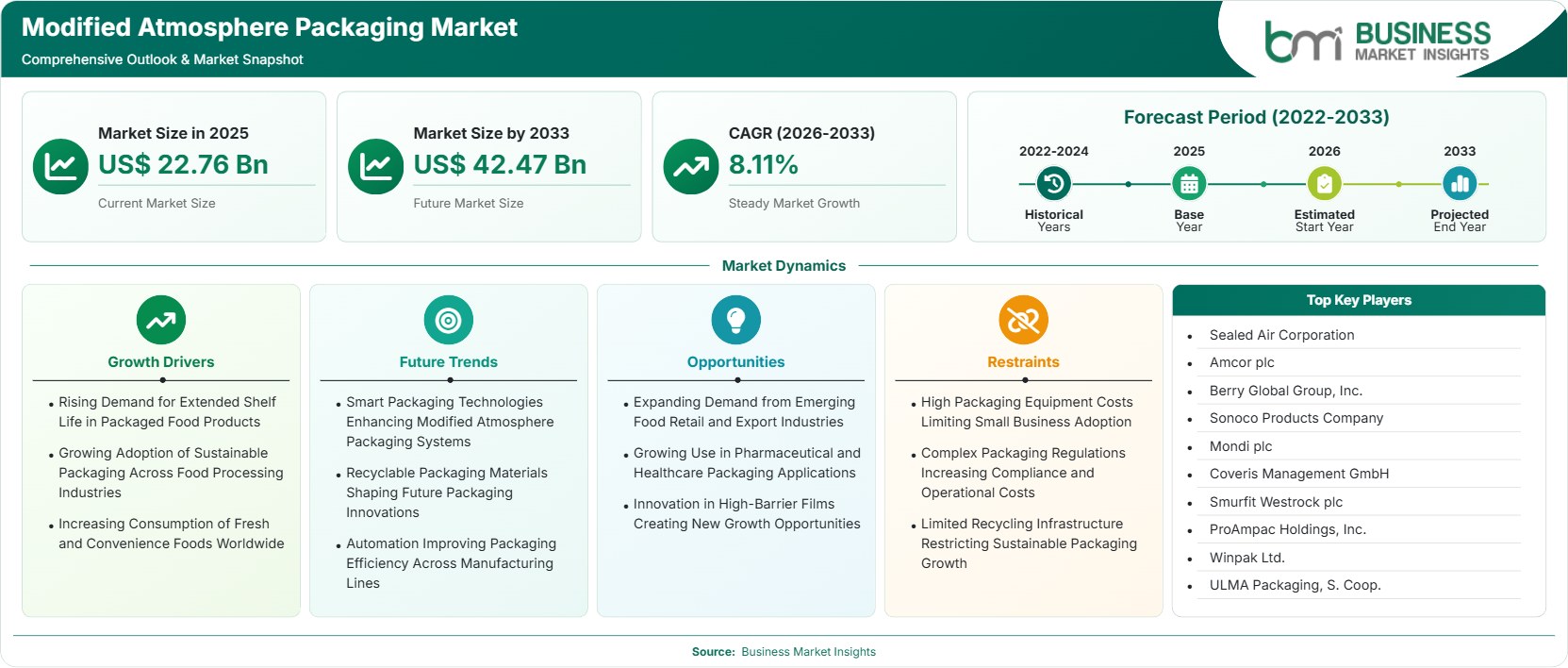
The Modified Atmosphere Packaging Market size was valued at US$ 22.76 billion in 2025 and is projected to reach US$ 42.47 billion by 2033, growing at a CAGR of 8.11% during 2026–2033, driven by extended shelf-life requirements, sustainable packaging adoption, convenience food consumption, emerging food exports, healthcare applications, and high-barrier film innovation.

Report Coverage
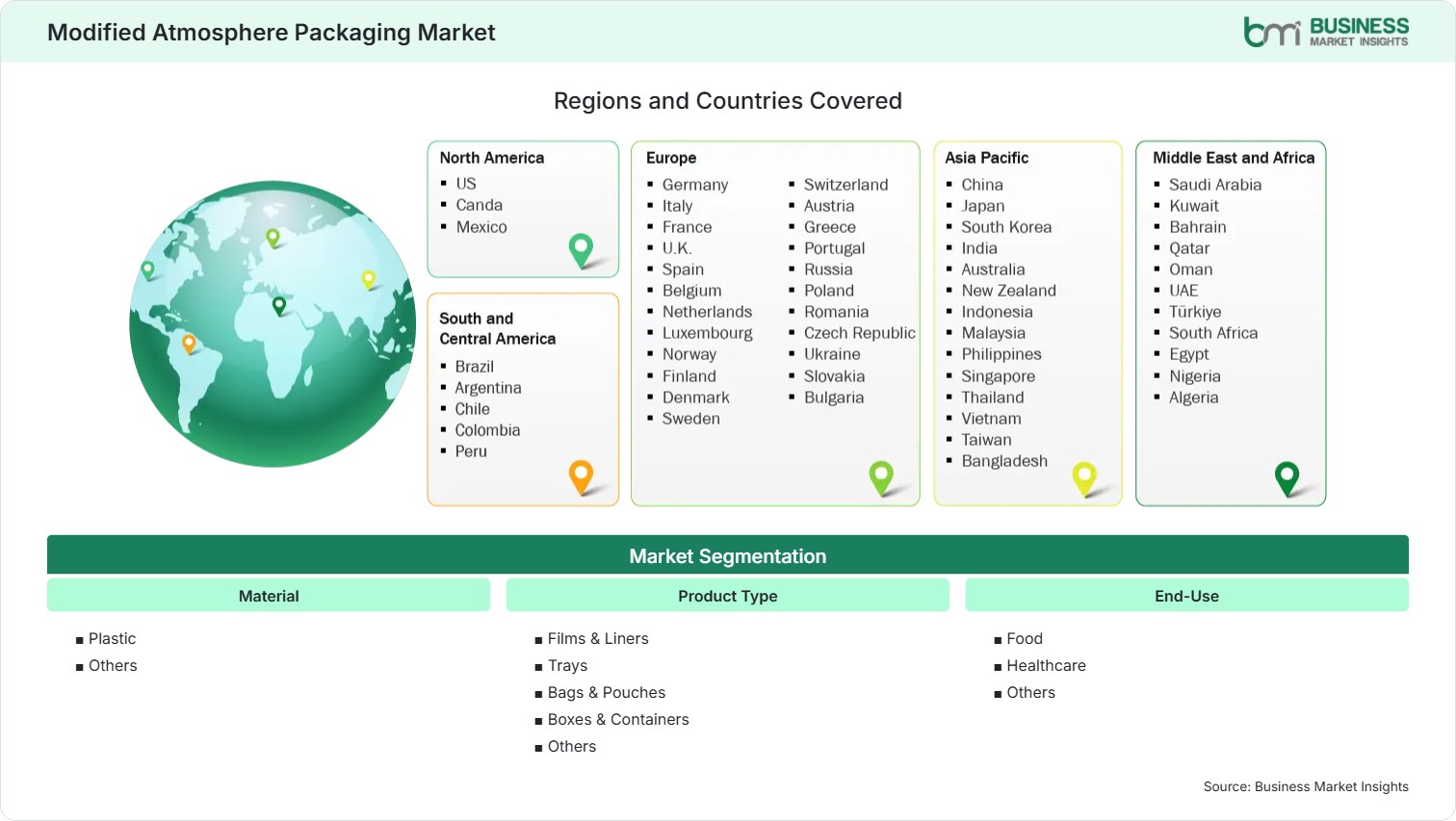
  • Material: Plastic, Others
  • Product Type: Films & Liners, Trays, Bags & Pouches, Boxes & Containers, Others
  • End-Use: Food, Healthcare, Others
US$ 22.76 Bn Market size in 2025
US$ 42.47 Bn Market Size by 2033
8.11% CAGR, 2026 - 2033
2026-2033 Forecast Period

01 AI Overview

Modified Atmosphere Packaging Market Summary

  • North America Region: North America holds a 29%–33% share in 2025, growing with a CAGR of 7.5%–8.5%, influenced by advanced food processing, convenience food consumption, cold-chain infrastructure, sustainability initiatives, and demand for high-performance barrier packaging solutions. The US market is expanding at a 7.5%–8.5% CAGR, supported by packaged food innovation, meat and seafood processing, retail expansion, and flexible packaging adoption.
  • Fastest Growing Region: Asia Pacific holds a 30%–34% Modified Atmosphere Packaging Market share in 2025, growing with a CAGR of 9.0%–10.0%, supported by urbanization, modern retail development, rising packaged food consumption, expanding food exports, and investments in processing infrastructure.
  • Leading Segment: Plastic holds a 62%–66% share in 2025, growing with a CAGR of 8.0%–9.0%, driven by lightweight construction, barrier performance, material flexibility, scalable production, and widespread adoption across food packaging applications.
  • High Growth Segment: Healthcare holds a 7%–10% share in 2025, growing with a CAGR of 9.0%–10.0%, supported by pharmaceutical distribution, medical product protection, sterile packaging requirements, and increasing demand for controlled-atmosphere preservation solutions.
  • Key Market Opportunity: High-barrier recyclable films, intelligent packaging integration, pharmaceutical applications, and emerging food export markets provide suppliers with opportunities to develop differentiated solutions combining shelf-life extension, sustainability, and operational efficiency.
  • Major Market Players: Sealed Air Corporation, Amcor plc, Berry Global Group, Inc., Sonoco Products Company, Mondi plc, Coveris Management GmbH, Smurfit Westrock plc, ProAmpac Holdings, Inc., Winpak Ltd., and ULMA Packaging, S. Coop.
02 Strategic Insights

Modified Atmosphere Packaging Market: Strategic Insights

modified-atmosphere-packaging-market-market-strategic-framework
FREE PDF
Request your free sample
Request free sample
03 Stakeholder View

Key Takeaways

  • The value chain increasingly connects polymer producers, film manufacturers, barrier coating specialists, packaging converters, equipment suppliers, food processors, retailers, and logistics providers, making technical collaboration critical for performance optimization.
  • Fresh meat, seafood, ready-to-eat meals, fresh produce, and dairy provide strong demand potential because controlled atmospheres can extend distribution windows while reducing quality deterioration and food waste.
  • Packaging development is shifting toward recyclable mono-material structures, thinner high-barrier films, improved gas permeability control, and packaging formats engineered for compatibility with automated filling and sealing equipment.
  • Asia Pacific offers a compelling investment case due to expanding modern retail, rising middle-class consumption, food processing modernization, and increasing domestic and export-oriented packaged food production.
  • Consolidation among packaging producers and converters is strengthening global portfolios, improving geographic reach, and enabling suppliers to combine flexible packaging, rigid formats, barrier technologies, and sustainable material capabilities.
  • Competitive differentiation increasingly depends on total packaging economics rather than material cost alone, with shelf-life extension, food waste reduction, machinery efficiency, recyclability, and regulatory compliance influencing procurement decisions.
04 Geographic Outlook

Modified Atmosphere Packaging Market Regional Highlights

North America Modified Atmosphere Packaging Market

North America accounted for a 29%–33% share in 2025 and is projected to grow at a 7.5%–8.5% CAGR during 2026–2033. The region benefits from sophisticated food processing, established cold-chain infrastructure, high convenience food consumption, and strong adoption of flexible packaging. The US dominates regional demand, while Canada provides additional opportunities through meat processing, seafood, fresh produce, and packaged food exports. Sustainability commitments are accelerating material innovation.

  • Large food processors increasingly deploy automated packaging lines that integrate gas flushing, sealing, and inspection technologies, supporting consistent shelf-life performance while improving throughput and reducing packaging-related production losses.
  • Consumption of prepared meals, fresh meat, seafood, and produce supports demand for packaging technologies that maintain product quality across longer retail and distribution cycles.
  • Packaging producers are developing recyclable and downgauged structures to address environmental expectations while maintaining oxygen barriers, mechanical strength, seal integrity, and required shelf-life performance.
  • Large grocery and foodservice customers increasingly demand standardized packaging specifications, encouraging suppliers to offer scalable solutions with consistent quality across geographically distributed processing operations.

US Modified Atmosphere Packaging Market

The US modified atmosphere packaging market represented a 25%–29% share in 2025 and is expected to expand at a 7.5%–8.5% CAGR through 2033. Strong demand from meat, seafood, fresh produce, dairy, and prepared meals supports adoption. Large-scale food processors increasingly prioritize packaging that extends distribution windows and reduces waste.

  • Extensive meat and seafood processing operations create substantial demand for packaging systems that maintain freshness, control oxidation, and support longer refrigerated distribution periods.
  • Rising consumption of prepared meals and ready-to-eat products is encouraging manufacturers to use packaging formats that combine extended shelf life with convenience and attractive retail presentation.
  • High-throughput food processors are investing in automated packaging systems, creating opportunities for suppliers offering films, trays, and equipment-compatible solutions with reliable sealing performance.

Europe Modified Atmosphere Packaging Market

Europe held a 24%–28% share in 2025 and Europe Modified Atmosphere Packaging Market forecast to register a 7.5%–8.5% CAGR through 2033. Germany leads regional demand through advanced food manufacturing and packaging capabilities, while the UK and France remain important markets. Spain is projected to grow at a 9.0%–10.0% CAGR, supported by fresh produce exports and food processing. Regulatory pressure around packaging waste is accelerating recyclable and resource-efficient formats.

  • Germany's advanced food processing industry and strong packaging manufacturing base support demand for high-performance films, trays, and barrier solutions across multiple food categories.
  • The UK modified atmosphere packaging market benefits from retailer-led sustainability commitments, encouraging packaging suppliers to develop recyclable structures and reduce material intensity without compromising shelf-life performance.
  • France provides opportunities through dairy, bakery, prepared foods, and fresh produce applications, where packaging performance is increasingly linked to food waste reduction strategies.
  • Spain's strong agricultural production and fresh produce export activity support higher demand for packaging that preserves quality throughout longer domestic and international distribution chains.

Asia Pacific Modified Atmosphere Packaging Market

Asia Pacific captured a 30%–34% share in 2025 and is expected to achieve a 9.0%–10.0% CAGR through 2033, making it the fastest-growing region. China leads regional demand, while Japan and South Korea maintain advanced packaging ecosystems. India is projected to grow at a 10.0%–11.0% CAGR as food processing, organized retail, convenience foods, and cold-chain infrastructure expand.

  • China's large food processing industry, expanding modern retail network, and growing packaged food consumption provide substantial opportunities for films, trays, pouches, and high-barrier packaging solutions.
  • India's food processing modernization and expanding organized retail sector are increasing demand for packaging that can improve shelf life and support broader distribution of fresh and convenience products.
  • Japan's advanced convenience food sector and sophisticated packaging industry support demand for high-performance materials, compact formats, automation, and technologies that preserve freshness.
  • South Korea's digitally enabled retail ecosystem and strong convenience food consumption create opportunities for advanced packaging formats combining shelf-life performance, functionality, and attractive presentation.

Rest of World Modified Atmosphere Packaging Market

South and Central America represented a 7%–10% share in 2025 and are expected to grow at a 7.0%–8.0% CAGR through 2033, led by Brazil and Mexico. Middle East and Africa accounted for a 5%–8% share, expanding at an 8.0%–9.0% CAGR. Brazil benefits from food exports, while the UAE and Saudi Arabia offer opportunities through modern retail, imported food distribution, and food processing investments.

  • Brazil's meat, poultry, seafood, and agricultural export industries create strong opportunities for packaging technologies capable of maintaining freshness and product integrity across extended supply chains.
  • Mexico's food manufacturing and export connections with North America support demand for packaging that enables longer distribution windows and consistent product quality across refrigerated logistics networks.
  • The UAE and Saudi Arabia are investing in food processing and modern retail, increasing demand for packaging solutions that protect imported and locally processed foods.
global-market-geography
FREE PDF
Request your free sample
Request free sample
05 Segment Analysis

Modified Atmosphere Packaging Market Segmentation

Material

Plastic accounted for a 62%–66% share in 2025 and is projected to grow at an 8.0%–9.0% CAGR during 2026–2034. Its dominance reflects flexibility, barrier performance, lightweight construction, and established conversion infrastructure.

  • Plastic: Plastic remains dominant because multilayer structures provide tailored oxygen, moisture, mechanical, and sealing properties across fresh food, meat, seafood, and convenience applications.
    • Polyethylene (PE): PE provides flexibility, sealability, and cost efficiency, supporting films and pouches used across food packaging where reliable sealing and moisture protection are required.
    • Polypropylene (PP): PP offers stiffness, heat resistance, and clarity, making it suitable for trays and packaging formats requiring structural performance and attractive product visibility.
    • Polyamide (PA): PA contributes mechanical strength and puncture resistance, supporting demanding meat and seafood applications where packaging durability is critical throughout handling and distribution.
    • Ethylene Vinyl Alcohol (EVOH): EVOH delivers strong oxygen barrier performance, helping protect sensitive foods and extending shelf life when integrated into compatible multilayer packaging structures.
  • Others: Alternative materials provide niche opportunities where manufacturers seek specialized barrier, sustainability, compostability, or performance characteristics beyond conventional plastic packaging structures.

Product Type

Films & Liners led product formats with a 39%–43% share in 2025 and are expected to grow at an 8.0%–9.0% CAGR through 2026–2034. Flexible formats benefit from lightweighting and material efficiency, while trays, bags, pouches, and containers address convenience and retail presentation. The modified atmosphere packaging market scope is broadening as converters develop formats compatible with recyclable structures and automated processing.

  • Films & Liners: Films and liners provide flexible gas barrier and sealing performance, supporting high-volume food applications where material efficiency and customized permeability are essential.
  • Trays: Trays offer structural protection and strong product presentation, making them widely applicable to meat, seafood, fresh produce, and prepared foods requiring controlled atmospheres.
  • Bags & Pouches: Bags and pouches combine lightweight construction with convenient handling, supporting ready-to-eat meals, fresh foods, and flexible packaging applications requiring efficient material utilization.
  • Boxes & Containers: Rigid boxes and containers provide structural protection and stacking efficiency, supporting food distribution and specialized applications where durability and product protection are priorities.
  • Others: Specialized formats address niche requirements, including customized packaging geometries, hybrid structures, and emerging formats designed around specific products and processing requirements.

End-Use

Food accounted for a 78%–82% share in 2025 and is projected to grow at an 8.0%–9.0% CAGR through 2026–2034. Demand is supported by shelf-life extension, food waste reduction, convenience consumption, and cold-chain expansion. Healthcare represents a smaller but faster-growing opportunity, while other applications remain specialized.

  • Food: Food remains the primary end-use because controlled atmospheres can slow deterioration and preserve quality across refrigerated and fresh product supply chains.
    • Meat & Seafood: Meat and seafood applications require oxygen and moisture management to preserve freshness, color, texture, and quality during refrigerated storage and distribution.
    • Ready-to-eat Meals: Ready-to-eat meals benefit from packaging that supports longer shelf life while maintaining convenience, presentation, and compatibility with high-volume automated food production.
    • Fruits & Vegetables: Fresh produce applications use controlled atmospheres to manage respiration and deterioration, supporting longer distribution periods and reducing losses throughout retail supply chains.
    • Dairy Products: Dairy packaging requires strong barrier performance and reliable sealing to protect sensitive products while maintaining freshness across refrigerated storage and retail distribution.
    • Bakery & Confectionery: Bakery and confectionery products benefit from packaging that controls oxygen and moisture exposure, supporting texture, freshness, and product quality throughout shelf life.
  • Healthcare: Healthcare applications offer growth opportunities through specialized packaging requiring controlled environments, product protection, and improved stability for pharmaceuticals and sensitive medical products.
  • Others: Industrial and specialized applications provide niche demand for packaging systems requiring controlled atmospheres, barrier performance, or tailored protection against environmental exposure.
06 Market Forces

Modified Atmosphere Packaging Market Dynamics

Key Market Drivers

Rising Demand for Extended Shelf Life in Packaged Food Products

The need for extending shelf life without compromising freshness is one of the main factors fueling the growth of the Modified Atmosphere Packaging Market. Manufacturers have been expanding into more geographical locations and hence require packaging that will keep the products protected during their storage, transit, and display at retail stores. Oxygen control is very critical in meat, seafood, vegetables, dairy, and ready-to-eat food. With food manufacturers under immense pressure to cut down on waste and become efficient in operation, packaging options that provide proven shelf-life extension become more critical in purchasing decisions.

Growing Adoption of Sustainable Packaging Across Food Processing Industries

The concept of sustainability has led to innovation in the packaging industry, whereby food processing companies and retailers are aiming at reducing material usage, increasing recyclability, and making good environmental decisions. High barrier packages have been using very complicated multi-layered structure which is not easy to recycle; hence there has been a need to overcome this technical issue for the converters. This has led to rapid innovations of monomaterial structures of polyethylene and polypropylene, barrier coating materials, thin films, and material recovery. The transition creates opportunities for material science innovation, but commercial success depends on balancing environmental performance with shelf-life requirements and production economics.

Increasing Consumption of Fresh and Convenience Foods Worldwide

Rising consumption of convenience and fresh foods is increasing the size of the target market for smart packaging solutions. The urban consumers are becoming interested in buying foods like ready-to-eat meals, cut fruits, fresh seafood, and packaged dairy foods, which provide convenience without any reduction in quality. Such foods require smart packaging that can deal with issues of respiration, oxidation, moisture, and microbial degradation. Modified Atmosphere Packaging Market trends are therefore closely connected to changes in food retail, meal preparation habits, and cold-chain infrastructure.

Key Market Opportunities

Expanding Demand from Emerging Food Retail and Export Industries

Emerging food retail and export industries are creating opportunities for packaging suppliers to support longer and more complex distribution networks. As food processors in Asia Pacific, Latin America, and the Middle East expand domestic and international sales, packaging must maintain product quality across longer transportation and storage periods. Investments in food processing infrastructure and cold-chain networks provide additional opportunities for packaging manufacturers that can demonstrate measurable improvements in shelf life and logistics efficiency.

Growing Use in Pharmaceutical and Healthcare Packaging Applications

Healthcare and pharmaceutical packaging offer a good avenue for diversification since there is need for advanced packaging for the fragile items. There could be potential use of controlled atmosphere in some of the areas that need minimal exposure of oxygen and better stability when it comes to packaging and transport. Despite the fact that the use of healthcare packaging is more regulated compared to food packaging, the value per application could be higher. The rise in the manufacture of pharmaceuticals and their global distribution makes the role of packaging more significant. Innovation in high-barrier films, specialty pouches, and controlled-environment packaging could therefore create new revenue streams beyond conventional food applications.

Innovation in High-Barrier Films Creating New Growth Opportunities

Developments in high-barrier film technology are allowing the combination of high oxygen barrier properties with recyclability, down gauging, and efficiency in production processes. Developments in polymer formulation, coating, adhesives, and multilayer films are allowing converters to meet their needs with fewer materials. Recyclable mono-material structures remain a key development area, although achieving barrier performance comparable to conventional multilayer packaging can be technically challenging.

Market Restraints and Challenges

High Packaging Equipment Costs Limiting Small Business Adoption

Factor: Modified Atmosphere Packaging often involves special equipment such as gas flushers, sealing machines, vacuum machines, dosing machines, and inspection machines, with capital investment depending on production size and degree of automation. Small-scale food processors will find it challenging to make justification of investment if the volume of production is low or there is a high turnover of products.

Impact: High capital cost will deter adoption of modified atmosphere packaging by small-scale food producers and compel them to continue using traditional packing. The challenge is particularly relevant in emerging markets where food processors may lack access to financing or technical expertise.

Complex Packaging Regulations Increasing Compliance and Operational Costs

Factor: Packaging companies face rising complexity in terms of requirements regarding food contact material, recycling, extended producer responsibility, labeling, waste management, and material composition in various jurisdictions. It can vary in requirements between regions, which poses challenges for international packaging producers and food producers.

Impact: The complexity of regulatory requirements may result in higher compliance costs, increased product development time, and need for additional testing or modification of packaging structures. Sustainability requirements may also result in technical conflicts if recyclable materials do not provide the same barrier properties as existing multilayers.

07 Company Analysis

Competitive Landscape

The Modified Atmosphere Packaging Market analysis indicates a highly competitive ecosystem dominated by global packaging manufacturers, flexible packaging specialists, rigid packaging suppliers, and integrated material technology providers. Competition is increasingly centered on sustainable material development, high-barrier performance, and the ability to provide integrated solutions.

Company Name

Overview

Products and Services relevant to this market

Sealed Air Corporation

Global packaging company specializing in food protection and packaging solutions across fresh and prepared food applications.

Cryovac food packaging, barrier films, vacuum packaging, trays, automated packaging systems, and food preservation solutions.

Amcor plc

Global packaging leader providing flexible and rigid packaging solutions for food, healthcare, and consumer markets.

High-barrier films, flexible packaging, trays, pouches, recyclable structures, and modified atmosphere packaging solutions.

Berry Global Group, Inc.

Global manufacturer of plastic packaging products serving food, healthcare, consumer, and industrial markets.

Flexible films, pouches, containers, barrier packaging, specialty films, and sustainable packaging solutions.

Sonoco Products Company

Diversified packaging manufacturer supplying flexible and rigid formats across food, consumer, and industrial applications.

Flexible packaging, trays, containers, barrier materials, thermoformed packaging, and food packaging solutions.

Mondi plc

Global packaging and paper company focused on sustainable packaging solutions across food and consumer industries.

Barrier films, flexible packaging, pouches, trays, paper-based solutions, and recyclable packaging structures.

Coveris Management GmbH

European packaging manufacturer specializing in flexible and rigid solutions for food and healthcare applications.

Flexible films, trays, pouches, barrier packaging, recyclable materials, and food packaging technologies.

Smurfit Westrock plc

Global packaging company providing paper and packaging solutions across food, beverage, healthcare, and consumer markets.

Corrugated packaging, cartons, flexible packaging, trays, containers, and sustainable packaging solutions.

ProAmpac Holdings, Inc.

Flexible packaging company developing high-performance and sustainable solutions for food, healthcare, and consumer products.

High-barrier films, pouches, flexible packaging, recyclable structures, and specialized food packaging formats.

Winpak Ltd.

North American packaging manufacturer focused on flexible and rigid packaging for food and healthcare markets.

Barrier films, lidding, trays, pouches, containers, and modified atmosphere food packaging solutions.

ULMA Packaging, S. Coop.

Packaging machinery and technology provider offering automated systems for food processing and packaging operations.

Thermoforming, flow wrapping, tray sealing, vacuum packaging, MAP machinery, and automated packaging systems.


10 Trust & Transparency

Research Methodology

The market analysis combines proprietary research with secondary data from government agencies, company disclosures, regulatory filings, industry databases and expert interviews. Market estimates are validated through data triangulation, cross-market benchmarking and analyst review.

View Full Research Methodology

11 Questions Answered

Frequently Asked Questions

What factors influence modified atmosphere packaging market report?

Food manufacturers typically assess barrier performance, shelf-life extension, material cost, equipment compatibility, sealing reliability, sustainability credentials, regulatory compliance, supply consistency, and technical support.

Can modified atmosphere packaging reduce food waste?

By slowing oxidation and deterioration, appropriately designed packaging can extend usable shelf life and provide longer distribution and retail windows.

What technology trend is reshaping packaging development?

The transition toward recyclable high-barrier structures is a major technology trend.

Why is Asia Pacific the fastest-growing region?

The region combines rapid urbanization, expanding modern retail, increasing packaged food consumption, food processing investment, and growing export activity.

Which food category offers the strongest demand potential in Modified Atmosphere Packaging Market?

Meat and seafood remain among the most important applications because products are highly sensitive to oxidation, microbial deterioration, and temperature fluctuations. Ready-to-eat meals and fresh produce also offer strong potential as convenience consumption and centralized food distribution expand.

Access the Full Modified Atmosphere Packaging Market Report

Get segment-level forecasts, regional estimates, competitive benchmarking, company profiles and downloadable Excel datasets.

Access the full Modified Atmosphere Packaging Market Report
350 pages PDF & Excel | 2026-08-03