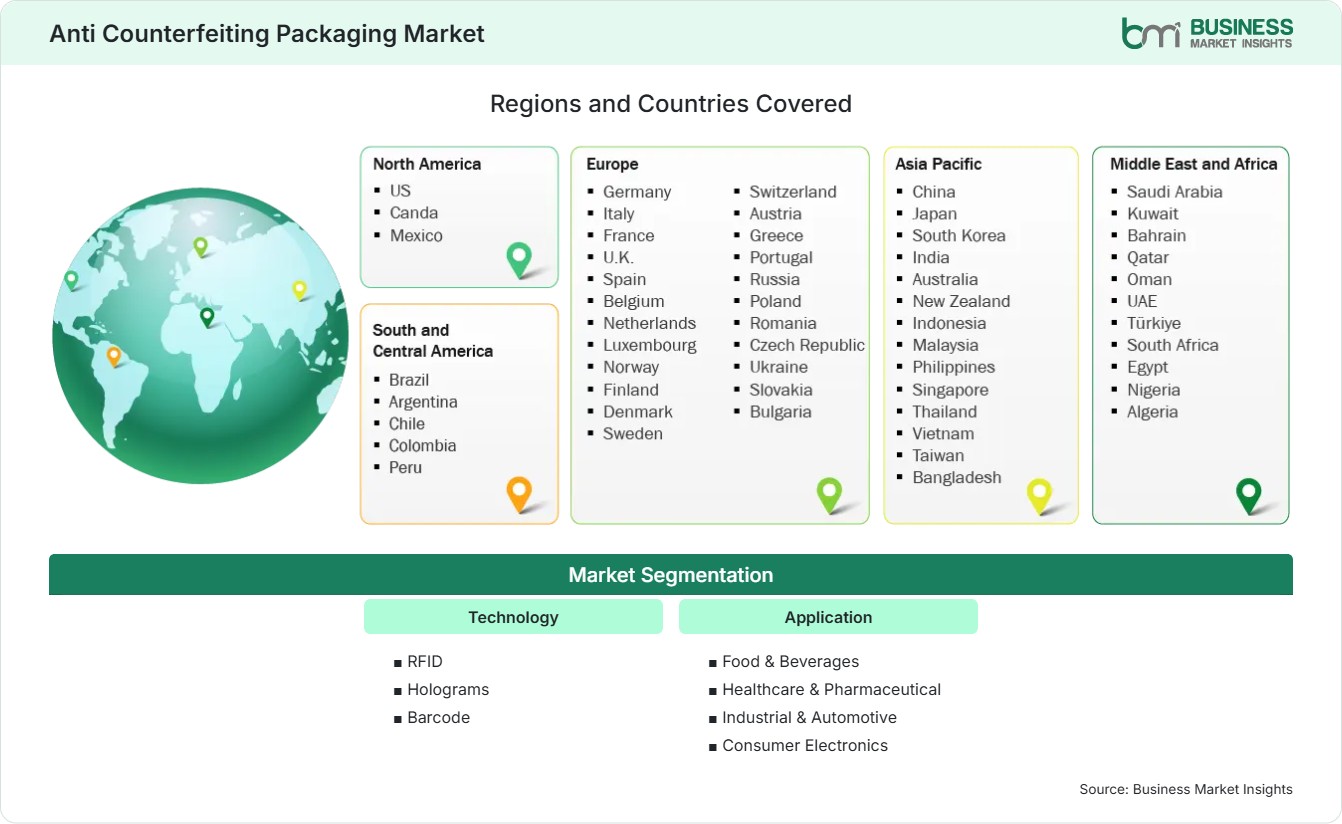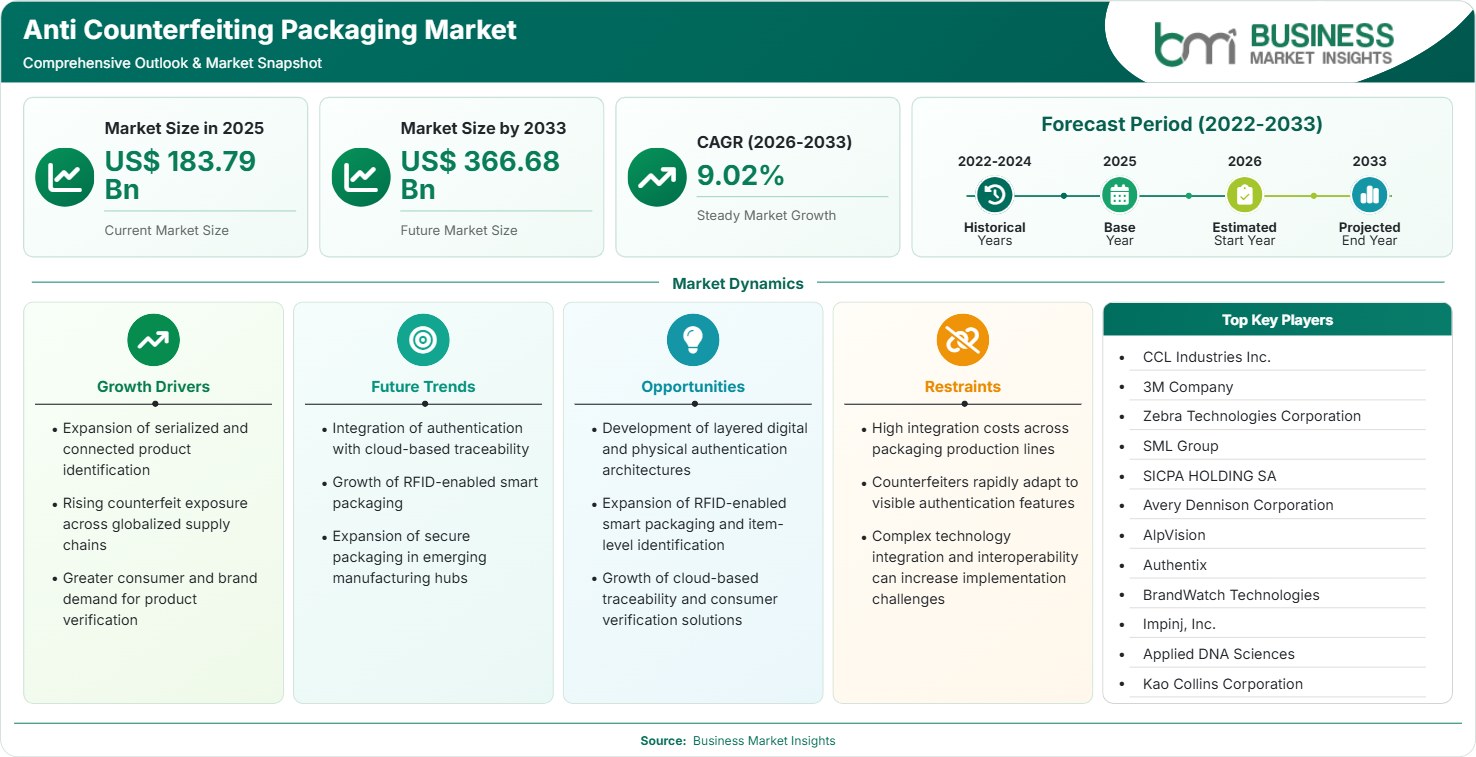
Anti Counterfeiting Packaging Market Regional Highlights
North America Anti Counterfeiting Packaging Market
North America represented a 27%–30% share in 2025 and is projected to register an 8.2%–8.8% CAGR from 2026–2033. The region benefits from mature pharmaceutical, food, electronics, and retail supply chains. The Anti Counterfeiting Packaging Market share is reinforced by advanced RFID infrastructure and strong brand-protection programs. The United States remains the principal demand center, while Canada supports specialty packaging and security-label manufacturing. Adoption is increasingly linked with digital identity, serialized products, automated inspection, and integrated logistics data.
- Pharmaceutical manufacturers increasingly connect serialization with authentication, enabling distributors and pharmacies to verify products while improving recall precision and inventory visibility.
- Retailers are expanding RFID usage beyond inventory counting toward loss prevention and product provenance, creating demand for labels capable of combining identification, authentication, and supply-chain analytics.
- Food and beverage brands are adopting covert features, secure codes, and tamper-evident constructions to address product diversion, substitution, and unauthorized distribution.
- Regional converters benefit from established printing, labeling, software, and packaging infrastructure, allowing advanced security features to be integrated without completely replacing conventional production assets.
US Anti Counterfeiting Packaging Market
The US had an 18%-21% share of the demand in 2025 and is expected to record an 8.4%-8.9% CAGR from 2026-2033. This is attributed to the sophistication of the country's healthcare logistics, retail facilities, manufacturing facilities, and high-value consumer goods. There is increasing demand for packaging that enables authentication and integration with digital systems. There is also an increasing need for consumer-level verification due to the nature of online marketplace sales and small-parcel shipments. The Anti Counterfeiting Packaging Market share remains supported by technology suppliers and specialized security-label providers.
- Healthcare is a major adoption catalyst because serialized identification can connect packaging to manufacturing, wholesaling, dispensing, and recall processes.
- Retail and consumer electronics companies increasingly use RFID and machine-readable identifiers to improve item visibility while creating additional barriers against substitution and unauthorized products.
- Industrial manufacturers are deploying secure labels and verification systems for components where counterfeit parts can create warranty, safety, performance, and reputational liabilities.
Europe Anti Counterfeiting Packaging Market
The Europe region had a market share of 24% - 27% in 2025 and is expected to grow at a CAGR of 8.5% - 9.1% from 2026 to 2033. Germany, France, Italy, and the United Kingdom are considered key players in the region, whereas Poland and Spain are good prospects for manufacturing. Germany is estimated to have a CAGR of 8.3% - 8.9%, whereas Poland has a growth potential of 9.4% - 10.0% CAGR owing to upgrades to packaging and industrial supply chain systems. The Anti Counterfeiting Packaging Market share is supported by pharmaceutical controls, premium consumer products, automotive manufacturing, and coordinated intellectual-property enforcement.
- European pharmaceutical traceability requirements encourage serialization and verification technologies, creating demand for packaging that supports secure identification across increasingly complex distribution networks.
- Automotive supply chains are adopting secure identification for components and replacement parts, where provenance and authenticity can affect safety, warranties, and regulatory accountability.
- Luxury goods producers increasingly combine visible design elements with covert identifiers, serialized codes, and digital verification to protect brand equity and resale channels.
- Packaging suppliers are also balancing security performance with recyclability, encouraging thinner substrates, material optimization, and security technologies compatible with established recycling systems.
Asia Pacific Anti Counterfeiting Packaging Market
Asia-Pacific held the largest regional share, accounting for 31%-34% in 2025, and is forecast to register a CAGR of 9.8%-10.6% through 2033. China, Japan, South Korea, India, and Southeast Asia are among its main demand centers. India is forecast to reach a CAGR of around 10.3%- 11.0%, while Vietnam and Indonesia present similar growth opportunities. The Growth in the Anti Counterfeiting packaging market stems from manufacturing volume, pharmaceutical exports, e-commerce, electronics production, and the adoption of digital traceability.
- China combines enormous manufacturing volumes with sophisticated packaging technology, making item-level identification important for domestic distribution and international exports.
- India is accelerating RFID and smart-label manufacturing capacity. Avery Dennison opened its first India-based RFID inlay production facility in Pune in April 2025, supporting regional RFID adoption.
- Japan and South Korea provide technologically mature environments for advanced labeling, electronics authentication, pharmaceutical identification, and precision packaging applications.
- Southeast Asian manufacturing hubs are increasingly attractive for localized authentication solutions because electronics, apparel, food, and pharmaceutical supply chains serve both regional and global markets.
Rest of World Anti Counterfeiting Packaging Market
The South and Central America region accounted for 11%-14% of the Rest of World market share in 2025, driven by growth in pharmaceutical products, food exports, alcoholic beverages, consumer goods, and cross-border shipments. Brazil and Mexico are the two countries with the best business opportunities, while Colombia and Chile are emerging adoption regions. The increasing formality in distribution is driving demand for verified labeling, serialization, and tamper-proof packaging.
Similarly, the Middle East and Africa are part of the 11%-14% Rest of World market share, with the UAE, Saudi Arabia, South Africa, and Turkey as key logistics and consumer markets. The growth drivers in the region are pharmaceutical imports, luxury goods, food items, improvements in customs processes, and the growth of e-commerce. The Anti Counterfeiting Packaging Market growth opportunity in the region is especially promising when the authentication process is integrated with logistics and customs information.
- Brazil offers scale through pharmaceuticals, food, beverages, and consumer goods, while local brand owners increasingly require authentication solutions suited to complex distribution networks.
- Mexico benefits from its manufacturing integration with North America, creating demand for secure identification across automotive, electronics, consumer products, and industrial packaging.
- Gulf markets emphasize product integrity in pharmaceuticals, luxury goods, food, and imported consumer products, favoring high-value authentication and digital verification technologies.
- South Africa provides a regional gateway for pharmaceuticals, food products, industrial goods, and consumer packaging, supporting adoption of traceability and authentication systems.