
Sustainable Beverage Market Outlook: Size, Share, Trends, Growth Analysis, Competitive Landscape & Forecast, 2026-2033

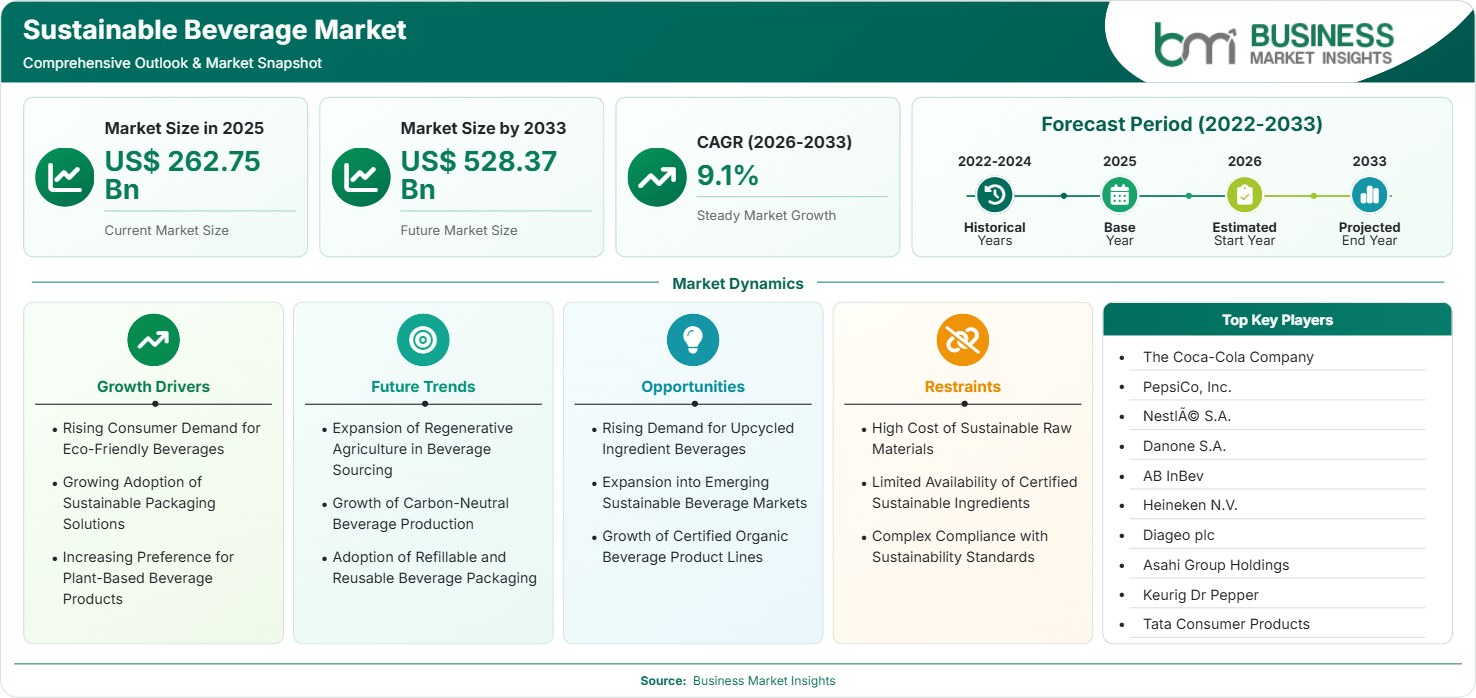
The Sustainable Beverage Market size was valued at US$ 262.75 Billion in 2025 and is projected to reach US$ 528.37 Billion by 2033, growing at a CAGR of 9.1% during 2026–2033. Rising consumer preference for environmentally responsible products, increasing demand for clean-label beverages, and growing investments in sustainable sourcing and recyclable packaging are driving market growth. Expanding organic beverage portfolios and circular packaging initiatives continue creating new opportunities.

Report Coverage
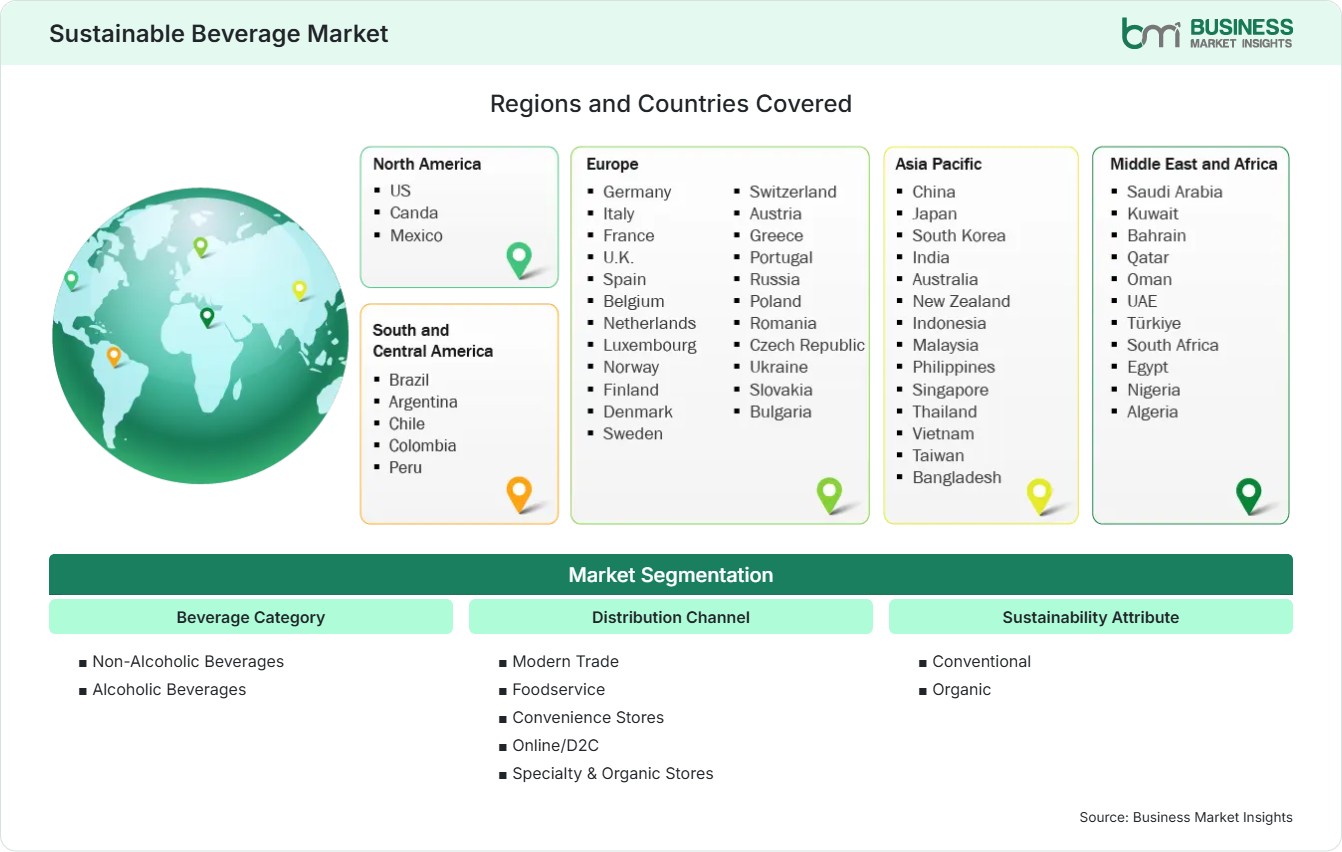
  • Beverage Category: Non-Alcoholic Beverages, Alcoholic Beverages
  • Distribution Channel: Modern Trade, Foodservice, Convenience Stores, Online/D2C, Specialty & Organic Stores
  • Sustainability Attribute: Conventional, Organic
US$ 262.75 Bn Market size in 2025
US$ 528.37 Bn Market Size by 2033
9.1% CAGR, 2026 - 2033
2026-2033 Forecast Period

01 AI Overview

Sustainable Beverage Market Summary

  • North America Region: North America holds a market share of 33%–36% in 2025 and is projected to grow at a CAGR of 8.6%–9.0% during 2026–2033. Strong consumer awareness, premium beverage demand, and corporate sustainability commitments continue supporting regional growth. The US remains the largest regional market, expanding at a CAGR of 8.7%–9.1%.
  • Fastest Growing Region: Asia Pacific accounts for 27%–30% of the market in 2025 and is expected to register the fastest CAGR of 9.8%–10.4% during the forecast period. Rising disposable incomes, expanding health-conscious consumer base, and increasing sustainable packaging adoption continue driving market expansion.
  • Leading Segment: Beverage Category – Non-Alcoholic Beverages account for 72%–75% of the market in 2025 and are projected to grow at a CAGR of 9.2%–9.7%. Growing demand for functional beverages, packaged water, and clean-label products continues supporting segment leadership.
  • High Growth Segment: Sustainability Attribute – Organic accounts for 29%–32% of the market in 2025 while registering a CAGR of 10.3%–10.9%. Increasing consumer preference for organic ingredients and environmentally friendly production practices continues to accelerate growth.
  • Key Market Opportunity: Rising investments in regenerative agriculture, recyclable packaging, and low-carbon beverage manufacturing are creating significant long-term opportunities for beverage producers.
  • Major Market Players: The Coca-Cola Company, PepsiCo, Inc., Nestlé S.A., Danone S.A., Anheuser-Busch InBev SA/NV, Heineken N.V., Diageo plc, Asahi Group Holdings, Ltd., Keurig Dr Pepper Inc., and Tata Consumer Products Limited.
02 Strategic Insights

Sustainable Beverage Market: Strategic Insights

Sustainable Beverage Market Strategic Framework
FREE PDF
Request your free sample
Request free sample
03 Stakeholder View

Key Takeaways

  • The market ecosystem includes ingredient suppliers, beverage manufacturers, packaging companies, retailers, certification organizations, and logistics providers supporting sustainable beverage production and distribution.
  • Non-alcoholic beverages continue offering the strongest commercial opportunity due to growing consumer demand for healthier, functional, and clean-label beverage products.
  • Innovation is increasingly focused on recyclable packaging, regenerative agriculture, plant-based ingredients, carbon-neutral manufacturing, and water-efficient production technologies.
  • Asia Pacific presents the strongest long-term investment opportunity owing to rising health awareness, urbanization, premium beverage consumption, and expanding retail infrastructure.
  • Strategic acquisitions, sustainable packaging investments, and partnerships with certified ingredient suppliers continue strengthening competitive positioning across the beverage industry.
  • Circular economy initiatives, transparent sourcing practices, and digital product traceability are becoming key differentiators among leading beverage manufacturers.
04 Geographic Outlook

Sustainable Beverage Market Regional Highlights

North America Sustainable Beverage Market

North America accounts for 33%–36% of the global market in 2025 and is projected to grow at a CAGR of 8.6%–9.0% during 2026–2033. The Sustainable Beverage Market share is supported by strong consumer preference for clean-label products, widespread adoption of recyclable packaging, and increasing corporate sustainability commitments. Premium beverage innovation and expanding organic product portfolios continue strengthening regional demand.

  • Beverage manufacturers are increasing investments in recyclable packaging, renewable energy, and responsible sourcing to meet evolving consumer expectations and ESG commitments.
  • Functional beverages, bottled water, and organic drinks continue witnessing strong consumer demand across supermarkets, specialty retailers, and online channels.
  • Retailers are expanding shelf space for environmentally certified beverage brands to meet growing demand for sustainable consumer products.
  • Digital supply chain monitoring and ingredient traceability technologies are improving transparency throughout beverage production and distribution.
  • Corporate carbon reduction initiatives continue encouraging investments in low-emission manufacturing and sustainable packaging solutions.

US Sustainable Beverage Market

The United States represents 28%–31% of the global market in 2025 and is expected to register a CAGR of 8.7%–9.1% through 2033. Rising demand for organic beverages, functional drinks, and premium sustainable brands continues driving market expansion. Beverage companies are increasingly investing in recyclable packaging, water conservation technologies, and responsible ingredient sourcing.

  • Consumers increasingly prioritize beverages with clean-label ingredients, reduced sugar formulations, and environmentally responsible packaging.
  • Beverage manufacturers continue expanding refillable packaging systems and recycled PET bottle adoption across multiple product categories.
  • Growing investments in regenerative agriculture continue strengthening sustainable ingredient sourcing across beverage supply chains.
  • Online retail platforms continue supporting wider availability of premium sustainable beverage brands nationwide.

Europe Sustainable Beverage Market

Europe holds 29%–32% of the global market in 2025 and is projected to grow at a CAGR of 8.8%–9.3% during the forecast period. Strict environmental regulations, strong sustainability awareness, and expanding organic food consumption continue supporting regional growth. Germany leads the regional market, while Spain records the fastest growth owing to increasing consumer demand for sustainable packaged beverages.

  • Germany maintains regional leadership through advanced recycling infrastructure, premium beverage consumption, and strong environmental regulations.
  • Spain is projected to witness the fastest regional growth due to rising organic beverage consumption and increasing sustainable packaging investments.
  • Beverage manufacturers continue adopting recyclable aluminum cans, recycled plastics, and lightweight packaging to reduce environmental impact.
  • Expanding organic certification programs continue supporting consumer confidence and premium product adoption.
  • Circular economy initiatives continue encouraging sustainable packaging innovation throughout the beverage industry.

Asia Pacific Sustainable Beverage Market

Asia Pacific accounts for 27%–30% of the global market in 2025 and is projected to record the fastest CAGR of 9.8%–10.4% during 2026–2033. Rising disposable incomes, rapid urbanization, and increasing consumer awareness of environmental sustainability continue driving market growth. China dominates the regional market, while India records the fastest growth due to expanding health-conscious consumer spending.

  • China continues leading regional demand through expanding packaged beverage consumption and increasing investments in sustainable manufacturing.
  • India records the fastest regional growth supported by growing demand for organic beverages, clean-label products, and eco-friendly packaging.
  • Japan and South Korea continue strengthening premium beverage innovation through environmentally responsible production technologies.
  • Beverage companies are increasingly investing in biodegradable packaging and renewable energy-powered manufacturing facilities.
  • Modern retail expansion continues improving availability of sustainable beverage products across urban markets.

Rest of World Sustainable Beverage Market

The Rest of World accounts for 8%–10% of the global market in 2025 and is projected to grow at a CAGR of 8.9%–9.4% during the forecast period.

South & Central America continue to witness increasing demand for sustainably produced beverages as premium consumer products gain popularity. Brazil leads the regional market, while Mexico records the fastest growth owing to expanding retail infrastructure and sustainable packaging adoption.

The Middle East & Africa continues benefiting from rising health awareness, premium beverage demand, and sustainability initiatives. Saudi Arabia leads the regional market, while the United Arab Emirates records the fastest growth through increasing investments in premium beverage retail and environmentally responsible packaging.

  • Brazil continues strengthening sustainable beverage production through expanding organic agriculture and recyclable packaging initiatives.
  • Mexico is witnessing rising demand for environmentally friendly beverages supported by retail expansion and changing consumer preferences.
  • Saudi Arabia continues investing in sustainable food and beverage manufacturing as part of broader economic diversification initiatives.
  • The United Arab Emirates is rapidly expanding premium beverage offerings through sustainable retail concepts and environmentally responsible packaging.
  • Growing consumer awareness and increasing regulatory focus on sustainable packaging continue supporting long-term market development across emerging economies.
Global Market Geography
FREE PDF
Request your free sample
Request free sample
05 Segment Analysis

Sustainable Beverage Market Segmentation

Beverage Category

Beverage category remains the largest determinant of product demand, innovation, and consumer purchasing behavior across the industry. Non-Alcoholic Beverages account for 72%–75% of the market in 2025 and are projected to grow at a CAGR of 9.2%–9.7% during 2026–2033. The Sustainable Beverage Market scope continues expanding as consumers increasingly prefer healthier, clean-label, and environmentally responsible beverage options.

  • Non-Alcoholic Beverages: Non-alcoholic beverages dominate the market due to growing demand for healthier drinks, clean-label formulations, sustainable packaging, and functional beverage innovations across global consumer markets.
    • Packaged Water: Sustainable packaged water brands increasingly adopt recycled PET bottles, lightweight packaging, and responsible water sourcing to reduce environmental impact.
    • Clean-label/Natural CSDs: Clean-label carbonated soft drinks are gaining popularity through natural sweeteners, reduced artificial ingredients, and environmentally friendly packaging solutions.
    • Juices & Juice Concentrates: Juice manufacturers are utilizing sustainably sourced fruits, recyclable packaging, and energy-efficient production processes to strengthen environmental performance.
    • Functional Beverages: Functional beverages continue expanding with plant-based ingredients, natural nutrition, probiotics, and wellness-focused formulations supported by sustainable sourcing practices.
    • Ready-to-Drink Tea & Coffee: Ready-to-drink tea and coffee products increasingly utilize certified sustainable ingredients, recyclable packaging, and responsible agricultural sourcing.
  • Alcoholic Beverages: Alcoholic beverage manufacturers are investing in sustainable brewing, renewable energy, recyclable packaging, and water conservation initiatives.
    • Beer: Breweries are adopting renewable energy, circular packaging, water reuse systems, and sustainable grain sourcing to reduce environmental footprints.
    • Wine: Sustainable wine production increasingly emphasizes organic vineyards, lightweight bottles, renewable energy, and environmentally responsible cultivation practices.
    • Spirits: Spirit manufacturers continue investing in sustainable distillation technologies, recyclable packaging, and responsible agricultural sourcing for premium product portfolios.
    • Low-/No-Alcohol Beverages: Low- and no-alcohol beverages are experiencing strong demand as consumers increasingly seek healthier and environmentally responsible alternatives.

Distribution Channel

Distribution channels continue evolving alongside changing consumer purchasing preferences and omnichannel retail strategies. Modern Trade accounts for 41%–44% of the market in 2025 and is projected to grow at a CAGR of 8.9%–9.4% during the forecast period. Expanding organized retail continues to shape Sustainable Beverage Market trends.

  • Modern Trade: Supermarkets and hypermarkets remain the leading distribution channel due to extensive product availability, premium shelf space, and growing consumer preference for sustainable beverage brands.
  • Foodservice: Foodservice operators increasingly incorporate sustainable beverages into restaurants, cafés, hotels, and institutional dining to meet evolving consumer expectations.
  • Convenience Stores: Convenience stores continue expanding sustainable beverage offerings to serve consumers seeking healthier products during daily purchases.
  • Online/D2C: Online and direct-to-consumer channels are witnessing rapid growth through subscription services, premium product availability, and personalized consumer engagement.
  • Specialty & Organic Stores: Specialty and organic retailers continue attracting environmentally conscious consumers seeking certified, sustainable, and premium beverage products.

Sustainability Attribute

Sustainability attributes significantly influence consumer purchasing decisions and brand positioning across beverage markets. Conventional products account for 68%–71% of the market in 2025 and are projected to grow at a CAGR of 8.7%–9.2% during 2026–2033. Manufacturers continue strengthening sustainability initiatives across conventional production systems while expanding environmentally responsible practices.

  • Conventional: Conventional sustainable beverages dominate due to wider product availability, established manufacturing capacity, and increasing adoption of recyclable packaging and responsible sourcing initiatives.
  • Organic: Organic beverages represent the fastest-growing segment as consumers increasingly prioritize certified ingredients, environmentally friendly farming practices, and clean-label beverage formulations.
06 Market Forces

Sustainable Beverage Market Dynamics

Key Market Drivers

Rising Consumer Demand for Eco-Friendly Beverages

Consumers are increasingly choosing beverages produced with environmentally responsible ingredients, recyclable packaging, and transparent supply chains. The Sustainable Beverage Market growth is supported by rising awareness of climate change, growing preference for clean-label products, and stronger purchasing decisions based on environmental impact. Beverage manufacturers continue expanding sustainable product portfolios while improving carbon reduction initiatives, responsible sourcing, and resource-efficient manufacturing practices to meet evolving consumer expectations.

Growing Adoption of Sustainable Packaging Solutions

Companies are making substantial investments in PET bottles that can be recycled, aluminum cans, biodegradable materials, reusable containers, and lightweight packaging to minimize their ecological footprint. Innovations in packaging assist organizations to meet the standards set forth in the sustainability policies and to use less material as well as enhance the efficiency of the circular economy approach.

Increasing Preference for Plant-Based Beverage Products

The rising trend of consumers being interested in living healthy lives and making environmentally friendly food choices has been boosting the demand for beverages based on plants. Beverages that are made from oats, almonds, soy, coconuts, and various other plants have been gaining momentum because of their reduced environmental impact and changing dietary preferences.

Key Market Opportunities

Rising Demand for Upcycled Ingredient Beverages

Food and beverage manufacturers are increasingly utilizing fruit peels, surplus produce, and other upcycled ingredients to develop innovative beverages while minimizing food waste. Sustainable Beverage Market Forecasts indicate growing investment in circular production models that improve resource efficiency and strengthen environmental sustainability across beverage manufacturing.

Expansion into Emerging Sustainable Beverage Markets

The trends of rapid urbanization, higher levels of disposable income, and heightened environmental consciousness among the people living in developing countries have brought about considerable opportunities for sustainable beverages companies. Increased consumer consciousness about eco-friendly packaging, ethical sourcing of raw materials, and environmental sustainability of production processes is resulting in more acceptance of sustainable beverages among consumers. Companies have started setting up new plants in such regions, improving their distribution channels, and forming business partnerships with retailers and distributors in order to penetrate into the markets effectively. Companies have also started offering a region-specific portfolio of products catering to the taste preferences and purchasing power of the people of the region.

Growth of Certified Organic Beverage Product Lines

There is a continuous increase in the demand for organic beverages due to increasing consumer preference for beverages that are produced without using synthetic pesticides, chemical fertilizers, genetic modifications, or any additives. The growing consciousness about the health and safety of food and the environment is making consumers prefer certified organic beverages in categories such as juices, tea, coffee, dairy drinks, and plant-based beverages. Beverage producers are continuously introducing new organic certified beverages in order to enhance premium brand positioning, attract health-conscious consumers, and differentiate themselves among competing companies. Such actions by beverage producers are anticipated to bring more innovations to the global organic beverage industry.

Market Restraints and Challenges

High Cost of Sustainable Raw Materials

Factor: Sustainable agricultural practices, certified ingredients, renewable packaging materials, and environmentally responsible sourcing often involve higher production and procurement costs.

Impact: Elevated production expenses can increase retail prices, limit affordability, and reduce adoption among price-sensitive consumers, particularly across developing markets.

Limited Availability of Certified Sustainable Ingredients

Factor: Reliable supplies of certified organic, responsibly sourced, and sustainably produced raw materials remain limited across several agricultural value chains.

Impact: Supply constraints may increase procurement risks, restrict production scalability, and create challenges in maintaining consistent product quality and certification compliance across global beverage operations.

07 Company Analysis

Competitive Landscape

The Sustainable Beverage Market analysis is characterized by intense competition among global beverage manufacturers focusing on sustainable sourcing, recyclable packaging, carbon footprint reduction, and clean-label product innovation. Companies are investing in regenerative agriculture, renewable energy-powered production facilities, circular packaging solutions, and organic product portfolios to strengthen their market positions.

Company Name

Overview

Products and Services Relevant to this Market

The Coca-Cola Company

Global beverage leader with an extensive portfolio of non-alcoholic beverages across multiple categories.

Packaged water, juices, functional beverages, recyclable packaging initiatives, and sustainable beverage production.

PepsiCo, Inc.

Multinational food and beverage company focused on sustainable product innovation and packaging.

Soft drinks, juices, bottled water, plant-based beverages, and sustainable packaging solutions.

Nestlé S.A.

Global food and beverage company emphasizing responsible sourcing and environmental sustainability.

Bottled water, coffee, ready-to-drink beverages, recyclable packaging, and sustainable ingredient sourcing.

Danone S.A.

International food and beverage company specializing in health-focused and environmentally responsible products.

Plant-based beverages, bottled water, organic beverages, and sustainable manufacturing solutions.

Anheuser-Busch InBev SA/NV

World's largest brewing company with significant sustainability initiatives across global operations.

Beer, low-carbon brewing technologies, recyclable packaging, and responsible ingredient sourcing.

Heineken N.V.

Global brewing company focused on renewable energy, water stewardship, and sustainable brewing practices.

Beer, low-alcohol beverages, sustainable brewing technologies, and circular packaging solutions.

Diageo plc

International alcoholic beverage company investing in carbon reduction and sustainable production.

Spirits, premium beverages, sustainable packaging, renewable energy initiatives, and responsible sourcing.

Asahi Group Holdings, Ltd.

Beverage manufacturer expanding environmentally responsible production and packaging initiatives.

Beer, soft drinks, functional beverages, recyclable packaging, and sustainable manufacturing technologies.

Keurig Dr Pepper Inc.

Leading beverage company offering hot and cold beverage products across multiple consumer segments.

Ready-to-drink beverages, packaged beverages, recyclable packaging, and sustainability-focused product development.

Tata Consumer Products Limited

Diversified beverage company with strong presence in tea, coffee, and packaged beverage markets.

Tea, coffee, ready-to-drink beverages, sustainable sourcing programs, and environmentally responsible packaging.

08 Industry Activity

Recent Developments

July 2026

ACR (AmerCareRoyal, LLC) acquired the assets of RediBagUSA, a well-established supplier of reusable retail bags, high-quality paper products, and sustainable packaging solutions serving grocery, restaurant, deli, medical, and industrial markets across the United States.

July 2026

Del Monte Corporation and Treatt launched an upcycled fruit extract range for beverage applications, featuring pineapple, watermelon, mango, and cantaloupe extracts derived from fruit processing by-products to support clean-label and sustainable beverage innovation.

June 2026

Ardagh Glass Packaging announced the launch of a new 275ml beverage bottle in collaboration with Fitz’s Bottling Company, expanding packaging options for premium beverages with a format designed to enhance brand differentiation and consumer appeal.

April 2026

Crown Holdings announced plans to establish a state-of-the-art beverage can manufacturing facility in Northern India, expanding its presence in the country and supporting growing demand for aluminum beverage cans through a long-term partnership with United Breweries.

10 Trust & Transparency

Research Methodology

The market analysis combines proprietary research with secondary data from government agencies, company disclosures, regulatory filings, industry databases and expert interviews. Market estimates are validated through data triangulation, cross-market benchmarking and analyst review.

View Full Research Methodology

11 Questions Answered

Frequently Asked Questions

What are the major opportunities in the market?

Key opportunities include expanding organic beverage portfolios, increasing use of upcycled ingredients, growth in emerging markets, regenerative agriculture initiatives, and wider adoption of sustainable packaging technologies.

Who are the major companies operating in the market?

Major companies include The Coca-Cola Company, PepsiCo, Inc., Nestlé S.A., Danone S.A., Anheuser-Busch InBev SA/NV, Heineken N.V., Diageo plc, Asahi Group Holdings, Ltd., Keurig Dr Pepper Inc., and Tata Consumer Products Limited.

Which region is expected to witness the fastest growth?

Asia Pacific is projected to record the fastest growth owing to increasing disposable incomes, expanding health-conscious consumer populations, rising sustainable packaging adoption, and growing organized retail networks.

Which segment dominates the sustainable beverage market report?

The Non-Alcoholic Beverages segment dominates due to strong consumer demand for packaged water, functional beverages, juices, ready-to-drink products, and clean-label beverage formulations.

What is driving the market?

The market is driven by rising consumer demand for eco-friendly beverages, growing adoption of recyclable packaging, increasing preference for plant-based products, and expanding investments in sustainable sourcing and low-carbon manufacturing.

Access the Full Sustainable Beverage Market Report

Get segment-level forecasts, regional estimates, competitive benchmarking, company profiles and downloadable Excel datasets.

Access the full Sustainable Beverage Market Report
350 pages PDF & Excel | 2026-07-31