Beverage Cartons Market Regional Highlights
North America Beverage Cartons Market
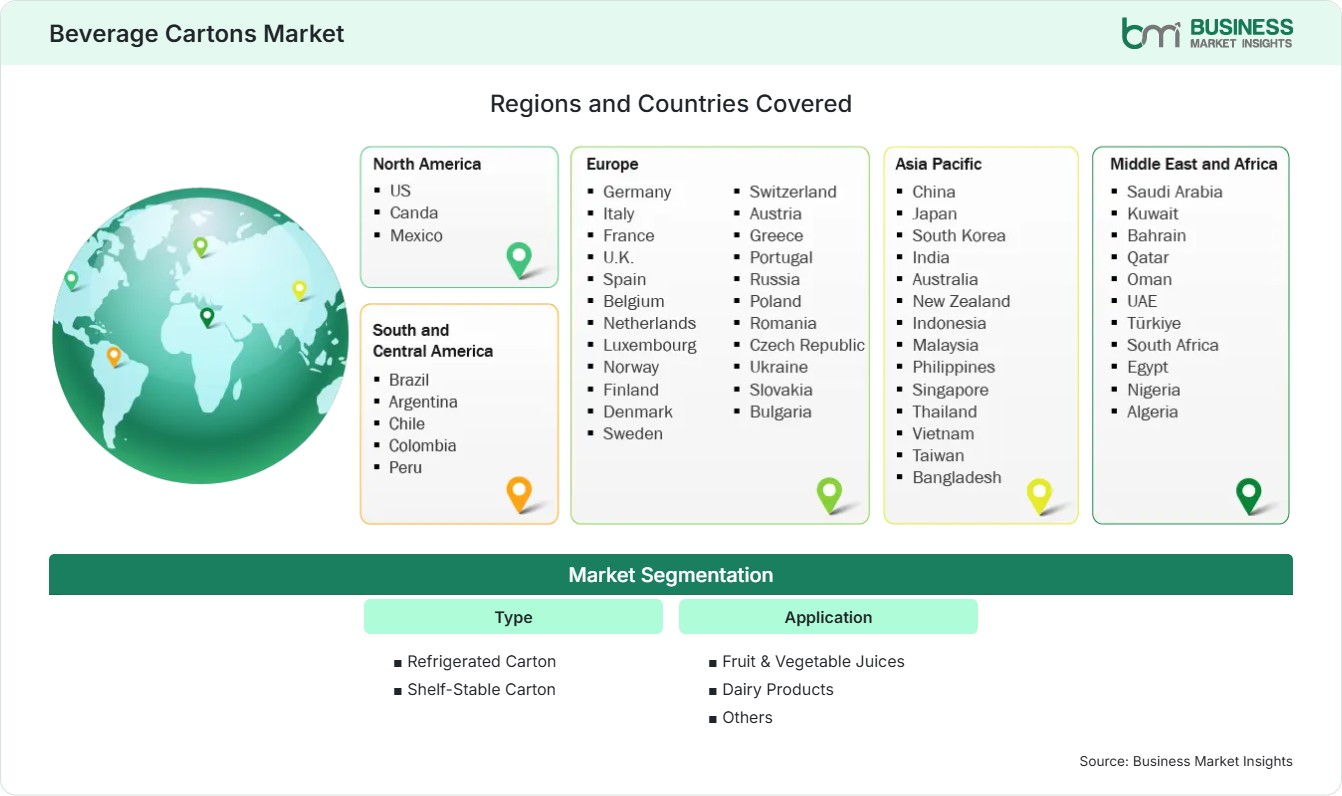
North America accounts for 18%–22% share in 2025 and is projected to grow at a CAGR of 4.50%–5.50% through 2033. Demand is supported by sustainable packaging initiatives, dairy and juice consumption, plant-based beverages, and convenience-oriented formats. Beverage Cartons Market share benefits from established filling infrastructure and strong brand participation.
- Beverage companies are increasing attention to packaging footprint reduction, encouraging carton suppliers to develop lighter structures and improve renewable material content without sacrificing product protection.
- Shelf-stable beverages are gaining relevance where consumers value convenience and extended storage, supporting demand for aseptic cartons across juices, dairy alternatives, and nutritional products.
- Recycling infrastructure investment remains strategically important because improved collection and processing capacity can strengthen consumer confidence and support corporate circularity commitments.
US Beverage Cartons Market
The US Beverage Cartons Market represents approximately 72%–76% of North American demand in 2025 and is projected to grow at a CAGR of 4.70%–5.70% through 2033. The market benefits from established beverage manufacturing, widespread modern retail, and growing interest in sustainable packaging.
- Major beverage brands are evaluating lower-impact packaging formats as corporate sustainability commitments increase pressure to reduce virgin plastic consumption and improve material circularity.
- Demand for plant-based milk and nutritional beverages is supporting carton adoption because shelf-stable formats enable broad distribution without continuous refrigeration.
- Packaging recovery remains a strategic consideration, with industry stakeholders pursuing improved collection, sorting, and processing systems to strengthen carton recycling outcomes.
Europe Beverage Cartons Market
Europe Beverage Cartons Market holds 25%–29% share in 2025 and is projected to grow at a CAGR of 4.50%–5.50%. Germany, France, the United Kingdom, Italy, and Spain are leading markets, while the Nordic region remains influential in sustainable packaging innovation. Germany is estimated at 4.80%–5.80% CAGR, supported by recycling awareness and packaged beverage demand. The United Kingdom is positioned at 4.70%–5.70% CAGR, driven by packaging circularity initiatives, plant-based beverages, and regulatory pressure.
- European packaging policy is increasing attention toward recyclability, recycled content, packaging waste reduction, and producer responsibility, encouraging innovation in carton structures and collection systems.
- Plant-based beverage growth is supporting carton demand as oat, soy, almond, and other alternatives expand across supermarkets, convenience channels, and foodservice applications.
- Aseptic packaging remains attractive for products requiring extended shelf life, enabling beverage manufacturers to reduce refrigeration needs and expand distribution across geographically dispersed markets.
- European producers are investing in lightweighting and fiber optimization to reduce material use while maintaining barrier performance and mechanical strength during transportation.
Asia Pacific Beverage Cartons Market
Asia Pacific Beverage Cartons Market accounts for 32%–36% share in 2025 and is projected to record the fastest regional CAGR of 6.00%–7.00%. China, Japan, India, South Korea, and Australia are leading markets, while Southeast Asia offers strong expansion potential. India is estimated at 7.00%–8.00% CAGR, supported by urbanization and packaged beverage demand.
- China remains a major regional market because of its large beverage manufacturing base, expanding convenience channels, and increasing adoption of packaged dairy and juice products.
- India offers strong potential as urban consumers increasingly purchase packaged beverages, while domestic manufacturers expand modern filling capacity and distribution networks.
- Southeast Asian markets are attracting investment in aseptic packaging as rising incomes, urbanization, and limited cold-chain availability increase demand for shelf-stable products.
- Plant-based beverage categories are expanding across major Asian cities, creating new opportunities for carton suppliers serving dairy alternatives and functional beverages.
Rest of World Beverage Cartons Market
South and Central America account for 8%–10% share in 2025 and are projected to grow at a CAGR of 5.00%–6.00%. Brazil, Mexico, Colombia, and Argentina lead regional demand, supported by juice consumption and established dairy industries. Brazil is estimated at 5.50%–6.50% CAGR, while Mexico is positioned at 5.00%–6.00% CAGR. The Middle East and Africa represent 7%–9% share in 2025 and are projected to grow at a CAGR of 5.50%–6.50%. Saudi Arabia, the UAE, South Africa, and Egypt offer leading opportunities, supported by packaged beverage consumption and modern retail.
- Latin American juice and dairy markets provide a strong foundation for carton demand, supported by established consumption patterns and broad availability of packaged beverages.
- Emerging retailers are expanding distribution networks across developing markets, increasing demand for lightweight and shelf-stable packaging that can withstand longer logistics routes.
- Middle Eastern markets favor extended-shelf-life beverages because ambient distribution can reduce dependence on continuous refrigeration across long-distance supply chains.
- African markets offer longer-term opportunities as urbanization and packaged beverage penetration increase, although recycling infrastructure and local manufacturing capacity remain critical constraints.
- Regional producers can strengthen competitiveness through localized production, partnerships with beverage manufacturers, and investment in packaging recovery systems that support sustainable growth.