
Non Alcoholic Beverages Market Outlook: Size, Share, Trends, Growth Analysis, Competitive Landscape & Forecast, 2026-2033

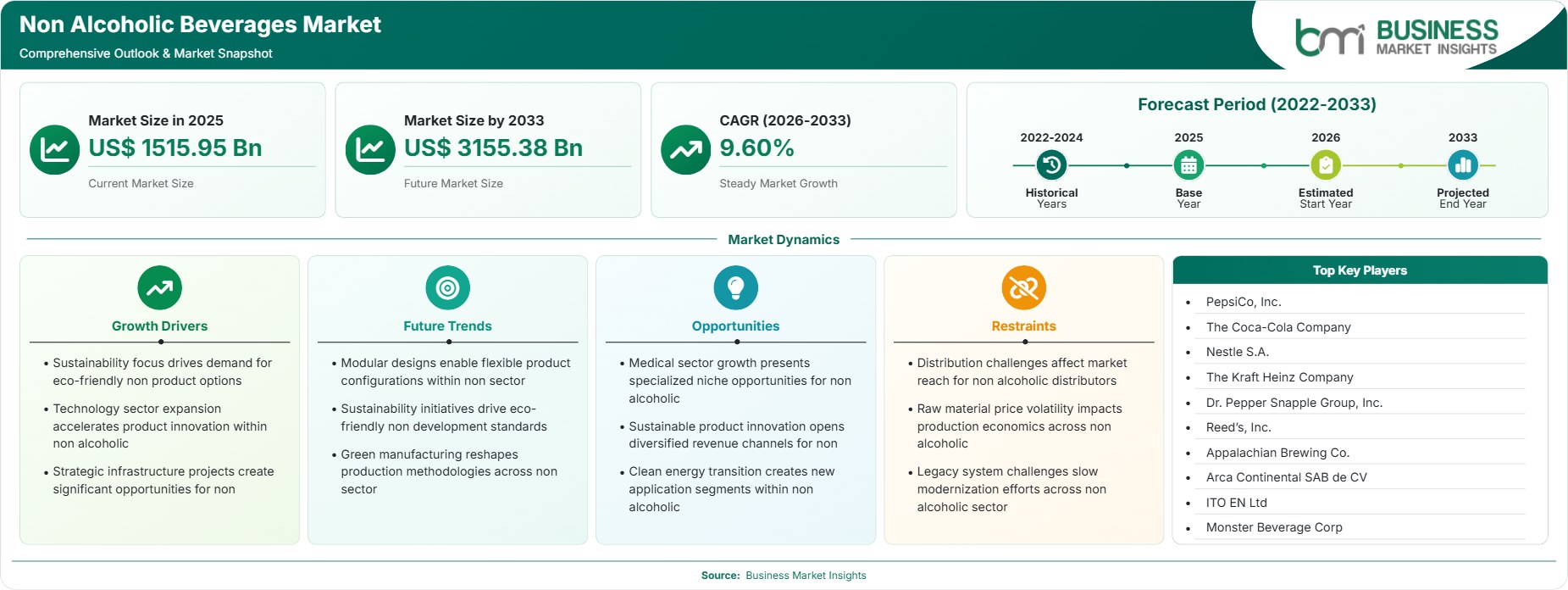
The Non-Alcoholic Beverages Market size was valued at US$ 1515.95 Billion in 2025 and is projected to reach US$ 3155.38 Billion by 2033, growing at a CAGR of 9.60% during 2026–2033, driven by health-conscious consumption, premiumization, and expanding retail channels globally.

Report Coverage
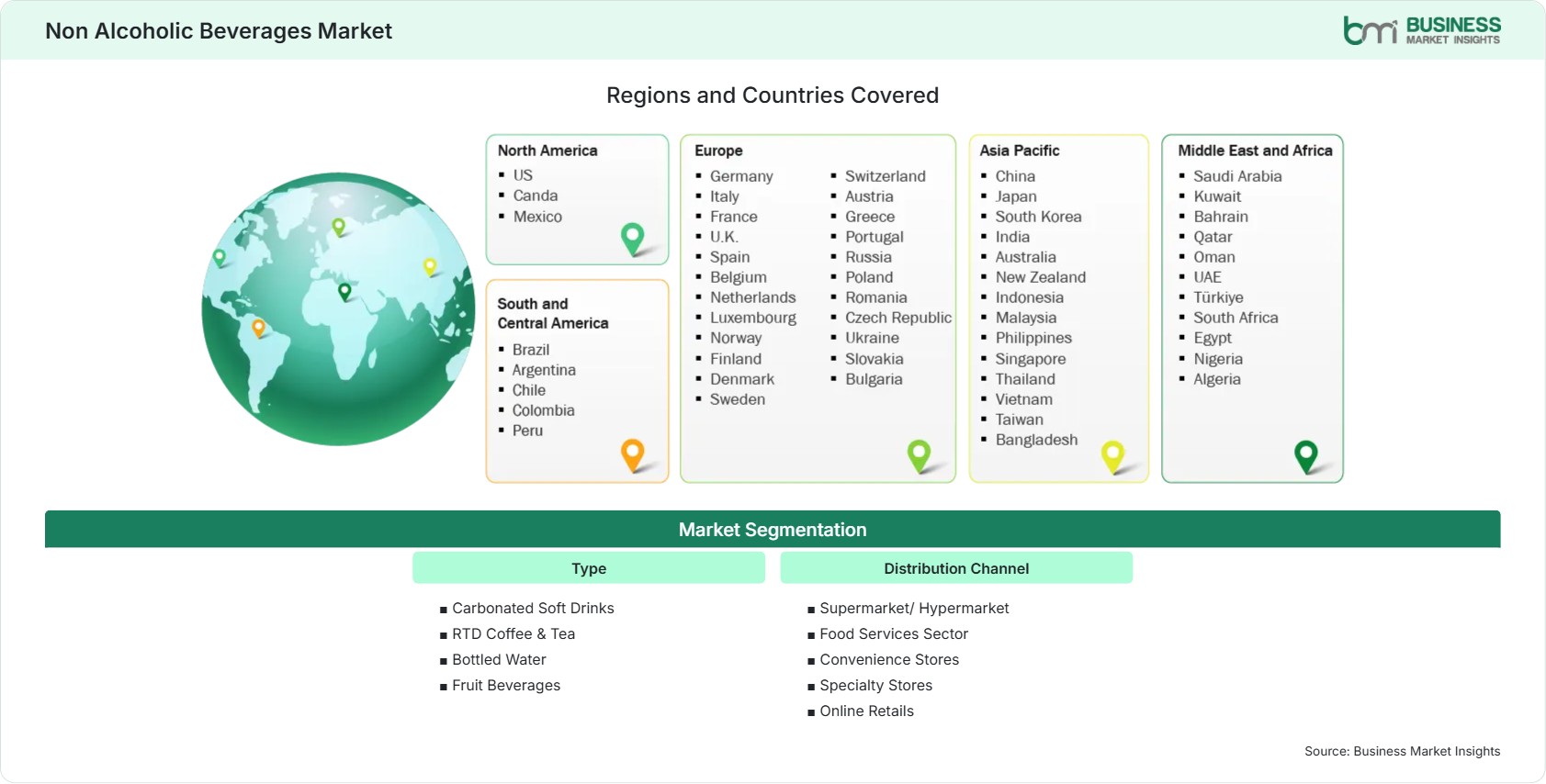
  • Type: Carbonated Soft Drinks, RTD Coffee & Tea, Bottled Water, Fruit Beverages
  • Distribution Channel: Supermarket/ Hypermarket, Food Services Sector, Convenience Stores, Specialty Stores, Online Retails
US$ 1515.95 Bn Market size in 2025
US$ 3155.38 Bn Market Size by 2033
9.60% CAGR, 2026 - 2033
2026-2033 Forecast Period

AI Overview

Non Alcoholic Beverages Market Summary

  • North America Region: North America holds 34%–37% share in 2025, growing with a CAGR of 7.8%–8.5%, driven by premium beverages, functional drinks demand, and advanced retail ecosystems. The U.S. market shows steady expansion with a CAGR of 7.5%–8.2% supported by innovation in low-sugar beverages.
  • Fastest Growing Region: Asia Pacific accounts for 28%–31% share in 2025 with a CAGR of 11.5%–12.8%, driven by urbanization, rising disposable incomes, and increasing adoption of packaged beverages across emerging economies.
  • Leading Segment: Carbonated Soft Drinks hold 38%–41% share in 2025 with a CAGR of 6.8%–7.5%, driven by strong brand penetration, global distribution networks, and consistent product innovation in flavors and packaging formats.
  • High Growth Segment: RTD Coffee & Tea accounts for 19%–22% share in 2025 with a CAGR of 10.8%–12.2%, driven by convenience trends, functional benefits, and increasing demand among younger urban populations globally.
  • Key Market Opportunity: Expansion of functional beverages enriched with vitamins, probiotics, and plant-based ingredients offers strong growth potential across developed and emerging markets with evolving consumer health awareness.
  • Major Market Players: PepsiCo, Inc.; The Coca-Cola Company; Nestlé S.A.; The Kraft Heinz Company; Keurig Dr Pepper Inc.; Reed’s, Inc.; Appalachian Brewing Company; Arca Continental, S.A.B. de C.V.; ITO EN, Ltd.; Monster Beverage Corporation
Strategic Insights

Non Alcoholic Beverages Market: Strategic Insights

Non Alcoholic Beverages Market Strategic Framework
FREE PDF
Request your free sample
Request free sample
Stakeholder View

Key Takeaways

  • The value chain is increasingly integrated, with manufacturers investing in direct distribution networks and digital sales platforms to improve margins and consumer engagement.
  • High-growth opportunities lie in RTD coffee, plant-based beverages, and fortified drinks, especially in urban and health-conscious demographics.
  • Innovation is shifting toward clean-label formulations, sustainable packaging, and AI-enabled supply chain optimization to improve efficiency and reduce waste.
  • Asia Pacific presents strong investment potential due to demographic expansion, urbanization, and evolving consumption patterns in countries such as India and China.
  • Mergers, acquisitions, and strategic collaborations are intensifying as companies seek to expand portfolios and geographic reach in competitive markets.
  • Regulatory compliance and sustainability initiatives are becoming critical competitive differentiators influencing long-term market positioning.
Geographic Outlook

Non Alcoholic Beverages Market Regional Highlights

North America Non-Alcoholic Beverages Market

North America accounts for 34%–37% share in 2025 and is projected to grow at a CAGR of 7.8%–8.5% during 2026–2033. Strong consumer demand for premium beverages and functional drinks drives growth. Advanced retail infrastructure and established brand presence further strengthen the region’s position.

  • Increasing demand for low-sugar and organic beverages is reshaping product portfolios, with manufacturers focusing on natural ingredients and health-oriented branding to capture evolving consumer preferences across the region.
  • Strong distribution networks and high penetration of supermarkets and convenience stores support consistent product availability, enhancing consumer accessibility and boosting overall consumption levels significantly.
  • Innovation in packaging, including recyclable materials and smart labeling, is gaining traction as companies align with sustainability goals and regulatory requirements in North America.
  • Growing popularity of energy drinks and functional beverages among younger consumers continues to drive category expansion, supported by targeted marketing strategies and digital campaigns.

US Non-Alcoholic Beverages Market

The U.S. holds 78%–82% share within North America in 2025, growing at a CAGR of 7.5%–8.2%. Strong consumer spending and innovation in premium beverages support sustained demand across categories.

  • High consumption of carbonated drinks remains significant, although demand is gradually shifting toward healthier alternatives such as flavored water and functional beverages with added nutrients.
  • Retail innovation, including direct-to-consumer platforms and subscription models, is enhancing consumer engagement and driving repeat purchases across beverage categories.
  • Regulatory focus on sugar reduction is influencing product reformulation strategies, encouraging manufacturers to introduce low-calorie and zero-sugar variants.
  • Investments in sustainable packaging and supply chain optimization are improving operational efficiency and strengthening market competitiveness.

Europe Non-Alcoholic Beverages Market

Europe accounts for 22%–25% share in 2025 with a CAGR of 6.5%–7.2%. Countries such as Germany and the UK lead adoption, while Eastern Europe shows faster growth.

  • Stringent regulations on sugar content and labeling are driving innovation in healthier beverage alternatives, pushing manufacturers toward natural ingredients and reduced-calorie formulations.
  • Demand for premium bottled water and functional beverages is increasing, supported by rising health awareness and changing consumer lifestyles across major European economies.
  • Sustainable packaging initiatives are gaining momentum, with companies investing in recyclable and biodegradable materials to meet environmental standards.
  • Growth in online retail channels is enhancing product accessibility and expanding market reach across urban and semi-urban regions.

Asia Pacific Non-Alcoholic Beverages Market

Asia Pacific holds 28%–31% Non-Alcoholic Beverages Market share in 2025 and is expected to grow at a CAGR of 11.5%–12.8%. China leads the market, while India and Southeast Asia show the fastest growth rates.

  • Rapid urbanization and increasing disposable incomes are driving demand for packaged beverages, particularly in metropolitan areas across emerging economies.
  • Expansion of modern retail infrastructure, including supermarkets and convenience stores, is improving product availability and boosting consumption.
  • Rising awareness of health and wellness is accelerating demand for functional beverages, including herbal teas and fortified drinks.
  • Strong investments by global players in local manufacturing facilities are enhancing supply chain efficiency and reducing operational costs.

Rest of World Non-Alcoholic Beverages Market

Rest of World accounts for 12%–15% market share in 2025 with a CAGR of 8.5%–9.5%. Latin America and the Middle East show steady growth driven by urbanization and increasing consumption patterns. Brazil leads in Latin America, while GCC countries dominate the Middle East market.

  • Growing middle-class populations and rising disposable incomes are driving demand for packaged beverages across South America and the Middle East.
  • Expansion of retail channels and increasing penetration of international brands are enhancing product accessibility and consumer choice.
  • Demand for bottled water and functional beverages is increasing due to climatic conditions and health awareness in these regions.
  • Investments in local production facilities are reducing import dependency and supporting regional market growth.
Global Market Geography
FREE PDF
Request your free sample
Request free sample
Segment Analysis

Non Alcoholic Beverages Market Segmentation

Type

This segment holds 100% of market revenue, with Carbonated Soft Drinks dominating 38%–41% share in 2025 and growing at 6.8%–7.5% CAGR. The Non-Alcoholic Beverages Market scope highlights diversified product demand driven by consumer preferences for convenience, taste, and health-oriented options.

  • Carbonated Soft Drinks: Strong brand loyalty and extensive global distribution networks support consistent demand, although growth is moderated by increasing health concerns and regulatory pressures on sugar content.
  • RTD Coffee & Tea: Rapid urbanization and busy lifestyles are driving demand for convenient beverage options, supported by innovation in flavors and functional ingredients.
  • Bottled Water: Rising health awareness and concerns about water quality are boosting consumption, with premium and flavored variants gaining popularity.
  • Fruit Beverages: Increasing preference for natural and fortified drinks is driving demand, supported by product innovation and expanding retail availability globally.

Distribution Channel

This segment reflects evolving purchasing behavior, with Supermarkets/Hypermarkets accounting for 35%–38% share in 2025 and growing at 7.5%–8.3% CAGR. The Non-Alcoholic Beverages Market trends indicate rising online sales and convenience-driven purchasing patterns.

  • Supermarket/ Hypermarket: Dominant retail channel offering wide product variety, competitive pricing, and high consumer footfall supporting steady sales growth.
  • Food Services Sector: Strong demand from restaurants, cafes, and quick-service outlets drives consumption, especially for premium and branded beverages.
  • Convenience Stores: High accessibility and quick purchase options make this channel popular for on-the-go consumption among urban consumers.
  • Specialty Stores: Focus on premium and niche beverages attracts health-conscious and affluent consumers seeking unique product offerings.
  • Online Retails: Rapid growth driven by digital adoption, offering convenience, discounts, and subscription models enhancing consumer engagement.
Market Forces

Non Alcoholic Beverages Market Dynamics

Key Market Drivers

Rising Demand for Health-Oriented Beverages

The consumer awareness of lifestyle diseases has impacted the drinking habits to a very large extent. As per the statistics given by the WHO, there has been a threefold increase of three times in the cases of obesity throughout the world since 1975, leading to consumers preferring drinks with low sugar content and functional drinks. This shift is directly supporting Non-Alcoholic Beverages Market growth, particularly in developed regions. Additionally, regulatory measures such as sugar taxes in Europe and North America are accelerating product reformulation. These factors collectively drive innovation and expansion across product categories, reinforcing demand for healthier alternatives globally.

Expansion of Modern Retail Infrastructure

There has been an accelerated proliferation of retail chains such as supermarket and hypermarket formats, which have been greatly improving product availability. As per the data provided by the IMF, urbanization levels have been rising across the globe, hence facilitating retail expansion in developing countries. The Non-Alcoholic Beverages Market trends indicate that there exists a high correlation between market expansion and consumption. The use of more shelf space and promotions in today's retail shops enhances product visibility. Moreover, the incorporation of payment technologies and loyalty programs has also encouraged consumer spending, hence market expansion.

Innovation in Packaging and Sustainability

Environmental sustainability concerns are becoming some of the key motivators for innovation in packaging due to the use of recycled and degradable packaging materials. As indicated by IEA statistics, packaging waste has become one of the major contributors to environmental problems, motivating regulations. There is an increased use of lightweight and recyclable packaging. This trend is influencing Non-Alcoholic Beverages Market growth by aligning with consumer preferences for eco-friendly products. Additionally, advancements in smart packaging technologies are enhancing product safety and shelf life. These innovations not only improve operational efficiency but also strengthen brand reputation and consumer trust.

Key Market Opportunities

Growth in Functional and Fortified Beverages

The increasing demand for functional beverages presents significant opportunities for market players. Consumers are actively seeking products that offer health benefits beyond basic hydration. The Non-Alcoholic Beverages Market Forecasts indicate that there is tremendous growth potential in this category owing to increasing health consciousness and preventive care practices. With increased investment in R&D for novel formulations, companies are able to come out with innovative product lines which contain additional ingredients. Developing countries offer lucrative opportunities because of increasing disposable income levels and changing lifestyles.

Expansion in Emerging Economies

Emerging markets in Asia Pacific, Latin America, and Africa offer significant growth opportunities due to increasing urbanization and rising disposable incomes. According to World Bank data, middle-class populations are expanding rapidly in these regions. This trend is creating demand for packaged beverages and premium products. Investments in local manufacturing and distribution networks are enhancing market penetration. Additionally, government initiatives supporting industrial growth are encouraging foreign investments. These factors collectively create a favorable environment for market expansion and long-term growth opportunities.

Digital Transformation and E-Commerce Growth

The rapid adoption of digital technologies and e-commerce platforms is transforming the beverage industry. Online retail channels are enabling direct consumer engagement and personalized marketing strategies. Businesses are using data analysis to determine what consumers want and customize their products accordingly. The subscription model and home delivery services are becoming increasingly common, especially in urban centers. With this technology revolution, companies are making money through different avenues and increasing customer loyalty. With the continued internet penetration around the world, e-commerce will become important in the future.

Market Restraints and Challenges

Stringent Regulatory Policies on Sugar Content

Factor: Governments worldwide are implementing strict regulations on sugar content in beverages.

Impact: Compliance costs will be higher, and there will be a need to change the formulations of products, resulting in reduced profit margins. Regulations such as taxes on sugar in Europe and North America are forcing manufacturers to cut down on sugar content in their products. Although this is healthy for consumers, it poses a challenge to companies to balance the tastes and branding of their products. Compliance with label requirements also poses additional challenges.

Fluctuating Raw Material Prices

Factor: Volatility in prices of key raw materials such as sugar, fruits, and packaging materials impacts production costs.

Impact: This results in the pressure on pricing and profitability for the manufacturers. The disruption in the supply chain and uncertainty in geopolitics also contribute to cost variation. It is imperative for companies to have a risk mitigation plan, such as supplier diversity and cost reduction. However, these efforts do not necessarily counterbalance the effects of price variability.

Company Analysis

Competitive Landscape

The Non-Alcoholic Beverages Market analysis highlights intense competition among global and regional players focusing on product innovation and distribution expansion.

Company Name

Overview

Products and Services relevant to this market

PepsiCo, Inc.

Global beverage and snack leader with strong distribution network and diversified product portfolio across regions.

Carbonated drinks, juices, bottled water, sports drinks, and functional beverages with strong brand positioning.

The Coca-Cola Company

Leading global beverage company with extensive brand portfolio and strong presence across developed and emerging markets.

Soft drinks, bottled water, juices, energy drinks, and ready-to-drink teas and coffees.

Nestlé S.A.

Multinational food and beverage company focusing on health-oriented and premium beverage offerings globally.

Bottled water, coffee, flavored drinks, and functional beverages with strong sustainability initiatives.

The Kraft Heinz Company

Major food and beverage company leveraging strong distribution and brand recognition across markets.

Juices, flavored beverages, and ready-to-drink products targeting mass and premium segments.

Keurig Dr Pepper Inc.

North American beverage company with diversified portfolio and strong retail presence.

Soft drinks, coffee, flavored beverages, and ready-to-drink tea products.

Reed’s, Inc.

Specialty beverage company focusing on natural and craft beverages with unique flavor profiles.

Ginger beverages, natural sodas, and functional drinks with organic ingredients.

Appalachian Brewing Company

Regional player focusing on craft beverages and niche markets in the United States.

Craft sodas, specialty beverages, and locally produced drinks targeting premium consumers.

Arca Continental, S.A.B. de C.V.

Leading bottler and distributor with strong presence in Latin America and North America.

Bottled beverages, soft drinks, and distribution services for global beverage brands.

ITO EN, Ltd.

Japanese beverage company specializing in tea-based products with strong regional presence.

Ready-to-drink teas, green tea beverages, and functional drinks.

Monster Beverage Corporation

Global leader in energy drinks with strong brand recognition and rapid market expansion.

Energy drinks, functional beverages, and performance-focused drink products.

Trust & Transparency

Research Methodology

The market analysis combines proprietary research with secondary data from government agencies, company disclosures, regulatory filings, industry databases and expert interviews. Market estimates are validated through data triangulation, cross-market benchmarking and analyst review.

View Full Research Methodology

Questions Answered

Frequently Asked Questions

What is the role of digital channels?

The Non-Alcoholic Beverages Market Report highlights that E-commerce platforms are enhancing accessibility, enabling direct consumer engagement, and driving sales growth.

How is sustainability impacting the market?

Companies are adopting eco-friendly packaging and reducing carbon footprints to meet regulatory and consumer expectations.

What are key growth segments?

RTD coffee and tea along with functional beverages are experiencing strong growth due to changing consumer preferences.

Which region leads the market?

North America leads due to strong retail infrastructure, high consumption levels, and continuous product innovation.

What is driving demand in the Non-Alcoholic Beverages Market?

Health awareness, urbanization, and demand for convenient beverage options are key drivers influencing consumption patterns globally.

Access the Full Non Alcoholic Beverages Market Report

Get segment-level forecasts, regional estimates, competitive benchmarking, company profiles and downloadable Excel datasets.

Access the full Non Alcoholic Beverages Market Report
350 pages PDF & Excel | 2026-08-31
Similar Research

Related Market Reports