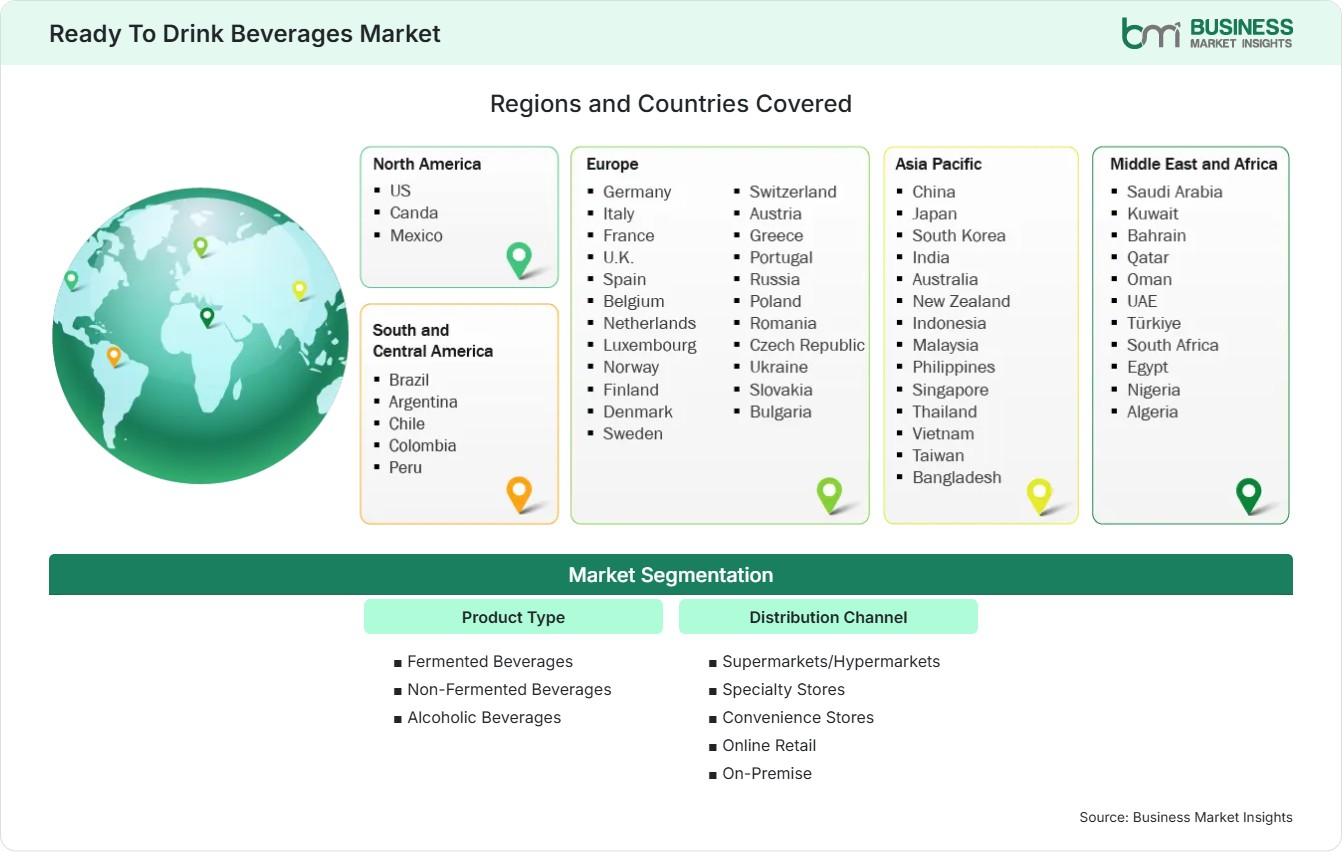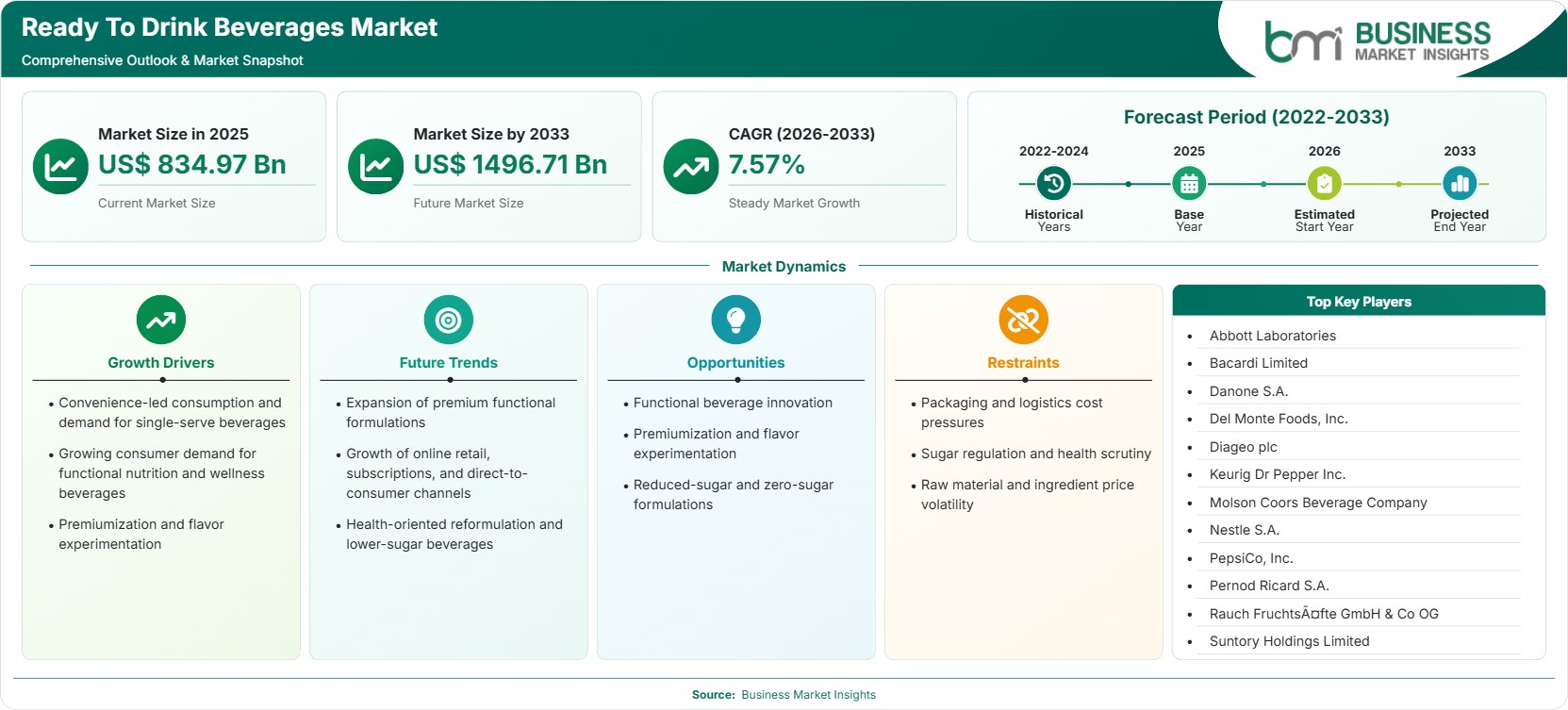
Ready To Drink Beverages Market Regional Highlights
North America Ready To Drink Beverages Market
North America represents 24%–27% of 2025 revenue and is projected to expand at a 6.5%–7.0% CAGR through 2033. Mature distribution, strong brand recognition, functional innovation, premium formats, and high convenience-store penetration support resilient demand. The Ready To Drink Beverages Market share reflects sophisticated consumer segmentation, including sports nutrition, energy, zero-sugar, protein, and wellness propositions. Market growth is increasingly tied to product differentiation rather than simple volume expansion, with manufacturers using packaging, flavor, and channel strategies to defend shelf space.
- Functional beverages are gaining strategic importance as established producers extend portfolios into protein, hydration, energy, prebiotic, and wellness-oriented propositions targeting active consumers.
- Convenience stores remain important because single-serve chilled beverages align with commuting, travel, workplace, and impulse occasions, supporting premium pricing for differentiated formats.
- Digital commerce is widening assortment and enabling multipack purchases, subscriptions, targeted promotions, and direct consumer engagement beyond traditional grocery distribution.
- Packaging innovation is becoming commercially relevant as lightweight containers, recycled materials, and improved recyclability increasingly influence retailer requirements and consumer purchasing decisions.
US Ready To Drink Beverages Market
The United States accounts for 78%–82% of North American 2025 revenue and is projected to grow at a 6.4%–6.9% CAGR through 2033. Its mature retail ecosystem supports rapid product launches across convenience stores, supermarkets, club stores, foodservice, and e-commerce. Ready To Drink Beverages Market share is reinforced by strong national brands, sophisticated merchandising, and high consumer willingness to trial limited editions. Reformulation, functional positioning, and premium packaging are becoming central mechanisms for protecting margins as consumers scrutinize sugar and ingredient labels.
- Zero-sugar and reduced-sugar beverages continue to provide manufacturers with portfolio-extension opportunities while responding to changing nutritional expectations and regulatory discussions surrounding sweetened drinks.
- Away-from-home consumption remains strategically valuable, with experiential beverage concepts increasingly linking drinks to entertainment, sports, restaurants, cinemas, and social occasions.
- Premium functional beverages are gaining shelf space as consumers increasingly seek convenient products combining refreshment with energy, protein, hydration, or wellness attributes.
Europe Ready To Drink Beverages Market
Europe holds 22%–25% of 2025 Ready To Drink Beverages Market revenue and is expected to expand at a 6.8%–7.3% CAGR through 2033. Germany, the United Kingdom, France, Italy, and Spain remain important markets, while Poland and other Central European economies provide stronger growth opportunities. Regulatory scrutiny of sugar, packaging waste, and environmental claims is accelerating formulation and packaging innovation. Companies are therefore emphasizing lower-sugar products, plant-based beverages, recyclable packaging, premium ingredients, and transparent labeling to sustain consumer trust.
- France and Germany provide scale through developed supermarket networks, while premium functional and plant-based offerings create incremental opportunities within established beverage categories.
- The United Kingdom remains attractive for innovation because convenience retail, foodservice, online grocery, and sophisticated private-label competition encourage rapid product differentiation.
- Poland and selected Central European markets provide higher-growth opportunities as modern retail expands and consumers increasingly adopt branded convenience beverages.
- Plant-based production investment is strengthening regional supply capabilities. Danone’s transformed French facility, for example, produces more than 300,000 liters of oat beverages daily for European markets.
Asia Pacific Ready To Drink Beverages Market
Asia Pacific holds 29%–33% of 2025 revenue and is projected to register an 8.2%–8.8% CAGR through 2033, making it the fastest-growing regional market. China, Japan, India, South Korea, Australia, and Southeast Asian economies combine large populations with expanding urban lifestyles and modern retail. Ready To Drink Beverages Market growth is supported by convenience stores, mobile commerce, premium functional beverages, localized flavors, and growing interest in products associated with health, energy, and digestive wellness.
- China provides scale and innovation potential through modern retail, food delivery, convenience channels, and rapid experimentation with functional and premium beverage formats.
- Japan remains highly developed for convenience-oriented beverages, with strong consumer acceptance of tea, fermented products, functional drinks, and compact single-serve packaging.
- India offers substantial volume potential as urbanization, income growth, organized retail, and digital commerce increase access to packaged beverages across diverse consumer groups.
- Australia and Southeast Asia provide premium opportunities in protein, plant-based, gut-health, and better-for-you beverages, supported by increasingly sophisticated health-oriented consumers.
Rest of World Ready To Drink Beverages Market
Rest of World accounts for 17%–20% of 2025 Ready To Drink Beverages Market revenue and is projected to grow at a 7.0%–7.6% CAGR through 2033. South and Central America benefit from established beverage cultures, expanding modern trade, and strong fruit-based consumption. Brazil and Mexico provide regional scale, while Colombia and Chile offer attractive premiumization opportunities. Middle Eastern and African markets are supported by youthful populations, urbanization, tourism, convenience retail, and increasing demand for packaged hydration and energy products.
The Middle East offers premium and functional opportunities, particularly in the Gulf states, while South Africa and other African markets provide longer-term growth through expanding retail infrastructure and cold-chain investment. Pricing remains important across developing markets.
- Brazil and Mexico provide significant demand pools where branded beverages, convenience channels, and localized fruit flavors create opportunities for international and domestic producers.
- Gulf markets offer premium opportunities through tourism, hospitality, modern retail, and consumer demand for functional hydration, energy, and sophisticated imported beverage concepts.
- South Africa combines established beverage distribution with growing interest in health-oriented products, while neighboring markets offer longer-term opportunities as formal retail expands.
- Africa’s growth potential depends heavily on affordability, logistics, refrigeration, and reliable distribution, making local production and regional sourcing important competitive advantages.