
Non-GMO Food Market Outlook: Size, Share, Trends, Growth Analysis, Competitive Landscape & Forecast, 2026–2033

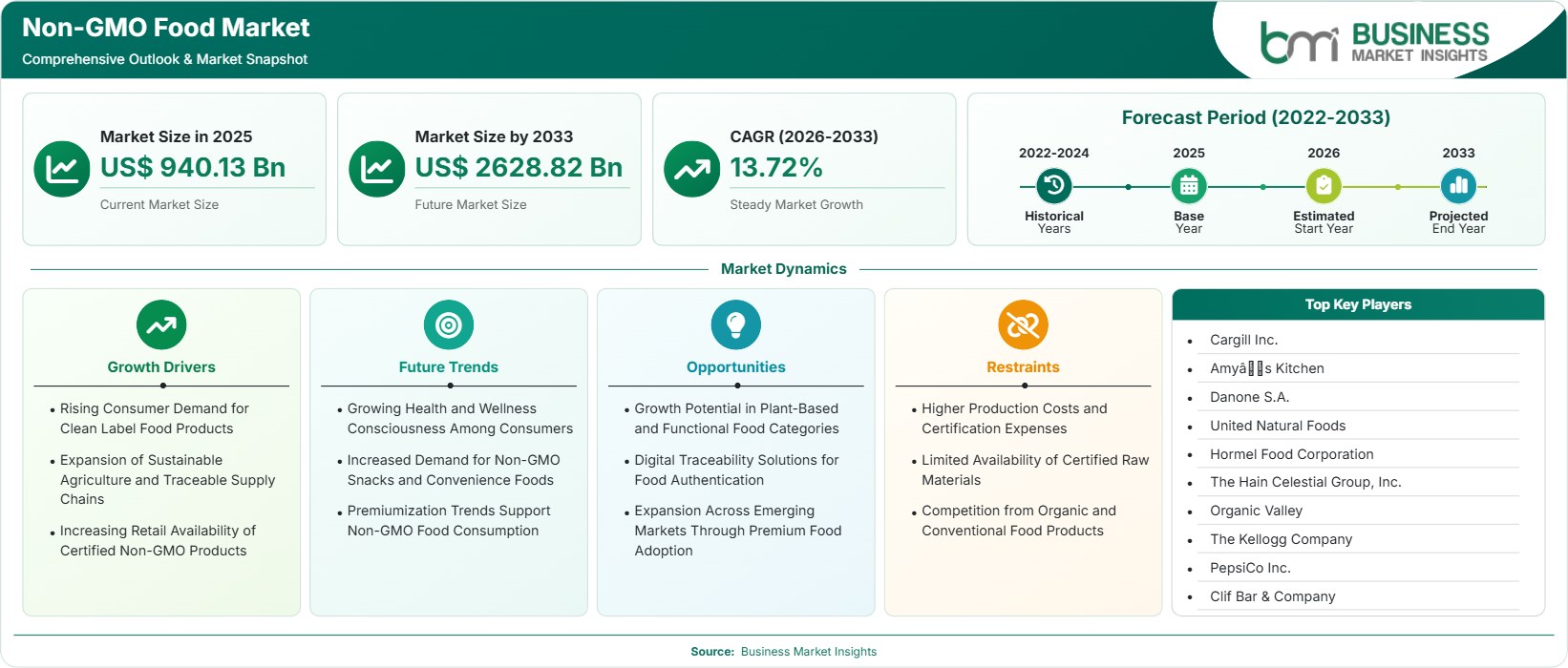
The Non-GMO Food size was valued at US$ 940.13 Billion in 2025 and is projected to reach US$ 2628.82 Billion by 2033, growing at a CAGR of 13.72% during 2026–2033, driven by clean-label preferences, rising consumer awareness, sustainable agriculture adoption, and expanding opportunities in organic retail channels, functional foods, and transparent supply chains.

Report Coverage
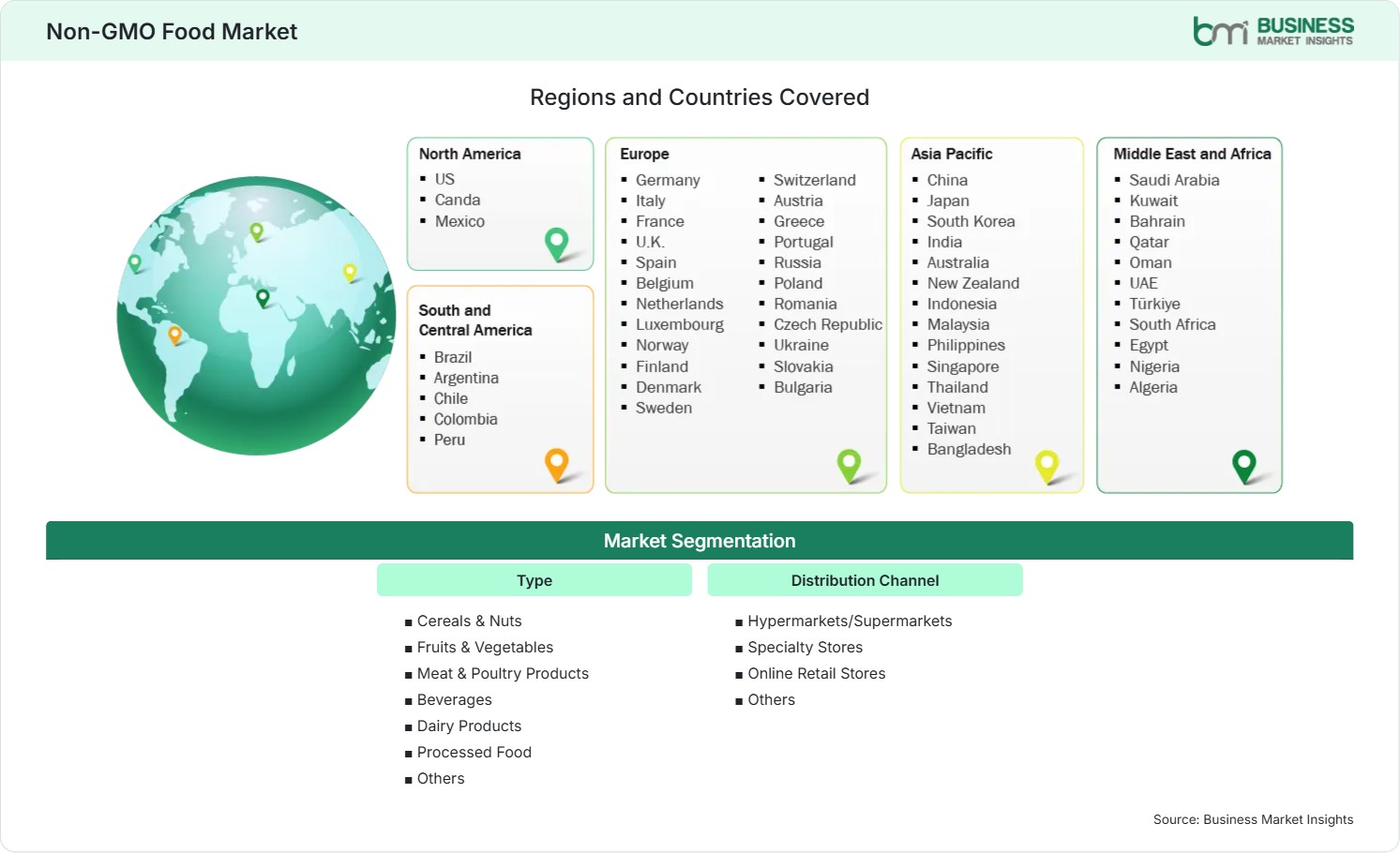
  • Type: Cereals & Nuts, Fruits & Vegetables, Meat & Poultry Products, Beverages, Dairy Products, Processed Food, Others
  • Distribution Channel: Hypermarkets/Supermarkets, Specialty Stores, Online Retail Stores, Others
US$ 940.13 Bn Market size in 2025
US$ 2628.82 Bn Market Size by 2033
13.72% CAGR, 2026 - 2033
2026-2033 Forecast Period

01 AI Overview

Non-GMO Food Market Summary

  • North America Region: North America holds market share of 35%–38% in 2025, growing with a CAGR of 12%–14% influenced by clean-label demand, advanced certification systems, premium food adoption, and innovation opportunities. The US market demonstrates strong consumer preference for verified products, expanding retail availability, and a projected CAGR of 12%–14% during 2026–2033.
  • Fastest Growing Region: Asia Pacific holds market share of 28%–31% in 2025, growing with a CAGR of 15%–17% influenced by increasing food safety awareness, urbanization, expanding middle-class consumption, regulatory improvements, and opportunities across emerging food processing markets.
  • Leading Segment: Cereals & Nuts hold market share of 22%–25% in 2025, growing with a CAGR of 13%–15% influenced by increasing breakfast product demand, plant-based nutrition trends, grain diversification, and opportunities for premium non-GMO ingredient development.
  • High Growth Segment: Beverages demonstrate market share of 12%–15% in 2025, growing with a CAGR of 15%–17% influenced by functional beverage innovation, clean ingredient positioning, wellness-focused consumption, and opportunities in plant-based and fortified beverage categories.
  • Key Market Opportunity: Rising demand for traceable food products creates opportunities through blockchain-enabled supply chains, certification platforms, sustainable farming partnerships, and premium product positioning across developed and emerging consumer markets.
  • Major Market Players: Cargill Inc., Amy’s Kitchen, Danone S.A., United Natural Foods, Hormel Food Corporation, Hain Celestial, Organic Valley, The Kellogg Company, PepsiCo Inc., and Clif Bar & Company.
02 Strategic Insights

Non-GMO Food Market: Strategic Insights

Non-GMO Food Market Strategic Framework
FREE PDF
Request your free sample
Request free sample
03 Stakeholder View

Key Takeaways

  • The value chain is becoming more integrated, with farmers, certification firms, ingredient suppliers, manufacturers, and retailers working together to enhance transparency, quality control, and consumer trust.
  • Opportunities for growth exist in the category of cereals, nuts, beverages, and processed foods where consumers are looking for healthy substitutes.
  • Innovation shift in the form of authentication technology, sustainable farming practices, and better processing technology which retain the nutrition without compromising the non-GMO certification.
  • Asia Pacific can be looked upon as an area of Non-GMO Food Market growth due to the increasing concern about food safety among the urban populations here. China, India, Japan, and Australia are some examples of countries where opportunities arise due to retail modernization and changing consumption patterns.
  • Investment activity is increasingly focused on portfolio expansion, strategic partnerships, and acquisitions involving organic, natural, and clean-label food businesses.
  • Retail transformation is creating additional growth pathways through online grocery platforms and direct-to-consumer models, allowing brands to communicate certification benefits, and product authenticity directly to consumers.
04 Geographic Outlook

Non-GMO Food Market Regional Highlights

North America Non-GMO Food Market

North America accounted for a 35%–38% Non-GMO Food Market share in 2025 and is projected to expand at a CAGR of 12%–14% from 2026–2033. The region benefits from mature certification systems, strong consumer awareness, and extensive clean-label product availability. The Non-GMO Food share remains supported by premium retail adoption and transparent sourcing requirements.

  • The US will continue to be the leading country due to existing GMO-free verification programs, development of organic distribution networks, and high consumer demands for clear labeling of the ingredients used.
  • In Canada, the growing trend is associated with the development of sustainable agriculture, knowledge of labeling of genetically modified ingredients, and availability of certified products via specialty stores and online retailers.
  • Manufacturers have been developing their supply chain in order to meet the demands of consumers related to sustainability, authenticity, and nutritional value of their products.
  • Retailers will keep expanding their presence in the region via supermarkets and e-commerce sites enabling small companies and well-known manufacturers to get access to the market.

US Non-GMO Food Market

The US represents approximately 28%–31% of the Non-GMO Food Market share within North America in 2025, expanding at a CAGR of 12%–14% between 2026–2033. Strong consumer preference for clean-label foods, widespread certification awareness, and innovation in plant-based products support sustained demand.

  • Consumer interest in food transparency continues increasing demand for verified products across cereals, beverages, dairy alternatives, and processed food categories.
  • Major retailers are expanding shelf space for certified products, creating opportunities for manufacturers focused on sustainable farming partnerships and differentiated product positioning.
  • Food technology companies are improving testing and authentication capabilities, supporting reliable certification processes and strengthening consumer confidence in product claims.

Europe Non-GMO Food Market

Europe held a 24%–27% share of the Non-GMO Food Market in 2025 and is anticipated to grow at a CAGR of 11%–13% during 2026–2033. The region is characterized by rigorous standards of food quality, environmental sustainability and an advanced organic food ecosystem. Germany, France, United Kingdom and Italy are among the major markets in the region, while other Eastern European countries are considered promising opportunities for expansion.

  • Germany is characterized by high levels of demand owing to existing patterns of organic food consumption, developed retail network and preference to environment-friendly food production.
  • France keeps on growing because of sustainable agriculture programs, high-quality food categories and increasing popularity of ingredient transparency models.
  • The United Kingdom has recently seen growth in demand owing to online grocery services, specialty retailers and ethical food purchases.
  • European manufacturers are focusing on certification compliance and sustainable supply chain management to strengthen competitiveness in premium food segments.

Asia Pacific Non-GMO Food Market

Asia Pacific represented a 28%–31% share of the Non-GMO Food Market in 2025 and is projected to register a CAGR of 15%–17% between 2026–2033. The region is the fastest-growing market due to urbanization, rising disposable income, and increasing concerns regarding food safety. China, India, Japan, and Australia are key markets, with Southeast Asian countries showing strong future potential.

  • China faces growing demand for transparency within its food products due to concerns regarding safety, quality, and information on ingredients.
  • India presents a promising market for growth by way of growing middle-class consumption, adoption of premium food products, and availability of packaged foods certified.
  • Japan represents a consistent market due to quality standards, health-related consumption habits, and preference of reputable food brands.
  • Australia represents an opportunity due to sustainable agriculture and food production systems focused on export of non-GMO products.

Rest of World Non-GMO Food Market

South and Central America accounted for a 7%–10% share of the Non-GMO Food Market in 2025, supported by agricultural capabilities and increasing export demand for certified food products. Brazil and Argentina are important producers, with improving processing infrastructure creating opportunities for value-added offerings.

The Middle East and Africa contributed a 5%–8% share in 2025, with growth driven by premium food imports, expanding urban populations, and rising awareness regarding food quality standards. Gulf countries are creating opportunities through modern retail expansion and diversified food supply chains.

  • Latin American producers are improving certification capabilities to access international markets and meet growing demand for traceable agricultural products.
  • Brazil is strengthening its position through large-scale farming expertise and increasing investment in sustainable food production systems.
  • Middle Eastern countries are expanding premium food categories through retail modernization and demand for imported certified products.
  • African markets are gradually adopting transparent food systems as urban consumers seek improved quality, safety, and nutritional value.
  • Regional growth opportunities are supported by international trade partnerships and investments in sustainable agricultural infrastructure.
Global Market Geography
FREE PDF
Request your free sample
Request free sample
05 Segment Analysis

Non-GMO Food Market Segmentation

Type

Cereals & Nuts represented a 22%–25% share of the Non-GMO Food Market in 2025 and are expected to grow at a CAGR of 13%–15% between 2026–2033. The segment benefits from increasing demand for healthier breakfast options, plant-based nutrition, and clean-label ingredients. Non-GMO cereals and nuts continue gaining traction among health-conscious consumers.

  • Cereals & Nuts: Widespread usage in breakfast cereals, snacks, baked foods, and staple foods is favorable for the demand, and non-GMO origin enhances the clean-label positioning of the products.
  • Fruits & Vegetables: High consumer inclination toward fresh and minimally processed foods creates an opportunity, and retailers are increasing offerings of certified and sustainably sourced fruits and vegetables.
  • Meat & Poultry Products: Rising consumer interest in feed and production processes is favoring non-GMO positioning and premium food segments can be targeted for differentiated products.
  • Beverages: Clean-label preference and development of beverages using plant-based formulas are increasing the demand for non-GMO ingredients in beverages.
  • Dairy Products: Demand is supported by consumer interest in ingredient transparency and feed sourcing, particularly across premium dairy offerings positioned around natural and responsible production.
  • Processed Food: Manufacturers are incorporating non-GMO ingredients into packaged foods to address clean-label preferences, improve product differentiation, and broaden access to health-conscious consumer groups.

Distribution Channel

Hypermarkets/Supermarkets accounted for a 40%–45% share of the Non-GMO Food Market in 2025 and are forecast to grow at a CAGR of 11%–13% between 2026–2033. Specialty stores remain important for consumers actively seeking natural, organic, and certified products. Online retail stores are gaining momentum through convenience, wider product discovery, subscription purchasing, and access to niche brands.

  • Hypermarkets/Supermarkets: Extensive assortment, established customer traffic, dedicated natural-food sections, and increasing private-label offerings support their leading position in non-GMO food distribution.
  • Specialty Stores: Health-focused shoppers and demand for natural, organic, and certified products support specialty stores, where product education and targeted assortments strengthen purchasing decisions.
  • Online Retail Stores: Digital purchasing expands product accessibility, enables comparison of certifications and ingredients, and supports niche brands seeking broader consumer reach beyond physical retail networks.
06 Market Forces

Non-GMO Food Market Dynamics

Key Market Drivers

Rising Consumer Demand for Clean Label Food Products

Growing consumer awareness regarding ingredient transparency is a major driver supporting growth across global markets. Consumers are increasingly evaluating product labels, sourcing practices, and certification claims before purchasing packaged foods. The Non-GMO Food market trends are reinforced by expanding demand for minimally processed products, organic alternatives, and sustainable agricultural practices. According to global food industry observations, clean-label categories continue gaining retail shelf presence as manufacturers reformulate products with recognizable ingredients. Companies are investing in certified supply chains and verification processes to strengthen consumer trust.

Expansion of Sustainable Agriculture and Traceable Supply Chains

The adoption of sustainable farming practices and improved supply chain transparency is accelerating market development. Producers are increasingly partnering with farmers using verified cultivation methods to ensure consistent availability of non-GMO ingredients. The Non-GMO Food growth is supported by rising retailer requirements for responsible sourcing, environmental accountability, and reliable certification documentation. Advanced tracking technologies, including digital supply chain monitoring systems, are improving ingredient visibility from farms to finished products. Food manufacturers are prioritizing long-term supplier relationships to manage quality standards and reduce sourcing uncertainty.

Increasing Retail Availability of Certified Non-GMO Products

Expansion of supermarkets, specialty stores, and online grocery platforms is improving accessibility to certified products worldwide. Retailers are allocating greater shelf space to products with transparent ingredient information as consumer interest in healthier food options rises. The Non-GMO Food trends indicate that digital commerce is becoming an important channel for educating consumers about certification benefits and product differentiation. Manufacturers are leveraging e-commerce platforms to reach niche consumer groups seeking premium food alternatives. Retail partnerships are also enabling smaller brands to compete through specialized offerings focused on sustainability, nutrition, and ethical sourcing.

Key Market Opportunities

Growth Potential in Plant-Based and Functional Food Categories

Increasing demand for plant-based nutrition creates significant opportunities for manufacturers developing non-GMO ingredients and finished products. Consumers are seeking alternatives that combine health benefits, sustainability, and transparent sourcing, encouraging innovation in beverages, snacks, and functional foods. Companies can capitalize on this opportunity by developing products using certified grains, legumes, nuts, and plant-based proteins. Expanding wellness trends are also supporting premium positioning for products with clear ingredient information and responsible production practices. The Non-GMO Food market Forecasts indicate that future growth opportunities will emerge from advanced formulations targeting health-conscious consumers.

Digital Traceability Solutions for Food Authentication

Technological advancements in food authentication provide opportunities to improve consumer confidence and operational efficiency. Blockchain-based tracking, digital certification platforms, and advanced testing methods are enabling companies to verify ingredient origins and maintain transparent supply networks. These solutions can help manufacturers differentiate products in competitive markets where authenticity has become a key purchasing factor. Companies implementing digital traceability systems can improve compliance management, reduce supply chain risks, and provide consumers with accessible information about product sourcing.

Expansion Across Emerging Markets Through Premium Food Adoption

Emerging economies offer substantial opportunities as urban consumers increasingly prioritize food safety, quality, and nutritional value. Rising disposable incomes, expanding organized retail, and increasing awareness of global food standards are supporting demand for certified products. Companies can expand through localized product development, strategic distribution partnerships, and investments in regional supply networks. Markets across Asia Pacific, Latin America, and the Middle East are creating opportunities for international and domestic manufacturers to introduce premium food categories. Growth strategies focused on affordability, accessibility, and consumer education can accelerate adoption.

Market Restraints and Challenges

Higher Production Costs and Certification Expenses

Factor: Increased cost of cultivation, certification, and logistics associated with non-GMO produce lead to increased cost of production. Impact: These factors can culminate into increased pricing of such produce, thus making it difficult for consumers who are sensitive to pricing and for companies trying to compete with conventionally produced food items. There is need for special practices and paperwork by farmers in order to meet certification criteria.

Limited Availability of Certified Raw Materials

Factor: Limited supply of certified non-GMO agricultural inputs creates sourcing challenges for manufacturers requiring consistent ingredient availability. Impact: Supply constraints can increase procurement complexity, delay product expansion, and affect production planning for companies operating large-scale food businesses. Weather variability, farming transition periods, and regional differences in certification infrastructure can influence ingredient supply stability. Manufacturers often need to establish long-term partnerships with certified growers to secure reliable raw materials. These challenges are particularly relevant for cereals, nuts, and plant-based ingredients with increasing demand.

07 Company Analysis

Competitive Landscape

The Non-GMO Food market analysis indicates a highly competitive environment driven by brand differentiation, certification capabilities, sustainable sourcing networks, and product innovation. Leading companies are expanding portfolios across cereals, beverages, dairy alternatives, snacks, and processed foods while strengthening relationships with certified agricultural suppliers. Market participants are focusing on clean-label positioning, digital traceability, and strategic partnerships to improve consumer trust and expand global distribution.

Company Name

Overview

Products and Services relevant to this market

Cargill Inc.

Global food and agriculture company providing ingredients, sourcing solutions, and supply chain capabilities across multiple food industries.

Supplies non-GMO ingredients, grains, oils, sweeteners, and agricultural sourcing solutions for food manufacturers worldwide.

Amy’s Kitchen

Organic and natural food producer specializing in vegetarian and clean-label prepared food products.

Offers non-GMO frozen meals, soups, pizzas, canned foods, and plant-based convenience products.

Danone S.A.

International food company focused on health-oriented nutrition, dairy, and plant-based food solutions.

Provides non-GMO dairy alternatives, organic products, beverages, and nutrition-focused food brands.

United Natural Foods

Major food distribution company supporting natural, organic, and specialty food categories.

Distributes certified natural foods, organic products, and non-GMO branded offerings through retail channels.

Hormel Food Corporation

Food manufacturer offering protein products, prepared foods, and consumer-focused food solutions.

Develops responsibly sourced meat products and processed foods aligned with transparency and quality standards.

Hain Celestial

Natural and organic products company operating across health-focused food and beverage categories.

Provides organic snacks, plant-based foods, beverages, and non-GMO certified consumer products.

Organic Valley

Farmer-owned cooperative focused on organic dairy, meat, and sustainable agricultural production.

Supplies organic dairy products, pasture-raised products, and foods produced through verified farming practices.

The Kellogg Company

Global food manufacturer known for cereals, snacks, and breakfast product innovation.

Offers cereal products and snacks incorporating clean-label and responsibly sourced ingredients.

PepsiCo Inc.

Multinational food and beverage company investing in healthier product portfolios and sustainability.

Develops beverages, snacks, and food products incorporating transparent sourcing and sustainable ingredient initiatives.

Clif Bar & Company

Nutrition-focused food company specializing in energy bars and active lifestyle products.

Produces organic and non-GMO snack bars using plant-based and responsibly sourced ingredients.

10 Trust & Transparency

Research Methodology

The market analysis combines proprietary research with secondary data from government agencies, company disclosures, regulatory filings, industry databases and expert interviews. Market estimates are validated through data triangulation, cross-market benchmarking and analyst review.

View Full Research Methodology

11 Questions Answered

Frequently Asked Questions

What is the future outlook for the Non-GMO Food market Report?

The report indicates continued expansion supported by sustainable farming investments, technology-enabled traceability, premium food adoption, and increasing global demand for transparent food products.

What role do retailers play in market development?

Retailers support growth by expanding shelf space for certified products, improving consumer education, and increasing accessibility through supermarkets, specialty stores, and online grocery platforms.

Which product categories offer strong growth potential?

Plant-based beverages, cereals, snacks, functional foods, and processed food products offer strong opportunities due to rising demand for healthier alternatives and recognizable ingredients.

How are manufacturers improving product transparency in this market?

Manufacturers are adopting certification systems, digital traceability platforms, and supplier verification programs to provide consumers with clearer information about ingredient origins and production methods.

What factors are driving demand for Non-GMO Food market products?

Consumer preference for clean-label foods, increased awareness of ingredient sourcing, sustainable agriculture adoption, and demand for transparent certification are major factors supporting market expansion across food categories.

Access the Full Non-GMO Food Market Report

Get segment-level forecasts, regional estimates, competitive benchmarking, company profiles and downloadable Excel datasets.

Access the full Non-GMO Food Market Report
350 pages PDF & Excel | 2026-08-24