Pharmaceutical Glass Packaging Market Regional Highlights
North America Pharmaceutical Glass Packaging Market
North America accounts for a 31%–34% Pharmaceutical Glass Packaging Market share in 2025 and is projected to grow at a CAGR of 10.5%–11.5% through 2033. The region benefits from extensive biologics production, mature injectable manufacturing, advanced fill-finish operations, and strong demand for high-integrity glass containers. The US represents the dominant national market within the region, while Canada contributes through pharmaceutical manufacturing and specialty drug production. Domestic capacity expansion is strengthening supply resilience for vials, cartridges, and other primary packaging formats.
- Biologics manufacturing is increasing demand for premium Type I glass, specialty vials, coated surfaces, and ready-to-use packaging designed for sensitive formulations.
- US domestic manufacturing initiatives are encouraging localized capacity for pharmaceutical glass and reducing dependence on distant production networks.
- Automated fill-finish facilities increasingly prioritize dimensional consistency and low-defect containers to protect throughput and reduce line interruptions.
- Demand for prefillable syringes and cartridges is expanding alongside self-administration and combination-product development.
US Pharmaceutical Glass Packaging Market
The US accounts for approximately 27%–30% of the global market and 86%–90% of North American demand in 2025, with a CAGR of 10.8%–11.8% through 2033. Its position reflects a large injectable medicines base, advanced biologics manufacturing, extensive contract manufacturing capacity, and increasing investment in domestic pharmaceutical supply chains. SCHOTT Pharma inaugurated expanded vial capacity in Pennsylvania in 2026, supported by more than US$60 million in investment.
- Biologics and specialty injectable therapies are increasing demand for high-value vials, cartridges, and prefillable glass syringes.
- Domestic capacity projects are improving supply continuity while supporting faster response to pharmaceutical demand fluctuations and public-health requirements.
- Combination products and home-based therapies are broadening demand for glass packaging compatible with autoinjectors and pen-injector systems.
Europe Pharmaceutical Glass Packaging Market
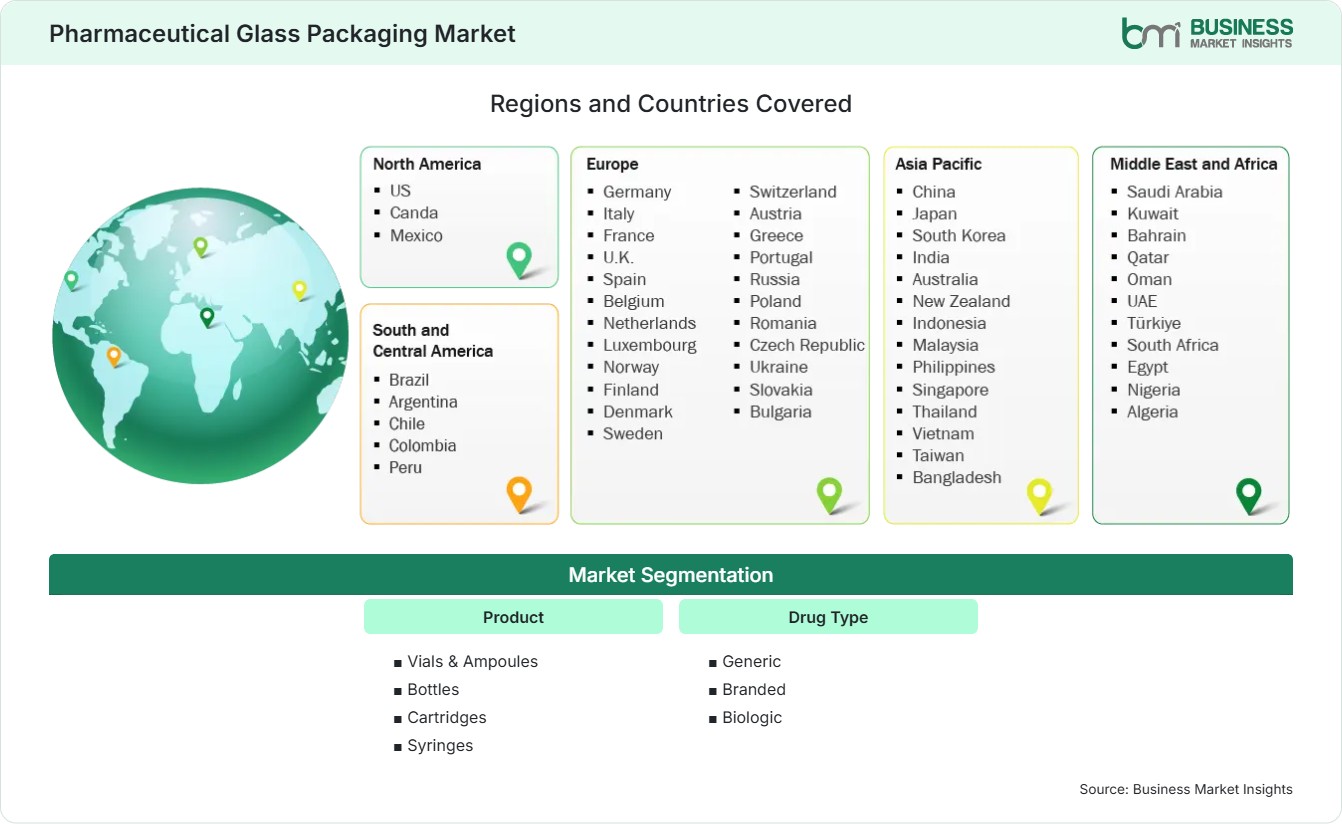
Europe represents a 28%–31% Pharmaceutical Glass Packaging market share in 2025 and is projected to expand at a CAGR of 10.8%–11.8%. Germany, Italy, France, Switzerland, and the Czech Republic form important production and technology centers. Germany remains a leading market because of its pharmaceutical manufacturing base and packaging expertise, while Serbia and Central Europe are attracting capacity investments. High-growth markets include Italy and Central European manufacturing clusters, supported by injectable production and regional supply-chain localization.
- Germany maintains strong demand for premium vials, ampoules, cartridges, and integrated drug-containment solutions due to its established pharmaceutical manufacturing ecosystem.
- Italy benefits from a deep glass-converting base and continued investment in tubular vials, ampoules, and ready-to-use formats.
- France supports premium pharmaceutical packaging through Type I glass manufacturing, analytical services, and specialized containment capabilities.
- Central European capacity investments are strengthening regional supply security and reducing exposure to long-distance transportation constraints.
Asia Pacific Pharmaceutical Glass Packaging Market
Asia Pacific accounts for 27%-30% in 2025 and demonstrates the highest growth rate among all regions, with a CAGR of 13.0%-14.2%. China, Japan, India, South Korea, and Southeast Asia are the main markets. China remains one of the largest production bases, while India is considered a fast-growing market due to pharmaceutical exports, manufacturing of injectables and biosimilars, and investments in local glass tubing and converting operations.
- India is expanding glass packaging capacity alongside pharmaceutical manufacturing, with growing demand for vials, cartridges, ampoules, and premium Type I containers.
- China combines a large pharmaceutical production base with established medicinal-glass manufacturing and continuing investments in domestic supply capability.
- Japan supports premium pharmaceutical packaging through strict quality requirements, established pharmaceutical manufacturers, and demand for chemically resistant borosilicate containers.
- Southeast Asia is emerging as an additional pharmaceutical manufacturing hub, increasing demand for reliable imported and locally converted glass packaging.
Rest of World Pharmaceutical Glass Packaging Market
Rest of World represents a 10%–13% Pharmaceutical Glass Packaging market share in 2025 and is projected to grow at a CAGR of 11.0%–12.2%. South and Central America are supported by expanding pharmaceutical production and healthcare access, while the Middle East and Africa benefit from local manufacturing initiatives and imported injectable medicines. Brazil and Mexico are leading Latin American markets, while Saudi Arabia, the United Arab Emirates, and South Africa provide notable regional opportunities.
Latin American pharmaceutical producers require efficient primary packaging materials for injectables, vaccines, and generics. There are opportunities for packaging firms to capitalize on the localization initiative underway in the Middle East to offer world-class packaging solutions. South Africa remains an important producer of pharmaceuticals in Africa, whereas the Gulf countries have become more specialized in healthcare services.
- Brazil and Mexico provide the strongest regional demand base because of pharmaceutical production scale and broad consumption of generic and branded medicines.
- Saudi Arabia and the United Arab Emirates are attracting pharmaceutical investments that can support demand for compliant primary packaging.
- South Africa serves as an established pharmaceutical manufacturing and distribution center for sub-Saharan markets.
- Local supply-chain development is increasing interest in regional warehousing, technical support, and packaging qualification services.