
Pharmaceutical Packaging Market Outlook: Size, Share, Trends, Growth Analysis, Competitive Landscape & Forecast, 2026-2033

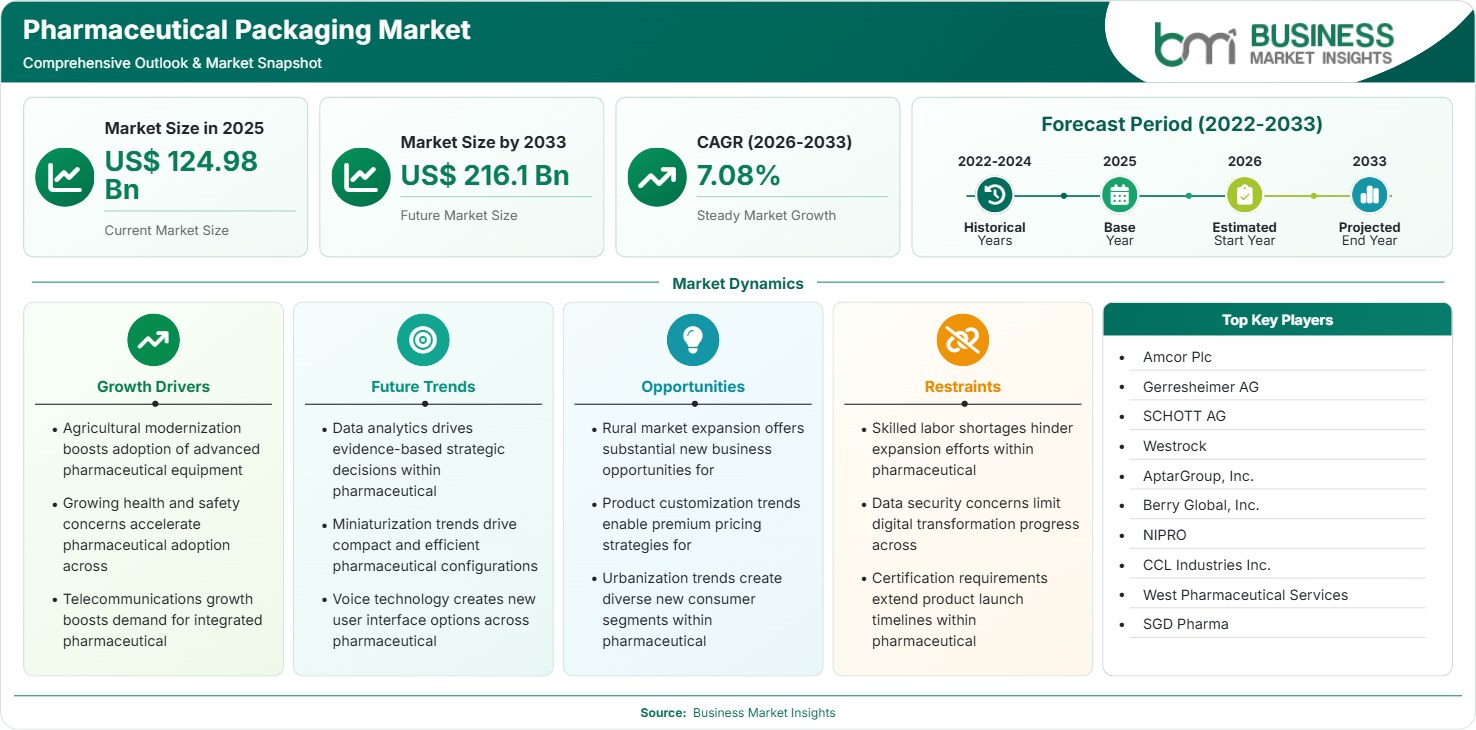
The Pharmaceutical Packaging Market size was valued at US$ 124.98 Billion in 2025 and is projected to reach US$ 216.1 Billion by 2033, growing at a CAGR of 7.08% during 2026–2033, driven by biologics, injectable therapies, sustainable packaging, serialization, and patient-centric delivery formats.

Report Coverage
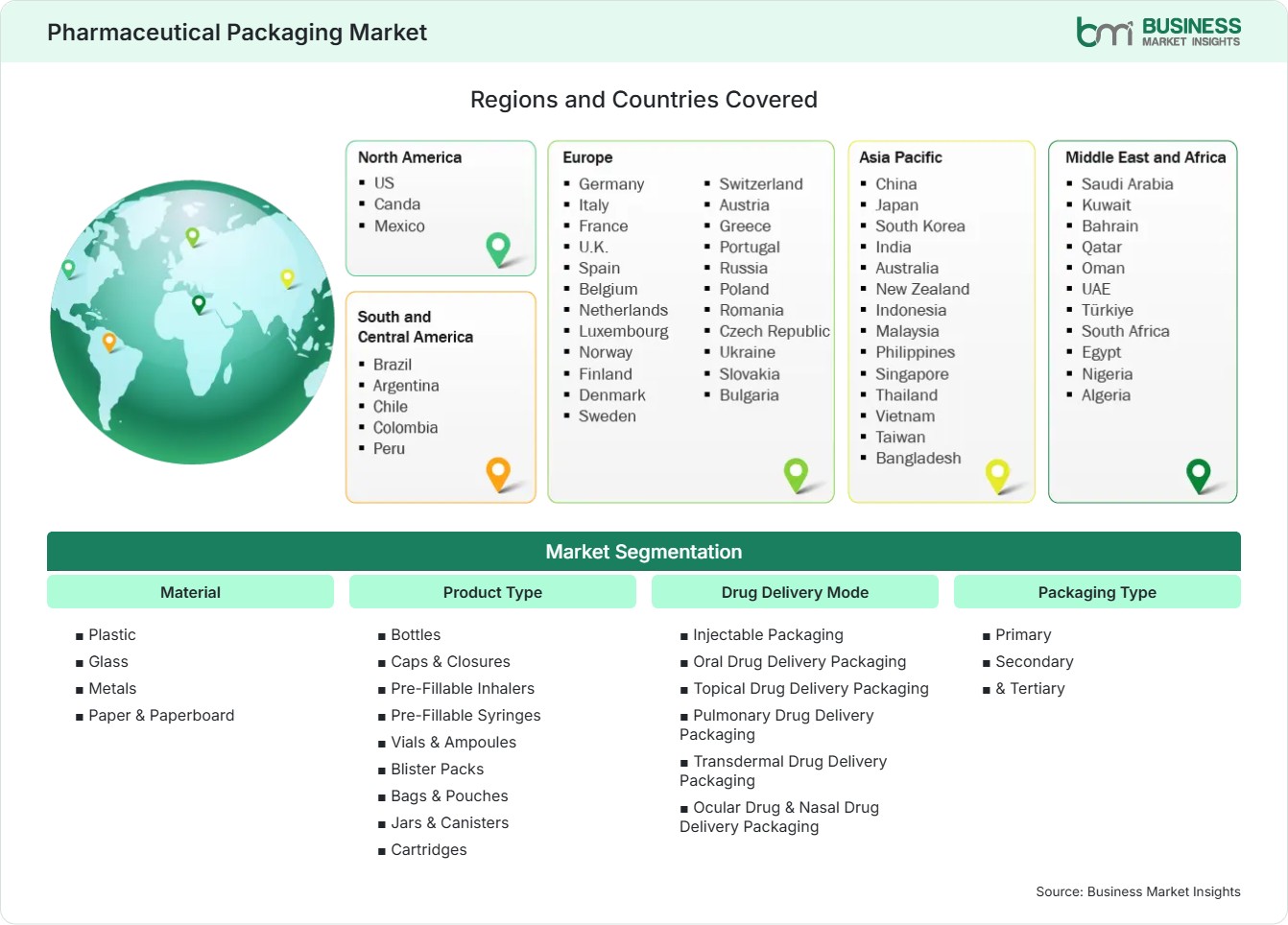
  • Material: Plastic, Glass, Metals, Paper & Paperboard
  • Product Type: Bottles, Caps & Closures, Pre-Fillable Inhalers, Pre-Fillable Syringes, Vials & Ampoules, Blister Packs, Bags & Pouches, Jars & Canisters, Cartridges
  • Drug Delivery Mode: Injectable Packaging, Oral Drug Delivery Packaging, Topical Drug Delivery Packaging, Pulmonary Drug Delivery Packaging, Transdermal Drug Delivery Packaging, Ocular Drug & Nasal Drug Delivery Packaging
  • Packaging Type: Primary, Secondary, & Tertiary
US$ 124.98 Bn Market size in 2025
US$ 216.1 Bn Market Size by 2033
7.08% CAGR, 2026 - 2033
2026-2033 Forecast Period

AI Overview

Pharmaceutical Packaging Market Summary

  • North America: North America holds a market share of 32%–35% in 2025, growing at a CAGR of 6.4%–6.9%, influenced by biologics, sterile injectables, advanced drug delivery, serialization, and capacity expansion. The U.S. market remains dominant, with a 6.3%–6.8% CAGR supported by biologics manufacturing, specialty medicines, and stringent container-closure requirements.
  • Fastest Growing Region: Asia Pacific holds a market share of 28%–31% in 2025 and is advancing at a CAGR of 7.9%–8.5%, supported by pharmaceutical manufacturing expansion, injectable production, healthcare investment, localization, rising medicine consumption, and sophisticated packaging capacity.
  • Leading Segment: Plastic represents a market share of 43%–47% in 2025 and records a CAGR of 7.2%–7.7%, driven by lightweight containers, flexible formats, compatibility with automated filling, design flexibility, cost efficiency, and increasing demand for patient-friendly packaging.
  • High Growth Segment: Pre-Fillable Syringes represent a market share of 8%–11% in 2025 and record a CAGR of 9.5%–10.2%, supported by biologics, self-administration, GLP-1 therapies, dose accuracy, reduced handling, and growing adoption of ready-to-use injectable systems.
  • Key Market Opportunity: Rising biologics, cell and gene therapies, GLP-1 medicines, and home-based treatment create opportunities for high-barrier materials, ready-to-use components, smart identification, sustainable formats, and integrated delivery systems.
  • Major Market Players: Amcor plc; Gerresheimer AG; SCHOTT AG; Smurfit Westrock plc; AptarGroup, Inc.; Berry Global, Inc.; Nipro Corporation; CCL Industries Inc.; West Pharmaceutical Services, Inc.; SGD Pharma; Ardagh Group S.A.
Strategic Insights

Pharmaceutical Packaging Market: Strategic Insights

Pharmaceutical Packaging Market Strategic Framework
FREE PDF
Request your free sample
Request free sample
Stakeholder View

Key Takeaways

  • Value creation is moving from commodity containers toward integrated containment ecosystems combining materials, closures, inspection, sterilization, labeling, and delivery components. Suppliers with validated platforms can reduce qualification complexity for pharmaceutical manufacturers.
  • Injectable packaging offers the strongest commercial upside because biologics, vaccines, specialty medicines, and self-administered therapies require higher-performance vials, cartridges, syringes, closures, and protective secondary formats.
  • Polymer engineering, high-performance glass, ready-to-use components, smart labels, RFID-enabled identification, recyclable blister structures, and automated inspection are redefining packaging specifications and manufacturing economics.
  • India and China provide compelling investment cases because local pharmaceutical production is expanding while multinational suppliers increasingly establish regional manufacturing to improve responsiveness, reduce logistics exposure, and satisfy localization requirements.
  • Consolidation is reshaping supplier portfolios. Amcor's integration of Berry Global strengthens scale across rigid and flexible formats, while Gerresheimer's portfolio actions demonstrate increasing emphasis on capital discipline and higher-value pharmaceutical solutions.
  • Pharmaceutical manufacturers increasingly prefer suppliers capable of supporting development, testing, regulatory documentation, validation, commercialization, and lifecycle changes rather than simply supplying packaging components.
Geographic Outlook

Pharmaceutical Packaging Market Regional Highlights

North America Pharmaceutical Packaging Market

North America accounts for 32%–35% of 2025 Pharmaceutical Packaging Market revenue and is projected to expand at a CAGR of 6.4%–6.9% through 2033. The region benefits from sophisticated pharmaceutical manufacturing, biologics, sterile injectables, specialty medicines, and stringent quality requirements. U.S. demand represents the majority of regional consumption, while Canada contributes through specialty pharmaceutical production and advanced packaging capabilities. Pharmaceutical manufacturers increasingly prioritize domestic or regional supply continuity, validated components, and packaging that supports complex drug stability requirements. The region also remains an innovation center for prefillable syringes, smart packaging, and patient-centric delivery formats.

  • Biologics manufacturing is increasing demand for high-integrity vials, elastomeric closures, cartridges, and prefillable syringe systems requiring stringent compatibility and sterility controls.
  • Pharmaceutical companies are investing in automated inspection, serialization, and digital traceability to improve quality assurance and strengthen product authentication across increasingly complex distribution networks.
  • Demand for sustainable formats is accelerating material redesign, including lightweight polymers, recyclable structures, and lower-material blister configurations that maintain required barrier performance.
  • Specialty medicines and home administration are supporting greater adoption of prefilled delivery formats, reducing preparation steps and improving dosing convenience for healthcare professionals and patients.

US Pharmaceutical Packaging Market

The U.S. represents approximately 82%–85% of North American revenue in 2025 and is projected to grow at a CAGR of 6.3%–6.8% through 2033. Pharmaceutical Packaging Market Demand is concentrated around sterile injectables, biologics, specialty medicines, oral solid doses, and advanced delivery systems. FDA requirements for container-closure systems require packaging to provide adequate protection against foreseeable external conditions, reinforcing demand for validated materials, closures, integrity testing, and controlled manufacturing.

  • Advanced therapies are increasing demand for ready-to-use components that minimize manual interventions and reduce contamination risks during sterile drug manufacturing and filling operations.
  • Domestic pharmaceutical investment is encouraging packaging suppliers to expand technical services, validation support, and regional production capabilities for critical components.
  • Growing self-administration is supporting prefillable syringes, cartridges, inhalation formats, and other delivery-oriented packaging designed around patient usability.

Europe Pharmaceutical Packaging Market

Europe held approximately 27%–30% of 2025 Pharmaceutical Packaging Market revenue and is projected to register a CAGR of 6.6%–7.1% through 2033. Germany, France, Italy, the United Kingdom, and Switzerland remain leading pharmaceutical and packaging hubs. Germany is projected to grow at approximately 6.8%–7.2%, while Italy and France are expected to record approximately 6.7%–7.1%. Sustainability regulation, advanced pharmaceutical manufacturing, biologics, and strong technical standards are accelerating investment in recyclable structures, lightweighting, and high-performance primary packaging.

  • Germany remains a major center for pharmaceutical glass, polymer systems, closures, and specialty manufacturing, supported by advanced engineering capabilities and strong pharmaceutical production.
  • France is strengthening its position in specialty pharmaceutical manufacturing and sustainable packaging development, creating opportunities for high-barrier flexible structures and advanced delivery components.
  • Italy benefits from pharmaceutical packaging expertise across glass, plastics, closures, and specialty containers, while increasing automation supports productivity and consistency.
  • Switzerland combines pharmaceutical innovation with high-value packaging requirements, particularly for biologics, specialty medicines, sterile products, and precision containment systems.

Asia Pacific Pharmaceutical Packaging Market

Asia Pacific accounts for approximately 28%–31% of 2025 Pharmaceutical Packaging Market revenue and is projected to achieve the fastest regional CAGR of 7.9%–8.5% through 2033. China, Japan, and India lead regional demand, while India is projected to record approximately 8.4%–8.9% growth and China approximately 8.0%–8.5%. Expanding pharmaceutical manufacturing, healthcare access, biologics, generic drug production, and localization are driving investment in glass tubing, vials, syringes, flexible packaging, closures, and automated inspection.

  • India is becoming a strategic manufacturing base for pharmaceutical packaging, supported by domestic pharmaceutical production, export-oriented manufacturers, and localization initiatives across high-value glass and polymer components.
  • China is expanding primary packaging capacity for injectable medicines, with new production facilities improving local availability and reducing dependence on imported pharmaceutical-grade packaging.
  • Japan maintains strong demand for precision packaging because of sophisticated pharmaceutical manufacturing, aging demographics, specialty therapies, and stringent quality expectations.
  • Southeast Asian markets are attracting packaging investment as pharmaceutical manufacturing expands, creating opportunities for flexible formats, bottles, closures, and secondary packaging systems.

Rest of World Pharmaceutical Packaging Market

Rest of World represents approximately 10%–13% of 2025 revenue and is projected to grow at a CAGR of 6.8%–7.4% through 2033. South and Central America are supported by expanding healthcare access, generic medicine production, and pharmaceutical imports, with Brazil and Mexico serving as leading markets. Brazil is projected to grow approximately 6.7%–7.2%, while Mexico is expected to advance approximately 6.9%–7.4%.

Middle Eastern and African demand is developing from healthcare infrastructure expansion, local manufacturing initiatives, and increasing medicine availability. Saudi Arabia and the United Arab Emirates are emerging as higher-growth markets, with estimated CAGRs of approximately 7.2%–7.8% and 7.4%–8.0%, respectively. These Pharmaceutical Packaging Markets favor durable, secure, and climate-resilient packaging.

  • Brazil's pharmaceutical manufacturing base supports demand for bottles, blister packs, vials, closures, and secondary packaging used across prescription and generic medicines.
  • Mexico benefits from proximity to North American pharmaceutical supply chains, encouraging localized production, contract manufacturing, and packaging investment.
  • Gulf countries are prioritizing healthcare localization, supporting opportunities for pharmaceutical packaging facilities and suppliers providing high-quality primary packaging.
  • Africa offers long-term potential as medicine access improves, although packaging suppliers must address logistics, affordability, infrastructure, and environmental storage conditions.
Global Market Geography
FREE PDF
Request your free sample
Request free sample
Segment Analysis

Pharmaceutical Packaging Market Segmentation

Material

Plastic accounted for approximately 43%–47% of 2025 revenue and is projected to expand at a CAGR of 7.2%–7.7% through 2033. Its lightweight construction, moldability, chemical resistance, and compatibility with automated filling support broad pharmaceutical applications. Glass remains essential for sterile and sensitive medicines, while metals and paper-based materials serve specialized containment and secondary packaging needs. Evolving Pharmaceutical Packaging Market scope increasingly encompasses material optimization, recyclability, barrier engineering, and lifecycle performance.

  • Plastic: Plastic containers provide lightweight, scalable solutions for bottles, closures, flexible packs, syringes, and specialty delivery formats, supported by design flexibility, process efficiency, and material engineering.
  • Glass: Glass remains critical for vials, ampoules, cartridges, and injectable products because of chemical stability, transparency, sterilization compatibility, and strong barrier performance.
  • Metals: Aluminum and related metal structures support closures, tubes, foils, and barrier applications where protection from moisture, light, oxygen, and contamination is essential.
  • Paper & Paperboard: Paper and paperboard serve cartons, labels, inserts, and secondary packaging, with demand increasingly influenced by lightweighting, recyclability, printing quality, and material reduction.

Product Type

Bottles, vials, ampoules, blister packs, and closures remain foundational formats, while prefillable syringes and cartridges are gaining importance with biologics and self-administration. Pharmaceutical Packaging Market share increasingly reflects demand shifting toward delivery-integrated formats. Product selection depends on drug sensitivity, dosage form, route of administration, filling equipment, sterilization requirements, patient usability, and regulatory validation.

  • Bottles: Bottles support oral liquids, tablets, capsules, and specialty formulations, with growth influenced by dosing convenience, barrier properties, child resistance, and automated filling compatibility.
  • Caps & Closures: Closures provide critical containment, tamper evidence, dosing functionality, and protection, with advanced designs improving integrity and compatibility with specialized drug formulations.
  • Pre-Fillable Inhalers: Prefillable inhalation formats support pulmonary therapies through controlled dosing, device integration, patient convenience, and reduced preparation requirements for respiratory medicines.
  • Pre-Fillable Syringes: Prefillable syringes simplify injectable administration, reduce handling, support dose accuracy, and align strongly with biologics, specialty medicines, and home-based treatment.
  • Vials & Ampoules: Vials and ampoules remain essential for sterile medicines, vaccines, and injectable formulations, requiring high chemical stability, dimensional precision, and container-closure integrity.
  • Blister Packs: Blister packs provide unit-dose protection, portability, dosing visibility, and barrier performance, supporting oral solid medicines and increasingly patient-centric packaging designs.
  • Bags & Pouches: Bags and pouches serve flexible pharmaceutical applications requiring lightweight construction, barrier properties, efficient logistics, and reduced material intensity.
  • Jars & Canisters: Jars and canisters support tablets, capsules, powders, and topical formulations, with demand shaped by moisture protection, dispensing convenience, and shelf-life requirements.
  • Cartridges: Cartridges support injectable and drug-delivery systems requiring precise dose containment, device compatibility, dimensional consistency, and reliable performance during administration.

Drug Delivery Mode

Injectable packaging represents the strongest strategic opportunity within delivery-oriented applications, while oral formats maintain broad installed demand. Pharmaceutical Packaging Market trends increasingly favor packaging designed alongside drug-delivery systems rather than as independent containers. Biologics, respiratory therapies, transdermal systems, and specialty medicines require increasingly precise compatibility between formulation, packaging material, device, and patient use.

  • Injectable Packaging: Injectable packaging requires sterile containment, low extractables, high integrity, and precise compatibility with biologics, vaccines, specialty medicines, and advanced therapies.
  • Oral Drug Delivery Packaging: Oral packaging emphasizes moisture, oxygen, light, and contamination protection while supporting unit-dose convenience, adherence, dispensing accuracy, and efficient automated production.
  • Topical Drug Delivery Packaging: Topical packaging supports creams, gels, ointments, and dermatological medicines through controlled dispensing, formulation compatibility, protection, and patient-friendly handling.
  • Pulmonary Drug Delivery Packaging: Pulmonary formats integrate containment and delivery requirements for inhaled medicines, emphasizing dose consistency, moisture control, device compatibility, and reliable administration.
  • Transdermal Drug Delivery Packaging: Transdermal packaging protects active ingredients from environmental exposure while supporting adhesive systems, controlled release, skin-contact compatibility, and product stability.
  • Ocular Drug & Nasal Drug Delivery Packaging: Ocular and nasal formats require precise dispensing, sterility or contamination control, material compatibility, and patient-friendly administration for sensitive formulations.

Packaging Type

Primary packaging remains the highest-value layer because it directly contacts pharmaceutical formulations and determines containment, stability, and compatibility requirements. Secondary and tertiary packaging support protection, identification, aggregation, and logistics. Market suppliers increasingly design packaging layers as interconnected systems, improving traceability, distribution efficiency, tamper resistance, and lifecycle sustainability across pharmaceutical supply chains.

  • Primary: Primary packaging directly contacts medicines and requires stringent compatibility, stability, sterility, barrier, and container-closure performance appropriate to the dosage form.
  • Secondary: Secondary packaging protects primary containers while providing labeling, information, aggregation, tamper evidence, and patient-facing functionality across distribution and dispensing environments.
  • Tertiary: Tertiary packaging supports transportation, warehousing, palletization, and supply-chain protection, emphasizing durability, handling efficiency, traceability, and distribution resilience.
Market Forces

Pharmaceutical Packaging Market Dynamics

Key Market Drivers

Expansion of Biologics and Sterile Injectable Manufacturing

Biologics, vaccines, peptide therapies, and other temperature-sensitive or chemically sensitive medicines are increasing the requirements for high-integrity vials, cartridges, prefillable syringes, and specialized closures. The Pharmaceutical Packaging Market is gradually becoming dependent on the technical needs of injectables rather than volume expansion in traditional packages. FDA guidelines highlight the need for container closures that would shield products from external elements that are likely to occur and maintain the integrity of sterile drugs. The WHO standards, too, have focused on the need for stability and packaging that does not impact the pharmaceutical ingredients.

Rising Demand for Patient-Centric Drug Delivery

Self-administration is shifting packaging specifications toward ready-to-use syringes, cartridges, inhalers, nasal systems, and easy-to-handle closures. This will ease preparation and help to ensure better dosage uniformity while making it possible for the treatment to take place outside hospital walls. It is especially important when chronic illnesses necessitate repeat dosages. This is why container providers are now incorporating container know-how, usability, label design, tamper resistance, and digital marking into their products. The example of SCHOTT Pharma's new polymer syringe system is a good demonstration of this trend.

Automation, Inspection, and Quality-by-Design Manufacturing

Automated inspection and advanced manufacturing systems are becoming competitive requirements as pharmaceutical customers demand tighter dimensional consistency and lower defect rates. The Pharmaceutical Packaging Market trends increasingly connect packaging production with automated vision inspection, digital quality systems, process monitoring, and traceability. The need for automation is more critical in packaging solutions such as injectables, which may pose a great risk in terms of particles, dimensional changes, sealing problems, or other integrity issues. Packaging companies are implementing automated production lines, which offer high throughput with less manual intervention, enabling their pharma clients to scale up with little increase in quality control effort.

Key Market Opportunities

Regionalization of High-Value Pharmaceutical Packaging Production

Regional manufacturing is creating investment opportunities for suppliers that can localize production of pharmaceutical-grade glass, polymer containers, closures, and delivery components. India and China are particularly attractive because pharmaceutical manufacturing is expanding while governments and companies seek greater supply-chain resilience. In August 2025, SCHOTT announced local production of high-precision glass tubing for syringes and cartridges at its Jambusar facility in Gujarat, directly addressing demand for injectable packaging and strengthening domestic pharmaceutical capabilities. Pharmaceutical Packaging Market Forecasts, therefore, increasingly depend on regional capacity additions rather than centralized production alone.

Sustainable and Recyclability-Oriented Packaging Platforms

Environmental requirements are creating opportunities for material science, lightweighting, mono-material structures, recyclable blister systems, and lower-carbon manufacturing. The opportunity is not simply to replace conventional materials, because pharmaceutical packaging must maintain barrier, stability, sterility, and regulatory performance. Recyclable thermoformed blister pack solutions, along with lifecycle assessment, are found in Amcor’s healthcare solutions portfolio, showing that there is a trend towards sustainable solutions that are validated through technical means as opposed to being environmentally sustainable only. Suppliers who have managed to reduce materials while retaining product protection can secure premium contracts from multinationals.

Smart Identification and Connected Packaging Systems

Digital identification creates an opportunity to combine pharmaceutical packaging with RFID, serialization, authentication, and inventory-management functions. The potential benefits of smart packaging include traceability, counterfeiting protection, better inventory control, and helping healthcare practitioners handle complicated medications. The business case is even more pronounced in specialty medicines and valuable biologicals because the financial and clinical costs of losing product and making mistakes in the chain of custody are greater. Packaging companies can compete based on labeling, data carriers, tamper-proofing, and systems that link the manufacturing, distribution, pharmacy, and usage sites without violating regulations.

Market Restraints and Challenges

High Validation Costs and Regulatory Complexity

Factor: Pharmaceutical packaging changes often require extensive compatibility, stability, extractables and leachables, container-closure integrity, sterilization, and validation assessments.

Impact: Timing of qualification and costs associated with development may hinder timely commercialization and the fast adoption of material substitutes. The FDA guidance regarding changes to glass vials and stoppers in 2024 shows the complexity of issues related to the approval of post-approval container-closure changes. For suppliers, it means increased technical service costs and prolonged qualification period for their customers, especially in case of introduction of new materials and coatings.

Material Costs, Supply Volatility, and Sustainability Trade-offs

Factor: Pharmaceutical packaging depends on specialized polymers, pharmaceutical-grade glass, aluminum, elastomers, coatings, and high-performance films that can face energy, feedstock, logistics, and capacity pressures.

Impact: High volatility in input costs can squeeze margins for suppliers and make contract pricing difficult. Alternative materials might also need additional tools and processes such as recycling. For the packaging companies, there is the challenge of balancing the use of reduced amount of material and maintaining sufficient barriers. This becomes especially challenging when the customers are expecting environmental progress but not at an extra cost to the package price.

Company Analysis

Competitive Landscape

The Pharmaceutical Packaging Market analysis indicates a competitive structure combining diversified packaging groups, specialty pharmaceutical containment manufacturers, glass specialists, closure suppliers, and delivery-system companies. Competition increasingly centers on validated performance, global manufacturing reach, technical services, sustainability, and the ability to integrate packaging with drug-delivery requirements.

Company Name

Overview

Products and Services relevant to this market

Amcor plc

Global packaging manufacturer with extensive healthcare capabilities spanning rigid and flexible formats and regional pharmaceutical production.

Pharmaceutical bottles, films, blister systems, injectable packaging, thermoformed solutions, pouches, and sustainability-oriented healthcare packaging.

Gerresheimer AG

German pharmaceutical packaging and drug-delivery specialist with strong glass and polymer manufacturing capabilities across global markets.

Vials, ampoules, cartridges, syringes, closures, pharmaceutical plastic containers, and integrated drug-delivery systems.

SCHOTT AG

Specialty glass technology company with extensive pharmaceutical containment expertise and growing polymer and delivery capabilities.

Pharmaceutical glass tubing, vials, ampoules, cartridges, syringes, polymer containment, and advanced primary packaging technologies.

Smurfit Westrock plc

Global paper and packaging group serving healthcare customers through cartons and protective secondary packaging solutions.

Folding cartons, paperboard packaging, labels, secondary pharmaceutical packaging, and supply-chain packaging solutions.

AptarGroup, Inc.

Drug-delivery and dispensing technology specialist serving pharmaceutical, consumer health, and specialty medicine applications.

Inhalers, nasal delivery systems, ophthalmic dispensers, injectable systems, closures, pumps, and drug-delivery technologies.

Berry Global, Inc.

Major packaging manufacturer whose healthcare and pharmaceutical capabilities are now integrated within Amcor's broader portfolio.

Rigid containers, flexible films, pharmaceutical packaging components, specialty healthcare formats, and polymer packaging solutions.

Nipro Corporation

Japanese healthcare technology company with pharmaceutical packaging and injectable delivery expertise.

Vials, syringes, cartridges, injectable components, glass systems, and pharmaceutical packaging technologies.

CCL Industries Inc.

Specialty packaging and labeling company serving regulated healthcare and pharmaceutical applications.

Pharmaceutical labels, specialty labels, security features, identification systems, and healthcare packaging components.

West Pharmaceutical Services, Inc.

Specialty manufacturer focused on injectable drug containment, administration, and delivery components.

Elastomer closures, components, ready-to-use systems, vial closures, syringes, and injectable containment technologies.

SGD Pharma

Pharmaceutical glass manufacturer specializing in primary packaging for injectable and sensitive medicines.

Glass vials, ampoules, cartridges, tubing, specialty pharmaceutical containers, and high-performance glass packaging.

Ardagh Group S.A.

Global glass and metal packaging producer with capabilities relevant to pharmaceutical and healthcare containment applications.

Glass containers, specialty packaging, metal formats, and engineered packaging solutions supporting regulated healthcare products.

Trust & Transparency

Research Methodology

The market analysis combines proprietary research with secondary data from government agencies, company disclosures, regulatory filings, industry databases and expert interviews. Market estimates are validated through data triangulation, cross-market benchmarking and analyst review.

View Full Research Methodology

Questions Answered

Frequently Asked Questions

How does regulation affect pharmaceutical packaging design?

The Pharmaceutical Packaging Market Report highlights that regulation affects material selection, container-closure integrity, stability, compatibility, sterilization, labeling, validation, and postapproval changes. FDA and WHO guidance make packaging performance an integral part of pharmaceutical quality, requiring manufacturers to demonstrate that packaging protects medicines throughout storage and use.

What role does sustainability play in pharmaceutical packaging?

Sustainability is influencing lightweighting, recyclable materials, mono-material structures, lower-energy manufacturing, and packaging optimization. However, pharmaceutical applications require environmental improvements to preserve drug stability, barrier performance, sterility, machinability, and regulatory compliance.

Why are prefillable syringes gaining adoption?

Prefillable syringes reduce preparation steps, support dose accuracy, improve convenience, and can lower handling requirements. Their adoption is closely connected with biologics, specialty medicines, vaccines, and therapies increasingly administered outside traditional hospital environments.

How is packaging changing for biologic medicines?

Biologics are increasing demand for high-integrity vials, cartridges, prefillable syringes, specialized closures, and temperature-sensitive protective formats. Packaging must control interaction with sensitive formulations while supporting sterility, stability, transportation, and increasingly patient-led administration.

What materials are most widely used for pharmaceutical packaging?

Plastic and glass are the dominant material platforms because they provide the balance of barrier protection, chemical compatibility, manufacturability, sterilization capability, and cost required across different dosage forms. Metals and paper-based materials remain important for specialized closures, barrier layers, cartons, labels, and secondary packaging.

Access the Full Pharmaceutical Packaging Market Report

Get segment-level forecasts, regional estimates, competitive benchmarking, company profiles and downloadable Excel datasets.

Access the full Pharmaceutical Packaging Market Report
350 pages PDF & Excel | 2026-08-17
Similar Research

Related Market Reports