Market Summary
Executive Summary and Global Market Analysis
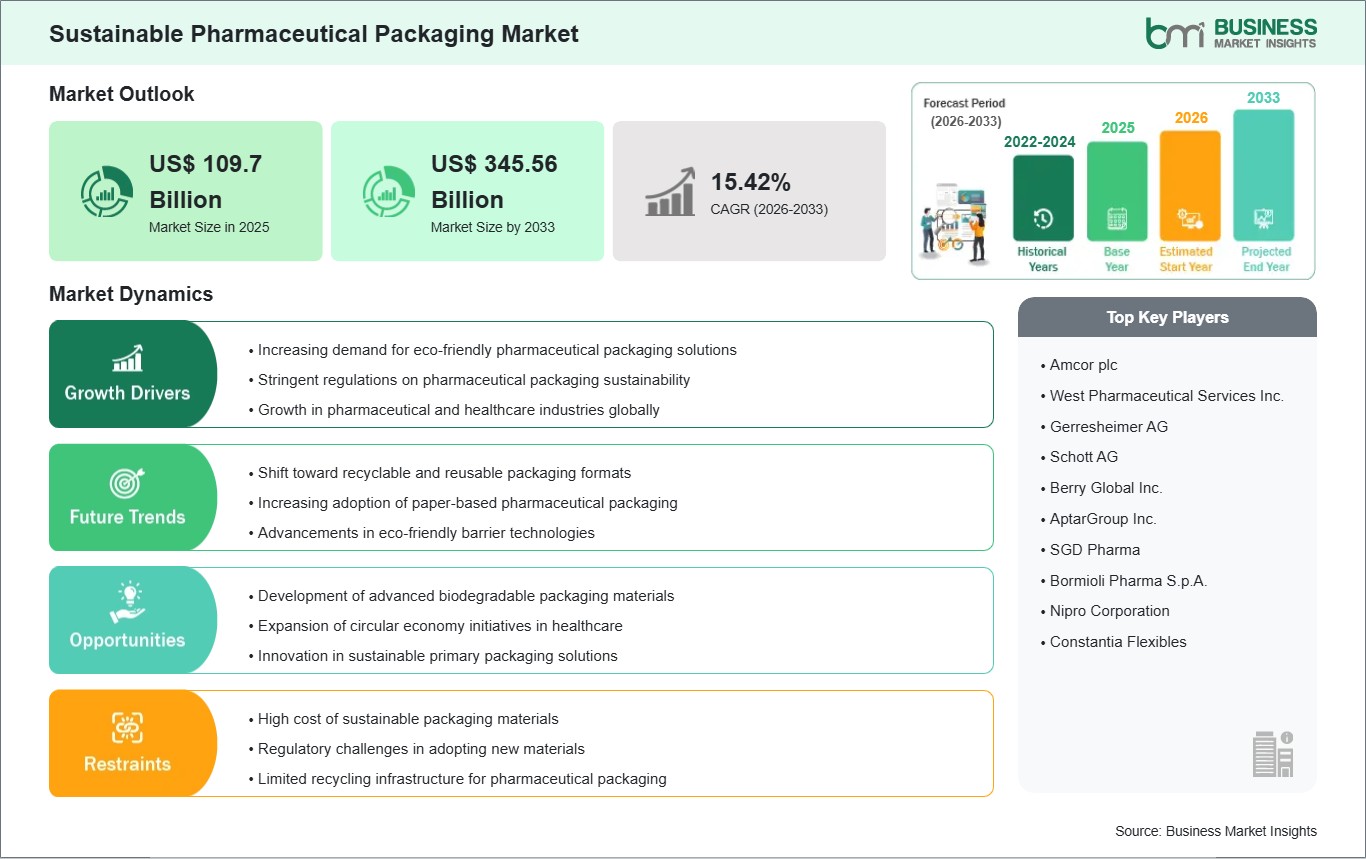
The market for sustainable pharmaceutical packaging is growing constantly due to increasing concerns about the environment, regulatory pressure, and the healthcare sector's demand for safe and efficient packaging solutions. Sustainable packaging is all about lowering the environmental footprint while still preserving the quality, safety, and effectiveness of the pharmaceutical products. Due to their versatility and compliance with stringent regulatory and performance standards, plastics command a large share of the material segment. Primary packaging is the frontrunner in the market as it is a key component to safeguard pharmaceutical products from contamination and also to maintain the product's stability.
The recyclable process segment has a major share owing to the increased need to reduce waste. Even though there are challenges such as increased costs and complex regulations, innovations in biodegradable materials and eco-friendly technologies are contributing to the growth of the market. There is an increased need to adopt sustainable practices in healthcare, which is a major contributor to growth. Innovations in materials used in pharmaceutical packaging are expected to contribute to growth. Overall, the sustainable pharmaceutical packaging market has growth prospects.
Segment Analysis
Sustainable Pharmaceutical Packaging Market Segmentation
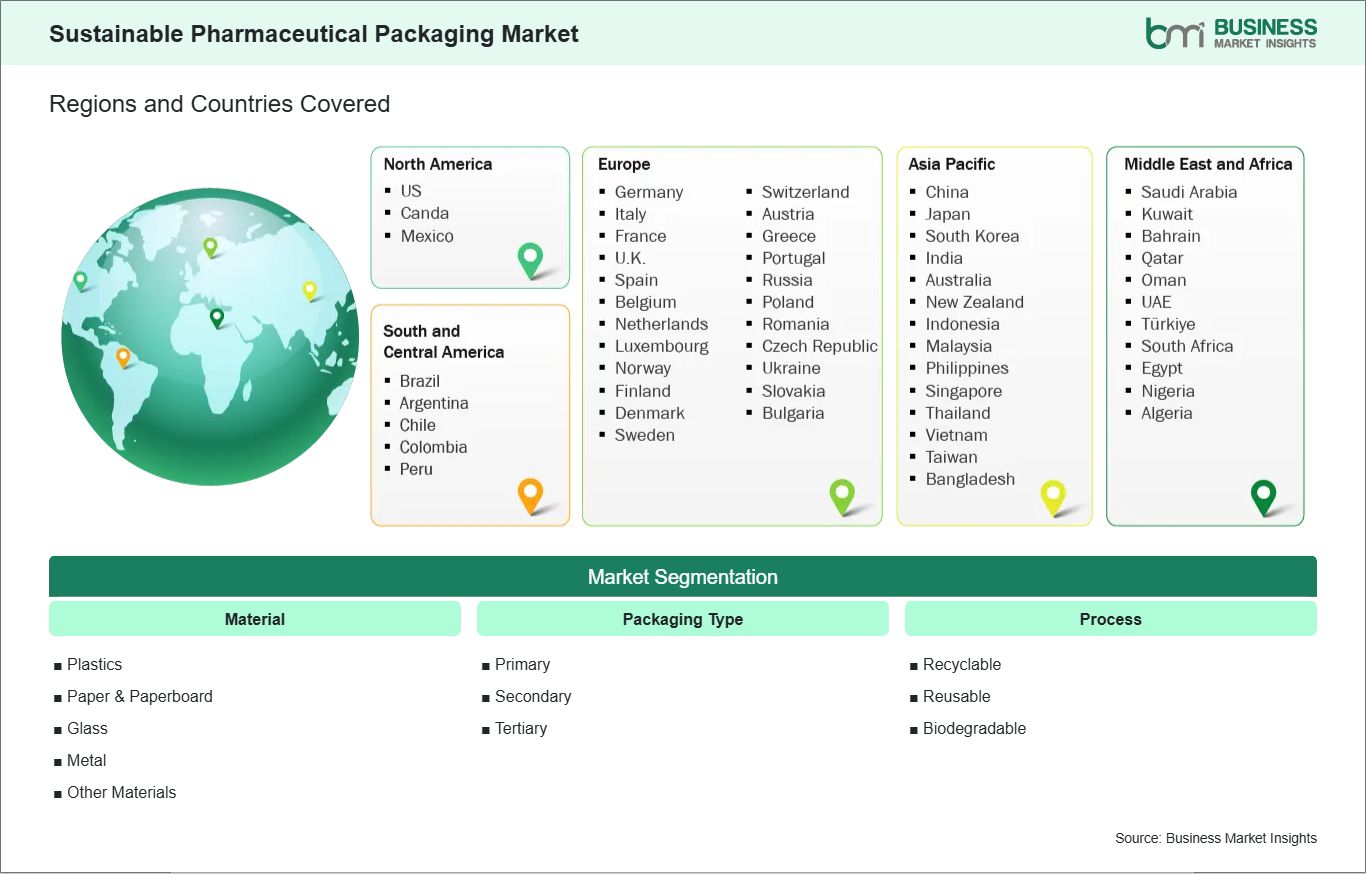
Key segments that contributed to the derivation of the Sustainable Pharmaceutical Packaging market analysis are material, packaging type, and process.
- By material, the sustainable pharmaceutical packaging market is segmented into Plastics, Paper & Paperboard, Glass, Metal, and Others. The Plastics segment dominated the market in 2025.
- By packaging type, the sustainable pharmaceutical packaging market is segmented into Primary, Secondary, and Tertiary. The Primary segment dominated the market in 2025.
- By process, the sustainable pharmaceutical packaging market is segmented into Recyclable, Reusable, and Biodegradable. The Recyclable segment dominated the market in 2025.
Market Forces
Sustainable Pharmaceutical Packaging Market Drivers and Opportunities
Increasing demand for eco-friendly pharmaceutical packaging solutions
The increasing need for eco-friendly pharmaceutical packaging solutions is a key factor that fuels the sustainable pharmaceutical packaging market. The increasing environmental concerns and awareness about the adverse effects of plastic waste have led pharmaceutical companies to adopt eco-friendly alternatives that not only minimize the environmental footprint but also meet the stringent product safety guidelines. The focus of pharmaceutical companies is shifting towards recyclable plastics, paper-based pharmaceutical packaging solutions, and biodegradable materials that not only meet the regulatory guidelines but also contribute to a sustainable environment. This is particularly important for the healthcare industry, which contributes to a high level of packaging waste.
Consumer awareness is another key factor contributing to the growth of the pharmaceutical packaging market, as consumers and healthcare providers are increasingly choosing eco-friendly products. This has encouraged pharmaceutical companies to invest more in research and development to come up with more innovative products. This not only helps pharmaceutical companies achieve regulatory compliance but also helps build brand image. As sustainability becomes a key aspect of pharmaceutical products, eco-friendly pharmaceutical packaging is likely to gain momentum, hence contributing to the growth of the pharmaceutical packaging market.
Development of advanced biodegradable packaging materials
The development of advanced biodegradable packaging materials presents significant opportunities in the sustainable pharmaceutical packaging market. Regulatory pressure to reduce plastic waste and carbon emissions is encouraging the adoption of materials that can naturally decompose without harming the environment. Biodegradable materials derived from renewable sources, such as polylactic acid (PLA) and starch-based plastics, are being engineered to meet the strict safety and performance requirements of pharmaceutical packaging. These innovations offer solutions that reduce environmental impact while ensuring product protection, stability, and compliance with industry standards.
Moreover, advancements in material science are improving the durability, barrier capabilities, and cost-effectiveness of biodegradable packaging materials, thus opening up their potential for wider adoption. Pharmaceutical companies aiming to reach sustainability objectives are investing in biodegradable materials to comply with regulatory and consumer demands. As a result of their adoption, biodegradable packaging materials are likely to play a crucial role in defining the future of packaging in the pharmaceutical sector, enabling companies to increase their market footprint while contributing to sustainability objectives.
Size and Share Analysis
Sustainable Pharmaceutical Packaging Market Size and Share Analysis
The global Sustainable Pharmaceutical Packaging market is experiencing steady growth, with market size and share analysis reflecting evolving treatment preferences and competitive dynamics among key players. The report evaluates important subsegments categorized within material, packaging type, and process highlighting their respective contributions to overall market performance.
By material, the Plastics subsegment dominated the market in 2025 due to its versatility, lightweight nature, cost-effectiveness, and ability to meet stringent pharmaceutical safety and barrier requirements, making it widely used for packaging medicines and healthcare products.
By packaging type, the Primary subsegment dominated the market in 2025 due to its direct contact with pharmaceutical products, ensuring safety, contamination prevention, and compliance with regulatory standards, making it essential in maintaining product integrity and shelf life.
By process, the Recyclable subsegment dominated the market in 2025 due to increasing regulatory focus on waste reduction, growing adoption of circular economy practices, and the ability to reuse materials efficiently, making it the most widely implemented sustainable packaging approach.
Report Coverage
Sustainable Pharmaceutical Packaging Market Report Coverage and Deliverables
The "Sustainable Pharmaceutical Packaging Market Size and Forecast (2022 - 2033)" report provides a detailed analysis of the market covering below areas:
- Sustainable Pharmaceutical Packaging market size and forecast at the regional and country levels for segments covered under the scope
- Sustainable Pharmaceutical Packaging market trends, as well as drivers, restraints, and opportunities
- Sustainable Pharmaceutical Packaging market analysis covering key trends, regional framework, major players, regulations, and recent developments
- Industry landscape and competition analysis covering market concentration, heat map analysis, prominent players, and recent developments for the Sustainable Pharmaceutical Packaging market
- Detailed company profiles, including SWOT analysis
Geographic Insights
Sustainable Pharmaceutical Packaging Market Geographic Insights
The geographical scope of the Sustainable Pharmaceutical Packaging market report is divided into: North America, Asia Pacific, Europe, Middle East & Africa, and South & Central America. North America held the largest share in 2025.
North America dominates the sustainable pharmaceutical packaging market due to strong regulatory frameworks, advanced healthcare infrastructure, and high adoption of sustainable practices. Regulatory bodies in the region are increasingly emphasizing environmentally friendly packaging solutions, encouraging pharmaceutical companies to adopt recyclable and sustainable materials. The presence of leading pharmaceutical companies and packaging manufacturers further drives market growth, as these players invest in research and development to create innovative and compliant packaging solutions.
Additionally, increasing awareness regarding environmental sustainability and the need to reduce healthcare-related waste are supporting the adoption of sustainable pharmaceutical packaging. Advanced recycling infrastructure and technological capabilities also contribute to market expansion. Companies in the region are focusing on integrating sustainable practices into their operations while maintaining strict compliance with safety and quality standards. These factors collectively strengthen North America`s leading position in the market.
Industry Activity
Recent Developments
The Sustainable Pharmaceutical Packaging market is evaluated by gathering qualitative and quantitative data post primary and secondary research, which includes important corporate publications, association data, and databases. A few of the key developments in the Sustainable Pharmaceutical Packaging market are:
- In May 2023, YewMaker and Connect in Pharma announced that they had shortlisted finalists for the Sustainable Medicines Packaging Awards, showcasing innovations in eco-friendly pharmaceutical packaging designs aimed at reducing waste and improving circularity in the pharma supply chain.
- In October 2022, Marchesini Group announced that it had upgraded its pharmaceutical packaging machinery portfolio with sustainable features, including reduced energy consumption and material efficiency, specifically targeting suppository and blister packaging lines.
Trust & Transparency
Research Methodology
The market analysis combines proprietary research with secondary data from government agencies, company disclosures, regulatory filings, industry databases and expert interviews. Market estimates are validated through data triangulation, cross-market benchmarking and analyst
review.
View Full Research Methodology
Key Sources Referred:
WPO (World Packaging Organization) SPC (Sustainable Packaging Coalition) FPA (Flexible Packaging Association) PMMI (The Association for Packaging and Processing Technologies) FEFCO (European Federation of Corrugated Board Manufacturers) AIPIA (Active & Intelligent Packaging Industry Association) IAPRI (International Association of Packaging Research Institutes) APR (Association of Plastic Recyclers) GPI (Glass Packaging Institute) Company Websites Company Annual Reports Company Investor Presentations