Sustainable Films for Packaging Market Regional Highlights
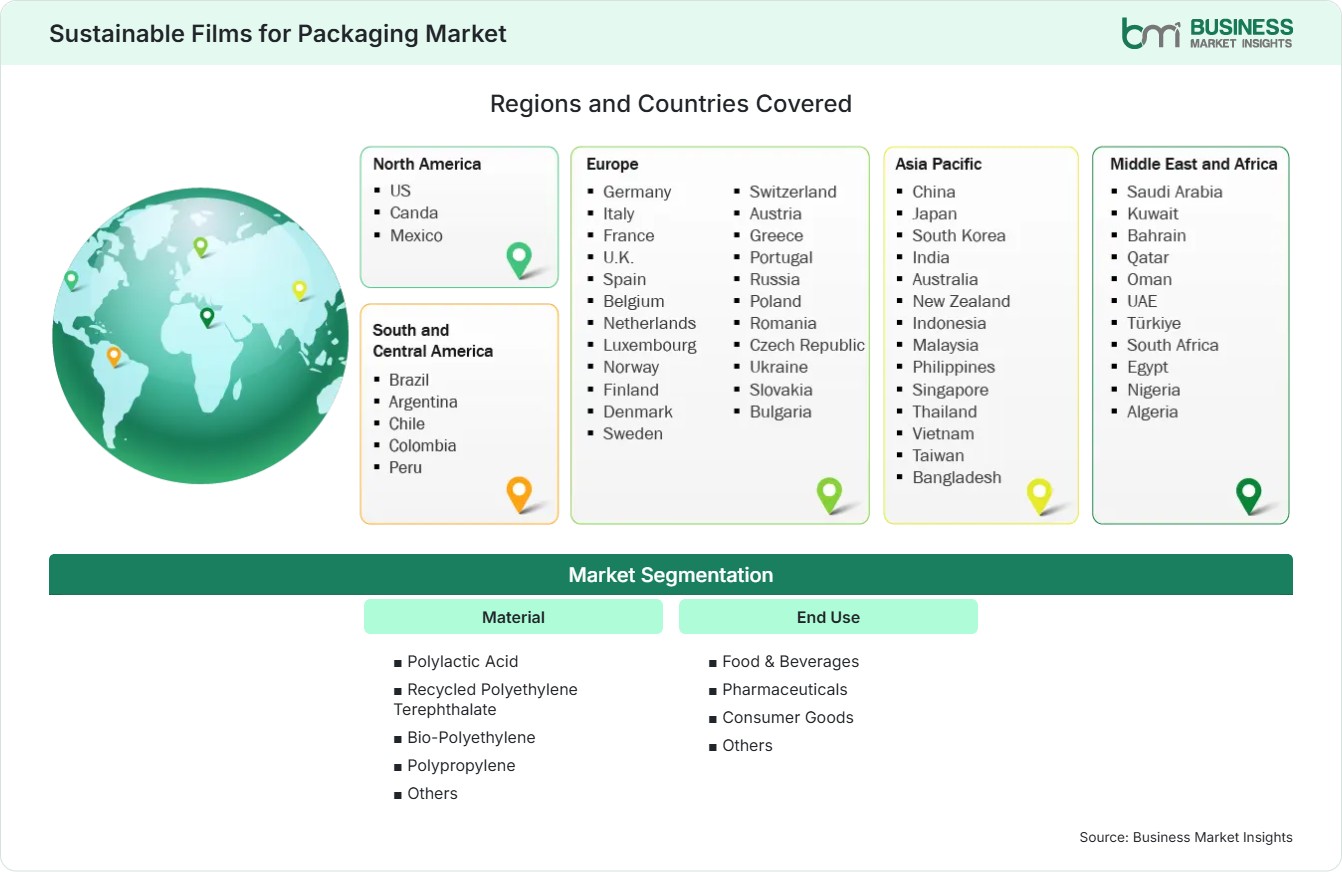
North America Sustainable Films For Packaging Market
North America accounted for 31%–34% of global revenue in 2025 and is projected to register a CAGR of 8.8%–9.2% during 2026–2033. The Sustainable Films For Packaging Market Share remains the highest globally owing to strong sustainability regulations, high consumer awareness, corporate ESG commitments, and significant investments in recyclable and bio-based flexible packaging. Food manufacturers, retail chains, and e-commerce companies continue replacing conventional plastic packaging with environmentally responsible film solutions to meet regulatory and consumer expectations.
- The United States dominates regional demand through extensive investments in recyclable packaging technologies, advanced polymer innovation, and corporate sustainability programs implemented by leading food and consumer goods manufacturers.
- Canada continues strengthening adoption through extended producer responsibility (EPR) policies, investments in recycling infrastructure, and increasing commercialization of compostable packaging materials.
- Brand owners increasingly collaborate with resin manufacturers and packaging converters to introduce mono-material packaging capable of improving recyclability without compromising product protection.
- Growing investment in chemical recycling, recycled-content films, and bio-based polymer manufacturing is strengthening long-term supply chain resilience throughout North America.
- Retailers continue encouraging sustainable packaging adoption by establishing ambitious recycled-content targets and reducing dependence on virgin fossil-based plastics.
US Sustainable Films For Packaging Market
The United States represented approximately 82%–85% of North American revenue in 2025 and is forecast to expand at a CAGR of 8.9%–9.3% through 2033. Increasing state-level plastic reduction initiatives, rapid innovation in flexible packaging materials, and growing investments by global packaging companies continue supporting long-term market expansion.
- Consumer packaged goods manufacturers increasingly adopt recyclable and compostable packaging films to improve sustainability performance while maintaining product quality and supply chain efficiency in sustainable films for packaging market.
- Advanced recycling facilities continue expanding production of recycled-content resins supporting circular packaging initiatives across food, beverage, healthcare, and industrial applications.
- Investments in digital packaging technologies and traceability systems improve material transparency while supporting regulatory compliance throughout the packaging lifecycle.
- Strategic collaboration between packaging converters, retailers, and polymer producers continues accelerating commercialization of sustainable packaging innovations.
Europe Sustainable Films For Packaging Market
Europe accounted for 29%–32% of global revenue in 2025 and is expected to register a CAGR of 9.0%–9.5% during the forecast period. Comprehensive environmental legislation, ambitious circular economy policies, and high adoption of recyclable packaging materials continue supporting regional leadership. Germany remains the largest regional market, while Italy is projected to record the fastest expansion with a CAGR of 9.8%–10.3% due to growing investments in biodegradable polymer production.
- Germany benefits from advanced packaging manufacturing capabilities, strong recycling infrastructure, and continuous innovation in high-performance sustainable flexible packaging materials.
- Italy strengthens regional growth through increasing production of bio-based polymers, compostable packaging materials, and investments in circular economy initiatives.
- France continues expanding sustainable packaging adoption through regulatory measures encouraging recyclable materials and reducing single-use plastic consumption in sustainable films for packaging market.
- Nordic countries invest heavily in renewable packaging materials, low-carbon manufacturing processes, and closed-loop recycling systems supporting long-term sustainability objectives.
- Consumer preference for environmentally responsible packaging continues encouraging retailers to transition toward recyclable flexible packaging across multiple product categories.
Asia Pacific Sustainable Films For Packaging Market
Asia Pacific represented 28%–31% of global revenue in 2025 and is projected to achieve the highest CAGR of 10.5%–11.1% through 2033. Rapid industrialization, expanding food processing industries, increasing exports, and strengthening environmental regulations continue driving adoption of sustainable packaging materials. China remains the largest regional market, while India is anticipated to register the fastest growth with a CAGR of 11.4%–12.0%.
- China continues expanding investments in recycled polymer manufacturing, sustainable packaging production, and advanced flexible packaging technologies serving domestic and export markets.
- India experiences strong demand due to rapid growth in packaged food consumption, regulatory initiatives targeting plastic waste reduction, and increasing domestic packaging manufacturing capacity.
- Japan emphasizes premium recyclable packaging, advanced barrier technologies, and lightweight packaging innovations supporting sustainability and product preservation.
- Australia continues promoting circular economy initiatives encouraging wider adoption of recyclable packaging films across food retail and consumer goods sectors.
- Regional manufacturers continue increasing production capacity for bio-based materials while strengthening collaboration with multinational consumer brands.
Rest of World Sustainable Films For Packaging Market
The Rest of World accounted for 8%–10% of global revenue in 2025 and is expected to register a CAGR of 9.3%–9.8% during the forecast period. South & Central America is benefiting from expanding food exports and packaging modernization, while the Middle East & Africa is witnessing increasing investment in sustainable manufacturing and waste management infrastructure.
Growing awareness regarding environmental sustainability and increasing regulatory initiatives continue encouraging packaging manufacturers to adopt recyclable materials while expanding regional production capabilities.
- Brazil leads South & Central America through increasing investment in renewable packaging materials, agricultural exports, and sustainable food packaging solutions.
- The United Arab Emirates records the fastest regional expansion with a CAGR of 10.0%–10.5%, supported by sustainability strategies, green manufacturing initiatives, and investments in advanced packaging technologies.
- Saudi Arabia continues strengthening sustainable manufacturing through industrial diversification initiatives encouraging environmentally responsible packaging production.
- South Africa gradually expands demand through growing retail modernization, food processing investments, and increasing adoption of recyclable flexible packaging materials.
- International packaging companies continue expanding regional manufacturing footprints to improve supply chain resilience and support rising demand for sustainable packaging products.