
Perforated Packaging Film Market Outlook: Size, Share, Trends, Growth Analysis, Competitive Landscape & Forecast, 2026-2033

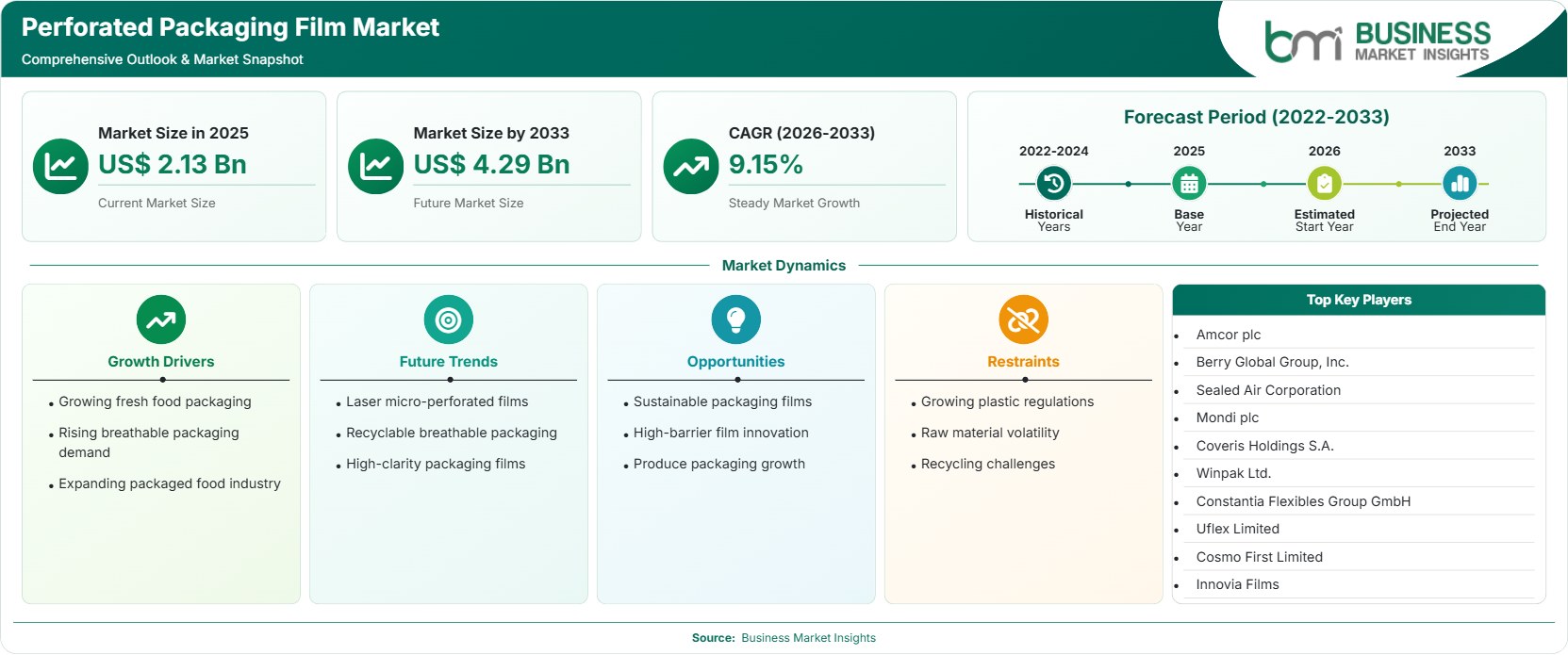
The Perforated Packaging Film size was valued at US$ 2.13 billion in 2025 and is projected to reach US$ 4.29 billion by 2033, growing at a CAGR of 9.15% during 2026–2033, driven by fresh food packaging expansion, breathable packaging demand, packaged food growth, sustainable film innovation, high-barrier technologies, and produce packaging opportunities.

Report Coverage
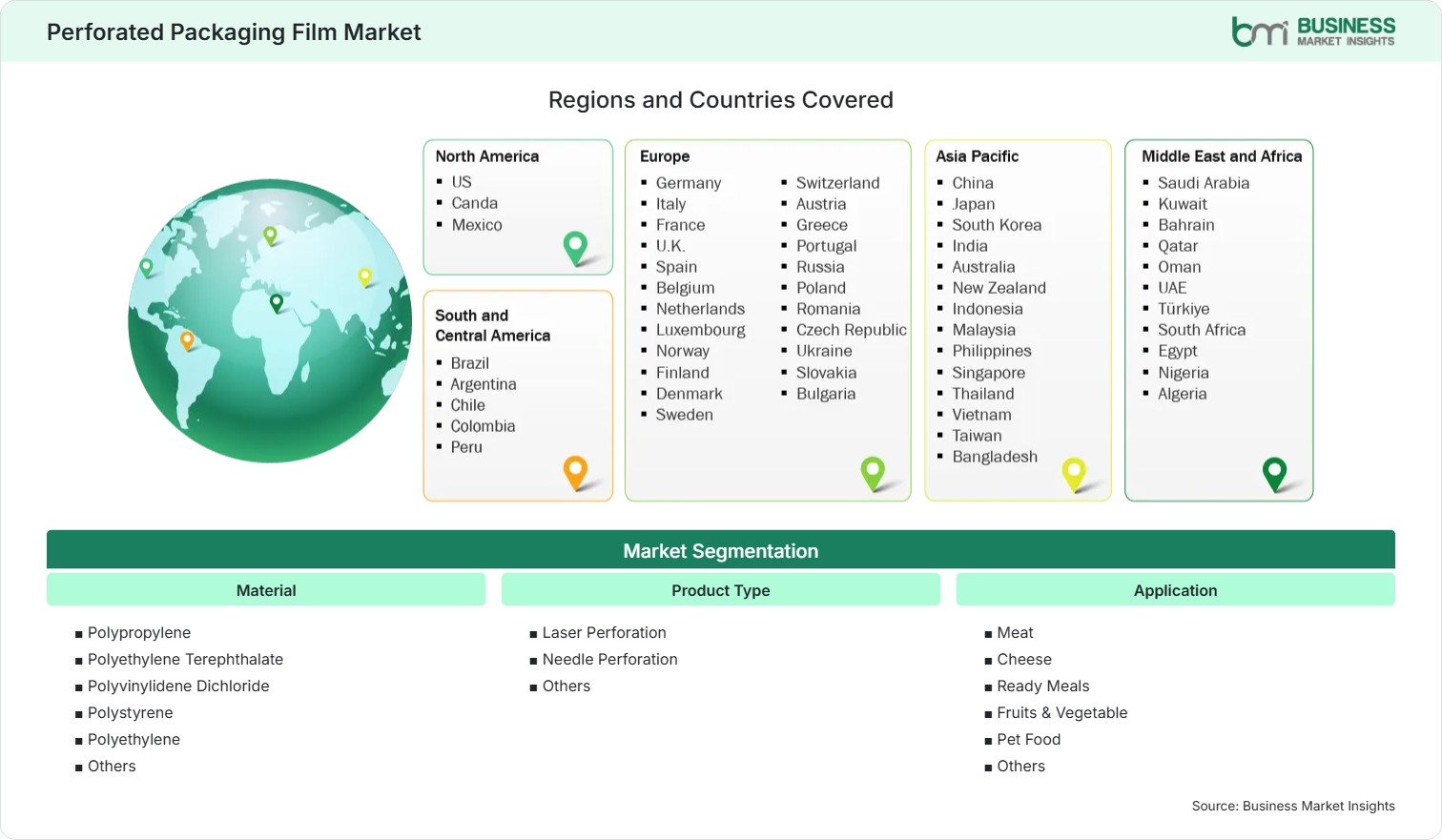
  • Material: Polypropylene, Polyethylene Terephthalate, Polyvinylidene Dichloride, Polystyrene, Polyethylene, Others
  • Product Type: Laser Perforation, Needle Perforation, Others
  • Application: Meat, Cheese, Ready Meals, Fruits & Vegetable, Pet Food, Others
US$ 2.13 Bn Market size in 2025
US$ 4.29 Bn Market Size by 2033
9.15% CAGR, 2026 - 2033
2026-2033 Forecast Period

01 AI Overview

Perforated Packaging Film Market Summary

  • North America Region: North America accounts for an estimated 28%–32% share in 2025 and is projected to grow at a CAGR of 8.4%–8.9% during 2026–2033. Fresh food consumption, advanced retail packaging, convenience food demand, and sustainable packaging initiatives create opportunities. The U.S. market remains a major contributor with a CAGR of 8.5%–9.0%, supported by food safety requirements and advanced flexible packaging adoption.
  • Fastest Growing Region: Asia Pacific holds approximately 32%–36% share in 2025 and is expected to expand at a CAGR of 10.0%–10.6% through 2033. Growing packaged food industries, expanding retail networks, urbanization, and increasing demand for extended shelf-life packaging solutions support regional growth.
  • Leading Segment: Polyethylene (PE) material represents around 30%–34% share in 2025 and is expected to grow at a CAGR of 8.8%–9.3%. Flexibility, cost efficiency, moisture resistance, and suitability for food applications continue supporting adoption.
  • High Growth Segment: Laser Perforation accounts for approximately 38%–42% share in 2025 and is projected to expand at a CAGR of 9.8%–10.4%. Precision control, improved ventilation, and compatibility with advanced packaging lines support growth.
  • Key Market Opportunity: Sustainable packaging films, recyclable structures, high-barrier technologies, and increasing demand for fresh produce packaging create opportunities for manufacturers developing advanced breathable film solutions.
  • Major Market Players: Amcor plc, Berry Global Group, Inc., Sealed Air Corporation, Mondi plc, Coveris Holdings S.A., Winpak Ltd., Constantia Flexibles Group GmbH, Uflex Limited, Cosmo First Limited, Innovia Films.
02 Strategic Insights

Perforated Packaging Film Market: Strategic Insights

perforated-packaging-film-market-market-strategic-framework
FREE PDF
Request your free sample
Request free sample
03 Stakeholder View

Key Takeaways

  • The packaging value chain is shifting toward engineered film solutions, with manufacturers focusing on polymer innovation, precision processing, sustainability, and application-specific designs.
  • Fresh produce, meat, and ready meal packaging represent major growth opportunities as food companies seek solutions that extend shelf life and reduce product losses.
  • Laser perforation technology and advanced barrier films are becoming important innovation areas as brands demand improved package performance and production efficiency.
  • Asia Pacific presents strong investment potential due to expanding food processing industries, rising urban populations, and increasing adoption of modern retail packaging systems.
  • Companies are pursuing strategic partnerships, capacity expansion, and technology investments to strengthen positions in sustainable flexible packaging markets.
04 Geographic Outlook

Perforated Packaging Film Market Regional Highlights

North America Perforated Packaging Film Market

North America represented approximately 28%–32% of the global Perforated Packaging Film Market share in 2025 and is projected to expand at a CAGR of 8.4%–8.9% during 2026–2033. The region benefits from advanced food packaging infrastructure, strong demand for convenience foods, and growing emphasis on reducing food waste. The Perforated Packaging Film share remains significant due to established flexible packaging manufacturers and adoption of innovative breathable packaging technologies.

  • The United States remains the largest contributor due to strong fresh food consumption, advanced retail networks, and high adoption of flexible packaging solutions.
  • Canada supports growth through increasing demand for sustainable packaging materials and improved food preservation technologies.
  • Food manufacturers are adopting perforated films to enhance freshness, reduce spoilage, and improve supply chain efficiency.
  • Sustainability initiatives are encouraging investment in recyclable and lower-impact packaging structures.

US Perforated Packaging Film Market

The United States accounted for approximately 24%–28% of global revenue in 2025 and is expected to register a CAGR of 8.5%–9.0% through 2033. The country remains a major market due to advanced food processing industries, strong retail penetration, and demand for convenience-oriented packaging. The Perforated Packaging Film market growth is influenced by fresh food packaging innovation, sustainability initiatives, and increasing demand for extended shelf-life solutions.

  • Food processors are increasingly using breathable films for meat, produce, dairy, and ready-to-eat meal applications.
  • Retailers are adopting advanced packaging formats to improve product presentation and minimize food waste.
  • Packaging companies are investing in recyclable film structures and high-performance polymer technologies.

Europe Perforated Packaging Film Market

Europe held an estimated 25%–29% share in 2025 and is forecast to grow at a CAGR of 8.0%–8.6% between 2026 and 2033. The region benefits from strong food safety standards, sustainability regulations, and demand for efficient packaging solutions. Germany, France, the United Kingdom, and Italy represent key markets due to established food industries and increasing adoption of environmentally responsible packaging technologies.

  • Germany remains a leading Perforated Packaging Film market due to advanced food processing capabilities and strong flexible packaging manufacturing expertise.
  • France demonstrates increasing adoption of sustainable packaging solutions across fresh food and retail applications.
  • The United Kingdom continues expanding convenience food packaging demand through retail and meal solution categories.
  • European regulations are accelerating development of recyclable films and reduced-plastic packaging alternatives.

Asia Pacific Perforated Packaging Film Market

Asia Pacific region holds about 32% to 36% of the market share in 2025 and is forecast to register the highest growth rate, at a CAGR of 10.0% to 10.6%. The factors that contribute to demand in the region include increased consumption of packaged food, urbanization, expansion of cold chains, and developments in the retail sector. China, India, Japan, and South Korea represent major growth markets for advanced food packaging solutions.

  • China remains a major contributor due to large food processing industries and increasing demand for packaged fresh products.
  • India represents strong potential through expanding organized retail, food processing investments, and rising convenience food consumption.
  • Japan supports demand through advanced packaging technologies and high consumer expectations for food quality.
  • South Korea demonstrates growth through innovative food products and adoption of modern packaging formats.

Rest of World Perforated Packaging Film Market

The Rest of World region accounted for approximately 7%–10% share in 2025 and is projected to grow at a CAGR of 8.7%–9.3% during the Perforated Packaging Film market forecasts period. Latin America, the Middle East, and Africa are experiencing gradual market development due to increasing packaged food demand, retail expansion, and improving food distribution systems. Growth opportunities are supported by food processing investments and demand for longer shelf-life solutions.

  • Brazil represents a key Latin American market due to expanding food industries and increasing packaged food consumption.
  • Mexico supports regional growth through retail modernization and rising demand for convenient food products.
  • Middle Eastern countries are investing in food supply infrastructure and advanced packaging technologies.
  • African markets provide emerging opportunities through urbanization and expanding processed food consumption.
  • Regional manufacturers are adopting efficient packaging solutions to improve food preservation and distribution capabilities.
global-market-geography
FREE PDF
Request your free sample
Request free sample
05 Segment Analysis

Perforated Packaging Film Market Segmentation

Material

The material segment holds around 88%-92% market share by revenue in the Perforated Packaging Film Market in 2025 and is expected to expand at a CAGR of 8.8%-9.3% during the forecast period of 2026-2033. Factors affecting material choice include flexibility, barrier properties, recyclability, processability, and application demands. Advanced films that combine performance, sustainability, and other benefits are being adopted by food producers to improve packaging efficiency.

  • Polypropylene (PP): PP films are widely used due to moisture resistance, clarity, lightweight properties, and suitability for food packaging applications requiring controlled ventilation.
  • Polyethylene Terephthalate (PET): PET films provide strength, dimensional stability, and high transparency, supporting applications requiring durability and improved packaging aesthetics.
  • Polyvinylidene Dichloride (PVDC): PVDC films offer strong barrier properties against oxygen and moisture, supporting applications requiring extended freshness and enhanced product protection.
  • Polystyrene (PS): PS films provide rigidity, lightweight characteristics, and cost efficiency, supporting selected food packaging applications where structural performance is required.
  • Polyethylene (PE): PE films represent a major material category due to flexibility, sealability, cost advantages, and broad compatibility with fresh food packaging requirements.
  • Others: Other materials include specialty polymers and engineered film structures developed to address specific barrier, sustainability, and performance requirements.

Product Type

The Product Type segment holds a share of about 72%–76% in the Perforated Packaging Film Market in 2025 and is forecast to witness a CAGR of 9.0%–9.5% up to 2033. Perforation type will be chosen based on package speed, airflow requirements, product sensitivity, and shelf-life considerations. The use of precision-based perforations is becoming more popular among manufacturers.

  • Laser Perforation: Laser perforation is gaining adoption due to precision control, consistent hole patterns, reduced material damage, and compatibility with automated packaging systems.
  • Needle Perforation: Needle perforation remains relevant due to cost efficiency, simple processing requirements, and suitability for applications requiring controlled ventilation.

Application

The Application category held 90%-94% market share in 2025 and is expected to witness growth at a CAGR of 8.9%-9.4% from 2026-2033. The increasing need for fresh, convenient, and minimally processed food products has been boosting demand for perforated film across various food categories. There has been an increase in the development of packaging solutions by manufacturers that preserve the food product.

  • Meat: Meat packaging applications are increasing due to demand for freshness preservation, controlled atmosphere compatibility, and improved product shelf-life management.
  • Cheese: Cheese packaging uses perforated films to regulate moisture exchange, maintain texture, and support product quality throughout distribution and storage.
  • Ready Meals: Ready meal packaging demand is expanding as consumers seek convenient food options requiring reliable freshness and preservation solutions.
  • Fruits & Vegetable: Fresh produce applications represent a major opportunity due to increasing demand for breathable packaging that reduces spoilage and maintains quality.
  • Pet Food: Pet food packaging adoption is growing as manufacturers seek durable and functional films supporting product freshness and consumer convenience.
06 Market Forces

Perforated Packaging Film Market Dynamics

Key Market Drivers

Growing Fresh Food Packaging Demand

The rise in consumer preference for fresh, minimally processed, and convenient food products is driving demand for packaging that maintains their quality throughout the supply chain. Films with perforations offer better oxygen and moisture balance, thereby keeping foods such as fruits, vegetables, and meat fresh. The investments made by food retailers and food processing firms in innovative packaging techniques have increased in an attempt to minimize food waste, extend shelf life, and improve aesthetics. Urbanization and the growth of organized retailing are creating even greater impetus for efficient food packaging systems. This trend is strengthening the Perforated Packaging Film Market growth as companies develop customized film structures designed for specific food categories. The focus on reducing food waste is encouraging the adoption of breathable packaging technologies across global markets.

Rising Demand for Breathable Packaging

The rising demand for ventilation packaging solutions is boosting the demand for perforated film technology across various applications for fresh foodstuffs. Being able to control gas exchange, such films are capable of minimizing condensation formation and creating favorable conditions for products. In addition, food manufacturers have been opting for packaging technologies that ensure quality and efficiency during long-term transportation. Laser perforation technologies enable the creation of precise micro-perforations suited to specific products. The increasing need for effective cold chain management and food preservation is expected to drive demand for breathable packaging technologies. The Perforated Packaging Film Market trends can be observed within the growing trend towards advanced packaging technologies.

Expansion of Packaged Food Industry

Growth in packaged food consumption is increasing demand for flexible packaging solutions that protect products throughout distribution networks. Changing lifestyles, urbanization, and rising preference for convenience foods are encouraging food manufacturers to adopt innovative packaging formats. There is a growing importance of perforated films among ready-to-eat foods, fresh vegetables, dairy products, and other packaged food segments that require controlled ventilation. New developments in the food processing sector in developing countries have increased demand for packaging materials and processes. Producers are responding by expanding their production, developing new polymers, and providing custom-made solutions. Growth in processed food categories is likely to continue supporting the trend in the future.

Key Market Opportunities

Sustainable Packaging Film Development

The shift towards more eco-friendly packaging is creating opportunities to develop new, recyclable, lightweight perforated films. The food industry is always looking for innovative ways of producing packaging materials that are environmentally friendly yet possess all the necessary characteristics. There have been innovations in monomaterial systems, recycled plastics, and film production. Companies that focus on developing sustainable packaging materials will be able to build a stronger market position due to increasing regulatory and consumer pressure. Sustainable perforated films are suitable for companies that want to minimize their plastic footprint without compromising product freshness and shelf life.

High-Barrier Film Innovation

Demand for advanced barrier performance is creating opportunities for manufacturers to develop films with improved protection against oxygen, moisture, and contamination. High-barrier perforated films can help extend product shelf life while maintaining necessary ventilation characteristics for sensitive food applications. Advancements in multilayers, polymer blends, and precise perforating techniques are leading to improved performance in packaging applications. Food companies are increasingly demanding solutions that provide effective food preservation, along with other criteria such as strength and sustainability. Companies that make customized high-performing films have the potential to meet demand from premium segments of the food industry and food processing companies around the globe.

Growth in Produce Packaging Applications

The increased use of fresh fruits and vegetables worldwide is creating many opportunities for manufacturers of perforated packaging films. Retailers and food processors are looking for ways to keep their products fresh and minimize spoilage while presenting them well during distribution. Growing interest in minimizing food waste is driving the adoption of breathable packaging for produce. Developing countries with growing supermarket networks and cold chains offer another opportunity for expansion. Producers are introducing specialized perforation designs along with light films to meet the specific needs of various types of produce. As fresh food supply chains become more sophisticated, demand for efficient produce packaging technologies is expected to increase across developed and developing economies.

Market Restraints and Challenges

Growing Plastic Regulations

Factor: Increasing government regulations on plastic usage, waste management requirements, and environmental standards are creating challenges for conventional packaging film manufacturers.

Impact: Regulatory restrictions can increase compliance costs, require material reformulation, and accelerate the need for sustainable alternatives. Companies producing traditional plastic films may face pressure to invest in recyclable materials, improved waste management systems, and environmentally responsible production methods. Transitioning toward compliant solutions can require significant research investment and operational adjustments. Manufacturers must balance sustainability requirements with performance, cost efficiency, and food safety standards. Regulatory changes across different regions create additional complexity for companies operating global packaging supply chains.

Raw Material Volatility and Recycling Challenges

Factor: Fluctuations in polymer prices and limitations in recycling infrastructure affect production costs and material recovery efficiency.

Impact: Raw material price instability can influence manufacturing expenses, pricing strategies, and profit margins for film producers. Recycling challenges associated with multilayer structures and contaminated food packaging can limit sustainability progress. Companies must invest in improved material design, recycling-compatible structures, and efficient supply chain management to address these challenges. Developing recyclable perforated films while maintaining barrier properties remains a key technical challenge. The industry is increasingly focusing on material innovation and circular economy solutions to reduce dependency on conventional plastics and improve long-term sustainability.

07 Company Analysis

Competitive Landscape

The competitive environment is influenced by innovations in flexible packaging, advancements in polymer technology, sustainable development practices, and the expansion of food-grade packaging offerings. The Perforated Packaging Film market analysis reveals rising competition among international packaging firms, which are developing breathable films, recyclable structures, high-barrier solutions, precise perforation techniques, and custom packaging solutions for fresh food products.

Company Name

Overview

Products and Services relevant to this market

Amcor plc

Global packaging company providing flexible and sustainable solutions for food and consumer markets.

Perforated films, flexible packaging, recyclable films, high-barrier structures, food packaging solutions, and sustainable materials.

Berry Global Group, Inc.

International packaging manufacturer specializing in engineered plastic packaging products.

Flexible films, food packaging films, breathable packaging solutions, specialty films, and sustainable packaging technologies.

Sealed Air Corporation

Packaging solutions provider focused on food protection and preservation technologies.

Food packaging films, vacuum packaging, breathable films, protective packaging solutions, and shelf-life extension technologies.

Mondi plc

Global packaging and paper company developing sustainable packaging solutions.

Flexible packaging films, recyclable structures, food packaging materials, barrier films, and sustainable packaging solutions.

Coveris Holdings S.A.

European packaging manufacturer focused on sustainable flexible packaging products.

Food packaging films, perforated films, recyclable packaging, barrier solutions, and specialty flexible materials.

Winpak Ltd.

Packaging company specializing in high-performance food and healthcare packaging solutions.

Flexible films, food-grade packaging, barrier films, specialty packaging systems, and preservation solutions.

Constantia Flexibles Group GmbH

Global flexible packaging producer serving food, beverage, and consumer industries.

Flexible films, sustainable packaging structures, barrier packaging, food protection films, and specialty solutions.

Uflex Limited

Indian multinational packaging company providing integrated flexible packaging solutions.

Flexible films, specialty packaging films, barrier films, food packaging solutions, and advanced film technologies.

Cosmo First Limited

Packaging film manufacturer specializing in specialty and sustainable film products.

BOPP films, specialty films, packaging films, coated films, and value-added flexible packaging solutions.

Innovia Films

Film manufacturer focused on specialty packaging and label film technologies.

Specialty films, breathable packaging films, sustainable films, and high-performance flexible packaging materials.

08 Industry Activity

Recent Developments

February 2026

Envalior and PerfoTec collaborated to develop a new breathable film for fresh produce that uses high-precision laser micro-perforation combined with tailored material permeability to naturally balance oxygen and carbon dioxide levels, eliminating the need for modified atmosphere packaging (MAP). The solution has been reported to extend the shelf life of bell peppers fourfold and enable peonies to be stored for up to 14 weeks.

February 2026

UFlex Limited introduced F HSS, a co-extruded, heat-sealable PET film designed for laser perforation and enhanced recyclability. The company showcased the new packaging film at PLASTINDIA 2026, highlighting its suitability for sustainable and high-performance flexible packaging applications.

November 2025

Amcor announced a significant expansion of its North America printing, lamination and converting capabilities for the protein market. This expansion emphasizes Amcor’s strong heritage in the meat, poultry and seafood industries and will support customers’ needs for flexible packaging.

September 2025

Coveris launched MonoFlexBP, a tray for refrigerated goods. With this sustainable alternative to non-recyclable materials, Coveris continues to lead the way in circular packaging innovation, offering high-performance solutions that address both environmental impact and consumer demand.

10 Trust & Transparency

Research Methodology

The market analysis combines proprietary research with secondary data from government agencies, company disclosures, regulatory filings, industry databases and expert interviews. Market estimates are validated through data triangulation, cross-market benchmarking and analyst review.

View Full Research Methodology

11 Questions Answered

Frequently Asked Questions

What does the Perforated Packaging Film Market Report cover?

The report covers market size, segmentation, regional trends, competitive landscape, drivers, opportunities, challenges, company developments, and strategic insights through 2033.

How are sustainability trends affecting perforated film development?

Sustainability trends are encouraging the development of recyclable films, mono-material structures, lightweight packaging solutions, and improved recycling-compatible packaging technologies.

Which region offers the highest growth opportunity?

Asia Pacific provides strong growth potential due to expanding food processing industries, urbanization, organized retail growth, and increasing adoption of advanced packaging solutions.

Which material dominates perforated packaging film production?

Polyethylene remains a major material category due to flexibility, sealability, cost efficiency, and compatibility with diverse fresh food packaging applications.

What factors are driving the Perforated Packaging Film Market growth?

The market is driven by rising fresh food packaging demand, breathable packaging adoption, packaged food expansion, food waste reduction initiatives, and development of sustainable film technologies.

Access the Full Perforated Packaging Film Market Report

Get segment-level forecasts, regional estimates, competitive benchmarking, company profiles and downloadable Excel datasets.

Access the full Perforated Packaging Film Market Report
350 pages PDF & Excel | 2026-07-29