
Agricultural Films Market Outlook: Size, Share, Trends, Growth Analysis, Competitive Landscape & Forecast, 2022-2033

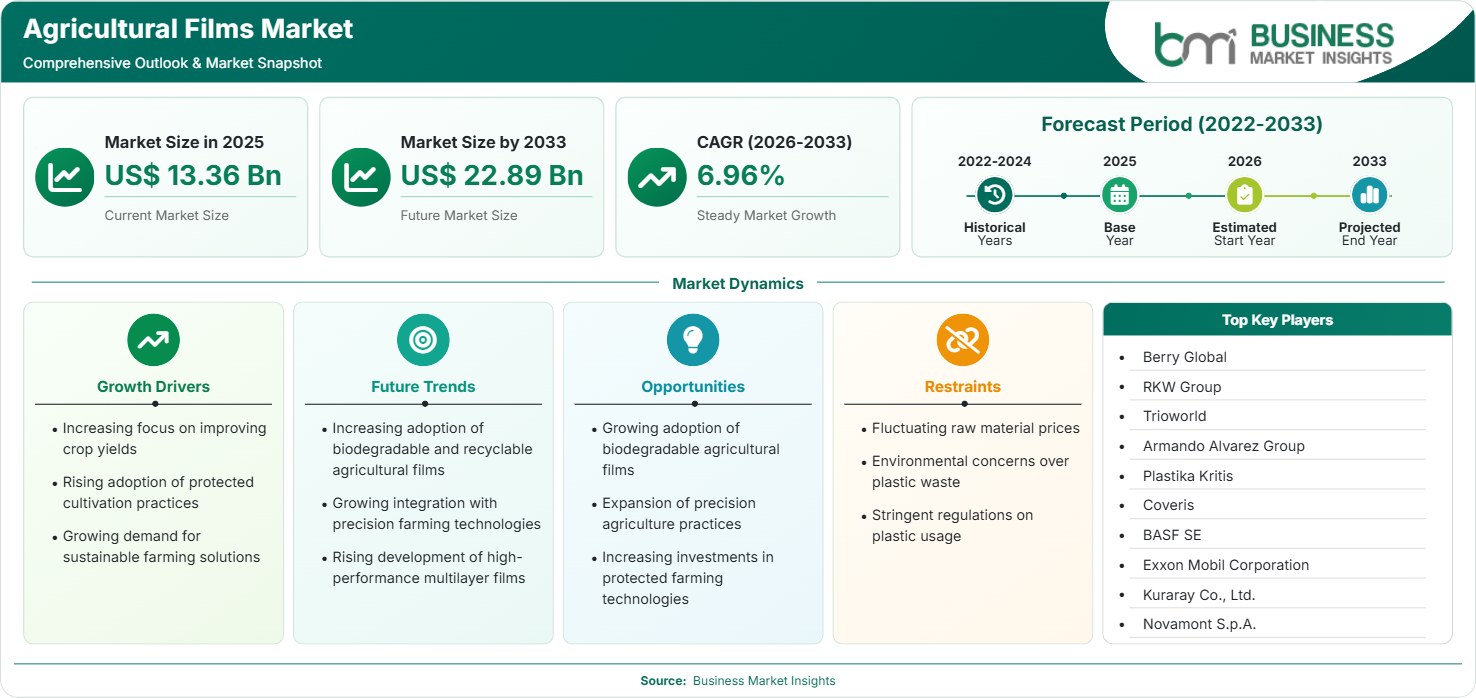
The Agricultural Films Market size was valued at US$ 13.36 Billion in 2025 and is projected to reach US$ 22.89 Billion by 2033, growing at a CAGR of 6.96% during 2026–2033. Rising crop productivity requirements, the expansion of protected cultivation, the adoption of sustainable farming, and investments in precision agriculture are driving demand, while biodegradable materials and advanced farming technologies create new opportunities.

Report Coverage
  • Material: LDPE, LLDPE, HDPE, EVA/EBA, Reclaims, Others
  • Application: Greenhouse, Mulching, Silage
US$ 13.36 Bn Market size in 2025
US$ 22.89 Bn Market Size by 2033
6.96% CAGR, 2026 - 2033
2026-2033 Forecast Period

01 AI Overview

Agricultural Films Market Summary

  • North America Region: North America holds 24%–27% share in 2025 and is projected to grow at a 6.4%–7.1% CAGR during 2026–2033, supported by greenhouse farming expansion, sustainable agriculture initiatives, and improved crop management practices. The US market is growing at a 6.7%–7.3% CAGR due to increasing adoption of advanced cultivation technologies and demand for efficient agricultural inputs.
  • Fastest Growing Region: Asia Pacific represents 38%–42% share in 2025 and is expanding at a 7.4%–8.1% CAGR through 2033, driven by rising food demand, protected farming adoption, government agricultural programs, and increasing investments in modern cultivation methods.
  • Leading Segment: Mulching applications account for 42%–45% share in 2025 and are expected to grow at a 7.0%–7.6% CAGR, supported by moisture retention requirements, weed control benefits, soil temperature management, and improved agricultural productivity.
  • High Growth Segment: Biodegradable agricultural film solutions within sustainable material applications represent 10%–13% share in 2025 and are projected to grow at a 9.0%–10.0% CAGR, driven by environmental regulations and demand for sustainable farming inputs.
  • Key Market Opportunity: Increasing adoption of biodegradable films, precision farming technologies, greenhouse cultivation, and advanced crop protection methods is creating opportunities for manufacturers developing sustainable agricultural solutions.
  • Major Market Players: Berry Global, RKW Group, Trioworld, Armando Alvarez Group, Plastika Kritis, Coveris, BASF SE, Exxon Mobil Corporation, Kuraray Co., Ltd., Novamont S.p.A.
02 Strategic Insights

Agricultural Films Market: Strategic Insights

Agricultural Films Market Strategic Framework
FREE PDF
Request your free sample
Request free sample
03 Stakeholder View

Key Takeaways

  • Agricultural film manufacturers are shifting toward high-performance polymers, recyclable materials, and biodegradable solutions to address productivity requirements and environmental concerns across farming ecosystems.
  • Mulching and greenhouse applications provide strong growth opportunities as farmers increasingly adopt protected cultivation methods to improve crop output and manage climate-related challenges.
  • Material innovation is becoming a competitive priority, with companies developing thinner, stronger, and more sustainable films that reduce resource consumption while maintaining agricultural performance.
  • Asia Pacific presents significant investment potential due to rising food requirements, expanding agricultural modernization programs, and increasing adoption of greenhouse farming practices.
  • Strategic collaborations between polymer producers, agricultural technology companies, and farming solution providers are supporting innovation in sustainable film development.
  • Future competitiveness will depend on the development of biodegradable materials, recycling capabilities, cost optimization, and compliance with evolving environmental standards.
04 Geographic Outlook

Agricultural Films Market Regional Highlights

North America Agricultural Films Market

North America represents 24%–27% of the Agricultural Films Market share in 2025 and is expected to grow at a 6.4%–7.1% CAGR during 2026–2033. The region benefits from advanced agricultural practices, increasing greenhouse cultivation, and demand for efficient crop management solutions. The United States remains the leading contributor, supported by technology-driven farming, sustainable agriculture programs, and increasing use of specialized films for crop protection and productivity improvement.

  • Farmers are adopting greenhouse films to improve production efficiency and extend cultivation seasons.
  • Sustainable agriculture initiatives are increasing demand for recyclable and environmentally improved film solutions.
  • Advanced farming technologies are supporting integration of agricultural films with precision cultivation methods.
  • Commercial growers are using mulching films to improve water management and crop performance.

US Agricultural Films Market

The US market accounts for 20%–22% share in 2025 and is projected to expand at a 6.7%–7.3% CAGR through 2033. Strong agricultural infrastructure, advanced farming practices, and increasing demand for resource-efficient cultivation methods support market development. Farmers are adopting greenhouse covers, mulch films, and silage solutions to improve operational efficiency and enhance crop quality.

  • Controlled environment agriculture is increasing demand for specialized greenhouse film technologies.
  • Sustainable farming practices are encouraging adoption of improved material formulations.
  • Large-scale farms are implementing advanced crop protection methods.
  • The integration of precision agriculture is supporting the efficient use of agricultural inputs.

Europe Agricultural Films Market

Europe contributes 22%–25% share in 2025 and is projected to grow at a 6.3%–7.0% CAGR during the forecast period. The region emphasizes sustainable agriculture, reduced plastic waste, and advanced cultivation methods. Germany, France, and Italy remain important markets due to the adoption of greenhouse farming and agricultural innovation. Increasing focus on circular economy practices is encouraging the development of recyclable and biodegradable agricultural film products.

  • European regulations are encouraging sustainable alternatives to conventional plastic films.
  • Greenhouse cultivation expansion is increasing demand for durable covering materials.
  • Farmers are adopting mulch films for improved resource efficiency.
  • Agricultural companies are investing in recyclable film technologies.
  • Innovation in biodegradable materials is supporting market development.

Asia Pacific Agricultural Films Market

Asia Pacific represents 38%–42% share in 2025 and is projected to expand at the highest rate of 7.4%–8.1% CAGR during 2026–2033. The region benefits from rising food consumption, agricultural modernization programs, and increasing adoption of protected cultivation practices. China and India are major contributors, while countries such as Japan and South Korea continue investing in advanced farming technologies. The Agricultural Films Market forecast for Asia Pacific is supported by expanding greenhouse infrastructure, growing demand for improved crop productivity, and government initiatives promoting efficient farming.

  • China is increasing the adoption of agricultural film through the expansion of greenhouse farming and modern crop production programs.
  • India is adopting protected cultivation methods to improve productivity, reduce weather dependence, and enhance farmers' incomes.
  • Southeast Asian countries are investing in modern agricultural technologies to support food security.
  • Growing awareness of water conservation is increasing demand for mulching films.
  • Agricultural technology providers are introducing sustainable film solutions for regional farming conditions.

Rest of World Agricultural Films Market

Rest of World accounts for 8%–10% share in 2025 and is projected to grow at a 6.8%–7.5% CAGR during 2026–2033. Latin America, the Middle East, and Africa are witnessing increasing adoption due to agricultural productivity challenges, climate variability, and demand for efficient farming solutions. Brazil and Mexico are important markets in Latin America, while Middle Eastern countries are investing in protected agriculture to improve food production in water-limited environments.

  • Brazil is expanding the use of agricultural film in commercial farming and crop protection applications.
  • Middle Eastern countries are adopting greenhouse technologies to improve agricultural output in harsh climates.
  • African markets are gradually adopting films for improved irrigation efficiency and crop management.
  • Agricultural modernization programs are supporting technology adoption across developing economies.
  • Sustainable farming investments are creating opportunities for advanced agricultural film manufacturers.
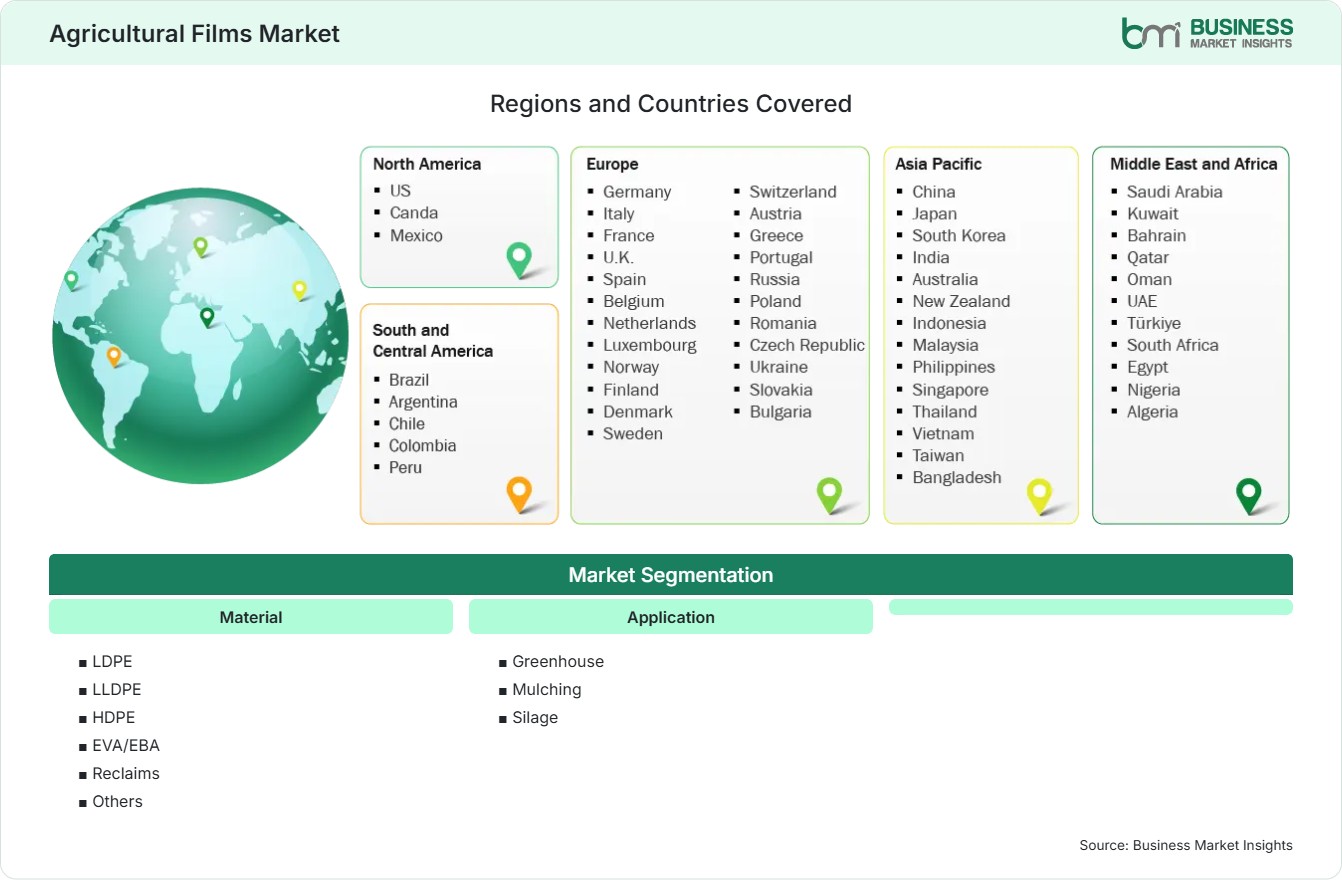
Global Market Geography
FREE PDF
Request your free sample
Request free sample
05 Segment Analysis

Agricultural Films Market Segmentation

Material

The material segment is an important element of the Agricultural Films Market, as the key aim is to enhance the durability, flexibility, and eco-friendliness of the materials. LDPE continues to be widely used owing to its superior transparency, toughness, and suitability for greenhouses and mulching. The material segment accounted for 45%-48% of the market share in 2025 and is expected to grow at a CAGR of 6.5%-7.2% from 2026-2033. Increasing demand for recyclable polymers and improved film performance is shaping material innovation across agricultural applications.

  • LDPE: LDPE films offer flexibility, durability, and transparency, making them suitable for greenhouse covers, mulching applications, and crop protection.
  • LLDPE: LLDPE films offer improved tensile strength, puncture resistance, and flexibility, supporting advanced agricultural applications requiring enhanced durability.
  • HDPE: HDPE films offer high strength and resistance, supporting applications requiring improved mechanical performance and longer service life.
  • EVA/EBA: EVA and EBA materials improve film flexibility, light transmission, and thermal properties for specialized greenhouse cultivation applications.
  • Reclaims: Reclaimed materials support circular economy initiatives by enabling recycling and reducing dependence on virgin plastic.

Application

The application segment is growing, with farmers using films to increase efficiency, optimize resource use, and protect their crops from environmental conditions. Mulching has been widely adopted for its moisture conservation, weed control, and soil temperature regulation. This segment has captured 42% to 45% of the market and will continue to grow at 7.0% to 7.6% CAGR till 2033. The Agricultural Films Market growth is supported by increasing adoption of protected cultivation and sustainable farming practices.

  • Greenhouse: Greenhouse films support controlled cultivation by regulating temperature, improving crop protection, and enabling year-round production.
  • Mulching: Mulching films help conserve soil moisture, suppress weeds, improve crop quality, and enhance agricultural productivity.
  • Silage: Silage films preserve animal feed quality by protecting against moisture, oxygen exposure, and environmental degradation.
06 Market Forces

Agricultural Films Market Dynamics

Key Market Drivers

Increasing focus on improving crop yields

With growing global food demand and the shortage of farmland, farmers are encouraged to adopt technologies that increase their productivity. Agricultural films play an integral role in ensuring favorable conditions for crop cultivation by regulating humidity, temperature, and weed growth. Agricultural Films Market growth is driven by the need to increase yields and maximize the use of water and fertilizer. Farmers are using films to mulch and cover greenhouses to improve crop quality and minimize production risks under fluctuating climatic conditions.

Rising adoption of protected cultivation practices

There is a rise in the practice of protected agriculture as farmers aim to gain more control over their growing conditions and reduce reliance on weather patterns. The use of greenhouse films and other agricultural films allows farmers to create controlled conditions that lead to increased productivity, higher-quality crops, and longer cultivation periods. The government's campaigns to encourage modern farming practices are motivating farmers in developing countries to build greenhouses. Agricultural firms are resorting to more advanced films to improve water efficiency and reduce crop losses, among other benefits.

Growing demand for sustainable farming solutions

Increasing environmental consciousness, along with new trends in agriculture, has increased demand for eco-friendly farm inputs, such as recyclable and biodegradable agricultural films. Farmers and producers are aiming to reduce plastic use without compromising efficiency. The companies have started investing in biopolymers, advanced recycling processes, and thin but efficient films. The Agricultural Films Market trends indicate increasing interest in solutions that balance agricultural efficiency with environmental responsibility. Regulatory initiatives and consumer preferences for sustainable food production are encouraging the adoption of advanced materials designed to improve lifecycle performance.

Key Market Opportunities

Growing adoption of biodegradable agricultural films

Advancements in the production of biodegradable agricultural films present a new opportunity for companies seeking to move towards sustainability by offering products as alternatives to conventional plastic materials. Awareness regarding environmental issues, the need to reduce plastic waste, and the push towards sustainable agricultural practices have motivated companies to explore the use of biological materials and biodegradable films. The use of biodegradable films may help address disposal problems without compromising the material's protective properties. Companies are focusing on improving their material quality and cost-effectiveness to promote commercial use among farmers.

Expansion of precision agriculture practices

The adoption of precision agriculture technology provides opportunities to develop advanced agricultural films in combination with smart farming systems. Technologies that help with efficient resource utilization, optimization of cultivation processes, and increased production are being adopted by farmers in large numbers. Films for agriculture, in combination with advanced cultivation methods, can help achieve efficient control over moisture, temperature, and inputs used in the agricultural process. Rising investment in smart farming technologies is motivating companies to develop advanced films tailored to crops.

Increasing investments in protected farming technologies

Protected farm technology investments are growing due to farmers' need for robust production systems that can reduce the risks posed by climate change. Demand for top-performing agricultural films is growing with the development of greenhouses, controlled environment agriculture, and modern crop protection systems. Protected cultivation efforts are being supported by governments and firms to secure food supply and effective utilization of agricultural resources. Opportunities have emerged for film manufacturers due to advances in modern greenhouses, irrigation, and climate control technologies.

Market Restraints and Challenges

Fluctuating raw material prices

Factor: Agricultural film production depends heavily on petroleum-based polymers such as polyethylene, making manufacturers vulnerable to changes in crude oil prices and polymer supply conditions.

Impact: Raw material price volatility increases production costs, affects profit margins, and creates uncertainty for manufacturers and agricultural users. Companies may face challenges in maintaining competitive pricing while investing in product innovation and the development of sustainable materials. Farmers may delay purchasing decisions when film costs increase significantly. Manufacturers are responding by improving supply chain efficiency, increasing the use of recycled materials, and developing alternative materials to reduce dependence on volatile raw material sources.

Environmental concerns over plastic waste

Factor: Conventional agricultural films pose disposal challenges because improper collection and recycling systems can lead to plastic accumulation in farming environments.

Impact: Environmental concerns can restrict the adoption of traditional films and increase regulatory pressure on manufacturers. Agricultural companies have to develop waste management solutions that reduce waste generation and increase demand for material recovery. There is a need for investment in biodegradable packaging, recycling, and the sustainable development of products to meet current environmental demands. Despite the increased requirements for operations related to changing waste management policies, there is an incentive for innovation.

07 Company Analysis

Competitive Landscape

The competitive environment includes polymer manufacturers, agricultural film specialists, and sustainability-focused material companies developing advanced farming solutions. Agricultural Films market analysis highlights that companies are investing in high-performance polymers, recyclable materials, biodegradable solutions, and customized film technologies to strengthen their position in global agricultural markets.

Company Name

Overview

Products and Services relevant to this market

Berry Global Inc.

Global manufacturer of engineered plastic products and agricultural solutions.

Agricultural films, greenhouse films, mulch films, and sustainable polymer solutions.

RKW Group

European manufacturer specializing in flexible films for agriculture and industrial applications.

Greenhouse films, silage films, mulch films, and specialty agricultural products.

Trioworld AB

Sustainable plastic film producer focused on circular economy solutions.

Agricultural films, silage covers, mulch films, and recyclable film technologies.

Armando Alvarez Group

Agricultural film manufacturer providing solutions for modern farming systems.

Greenhouse films, mulch films, silage films, and crop protection products.

Plastika Kritis S.A.

Global producer of agricultural plastic films and polymer compounds.

Greenhouse coverings, mulching films, irrigation products, and agricultural solutions.

Coveris Management GmbH

Packaging and flexible film company developing sustainable material solutions.

Agricultural films, recyclable plastics, and specialty flexible film products.

BASF SE

Chemical company providing advanced polymer and material technologies.

Polymer additives, agricultural solutions, specialty materials, and sustainable formulations.

Exxon Mobil Corporation

Energy and chemical company producing advanced polymer materials.

Polyethylene resins, performance polymers, and materials used in agricultural film manufacturing.

Kuraray Co., Ltd.

Specialty chemical company developing high-performance materials.

Functional polymers, specialty films, and advanced material solutions.

Novamont S.p.A.

Bio-based materials company focused on sustainable polymers.

Biodegradable materials, compostable films, and sustainable agricultural applications.


10 Trust & Transparency

Research Methodology

The market analysis combines proprietary research with secondary data from government agencies, company disclosures, regulatory filings, industry databases and expert interviews. Market estimates are validated through data triangulation, cross-market benchmarking and analyst review.

View Full Research Methodology

11 Questions Answered

Frequently Asked Questions

What insights are provided in the Agricultural Films Market Report?

The report provides analysis of market size, segmentation, regional performance, competitive developments, technology trends, growth opportunities, and strategic factors influencing industry expansion.

How is technology influencing agricultural film development?

Technology is improving film durability, light management, recycling capability, and material performance through advanced polymer formulations, bio-based materials, and precision agriculture integration.

Why are biodegradable agricultural films gaining attention?

Biodegradable films are gaining attention because they address plastic waste concerns, support sustainable farming practices, comply with environmental initiatives, and provide alternatives to conventional petroleum-based agricultural films.

Which application segment dominates the Agricultural Films Market?

Mulching dominates due to its ability to conserve soil moisture, control weed growth, regulate temperature, improve crop quality, and enhance productivity across commercial farming operations.

What factors are driving the Market growth?

The market is driven by increasing demand for higher crop yields, expansion of protected cultivation, adoption of precision farming, rising food requirements, and growing interest in sustainable agricultural solutions that improve resource efficiency.

Access the Full Agricultural Films Market Report

Get segment-level forecasts, regional estimates, competitive benchmarking, company profiles and downloadable Excel datasets.

Access the full Agricultural Films Market Report
350 pages PDF & Excel | 2026-08-03