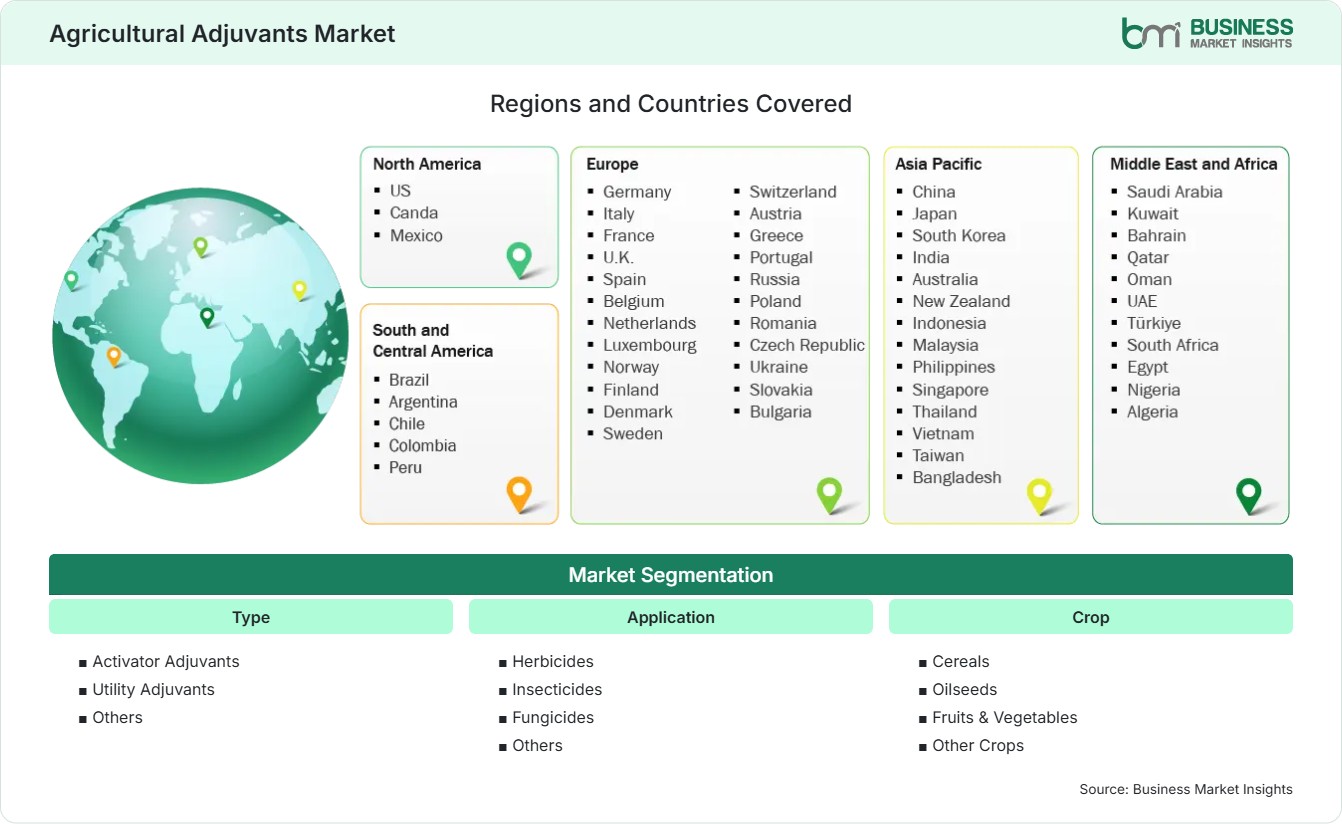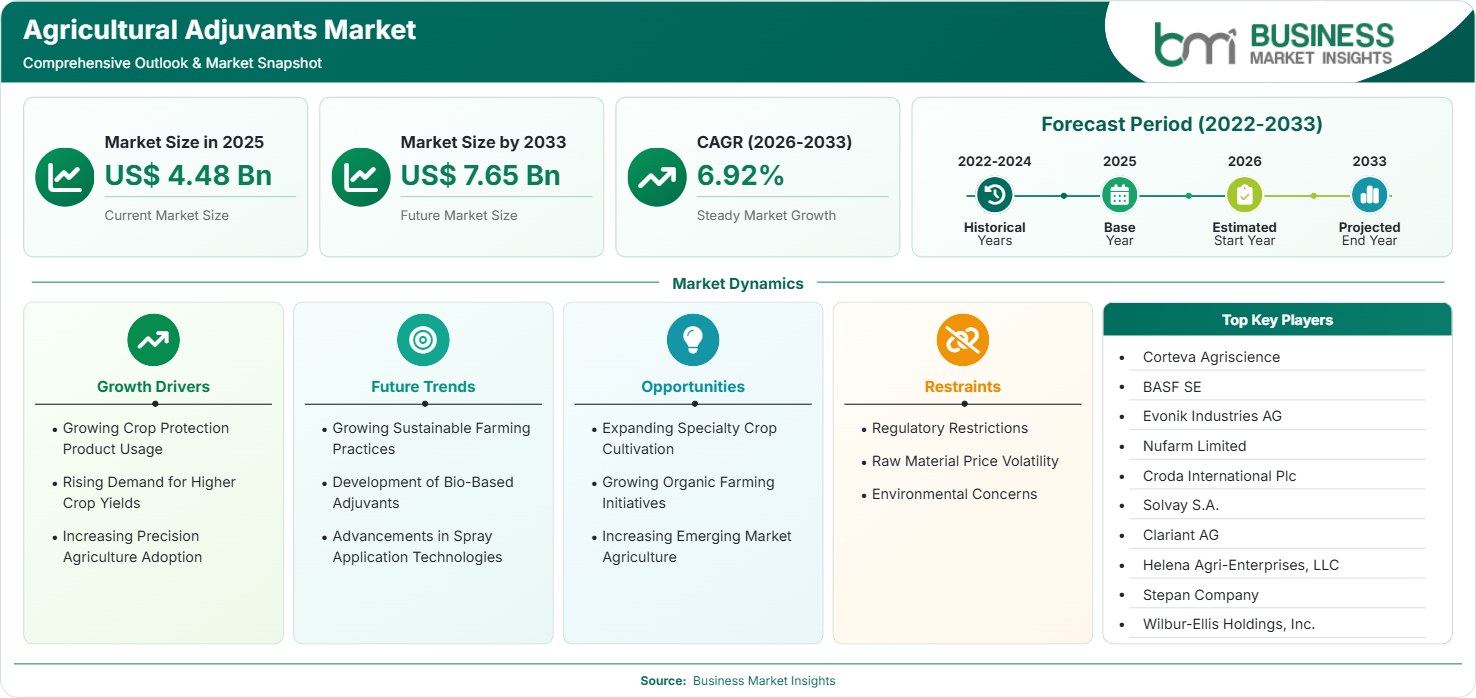
Agricultural Adjuvants Market Regional Highlights
North America Agricultural Adjuvants Market
North America accounted for a 32%–36% share in 2025 and is projected to grow at a CAGR of 6.50%–7.00% during 2026–2033. The region maintains a strong position due to advanced agricultural practices, high adoption of precision spraying, and extensive commercial farming operations. The Agricultural Adjuvants Market share is influenced by demand for efficient crop protection products, sustainable formulations, and improved application performance across the US and Canada. Growing regulatory emphasis on optimized chemical usage supports continued adoption.
- Large-scale farms across the US are adopting advanced spraying technologies that require specialized adjuvant solutions for improved pesticide coverage, absorption, and application consistency.
- Canada is increasing demand for crop protection enhancement products through commercial grain cultivation, sustainable farming practices, and improved agricultural productivity initiatives.
- Manufacturers are developing low-impact formulations aligned with environmental standards and grower requirements for efficient resource utilization and reduced chemical waste.
- Precision agriculture platforms are enabling data-driven application strategies, increasing demand for compatible adjuvant products across modern farming operations.
US Agricultural Adjuvants Market
The US accounted for a 27%–31% share in 2025 and is expected to expand at a CAGR of 6.60%–7.10% during 2026–2033. The country benefits from extensive agricultural acreage, advanced crop protection adoption, and strong presence of agrochemical manufacturers. The Agricultural Adjuvants Market growth is driven by demand for improved herbicide performance, sustainable farming practices, and precision application technologies supporting higher productivity.
- Major agricultural regions are increasing adoption of spray optimization solutions to improve herbicide effectiveness and minimize input losses.
- Corn, soybean, and specialty crop producers are integrating advanced adjuvant technologies into crop management programs for improved field performance.
- Research activities by agricultural companies are supporting development of next-generation formulations with enhanced compatibility and environmental benefits.
Europe Agricultural Adjuvants Market
Europe represented a 20%–24% share in 2025 and is projected to grow at a CAGR of 5.80%–6.40% during 2026–2033. The region is influenced by sustainable agriculture initiatives, regulatory requirements, and increasing adoption of precision farming practices. Germany, France, the UK, and Spain remain important markets due to their developed agricultural sectors. Demand is rising for efficient formulations that support reduced chemical usage and improved environmental compliance.
- Germany is expanding adoption of advanced agricultural inputs through sustainable farming programs and technology-driven crop management approaches.
- France continues supporting specialty crop production and precision agriculture adoption, increasing demand for application-enhancing additives.
- The UK market is influenced by regulatory focus on responsible pesticide use and improved agricultural efficiency.
- European farmers are adopting optimized spray technologies to improve coverage while reducing unnecessary chemical applications.
- Sustainability regulations are encouraging development of biodegradable and environmentally compatible adjuvant formulations.
Asia Pacific Agricultural Adjuvants Market
Asia Pacific accounted for a 28%–32% share in 2025 and is projected to expand at a CAGR of 7.20%–7.80% during 2026–2033. The region represents the fastest-growing market due to agricultural modernization, rising food demand, expanding commercial cultivation, and increasing adoption of advanced crop protection practices. The Agricultural Adjuvants Market is gaining momentum across China, India, Japan, and Southeast Asia as farmers seek improved agrochemical efficiency and higher crop productivity through optimized application technologies.
China is increasing adoption of advanced agricultural inputs through large-scale farming modernization programs, precision agriculture investments, and productivity enhancement initiatives.
India is witnessing rising demand due to expanding crop protection usage, government-supported agricultural technology adoption, and growing awareness among farmers regarding efficient chemical application.
Japan and South Korea are focusing on sustainable farming practices, encouraging development of specialized formulations with improved environmental compatibility.
Southeast Asian countries are adopting adjuvant technologies to improve plantation crop productivity and support commercial agriculture expansion.
Growing research collaborations between agrochemical companies and agricultural institutions are accelerating innovation in region-specific formulations.
Rest of World Agricultural Adjuvants Market
Latin America, Middle East, and Africa collectively represented a 12%–16% share in 2025 and are projected to grow at a CAGR of 6.80%–7.30% during 2026–2033. Agricultural expansion, export-oriented crop production, and increasing farm productivity initiatives are supporting adoption across Brazil, Argentina, South Africa, and Gulf countries. The market is benefiting from rising awareness of efficient input management and improved crop protection performance.
Latin American countries are adopting advanced crop protection practices across soybean, corn, and sugarcane cultivation, increasing demand for application-enhancing solutions.
Brazil remains a major contributor due to large agricultural exports, commercial farming operations, and increasing precision agriculture adoption.
Argentina is expanding usage through improved crop management practices and demand for optimized pesticide performance.
Middle Eastern countries are investing in agricultural technology solutions to improve productivity under water-limited farming conditions.
African markets are gradually adopting specialized agricultural inputs through government initiatives and international farming development programs.