Market Summary
Executive Summary and Global Market Analysis
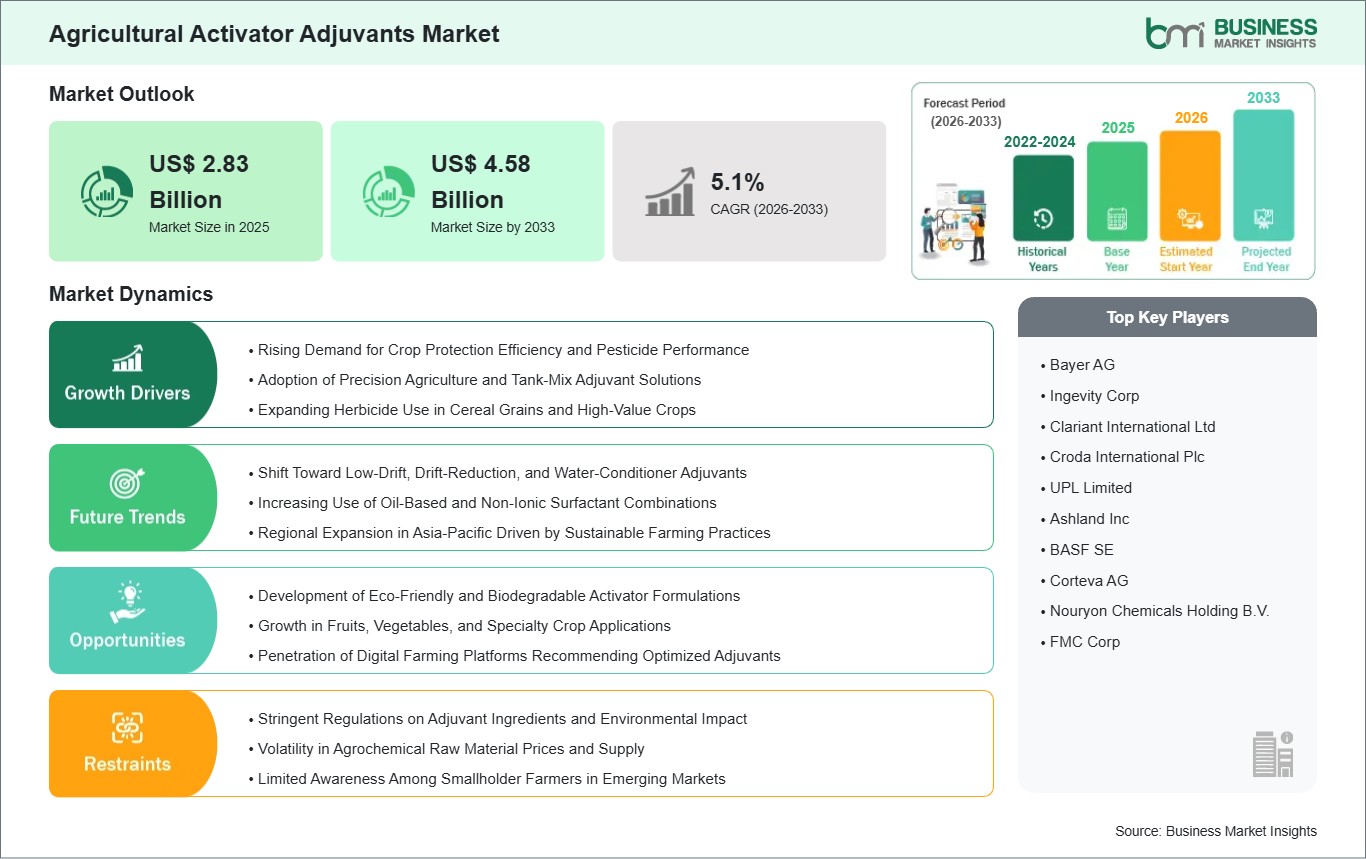
Agricultural activator adjuvants are important performance-enhancing inputs in the crop protection and agricultural chemicals sector as functional additives to enhance the effectiveness, reliability, and efficiency of herbicides, insecticides, fungicides, and plant growth regulators of various farm systems. They are mainly used to improve the performance of sprays through increasing wetting, spreading, adhesion, penetration, and retention of active ingredients in plant surfaces. Agricultural activator adjuvant is an essential formulation ingredient that enhances the biological efficacy by 2 to 3 times, diminishes spray drift and runoff, and enhances rainfastness, as well as uniformity of coverage, which in turn raises yield potential and input efficiency. They help in putting weeds and pests at bay in large-scale row crop farming, regardless of the climatic and soil conditions. They can be used in horticulture, in specialty crop production, to achieve optimal precision spraying and reduction of crop injury. In the contemporary system of sustainable agriculture, activator adjuvants will aid in the minimization of chemicals and increase the efficiency of resources and compatibility with integrated pest management systems. Its benefits are flexibility of formulation, ability to use a broad range of active ingredients, enhanced tank-mix stability, field performance, and flexibility to other application procedures and water characteristics. The strong forces behind market growth include increased food demand in the world, the use of high-efficiency crop protection products, the growth of commercial agriculture, and the rise in focus on improving the value of agricultural inputs. Further on, the development of bio-based and versatile adjuvants, surfactant chemistry innovation, and regulatory interest in low-toxicity and sustainable solutions to agriculture are also steadily driving growth in the market across the globe. The trends make agricultural activator adjuvants the only necessary tool in the transformation of the current, productivity-based, and environment-friendly farming.
Although there is a high growth potential, the agricultural activator adjuvants market encounters threats, which include fluctuations in prices of raw materials, regulatory inspections, and other environmental and ecological impacts, and variations in performance under varying field conditions. The adoption in developing areas may be restricted by compliance with the changing agrochemical regulations, the sensitivity of farmers to costs, and the substantial field validation requirements. Besides this, manufacturers have the added task of ensuring that there is uniform quality and compatibility between different formulations of crop protection by having close control of formulations. However, there are great opportunities in terms of creating bio-based adjuvants, precision farming technologies, and raising the necessity of sustainable and highly efficient inputs into crops. It can be deduced that the future of the global market of agricultural activator adjuvants will depend on sustained research and development, favorable regulatory policies of sustainable agriculture, and the process of further progression of smarter and more efficient crop protection systems.
Segment Analysis
Agricultural Activator Adjuvants Market Segmentation
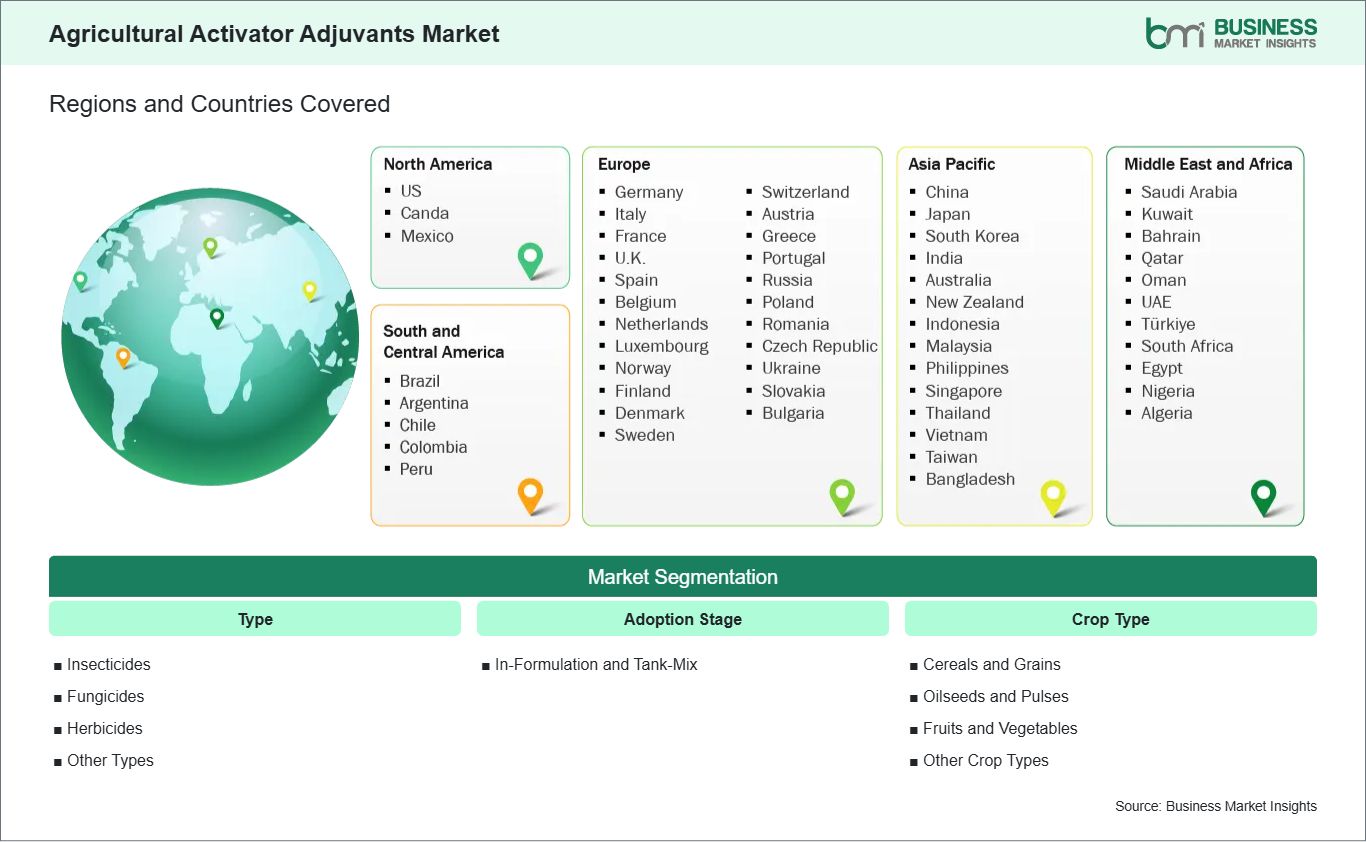
Key segments that contributed to the derivation of the agricultural activator adjuvants market analysis are type, adoption stage, and crop type.
- By type, the agricultural activator adjuvants market is divided into insecticides, fungicides, herbicides, and others. The herbicides segment dominated the market in 2025.
- By adoption stage, the market is divided into in-formulation and tank-mix. The in-formulation segment dominated the market in 2025.
- By crop type, the agricultural activator adjuvants market is categorized into cereals and grains, oilseeds and pulses, fruits and vegetables, and Others. The cereals and grains segmented is further sub-segmented into corn, wheat, rice, and others. The oilseeds and pulses segment is further sub-segmented into soybean, cotton, rapeseed/canola, peas and legumes, and others. The fruits and vegetables segment is further sub-segmented into tomatoes, chilies, onions, bananas, citrus fruits, berries, and others. The cereals and grains segment held the largest share of the market in 2025.
Market Forces
Agricultural Activator Adjuvants Market Drivers and Opportunities
Rising Adoption of Agricultural Activator Adjuvants in Crop Protection
The use of agricultural activator adjuvants is rapidly increasing because they can promote the effectiveness, coverage, and performance of herbicides, insecticides, fungicides, and plant growth regulators. Agricultural activator adjuvants have gained popularity in large-scale farming, horticulture, and specialty crop production. Increased crop production needs as a result of the necessity to streamline the use of inputs and minimize the use of chemicals have compelled farmers and agribusiness to use adjuvants that enhance the adhesion, penetration, and uniformity of spray. Activator adjuvants are used in the cereal production, oilseed, and fruit and vegetable industries to facilitate better control of pests and weeds in different climatic conditions to gain better yield in terms of production and lower the cost of operation. At the same time, the growth in the use of precision farming methods, mechanized spraying systems, and integrated pest management programs has further increased the need to use high-performance adjuvants to help in maintaining consistency and reliability in crop protection. Third-world economies, where agriculture is becoming more commercialized and the government is encouraging the use of modern farming practices, are also contributing to its adoption. As manufacturers are paying attention to formulation compatibility, increased efficacy, and cost-effective solutions, agricultural activator adjuvants are becoming increasingly popular as an indispensable part of contemporary agriculture.
Advancements in Bio-Based and Eco-Friendly Agricultural Adjuvants
Conventional adjuvants usually use synthetic surfactants and chemicals that might be of environmental and regulatory interest regarding the health of soil, contamination of the water supply, and ecosystem influence. With the increased pressure on sustainability requirements and stakeholders emphasizing environmentally friendly farming methods, the bio-based, biodegradable as well and low-toxicity adjuvants are gaining opportunities. Next-generation products provide similar or even greater spray performance, with minimal ecological footprint, which is part of the global agenda of encouraging sustainable agriculture and decreasing the use of dangerous chemicals. The growing use of organic cultivation, integrated pest management, and an approach to the circular economy is increasing the need for ecologically conscious adjuvant solutions. The agribusinesses and farmers are becoming more ready to invest in sustainable inputs to address the regulatory demands, certification, and the ESG goals. The bio-friendly adjuvants are being enhanced by innovations in green chemistry, enzyme-based formulations, and natural surfactants, which allow improving the performance, stability, and scalability of the latter. Firms that invest in research and development, sustainable products, and strategic alliances are in a good position to pursue the high-value opportunities in the market, enhance the credibility of the brand, and achieve long-term growth in a market that is becoming more environmentally conscious and high-performance crop protection solutions.
Size and Share Analysis
Agricultural Activator Adjuvants Market Size and Share Analysis
The Agricultural Activator Adjuvants market demonstrates steady growth, with size and share analysis revealing evolving trends and competitive positioning among key players. The report further examines subsegments categorized within type, adoption stage, and crop type, offering insights into their contribution to overall market performance.
Based on type, the herbicides segment dominates the agricultural activator adjuvants market. Herbicide adjuvants are used to improve the herbicides, which also lead to coverage on the spray, enhanced penetration to the leaf, and the efficiency of the active ingredient, and are therefore important in effective weed control in a wide variety of crops. Their capability to minimize drift, enhance rainfastness, and optimal the application of chemicals has positioned them as the choice of farmers and agribusinesses seeking greater crop yields at reduced costs of crop protection. Their compatibility with a very broad profusion of herbicide formulations and application methods has strengthened their usage in large-scale cereal, oilseed, fruit, and vegetable farming, making the herbicides segment the most important demand force in the agricultural activator adjuvants market.
Report Coverage
Agricultural Activator Adjuvants Market Report Coverage and Deliverables
The " Agricultural Activator Adjuvants Market Size and Forecast (2022–2033)" report provides a detailed analysis of the market covering below areas:
- Agricultural Activator Adjuvants market size and forecast at global, regional, and country levels for all the key market segments covered under the scope
- Agricultural Activator Adjuvants market trends, as well as market dynamics such as drivers, restraints, and key opportunities
- Agricultural Activator Adjuvants market analysis covering key market trends, global and regional framework, major players, regulations, and recent market developments
- Industry landscape and competition analysis covering market concentration, heat map analysis, prominent players, and recent developments for the agricultural activator adjuvants market
- Detailed company profiles, including SWOT analysis
Geographic Insights
Agricultural Activator Adjuvants Market Geographic Insights
The geographical scope of the Agricultural Activator Adjuvants market report is divided into five regions: North America, Asia Pacific, Europe, the Middle East & Africa, and South & Central America.
The Asia Pacific Agricultural Activator Adjuvants Market is segmented into China, Japan, South Korea, India, Australia, New Zealand, Indonesia, Malaysia, the Philippines, Singapore, Thailand, Vietnam, Taiwan, Bangladesh, and the Rest of the Asia Pacific. Asia Pacific has seen a surge in contemporary agriculture and crop protection programs, making the region one of the centres of the agricultural activator adjuvants market. This growth is also consolidated by increasing usage of high-efficiency crop protection products, mechanized spraying systems, and precision farming practices that improve the effectiveness, coverage, and yield of the application.
The continued commercialization of agriculture and the rising mechanization of farms, and the increasing popularity of sustainable farming and optimization of inputs, further reinforced the position of Asia Pacific as a large consumer of agricultural activator adjuvants as well as a producer. All these add to the strategic value of the region in the global crop protection value chain.
Industry Activity
Recent Developments
The Agricultural Activator Adjuvants market is evaluated by gathering qualitative and quantitative data post-primary and secondary research, which includes important corporate publications, association data, and databases. A few of the key developments in the agricultural activator adjuvants market are:
- In June 2025, Bayer and Kimitec launched two biological products, Ambition Complete Gen2 and Ambition Secure Gen2, from their partnership. Currently undergoing regulatory processes, these products will be part of Bayer's Crop Performance Enhancer portfolio, aimed at promoting regenerative agriculture. Ambition Complete Gen2 features a gel-based formulation that improves nutrient assimilation, stress resilience, and metabolic activation in plants for enhanced performance.
- In May 2024, Rizobacter BioSoluções introduced RizoPower, a new BioActivator derived from soy, corn, cotton, sugarcane, rice, and wheat. This product, intended for foliar application, features the company's exclusive UBP molecule, marking a significant innovation in the field of bioactivators.
Trust & Transparency
Research Methodology
The market analysis combines proprietary research with secondary data from government agencies, company disclosures, regulatory filings, industry databases and expert interviews. Market estimates are validated through data triangulation, cross-market benchmarking and analyst
review.
View Full Research Methodology
Key Sources Referred:
World Bank Global Trade IndicatorsEuropean Chemicals AgencyInternational Council of Chemical AssociationsInternational Monetary Fund (IMF)World Trade Organization (WTO)International Trade Administration (ITA)Company WebsitesCompany Annual ReportsCompany Investor Presentations