
Agricultural Spray Surfactants Market Outlook: Size, Share, Trends, Growth Analysis, Competitive Landscape & Forecast, 2026–2033

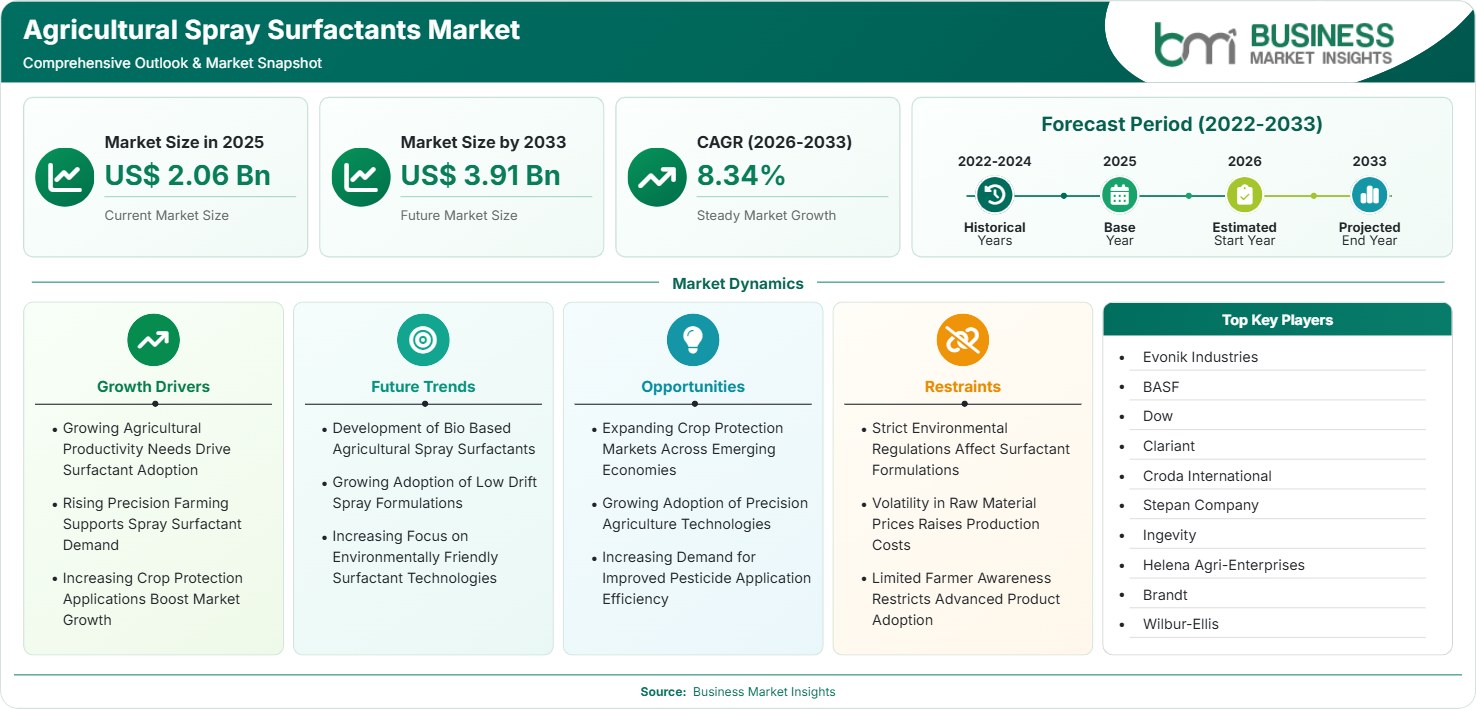
The Agricultural Spray Surfactants Market size was valued at US$ 2.06 billion in 2025 and is projected to reach US$ 3.91 billion by 2033, growing at a CAGR of 8.34% during 2026–2033, supported by crop protection demand, precision spraying, improved agrochemical performance, formulation innovation, and sustainable agriculture requirements.

Report Coverage
  • Type: Cationic, Non-Ionic, Anionic, Amphoteric
  • Application: Herbicides, Fungicides, Insecticides, Others
  • Crop Type: Cereals & Grains, Fruits & Vegetables, Others
US$ 2.06 Bn Market size in 2025
US$ 3.91 Bn Market Size by 2033
8.34% CAGR, 2026 - 2033
2026-2033 Forecast Period

01 AI Overview

Agricultural Spray Surfactants Market Summary

  • North America Region: North America holds a 40%–44% share in 2025 and is projected to grow at a 7.2%–8.0% CAGR through 2033, supported by intensive crop protection, precision agriculture, sophisticated formulation practices, established distribution, and demand for efficient spray performance.
  • Fastest Growing Region: Asia Pacific holds a 25%–29% share in 2025 and is projected to grow at a 9.0%–10.0% CAGR through 2033, supported by expanding crop production, rising agrochemical use, farm mechanization, precision agriculture, and increasing demand for efficient pesticide application.
  • Leading Segment: Non-Ionic holds a 34%–38% share in 2025 and is projected to grow at an 8.2%–9.0% CAGR through 2033, supported by formulation compatibility, spreading performance, low interaction with active ingredients, and broad herbicide applications.
  • High Growth Segment: Herbicides hold a 45%–49% Agricultural Spray Surfactants Market share in 2025 and are projected to grow at a 9.0%–9.8% CAGR through 2033, supported by weed-management requirements, improved spray deposition, precision application, resistance management, and demand for efficient crop protection.
  • Key Market Opportunity: Formulation optimization, precision spraying, bio-based chemistry, emerging agricultural economies, and application-specific surfactants create attractive opportunities for suppliers developing efficient, compliant, and differentiated crop protection solutions.
  • Major Market Players: Evonik Industries AG; BASF SE; Dow Inc.; Clariant AG; Croda International Plc; Stepan Company; Ingevity Corporation; Helena Agri-Enterprises, LLC; Brandt Consolidated, Inc.; Wilbur-Ellis Holdings, Inc.
02 Strategic Insights

Agricultural Spray Surfactants Market: Strategic Insights

Agricultural Spray Surfactants Market Strategic Framework
FREE PDF
Request your free sample
Request free sample
03 Stakeholder View

Key Takeaways

  • Value creation increasingly depends on formulation performance, technical support, application knowledge, and the ability to integrate surfactants into complete crop protection programs.
  • Herbicide-focused formulations provide attractive expansion potential because weed control remains a recurring agronomic requirement across broad-acre and specialty crops.
  • Product innovation is moving toward lower-impact chemistries, improved biodegradability, formulation compatibility, and performance under variable water and weather conditions.
  • Asia Pacific offers an attractive expansion platform as agricultural modernization increases demand for efficient application technologies and higher-performing crop protection inputs.
  • Suppliers can strengthen competitive positions through regional manufacturing, formulation partnerships, distributor development, and closer collaboration with agrochemical formulators.
  • Portfolio diversification toward precision application, biological crop protection, and environmentally compatible formulations can improve resilience as regulatory requirements evolve.
04 Geographic Outlook

Agricultural Spray Surfactants Market Regional Highlights

North America Agricultural Spray Surfactants Market

North America holds a 40%–44% share in 2025 and is projected to grow at a 7.2%–8.0% CAGR through 2033. Demand is supported by intensive commercial farming, established crop protection practices, formulation sophistication, and growing emphasis on application efficiency.

  • The United States remains the principal regional demand center, supported by broad-acre farming, established crop protection programs, precision application technologies, and sophisticated agricultural input distribution networks.
  • Canada contributes through cereal, oilseed, specialty crop, and pulse production, where weather variability and crop protection requirements encourage effective spray coverage and formulation performance.
  • Precision agriculture is strengthening demand for application-specific surfactants that support controlled droplet behavior, improved deposition, reduced wastage, and more consistent performance across variable field conditions.
  • Sustainable formulation development is becoming increasingly important as manufacturers and growers seek products balancing application effectiveness, environmental compatibility, and evolving regulatory expectations.

US Agricultural Spray Surfactants Market

The U.S. represents approximately 82%–86% of North American demand in 2025 and is projected to grow at a 7.3%–8.1% CAGR through 2033. Demand remains supported by large-scale agriculture, sophisticated spraying systems, and established agrochemical distribution.

  • Commercial corn, soybean, wheat, cotton, and specialty crop production creates recurring demand for surfactants that improve pesticide spreading, retention, penetration, and application consistency.
  • Precision sprayers, variable-rate application, and digital farm management are increasing demand for formulations designed around specific spray conditions and active-ingredient requirements.
  • Established agricultural retailers and distributors provide manufacturers with broad market access while enabling technical recommendations that influence product selection at the farm level.

Europe Agricultural Spray Surfactants Market

Europe holds a 19%–22% share in 2025 and is projected to grow at a 6.8%–7.6% CAGR through 2033. Germany, France, Italy, Spain, and the United Kingdom remain important markets, while Central Europe offers stronger expansion potential.

  • France and Germany provide substantial demand through extensive cereal, oilseed, specialty crop, and horticultural production requiring efficient crop protection application.
  • Spain and Italy offer strong opportunities in fruits, vegetables, vineyards, and other specialty crops where coverage, wetting, and deposition directly influence treatment performance.
  • Poland and neighboring Central European markets provide higher-growth opportunities as farm modernization, mechanization, and professional crop protection practices continue expanding.
  • Regulatory pressure encourages suppliers to develop biodegradable, lower-impact, and application-efficient formulations capable of maintaining performance while meeting increasingly demanding environmental expectations.

Asia Pacific Agricultural Spray Surfactants Market

Asia Pacific holds a 25%–29% share in 2025 and is projected to grow at a 9.0%–10.0% CAGR through 2033. China, India, Japan, Australia, and Southeast Asia represent major demand centers, with India and Southeast Asia offering strong expansion potential.

  • China combines large agricultural output with extensive crop protection requirements, supporting demand for formulation additives that improve application efficiency across cereals, vegetables, fruits, and cash crops.
  • India provides strong expansion potential as farm mechanization, commercial crop production, precision agriculture, and organized agricultural input distribution increase across major growing regions.
  • Japan represents a mature market where sophisticated farming practices, specialty crops, formulation quality, and application precision support demand for technically differentiated surfactants.
  • Indonesia, Thailand, and Vietnam provide attractive opportunities as commercial agriculture, plantation crops, horticulture, and modern crop protection practices expand across increasingly organized agricultural value chains.

Rest of World Agricultural Spray Surfactants Market

South and Central America hold a significant portion of Rest of World demand, supported by commercial agriculture, plantation crops, and expanding crop protection requirements. Brazil and Argentina provide strong opportunities through soybean, corn, sugarcane, and other large-scale crop production.

The Middle East and Africa offer emerging opportunities as agricultural intensification, irrigation development, horticulture, and food-security programs increase demand for efficient crop protection inputs. Brazil and South Africa remain important markets, while selected Gulf and African economies provide higher-value specialty opportunities.

  • Brazil benefits from large-scale agriculture and intensive crop protection practices, creating demand for surfactants that improve spray performance across broad-acre and plantation applications.
  • Argentina provides opportunities across soybean, corn, wheat, and other crops where formulation efficiency and reliable spray deposition support crop protection outcomes.
  • South Africa offers demand through commercial farming, horticulture, and established agricultural input networks, with specialized crops supporting differentiated formulation requirements.
  • Middle Eastern markets increasingly emphasize efficient agricultural water and input use, creating opportunities for surfactants that improve spray coverage under demanding cultivation conditions.
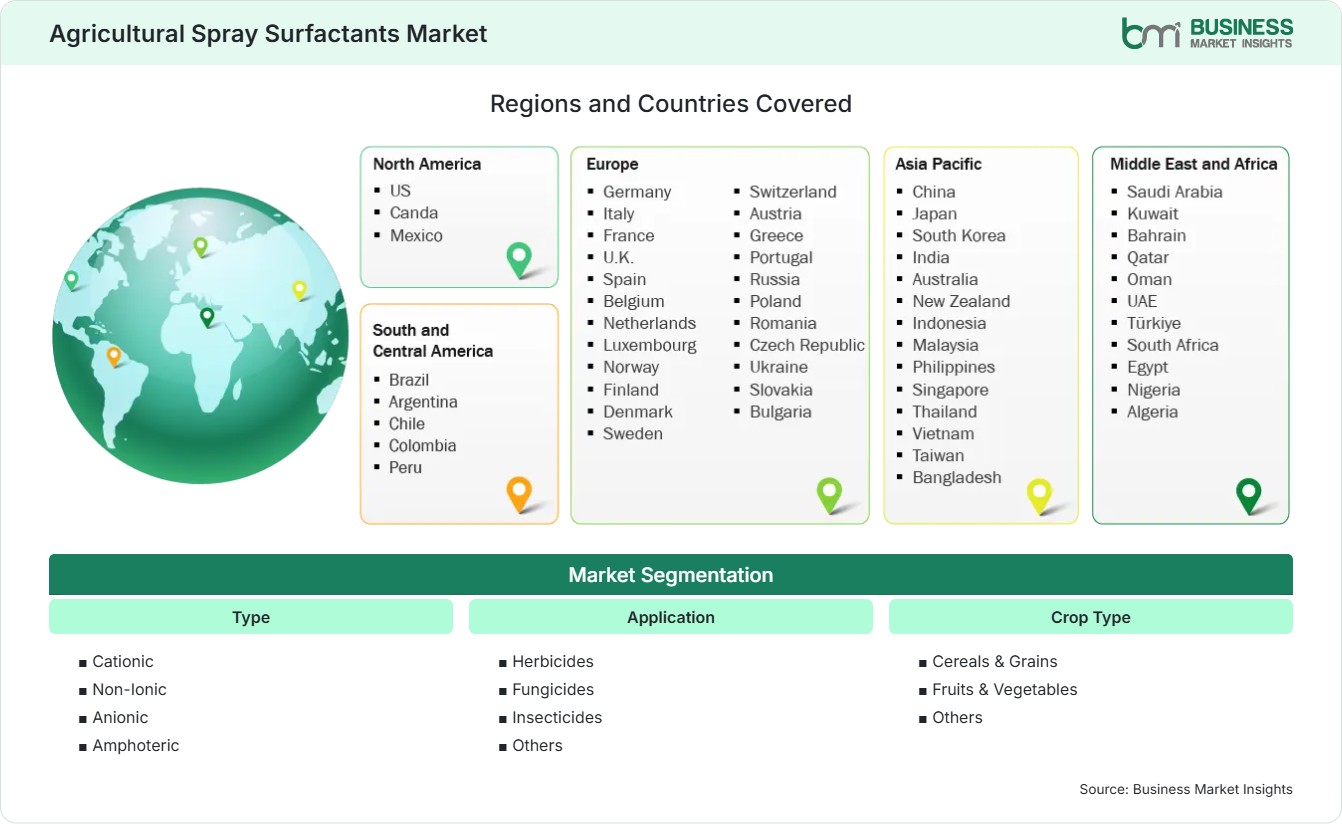
Global Market Geography
FREE PDF
Request your free sample
Request free sample
05 Segment Analysis

Agricultural Spray Surfactants Market Segmentation

Type

Non-Ionic holds a 34%–38% share in 2025 and is projected to grow at an 8.2%–9.0% CAGR through 2033. Its broad compatibility, formulation flexibility, and strong performance across crop protection applications support segment leadership and sustained adoption.

  • Cationic: Cationic formulations provide specialized surface interactions and wetting characteristics, supporting selected crop protection applications where targeted adhesion and formulation behavior justify their use.
  • Non-Ionic: Non-ionic surfactants provide broad formulation compatibility, effective wetting, spreading, and penetration, supporting extensive use across herbicides, fungicides, and insecticide formulations.
  • Anionic: Anionic surfactants support emulsification, dispersion, and wetting requirements in selected agricultural formulations, with adoption influenced by compatibility, formulation stability, and application performance.
  • Amphoteric: Amphoteric surfactants offer formulation flexibility across varying chemical environments and can support specialty agricultural applications where mildness, compatibility, and performance balance are important.

Application

Herbicides hold a 45%–49% share in 2025 and are projected to grow at a 9.0%–9.8% CAGR through 2033. Weed-management requirements, formulation optimization, precision spraying, and improved deposition continue supporting the application segment.

  • Herbicides: Herbicide formulations use surfactants to improve spreading, wetting, retention, and active-ingredient delivery, supporting effective weed control across broad-acre and specialty crop systems.
  • Fungicides: Fungicide applications benefit from improved surface coverage and retention, particularly where disease control depends on consistent deposition across leaves, stems, fruits, and complex crop canopies.
  • Insecticides: Insecticide formulations use surfactants to improve coverage and contact across plant surfaces, supporting treatment consistency where pests occupy difficult-to-reach foliage or crop structures.

Crop Type

Cereals & Grains represent the leading crop category, supported by extensive cultivated acreage and recurring weed, disease, and insect-management requirements. Fruits & Vegetables provide stronger formulation differentiation because crop surfaces and application conditions vary substantially.

  • Cereals & Grains: Large-scale cereal and grain production creates sustained demand for efficient spray adjuvants, particularly where herbicide and fungicide programs require consistent coverage across extensive cultivated acreage.
  • Fruits & Vegetables: Specialty crops require precise wetting, spreading, and deposition because complex foliage and sensitive surfaces can influence pesticide effectiveness, creating opportunities for differentiated surfactant formulations.
06 Market Forces

Agricultural Spray Surfactants Market Dynamics

Key Market Drivers

Growing Agricultural Productivity Needs Drive Surfactant Applications

There is increasing pressure for increased productivity on farms, and this is pushing farmers to maximize each and every use of crop protection products. Surfactants increase the distribution of the formulation on plant leaves as well as its retention. The relevance of surfactants is especially significant when there are variable weather conditions, problematic leaves, restricted time for application, and increasingly complicated crop protection programs. Companies are developing formulations based on the unique active ingredient and crop requirements. The resulting Agricultural Spray Surfactants Market trend favors performance-oriented formulations rather than undifferentiated additives.

Rising Precision Farming Supports Spray Surfactant Demand

Precision farming promotes the use of better-controlled crop protection input applications with the help of enhanced field surveillance, variable rate technology, automated spraying, and farm management through data. All of these factors make the formulations more crucial when it comes to providing better coverage at targeted rates of application. Spray surfactants may assist in achieving this goal as they help to improve the spreading, retention, penetration, and deposition of droplets on plant leaves. The Agricultural Spray Surfactants Market growth is driven by growing adoption of precision agriculture, increased need for efficient spraying, and better accuracy of application.

Increasing Crop Protection Applications Boost Market Demand

The success of crop protection is reliant on efficient use despite evolving challenges posed by pests, diseases, and weeds. Surfactants contribute to the efficiency of many spray formulations through increased contact of their active ingredients with the plant surface. The contribution of surfactants is critical, especially when farmers need consistent performance despite the use of low spray volumes or targeting. Increasingly complex formulation is also driving closer collaboration among those who manufacture the active ingredients, formulators, and adjuvants. Such an environment fosters the creation of application-specific formulations that deal with compatibility, coverage, retention, and environmental concerns while not exclusively increasing the amount of pesticide used.

Key Market Opportunities

Expanding Crop Protection Markets Across Emerging Economies

The growing markets for crop protection in new agricultural economies provide avenues for surfactant companies to improve their market penetration by formulating products locally and establishing partnership programs in distribution. Increased farm commercialization, increased usage of quality seeds, higher mechanization levels, and increased demand for crop efficiency are increasing the requirement for better spray systems. The Agricultural Spray Surfactants Market forecast stands to gain from the opportunity presented by growers moving towards a more systematic approach to crop protection. Suppliers can gain access to the market by providing products that are suited for local crops, weather conditions, water quality, and common pesticide formulas.

Growing Adoption of Precision Agriculture Technologies

The advent of precision farming is offering possibilities of collaboration from surfactant suppliers, apart from being merely chemical suppliers. The spray optimization systems, automated spraying systems, drones, digital agronomy, and variable rate technologies all need formulations that would be able to suit the controlled application system. There could be differentiating possibilities of formulations based on the areas of droplet control, deposition, compatibility, and reduction of spraying wastage. Collaboration with equipment companies, crop protection formulators, and agritech can yield integrated products instead of single-use additives. This strategy can help with customer retention, along with creating avenues for premium formulations for different spraying conditions and crop management.

Increasing Demand for Improved Pesticide Application Efficiency

An increase in pesticide application efficiency means that there is an opportunity for better formulation to improve coverage even without having the same increase in active ingredient. Farmers are evaluating products by how well they perform in the fields, their ease of application, their safety, and compatibility with current spray program practices. This is something that suppliers can capitalize on using chemistry formulated to suit the needs of water hardness, temperature, humidity, leaf structure, and the active ingredient itself. Suppliers can also try to formulate pesticides with biological crop protection products. Technical validation can be important for suppliers to differentiate themselves in today's increasingly complex agricultural inputs market.

Market Restraints and Challenges

Strict Environmental Regulations Affect Surfactant Formulations

Factor: The environmental agencies are increasing their focus on chemical persistence, aquatic toxicity, biodegradability, employee exposure, and other aspects of their environmental impact. Impact: The product formulation team will be faced with higher testing costs, lengthy qualification periods, and possible limitations regarding the choice of chemistries used. This may increase the cost of developing new formulations or reformulating existing products. In order to meet this challenge, suppliers will have to maintain regulatory compliance while researching alternative chemistries, biodegradability, and field application performance.

Volatility in Raw Material Prices Raises Production Costs

Factor: The production process of the surfactant industry depends on various inputs such as chemicals, special raw materials, energy, transportation, and packaging, which can be affected by changes in price levels due to the dynamic nature of the markets. Impact: Changes in input prices can affect the profit margin of the producers, the pricing strategies of the consumers, and uncertainty about future sourcing. There are various ways that suppliers can reduce risk exposure through supplier diversification, production plants, inventory management, formula optimization, and a proper procurement process. However, the price-sensitive agricultural consumers will not agree to price increases.

07 Company Analysis

Competitive Landscape

The competitive environment combines specialty chemical manufacturers, agricultural input suppliers, formulation specialists, and distribution-oriented businesses. Agricultural Spray Surfactants Market analysis shows that differentiation centers on formulation expertise, crop-specific performance, regulatory capabilities, product breadth, technical support, and agricultural distribution reach.

Company Name

Overview

Products and Services relevant to this market

Evonik Industries AG

Specialty chemicals company with broad formulation expertise and capabilities serving agricultural and industrial applications.

Specialty surfactants, formulation additives, wetting agents, dispersants, and chemistry supporting crop protection formulations.

BASF SE

Diversified chemical and agricultural solutions company with extensive crop protection formulation capabilities and global agricultural relationships.

Agricultural surfactants, formulation additives, crop protection technologies, adjuvant solutions, and application-oriented chemistry.

Dow Inc.

Global materials and chemicals supplier with advanced formulation technologies serving agricultural and specialty chemical applications.

Surfactants, performance additives, formulation ingredients, dispersants, wetting agents, and agricultural chemistry solutions.

Clariant AG

Specialty chemicals manufacturer focused on high-performance ingredients, sustainable chemistry, and application-specific formulation technologies.

Agricultural surfactants, wetting agents, emulsifiers, dispersants, and specialty additives for crop protection formulations.

Croda International Plc

Specialty chemicals producer emphasizing high-performance ingredients, sustainable chemistry, and formulation expertise across agricultural applications.

Crop protection adjuvants, surfactants, emulsifiers, wetting agents, and formulation technologies for agricultural products.

Stepan Company

Specialty chemical manufacturer with established surfactant expertise and application-focused formulation capabilities.

Agricultural surfactants, emulsifiers, wetting agents, dispersants, and formulation ingredients for crop protection products.

Ingevity Corporation

Specialty chemicals company developing performance materials and chemical solutions for industrial and agricultural applications.

Specialty surfactants, formulation additives, dispersants, and performance chemistry supporting agricultural applications.

Helena Agri-Enterprises, LLC

Agricultural input provider combining product distribution, formulation, application technology, agronomic services, and precision agriculture capabilities.

Crop protection inputs, adjuvants, surfactant products, formulation support, application services, and precision agriculture solutions.

Brandt Consolidated, Inc.

Agricultural solutions provider with expertise in crop inputs, adjuvants, plant nutrition, and application technologies.

Spray adjuvants, surfactants, crop protection additives, formulation products, and application-support technologies.

Wilbur-Ellis Holdings, Inc.

Agricultural solutions company serving growers through crop protection products, distribution, formulation, and agronomic services.

Agricultural adjuvants, surfactants, crop protection products, formulation solutions, and technical agronomy services.

10 Trust & Transparency

Research Methodology

The market analysis combines proprietary research with secondary data from government agencies, company disclosures, regulatory filings, industry databases and expert interviews. Market estimates are validated through data triangulation, cross-market benchmarking and analyst review.

View Full Research Methodology

11 Questions Answered

Frequently Asked Questions

What does the Agricultural Spray Surfactants Market report indicate about future competition?

The report indicates that competition will increasingly focus on formulation performance, regulatory readiness, sustainability, crop-specific applications, technical support, and distribution capabilities. Suppliers combining specialty chemistry with agricultural application expertise can strengthen customer relationships while addressing the industry's shift toward efficient, targeted, and environmentally compatible crop protection.

Why are emerging agricultural markets creating new opportunities for surfactant suppliers?

Emerging markets are adopting mechanized farming, professional crop protection practices, precision application, and organized agricultural distribution. These developments increase the need for reliable spray performance across diverse crops and environmental conditions, creating opportunities for suppliers offering localized formulations, technical support, competitive pricing, and dependable regional supply.

How are advanced formulation technologies influencing surfactant adoption?

Advanced formulation technologies are improving compatibility, wetting, spreading, retention, and active-ingredient delivery. Manufacturers increasingly design surfactants around specific crop protection chemistries, water conditions, application equipment, and crop surfaces, enabling more targeted solutions and helping growers improve consistency without relying solely on higher spray volumes.

Which applications present the strongest opportunity in the market?

Herbicide applications offer a strong opportunity because weed management remains a recurring crop protection requirement across broad-acre farming and specialty agriculture. Fungicide and insecticide applications also provide opportunities where improved coverage, retention, and deposition can strengthen treatment consistency and support more efficient crop protection programs.

What factors are improving Agricultural Spray Surfactants Market return on investment?

Improved pesticide performance, precision application, better spray coverage, formulation optimization, and demand for efficient crop protection are strengthening commercial value. Suppliers can improve returns by developing differentiated formulations, supporting technical application programs, and targeting specialty crops where performance requirements justify higher-value products.

Access the Full Agricultural Spray Surfactants Market Report

Get segment-level forecasts, regional estimates, competitive benchmarking, company profiles and downloadable Excel datasets.

Access the full Agricultural Spray Surfactants Market Report
350 pages PDF & Excel | 2026-08-19