
Silicone Surfactants Market Outlook: Size, Share, Trends, Growth Analysis, Competitive Landscape & Forecast, 2026-2033

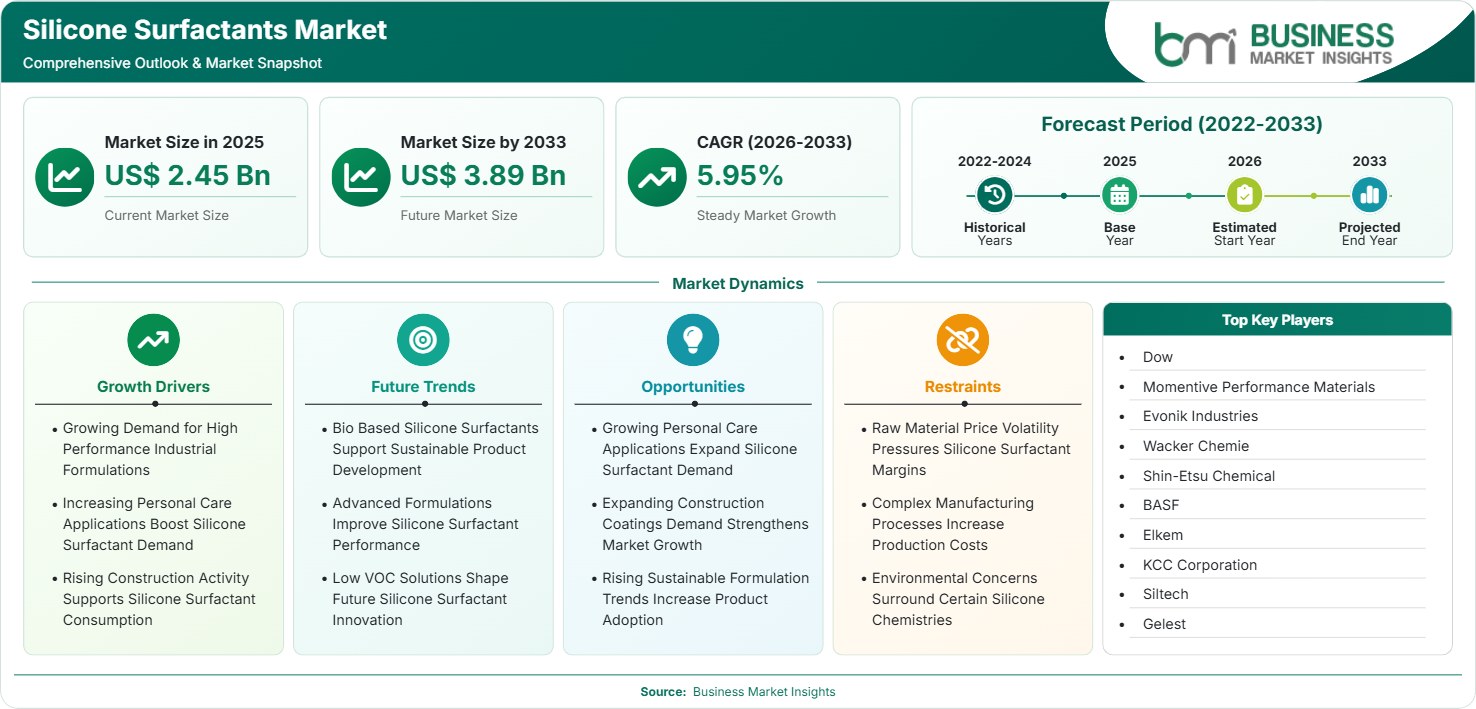
The Silicone Surfactants Market size was valued at US$ 2.45 billion in 2025 and is projected to reach US$ 3.89 billion by 2033, growing at a CAGR of 5.95% during 2026–2033, driven by demand for high-performance formulations, construction activity, personal care applications, and sustainable product development.

Report Coverage
  • Application: Emulsifiers, Foaming Agents, Solubilizers, Others
  • End-Use: Refrigeration, Construction, Paints & Coatings, Personal Care, Others
US$ 2.45 Bn Market size in 2025
US$ 3.89 Bn Market Size by 2033
5.95% CAGR, 2026 - 2033
2026-2033 Forecast Period

AI Overview

Silicone Surfactants Market Summary

  • North America Region: North America holds a 28%–32% share in 2025, growing at a CAGR of 5.6%–6.2% during 2026–2033, supported by advanced coatings, construction chemicals, personal care innovation, formulation upgrades, and demand for high-performance surfactant technologies. The U.S. Silicone Surfactants Market grows at a 5.7%–6.3% CAGR, supported by construction coatings, personal care innovation, and industrial formulation demand.
  • Fastest Growing Region: Asia Pacific holds a 34%–38% share in 2025, growing at a CAGR of 6.4%–7.1% during 2026–2033, driven by expanding construction, manufacturing, personal care consumption, coatings production, and investment in advanced formulation capabilities.
  • Leading Segment: Emulsifiers hold a 32%–36% share in 2025, growing at a CAGR of 5.8%–6.4% during 2026–2033, supported by stable demand for formulation stability, dispersion control, processing efficiency, and improved product performance across industrial applications.
  • High Growth Segment: Personal Care holds a 24%–28% share in 2025, growing at a CAGR of 6.2%–6.9% during 2026–2033, driven by premium formulations, sensory performance, conditioning benefits, multifunctional products, and consumer preference for sophisticated personal care solutions.
  • Key Market Opportunity: Sustainable formulations, advanced personal care products, energy-efficient construction materials, and innovative coatings create opportunities for silicone surfactant suppliers to develop differentiated, lower-impact, high-performance formulation technologies.
  • Major Market Players: Dow, Momentive Performance Materials, Evonik Industries, Wacker Chemie, Shin-Etsu Chemical, BASF, Elkem, KCC Corporation, Siltech, and Gelest.
Strategic Insights

Silicone Surfactants Market: Strategic Insights

Silicone Surfactants Market Strategic Framework
FREE PDF
Request your free sample
Request free sample
Stakeholder View

Key Takeaways

  • The value chain extends from silicone intermediates and specialty chemical manufacturing to formulation development, distributors, and industrial end users. Suppliers with integrated production and technical support can protect margins and improve customer retention.
  • Personal care and advanced coatings offer attractive upside because formulators increasingly require ingredients that improve spreading, stabilization, surface control, texture, and processing efficiency.
  • Product development is shifting toward multifunctional silicone surfactants that provide multiple formulation benefits, reducing the need for separate additives while improving performance consistency.
  • Asia Pacific provides a compelling expansion opportunity due to its construction activity, manufacturing base, growing personal care consumption, and increasing demand for specialty chemical formulations.
  • Industry participants are likely to prioritize capacity optimization, application laboratories, technical service networks, and strategic partnerships that improve access to high-value customers and emerging end-use markets.
  • Sustainability is becoming a formulation consideration alongside performance, encouraging suppliers to develop products that support resource efficiency, lower processing requirements, and improved environmental profiles.
Geographic Outlook

Silicone Surfactants Market Regional Highlights

North America Silicone Surfactants Market

North America accounts for a 28%–32% share in 2025 and is projected to expand at a CAGR of 5.6%–6.2% during 2026–2033. The region benefits from mature specialty chemical manufacturing, advanced construction materials, sophisticated coatings, and premium personal care formulations. The U.S. represents the leading regional Silicone Surfactants Market, supported by established industrial demand and technical innovation. Canada contributes through construction and specialty formulation applications, while regional suppliers benefit from strong customer relationships and established distribution infrastructure across industrial and consumer markets.

  • Advanced coatings manufacturers increasingly use silicone surfactants to improve spreading, surface appearance, foam control, and formulation consistency across demanding applications.
  • Construction activity supports demand for specialized additives used in insulation materials, sealants, coatings, and other performance-oriented building formulations.
  • Personal care formulators increasingly seek ingredients capable of delivering sensory benefits, improved application characteristics, and multifunctional performance within sophisticated product formulations.
  • The United States remains the leading country, with a 5.7%–6.3% CAGR, while Canada provides additional opportunities through construction materials and specialty chemical applications.

US Silicone Surfactants Market

The U.S. holds a 22%–26% Silicone Surfactants Market share of the global market in 2025 and is projected to grow at a CAGR of 5.7%–6.3% during 2026–2033. Demand is supported by construction chemicals, paints and coatings, personal care, and specialized industrial formulations. Manufacturers benefit from established specialty chemical infrastructure and strong research capabilities. The market also favors premium additives capable of delivering measurable performance improvements. Growth opportunities are emerging through sustainable formulation development, advanced construction products, and multifunctional ingredients designed to meet changing technical requirements across multiple applications.

  • Construction and coatings remain important demand centers as manufacturers seek improved surface quality, processing control, durability, and formulation efficiency.
  • Personal care innovation supports premium ingredient demand, particularly for products requiring enhanced sensory characteristics, spreading, conditioning, and formulation stability.
  • Strong research infrastructure encourages development of application-specific silicone surfactants that address performance requirements while supporting more efficient formulation design.

Europe Silicone Surfactants Market

Europe represents a 24%–28% share in 2025 and is expected to grow at a CAGR of 5.1%–5.8% during 2026–2033. Germany, France, Italy, and the United Kingdom remain important markets, supported by specialty chemicals, construction materials, coatings, and personal care manufacturing. Germany leads regional demand, while France and the United Kingdom provide opportunities in cosmetics and advanced formulations. Italy benefits from construction and industrial applications. Sustainability priorities and regulatory requirements are encouraging suppliers to improve product efficiency and develop formulations aligned with evolving environmental expectations.

  • Germany remains a leading country, supported by specialty chemical manufacturing, construction materials, industrial coatings, and strong technical expertise.
  • France and the United Kingdom benefit from sophisticated personal care and cosmetic industries requiring advanced sensory and formulation performance.
  • Italy offers opportunities linked to construction activity, coatings, and industrial manufacturing, with specialized additives supporting improved product performance.
  • Sustainability considerations are influencing formulation development, encouraging efficient ingredients and technologies that support lower resource consumption and improved environmental performance.

Asia Pacific Silicone Surfactants Market

Asia Pacific holds a 34%–38% share in 2025 and is forecast to grow at a CAGR of 6.4%–7.1% during 2026–2033, making it the fastest-growing regional market. China leads regional demand, supported by manufacturing, construction, coatings, and personal care production. India represents a high-growth market as industrialization, infrastructure development, and consumer product manufacturing expand. Japan and South Korea contribute through advanced chemical manufacturing and technology-intensive formulations. Regional growth is reinforced by increasing specialty chemical consumption and investment in domestic production capabilities.

  • China remains the leading country, supported by large construction, manufacturing, coatings, and personal care industries requiring specialized formulation ingredients.
  • India is a high-growth market, with expanding infrastructure, manufacturing capacity, consumer markets, and increasing adoption of specialty chemical technologies.
  • Japan and South Korea provide opportunities through advanced manufacturing, technical innovation, and sophisticated industrial and consumer formulation applications.
  • Rising local production capacity can improve supply availability and shorten delivery cycles, supporting broader adoption among regional formulators and manufacturers.

Rest of World Silicone Surfactants Market

South and Central America account for a smaller but developing portion of global demand, supported by construction, coatings, personal care, and industrial applications. Brazil leads regional consumption, while Mexico benefits from manufacturing and construction activity. The region is projected to grow at a CAGR of 4.8%–5.5% during 2026–2033. Adoption depends on industrial investment, economic conditions, and access to specialty chemical distribution networks serving local formulators and manufacturers.

The Middle East and Africa provide emerging opportunities through construction projects, infrastructure development, coatings, and consumer product manufacturing. Saudi Arabia and the United Arab Emirates represent leading markets, while South Africa offers opportunities in industrial and consumer applications. The region is expected to expand at a CAGR of 5.0%–5.7% during 2026–2033 as investment in construction and manufacturing supports specialty formulation demand.

  • Brazil leads South and Central America, supported by construction materials, coatings, personal care production, and established industrial chemical distribution networks.
  • Mexico benefits from manufacturing activity and construction demand, creating opportunities for suppliers serving industrial formulations and performance-oriented coatings.
  • Saudi Arabia and the United Arab Emirates lead Middle Eastern demand through construction and infrastructure investments requiring advanced materials and specialized formulations.
  • South Africa provides an important African market, with demand supported by industrial applications, construction activity, and consumer product manufacturing.
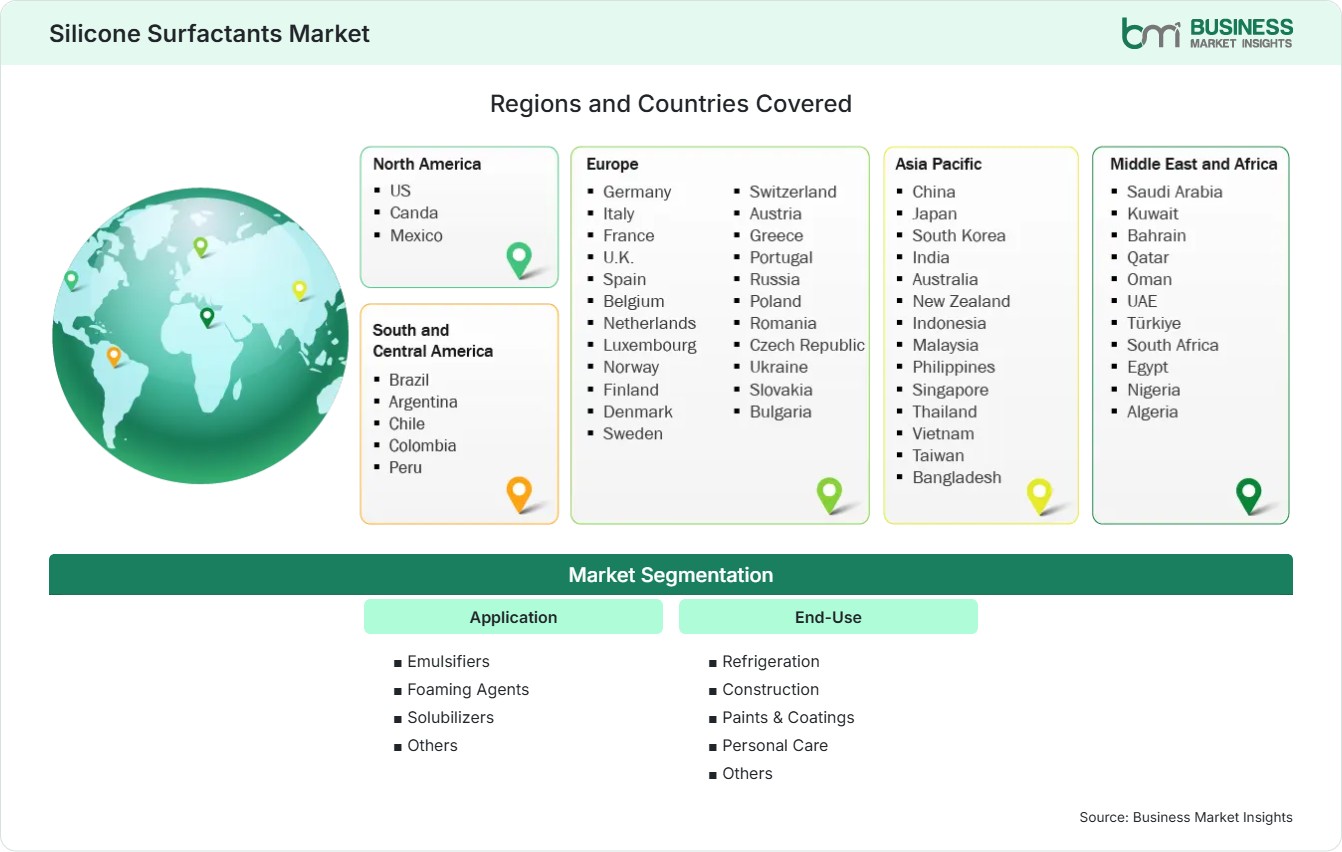
Global Market Geography
FREE PDF
Request your free sample
Request free sample
Segment Analysis

Silicone Surfactants Market Segmentation

Application

The Application segment is led by Emulsifiers, which account for a 32%–36% share in 2025 and are projected to grow at a CAGR of 5.8%–6.4% during 2026–2033. Demand is supported by formulation stability, dispersion control, and processing requirements. The Silicone Surfactants Market scope extends across multiple applications as manufacturers seek specialized additives that improve performance and consistency.

  • Emulsifiers: Silicone-based emulsifiers support stable formulations, improved dispersion, and enhanced processing characteristics across industrial and consumer applications requiring consistent product quality.
  • Foaming Agents: Foaming agents enable controlled foam generation and stabilization, supporting applications where cellular structure, insulation performance, and processing efficiency influence finished product characteristics.
  • Solubilizers: Solubilizers improve compatibility between formulation components, supporting stable product development in applications requiring uniform distribution of otherwise difficult-to-combine ingredients.

End-Use

The End-Use segment is led by Personal Care, representing a 24%–28% share in 2025 and expanding at a CAGR of 6.2%–6.9% during 2026–2033. Demand is supported by premium formulations, improved sensory performance, and multifunctional product development. Silicone Surfactants Market trends increasingly reflect demand for ingredients that combine technical performance with consumer-focused benefits.

  • Refrigeration: Silicone surfactants support specialized formulations used in refrigeration-related materials, where controlled foaming, insulation performance, and processing consistency are important.
  • Construction: Construction applications use silicone surfactants in insulation, coatings, sealants, and related materials where improved processing, surface properties, and performance are required.
  • Paints & Coatings: Silicone surfactants enhance wetting, spreading, surface appearance, foam control, and formulation stability across architectural and industrial coating applications.
  • Personal Care: Personal care formulators use silicone surfactants to improve texture, spreading, conditioning, sensory characteristics, and stability across premium cosmetic and personal care products.
Market Forces

Silicone Surfactants Market Dynamics

Key Market Drivers

Growing Demand for High Performance Industrial Formulations

Formulators in industry are now demanding additives that provide better processability, surface properties, foam control, and product uniformity. Silicone surfactants can provide functional benefits in coatings, construction materials, refrigerants, and specialty chemicals. The ability to provide multiple benefits can support the use of silicone surfactants in industries seeking greater efficiency without extensive reformulation of existing processes. The Silicone Surfactants Market growth is driven by the need for specialized chemicals to meet exacting technical requirements. There is now a trend toward producing grades tailored to specific applications to better match the formulation.

Increasing Personal Care Applications Boost Silicone Surfactant Demand

The manufacturers of personal care products are introducing complex formulations that will require better texture, spreadability, conditioning, and sensory properties. The silicone surfactants can help meet such needs by keeping the formulation stable and imparting appealing characteristics. High-end formulations of skincare, haircare, and cosmetic products provide a strong platform for incorporating special ingredients that can deliver multiple benefits in a single formulation. People are also looking for products that deliver better application performance, creating a need for improved ingredient technology. It will be beneficial for suppliers to develop products that suit formulation needs and provide technical assistance to clients.

Rising Construction Activity Supports Silicone Surfactant Consumption

Construction plays a role in generating demand for additives used in insulation, coatings, sealants, and other construction materials with specific performance requirements. Silicones could offer foaming control and other benefits, such as cellular structure, surface properties, and processability, in construction products. Such demand is important in situations where companies require materials that deliver reliable performance in tough conditions. The construction of infrastructure projects and the creation of energy-efficient buildings could be areas where there is greater demand for construction chemicals. Companies with technical capabilities in polyurethane systems, coatings, and insulation would be able to tailor-make their products.

Key Market Opportunities

Growing Personal Care Applications Expand Silicone Surfactant Demand

The ongoing evolution of high-end personal care products opens up opportunities for silicone surfactant producers to offer more sophisticated materials with improved properties, from both sensory and technical standpoints. New cosmetic product innovations in skincare, haircare, and color cosmetics will increase demand for unique surfactants that help achieve spreadability, conditioning, texture, and formula stability. The companies can enhance their competitive advantage by partnering with formulators during the development of new products and by offering tailor-made solutions. Another factor that increases demand is the growing desire of consumers in emerging countries to buy premium beauty products.

Expanding Construction Coatings Demand Strengthens Market Growth

The increasing demand for high-performance construction coatings has opened new avenues for silicone surfactants, which provide wetting, spreading, surface effects, foam control, and formulation consistency. Infrastructure development, refurbishment activities, and energy-efficient building standards have spurred innovations in higher-performance coating systems by various manufacturers. The Silicone Surfactants Market forecast is supported by the continued use of these additives in construction coatings, especially when manufacturers need better surface control and processing. Collaboration with coatings and construction chemicals formulators would help in product customization. Suppliers could also benefit from expanding technical services in emerging economies, where there is an increasing need for specialized formulation expertise among local manufacturers.

Rising Sustainable Formulation Trends Increase Product Adoption

The growing focus on sustainability issues presents opportunities to use silicone surfactants that enable more resource-efficient manufacturing processes and better product performance during formulation. Materials that can offer multiple functionalities simultaneously can help reduce the complexity of additive use and optimize material utilization. Suppliers can consider developing materials that will help reduce processing needs, increase durability, and make the processes of construction, coating, and personal care formulation more efficient. The issue of sustainability is also prompting people to pay attention to the origins of materials and their performance throughout their lifecycles.

Market Restraints and Challenges

Raw Material Price Volatility Pressures Silicone Surfactant Margins

Factor: Silicone surfactant production depends on specialized chemical inputs whose prices can fluctuate due to energy costs, feedstock availability, supply disruptions, and broader chemical market conditions. Impact: The unpredictability of input costs can squeeze the manufacturer's margins and make pricing decisions difficult, especially when consumers are reluctant to accept price changes. The supplier can take steps to ensure that the risks of such cost volatility are reduced by improving their procurement practices, making their production more efficient, and diversifying their sources. The long-term agreements with consumers can also affect how fast the rise in costs is passed down the value chain.

Complex Manufacturing Processes Increase Production Costs

Factor: Silicone surfactants often require specialized synthesis, controlled processing conditions, and stringent quality management to achieve consistent performance across demanding applications. Impact: The complexity of the manufacturing process is known to be an obstacle to reducing production costs and rapid capacity scaling. It also poses difficulties for supplier companies that wish to pursue low-cost strategies. Product customization adds even greater demands on technology and processes when client companies want specific performance qualities in their products. Under such conditions, supplier firms need to invest in process improvements, quality assurance, technological capabilities, and scientific research.

Company Analysis

Competitive Landscape

The Silicone Surfactants Market analysis indicates a competitive environment shaped by specialty chemical expertise, product breadth, technical service capabilities, and geographic reach. Leading participants compete through formulation innovation, application-specific product development, manufacturing scale, and customer collaboration.

Company Name

Overview

Products and Services relevant to this market

Dow

A global materials science company with extensive silicone chemistry capabilities and broad industrial and consumer market exposure.

Silicone-based surfactants, specialty additives, formulation technologies, technical support, and solutions for construction, coatings, and personal care applications.

Momentive Performance Materials

A specialty silicones and advanced materials company serving diverse industrial and consumer applications worldwide.

Silicone surfactants, additives, specialty silicones, formulation support, and application solutions for construction, coatings, personal care, and industrial markets.

Evonik Industries

A specialty chemicals company focused on high-value ingredients and application-driven solutions across multiple industries.

Specialty surfactants, formulation additives, technical services, and performance ingredients supporting industrial, coatings, construction, and consumer applications.

Wacker Chemie

A global chemical manufacturer with strong expertise in silicones and specialty chemical technologies.

Silicone-based additives, surfactants, dispersions, formulation solutions, and technical services for construction, coatings, and industrial applications.

Shin-Etsu Chemical

A diversified chemical company with significant capabilities in silicone materials and advanced specialty products.

Silicone materials, specialty additives, surfactant technologies, and application-focused solutions serving industrial and consumer formulation markets.

BASF

A major global chemical producer offering specialty ingredients and formulation technologies across numerous end-use sectors.

Specialty chemical additives, surfactant technologies, formulation ingredients, and solutions for personal care, coatings, construction, and industrial applications.

Elkem

A global silicone and specialty materials producer serving construction, healthcare, personal care, and industrial customers.

Silicone-based surfactants, specialty silicone materials, formulation technologies, and technical solutions for diverse industrial and consumer applications.

KCC Corporation

A diversified materials company with silicone technologies supporting construction, industrial, and specialty applications.

Silicone products, specialty additives, formulation materials, and application solutions for construction, coatings, and related industrial markets.

Siltech

A specialty silicone manufacturer focused on innovative silicone-based materials and customized performance solutions.

Silicone surfactants, specialty silicone additives, custom formulations, and technical solutions for coatings, personal care, and industrial applications.

Gelest

A specialty materials company providing advanced organosilicon and metal-organic technologies for demanding applications.

Specialty silicones, organosilicon materials, surfactant technologies, technical consultation, and customized solutions for advanced formulations and industrial applications.

Trust & Transparency

Research Methodology

The market analysis combines proprietary research with secondary data from government agencies, company disclosures, regulatory filings, industry databases and expert interviews. Market estimates are validated through data triangulation, cross-market benchmarking and analyst review.

View Full Research Methodology

Questions Answered

Frequently Asked Questions

What information is included in a Silicone Surfactants Market Report?

The report covers market size, growth projections, segmentation, regional analysis, competitive positioning, application trends, key drivers, opportunities, restraints, technological developments, and strategic industry insights.

What challenges affect silicone surfactant manufacturers?

Manufacturers face raw material price volatility, specialized production requirements, manufacturing complexity, quality control demands, and the need to continuously develop application-specific products that meet changing customer expectations.

How is sustainability influencing silicone surfactant development?

Sustainability is encouraging suppliers to develop efficient, multifunctional, and lower-impact formulation technologies that can support resource optimization while maintaining performance in construction, coatings, industrial, and personal care applications.

Which application segment represents a leading market opportunity?

Emulsifiers represent a leading application category because they support formulation stability, dispersion control, processing efficiency, and consistent product characteristics across industrial and consumer applications.

What factors are driving the Silicone Surfactants Market?

Demand is supported by high-performance industrial formulations, personal care innovation, construction activity, advanced coatings, and growing interest in multifunctional specialty additives that improve processing and product performance.

Access the Full Silicone Surfactants Market Report

Get segment-level forecasts, regional estimates, competitive benchmarking, company profiles and downloadable Excel datasets.

Access the full Silicone Surfactants Market Report
350 pages PDF & Excel | 2026-08-06
Similar Research

Related Market Reports