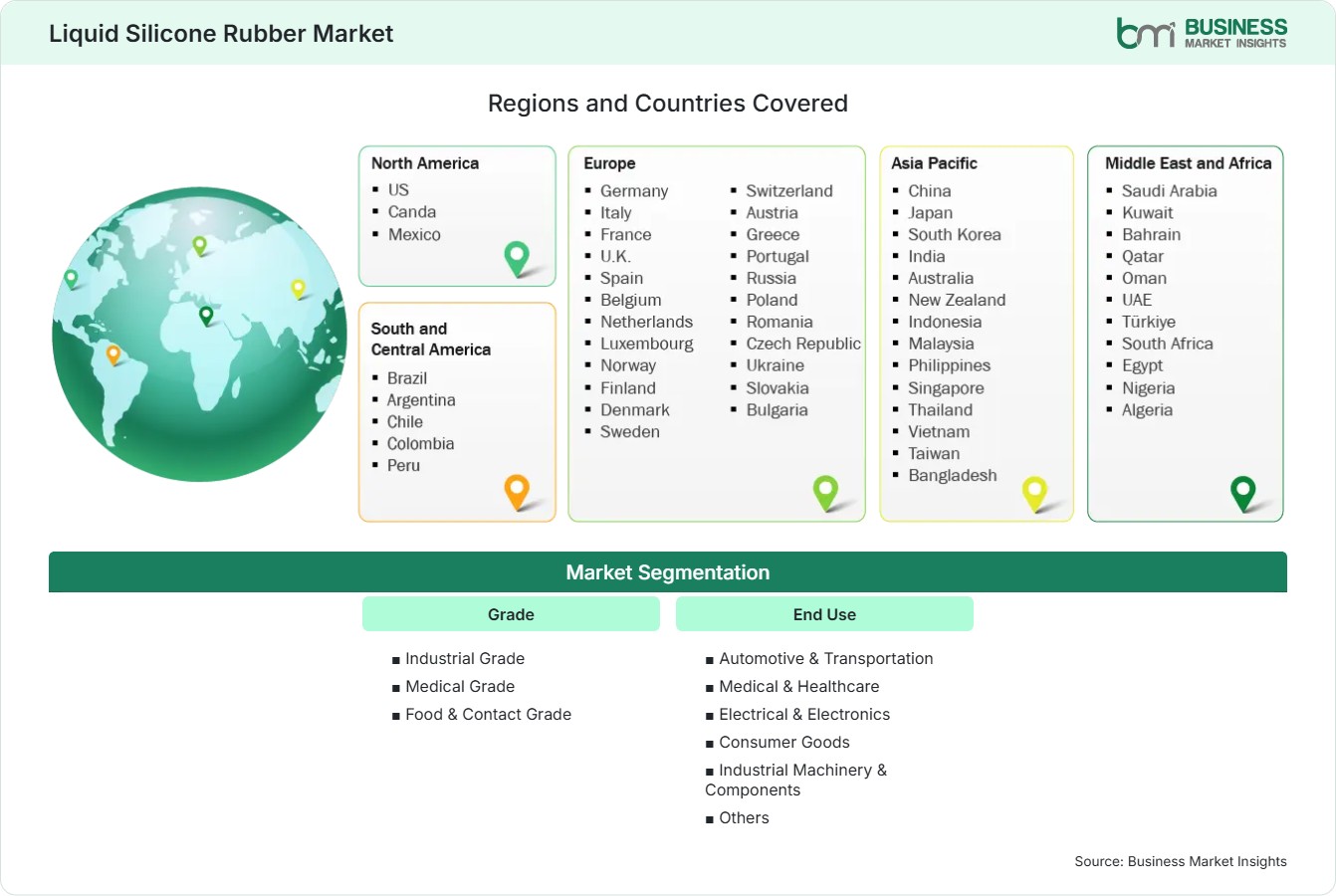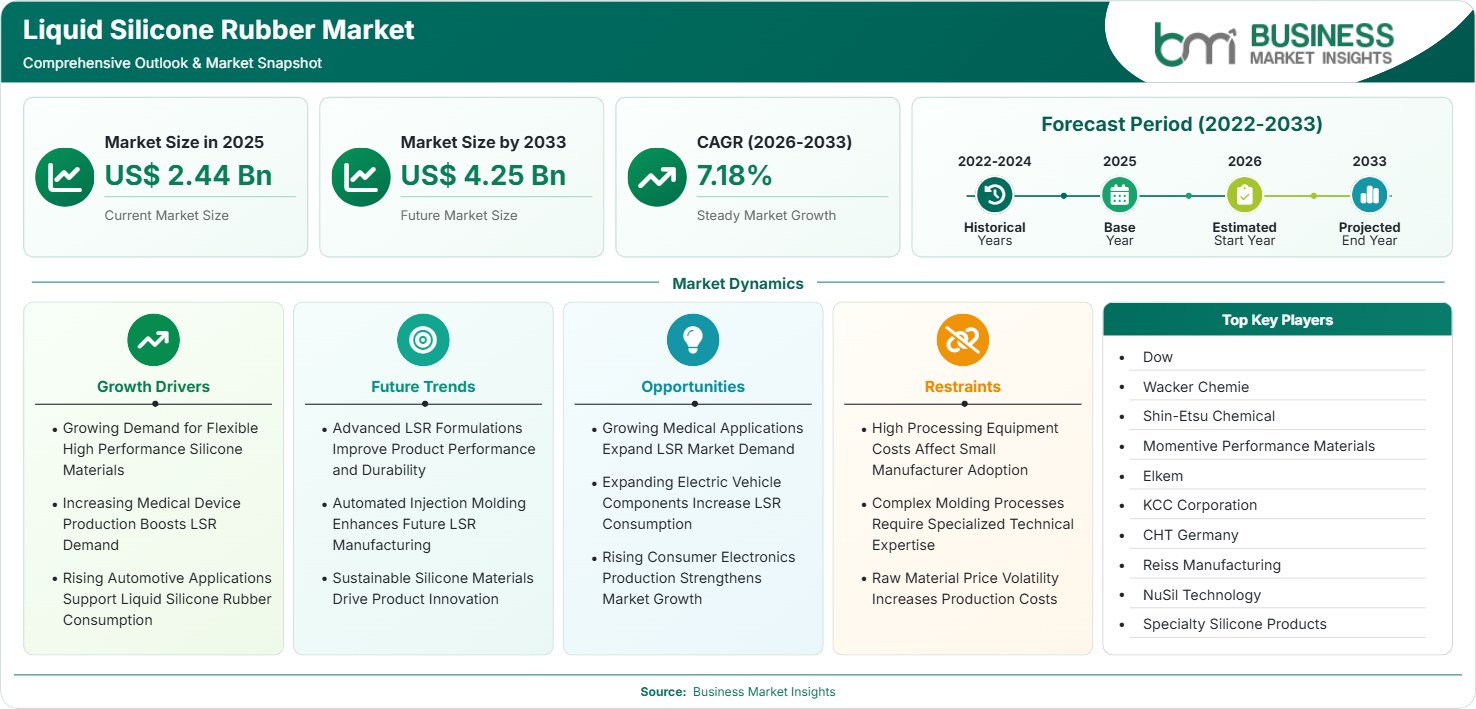
Liquid Silicone Rubber Market Regional Highlights
North America Liquid Silicone Rubber Market
North America held 27%–31% Liquid Silicone Rubber Market share in 2025 and is projected to expand at a CAGR of 6.5%–7.2% during 2026–2033. The region benefits from established medical-device manufacturing, automotive production, electronics development, and industrial processing capabilities. The US remains the dominant contributor, supported by healthcare innovation and reshoring initiatives. Mexico provides additional opportunities through automotive and electronics manufacturing.
- Medical-device manufacturing supports demand for biocompatible materials used in seals, tubing, valves, wearable components, and drug delivery systems requiring reliable performance and sterilization compatibility.
- Automotive manufacturers increasingly use silicone components in sensors, connectors, gaskets, lighting systems, and EV applications, where thermal stability and electrical insulation are critical.
- Electronics reshoring and domestic supply-chain development create opportunities for precision-molded components used in connectors, protection systems, and increasingly compact electronic assemblies.
- Automated molding investments are improving production consistency and reducing labor dependence, supporting adoption of advanced liquid silicone rubber processing technologies across high-volume manufacturing operations.
US Liquid Silicone Rubber Market
The US represented 19%–22% of global demand and 70%–75% of North American demand in 2025, expanding at a CAGR of 6.7%–7.4% through 2033. Demand is supported by medical technology, automotive electronics, EV components, consumer products, and industrial applications. Domestic manufacturing investments are encouraging greater automation and precision processing.
- Medical and healthcare applications remain important because US manufacturers require validated materials for devices involving direct or indirect patient contact and repeated sterilization cycles.
- EV manufacturing is increasing demand for electrically insulating seals, connectors, gaskets, and protective components capable of maintaining performance under thermal and chemical exposure.
- Advanced electronics manufacturing favors precision molding for miniature components, where consistent dimensions, low defect rates, and reliable insulation properties influence product performance.
Europe Liquid Silicone Rubber Market
Europe held 25%–29% share in 2025 and is projected to grow at a CAGR of 6.2%–7.0% during 2026–2033. Germany leads regional demand, supported by automotive engineering, industrial machinery, and specialty chemical capabilities. Italy and France maintain important medical, automotive, and industrial applications, while Poland offers higher Liquid Silicone Rubber Market growth potential from expanding manufacturing. Germany is estimated to grow at 6.3%–7.1% CAGR, while Poland may reach 7.0%–7.8% CAGR through 2033, supported by manufacturing investments and supply-chain expansion.
- Germany remains the leading Liquid Silicone Rubber Market, benefiting from automotive manufacturing, industrial automation, specialty chemicals, and established expertise in precision molding and advanced materials processing.
- France supports demand through aerospace, healthcare, automotive, and industrial applications requiring durable elastomeric components with consistent performance under demanding operating conditions.
- Italy provides opportunities across automotive components, consumer products, machinery, and medical applications, with manufacturers increasingly adopting automated processing to improve productivity and consistency.
- Poland represents a high-growth manufacturing opportunity as automotive and industrial supply chains expand, increasing requirements for precision-molded components and specialized elastomer materials.
Asia Pacific Liquid Silicone Rubber Market
Asia Pacific held 38%–42% share in 2025 and is forecast to expand at a CAGR of 7.8%–8.6% during 2026–2033. China leads regional consumption, supported by electronics, automotive, healthcare, and consumer manufacturing. Japan and South Korea remain advanced technology markets, while India and Southeast Asia offer strong growth potential. China is estimated to grow at 7.7%–8.5% CAGR, while India may reach 8.4%–9.2% CAGR. Expanding manufacturing ecosystems and increasing automation strengthen regional demand.
- China remains the leading Liquid Silicone Rubber Market, supported by large electronics, automotive, consumer goods, and healthcare manufacturing ecosystems requiring high-volume precision-molded silicone components.
- Japan maintains demand for advanced materials across medical devices, automotive systems, electronics, and industrial equipment, emphasizing reliability, precision, and specialized formulation performance.
- South Korea benefits from electronics, semiconductor, automotive, and battery manufacturing, creating opportunities for silicone components requiring electrical insulation, thermal stability, and dimensional consistency.
- India offers high-growth potential as healthcare, automotive, electronics, and consumer manufacturing capacity expands, increasing demand for locally produced precision components and advanced materials.
- Southeast Asia is attracting manufacturing investments across electronics and automotive supply chains, creating opportunities for suppliers offering scalable processing technologies and localized technical support.
Rest of World Liquid Silicone Rubber Market
South and Central America represented 6%–9% of global demand in 2025, with Brazil and Mexico-linked supply chains supporting automotive, healthcare, and consumer applications. Brazil is estimated to grow at 6.0%–6.8% CAGR, while Colombia offers 6.8%–7.6% potential. Manufacturing modernization and healthcare investment create additional demand.
- Brazil provides opportunities across automotive, healthcare, consumer products, and industrial applications as manufacturers increasingly seek reliable materials for durable and precision-molded components.
- Mexico-linked automotive and electronics production supports regional demand for seals, connectors, gaskets, and protective components requiring resistance to temperature, chemicals, and environmental exposure.
- Saudi Arabia and the UAE are developing diversified manufacturing ecosystems, creating opportunities for advanced materials in healthcare, consumer products, industrial equipment, and emerging manufacturing projects.
- South Africa benefits from automotive production and healthcare applications, supporting demand for specialized silicone components with consistent performance and established quality requirements.