
Chlorobutyl Rubber Market Outlook: Size, Share, Trends, Growth Analysis, Competitive Landscape & Forecast, 2026–2033

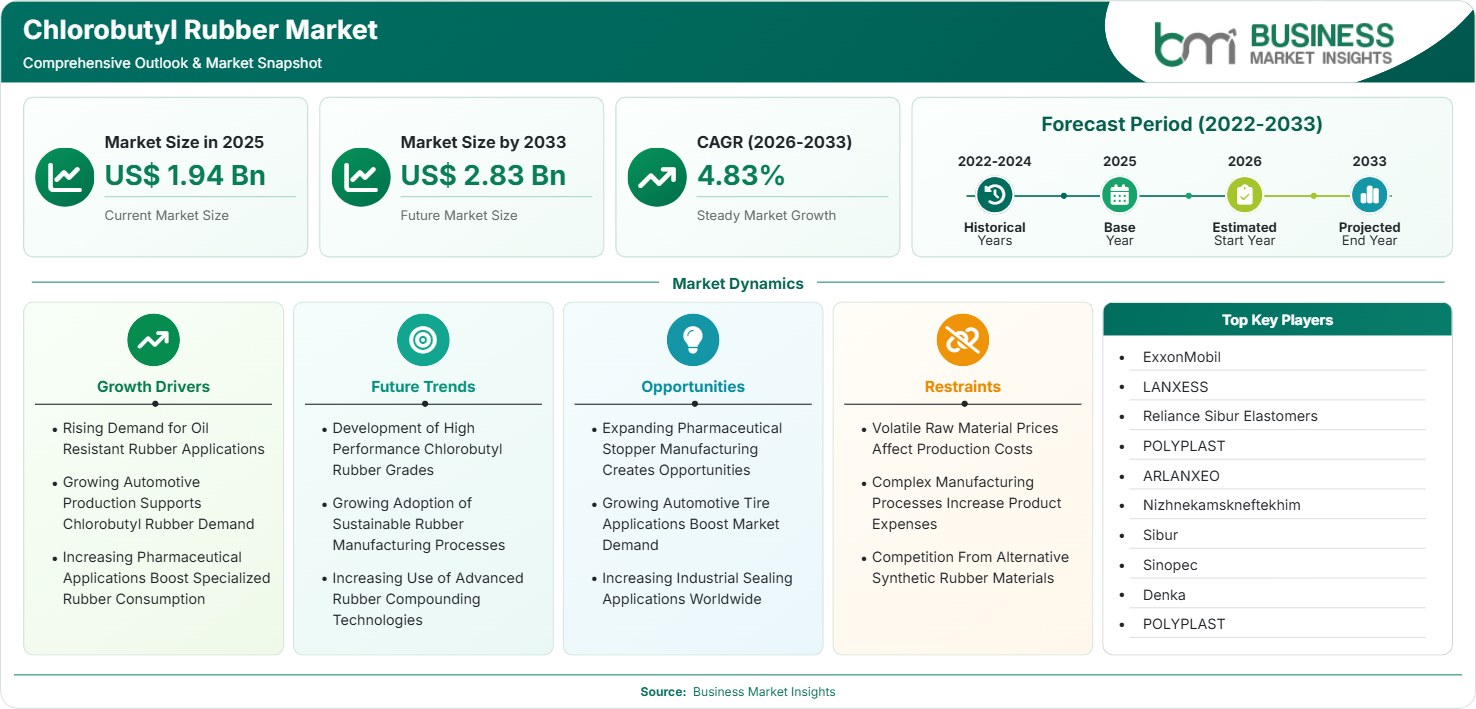
The Chlorobutyl Rubber Market size was valued at US$ 1.94 billion in 2025 and is projected to reach US$ 2.83 billion by 2033, growing at a CAGR of 4.83% during 2026–2033, driven by automotive tire demand, pharmaceutical closures, sealing applications, chemical resistance, and durable rubber requirements.

Report Coverage
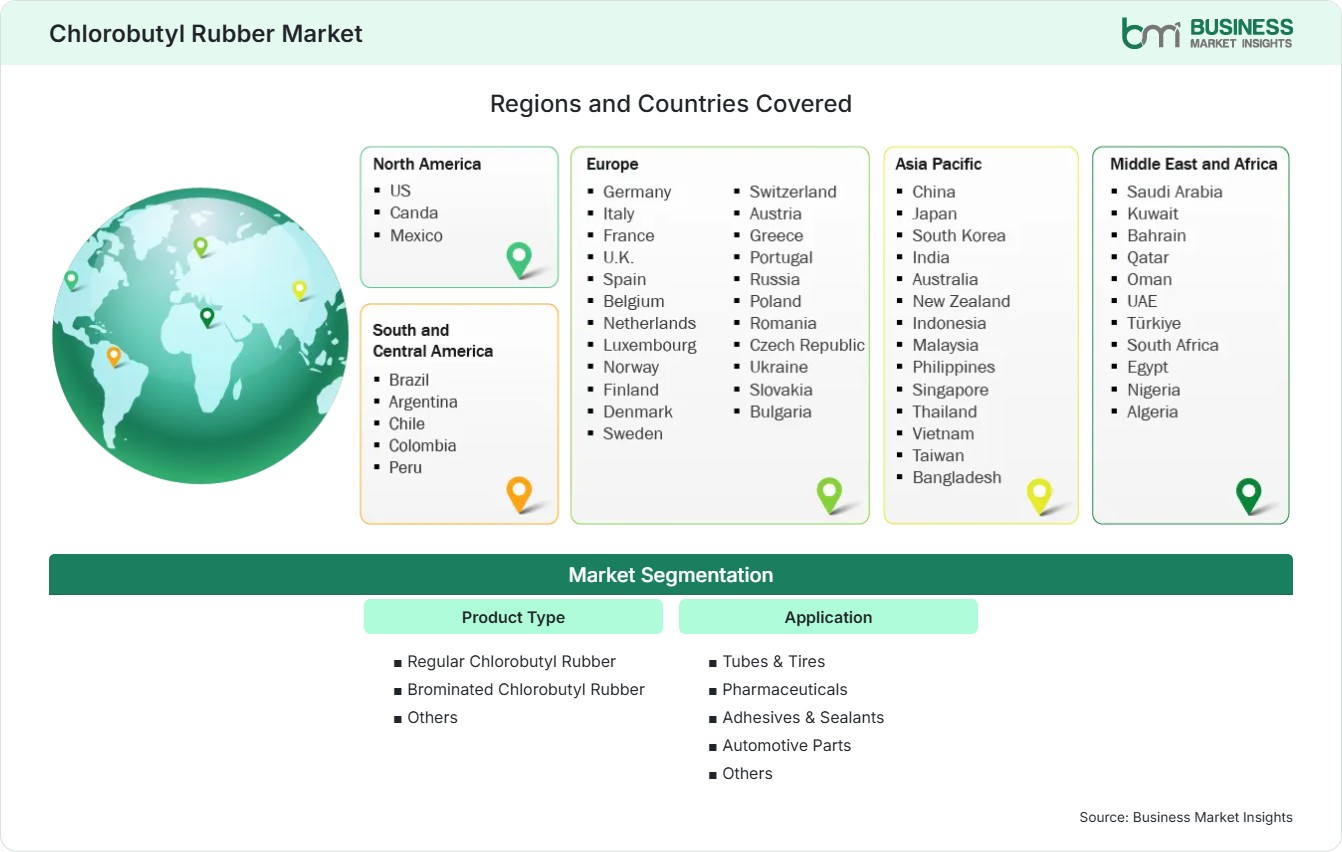
  • Product Type: Regular Chlorobutyl Rubber, Brominated Chlorobutyl Rubber, Others
  • Application: Tubes & Tires, Pharmaceuticals, Adhesives & Sealants, Automotive Parts, Others
US$ 1.94 Bn Market size in 2025
US$ 2.83 Bn Market Size by 2033
4.83% CAGR, 2026 - 2033
2026-2033 Forecast Period

AI Overview

Chlorobutyl Rubber Market Summary

  • North America: North America holds 25%-29% share in 2025, growing at a CAGR of 4.4%-5.1%, supported by automotive manufacturing, pharmaceutical packaging, industrial sealing, replacement tires, and demand for rubber compounds with strong gas and chemical resistance. The U.S. accounts for 76%-81% of regional demand, supported by established tire manufacturing, pharmaceutical packaging, automotive component production, and industrial sealing applications.
  • Fastest Growing Region: Asia Pacific holds 39%-43% share in 2025 and grows at a CAGR of 5.2%-6.0%, driven by automotive manufacturing expansion, pharmaceutical production, tire capacity additions, industrialization, and increasing adoption of specialized elastomers across manufacturing industries.
  • Leading Segment: Regular Chlorobutyl Rubber holds 57%-61% share in 2025 and grows at a CAGR of 4.5%-5.0%, supported by established use in tubes, tires, automotive components, sealing products, and applications requiring low permeability and weather resistance.
  • High Growth Segment: Pharmaceuticals holds 13%-17% share in 2025 and grows at a CAGR of 6.0%-7.0%, supported by pharmaceutical stopper production, injectable packaging, controlled permeability requirements, and increasing demand for reliable elastomeric closure materials.
  • Key Market Opportunity: Pharmaceutical closures, specialized automotive tires, industrial seals, and high-performance elastomer applications provide attractive opportunities as manufacturers prioritize chemical resistance, low gas permeability, durability, and reliable product performance.
  • Major Market Players: ExxonMobil, LANXESS, Reliance Sibur Elastomers, POLYPLAST, ARLANXEO, Nizhnekamskneftekhim, Sibur, Sinopec, Denka, POLYPLAST.
Strategic Insights

Chlorobutyl Rubber Market: Strategic Insights

Chlorobutyl Rubber Market Strategic Framework
FREE PDF
Request your free sample
Request free sample
Stakeholder View

Key Takeaways

  • Supply chains are becoming more integrated around halobutyl polymer production, compounding, tire manufacturing, pharmaceutical closure production, and specialized sealing applications, increasing the value of consistent polymer quality.
  • Pharmaceutical closures offer an attractive application opportunity because manufacturers require elastomers capable of supporting controlled permeability, chemical compatibility, dimensional stability, and reliable sealing performance.
  • Product development is increasingly focused on balancing permeability, cure characteristics, mechanical properties, processability, and application-specific performance rather than optimizing a single material characteristic.
  • Asia Pacific presents the strongest expansion opportunity because automotive manufacturing, tire production, pharmaceutical processing, and industrial equipment manufacturing are expanding across several major economies.
  • Investment priorities are increasingly directed toward polymer production efficiency, specialty-grade development, pharmaceutical-quality capabilities, feedstock security, and regional supply-chain resilience.
  • Suppliers that can provide consistent grades, technical support, application customization, and reliable delivery can strengthen relationships with tire, pharmaceutical, automotive, and industrial customers.
Geographic Outlook

Chlorobutyl Rubber Market Regional Highlights

North America Chlorobutyl Rubber Market

North America holds 25%-29% share in 2025 and grows at a CAGR of 4.4%-5.1%. The region benefits from established automotive manufacturing, pharmaceutical production, industrial equipment demand, replacement tires, and specialized sealing applications requiring durable elastomer performance.

  • U.S. demand is supported by established automotive and pharmaceutical manufacturing ecosystems, while industrial sealing applications create additional opportunities for specialized rubber compounds.
  • Canada contributes through automotive component manufacturing, industrial processing, pharmaceutical activities, and replacement tire demand requiring durable low-permeability elastomer solutions.
  • Pharmaceutical applications increasingly emphasize closure integrity, dimensional stability, extractables control, and compatibility with demanding drug-packaging environments.
  • Industrial users value chlorobutyl rubber for applications requiring resistance to gases, moisture, chemicals, weathering, and long-term environmental exposure.

US Chlorobutyl Rubber Market

The U.S. represents 76%-81% of North American demand in 2025 and grows at a CAGR of 4.3%-5.0%. Automotive replacement, pharmaceutical packaging, tire production, and industrial sealing remain important demand foundations.

  • Pharmaceutical manufacturers provide a durable demand base through stopper and closure applications requiring dependable sealing and controlled permeability characteristics.
  • Tire and tube applications benefit from chlorobutyl rubber's ability to reduce air loss and support long-term performance under demanding operating conditions.
  • Industrial applications provide incremental demand across hoses, seals, gaskets, and specialized components exposed to chemicals, gases, temperature changes, and weathering.

Europe Chlorobutyl Rubber Market

Europe holds 23%-27% Chlorobutyl Rubber Market share in 2025 and grows at a CAGR of 4.2%-5.0%. Germany leads regional demand, while France, Italy, and the United Kingdom provide opportunities across automotive, pharmaceutical, tire, and industrial applications.

  • Germany benefits from advanced automotive manufacturing, tire production, industrial engineering, and pharmaceutical activities requiring specialized elastomer materials.
  • France supports demand through pharmaceutical manufacturing, automotive applications, industrial equipment, and high-performance sealing requirements.
  • Italy provides opportunities across automotive components, tire-related products, industrial machinery, and specialty rubber applications.
  • The United Kingdom offers opportunities in pharmaceutical packaging, industrial seals, automotive components, and replacement tire applications.

Asia Pacific Chlorobutyl Rubber Market

Asia Pacific holds 39%-43% share in 2025 and grows at a CAGR of 5.2%-6.0%. China leads regional demand, while India, Japan, and South Korea provide high-value growth opportunities across automotive and pharmaceutical applications.

  • China combines large automotive and tire manufacturing capacity with expanding pharmaceutical production, supporting broad consumption of specialized elastomer materials.
  • India offers strong opportunities through vehicle manufacturing, tire production, pharmaceutical manufacturing, and expanding industrial infrastructure.
  • Japan supports premium elastomer applications through advanced automotive production, pharmaceutical packaging, industrial equipment, and high-performance component manufacturing.
  • South Korea contributes through automotive manufacturing, industrial production, chemical processing, and specialized rubber component applications.

Rest of World Chlorobutyl Rubber Market

Rest of World represents 8%-12% share in 2025 and grows at a CAGR of 4.1%-4.9%. Latin American automotive production and pharmaceutical manufacturing provide demand, while Middle Eastern industrial development creates additional sealing opportunities.

Brazil and Mexico are important Latin American Chlorobutyl Rubber Markets because of automotive production, tire manufacturing, pharmaceutical activities, and industrial processing. Argentina and Colombia provide smaller but developing opportunities through vehicle fleets, industrial applications, and pharmaceutical supply chains.

Middle Eastern and African demand is supported by industrial equipment, oil and gas-related applications, healthcare manufacturing, transportation infrastructure, and replacement tire requirements. Saudi Arabia, the United Arab Emirates, and South Africa offer attractive opportunities for specialized industrial and automotive elastomer applications.

  • Brazil provides opportunities through automotive production, tire manufacturing, pharmaceutical packaging, and industrial equipment requirements.
  • Mexico benefits from automotive manufacturing clusters, component production, tire demand, and industrial sealing applications.
  • Saudi Arabia supports industrial sealing demand through infrastructure development, energy-related equipment, manufacturing investment, and transportation activity.
  • South Africa provides opportunities through automotive assembly, mining equipment, industrial applications, healthcare manufacturing, and replacement tire demand.
Global Market Geography
FREE PDF
Request your free sample
Request free sample
Segment Analysis

Chlorobutyl Rubber Market Segmentation

Product Type

Regular Chlorobutyl Rubber holds 57%-61% share in 2025 and grows at a CAGR of 4.5%-5.0% through 2033, supported by established tire, tube, automotive, sealing, and industrial applications. Brominated grades serve applications requiring enhanced cure characteristics and performance, while other formulations address specialized requirements.

Chlorobutyl Rubber Market scope extends across conventional and halogenated grades as manufacturers balance permeability, processability, durability, chemical resistance, and application-specific performance.

  • Regular Chlorobutyl Rubber: Regular grades support mainstream tires, tubes, seals, automotive components, and industrial products requiring low permeability, weather resistance, and dependable durability.
  • Brominated Chlorobutyl Rubber: Brominated grades provide enhanced curing characteristics and compatibility with selected formulations, supporting advanced tire, pharmaceutical, and specialized sealing applications.
  • Others: Specialized grades address application-specific performance requirements involving processing, permeability, chemical resistance, temperature stability, and customized elastomer performance.

Application

Tubes & Tires hold 54%-58% share in 2025 and grow at a CAGR of 4.3%-4.9% through 2033, supported by tire production, replacement demand, and requirements for low air permeability. Pharmaceutical applications provide faster expansion, while automotive parts and sealing applications broaden demand across industrial and mobility sectors.

  • Tubes & Tires: Tire and tube manufacturers use chlorobutyl rubber for air retention, durability, weather resistance, and reliable performance under variable operating conditions.
  • Pharmaceuticals: Pharmaceutical closures use chlorobutyl rubber for dependable sealing, controlled permeability, chemical compatibility, and protection of sensitive drug formulations.
  • Adhesives & Sealants: Sealant applications benefit from resistance to gases, moisture, chemicals, and environmental exposure across industrial and construction-related applications.
  • Automotive Parts: Automotive components use chlorobutyl rubber where durability, resistance to environmental exposure, sealing performance, and controlled permeability are important.
  • Others: Other applications include specialized industrial components and engineered rubber products requiring combinations of flexibility, durability, chemical resistance, and low permeability.
Market Forces

Chlorobutyl Rubber Market Dynamics

Key Market Drivers

Rising Demand for Oil Resistant Rubber Applications

Market drivers include demand for oil and chemical-resistant elastomers, which will help drive the market for chlorobutyl rubber into industries such as automotive manufacturing, in addition to many other sectors. Industries have a growing need for elastomers that can retain their dimensions and functional properties in the presence of oils, gases, water, and changing environments. Thus, the Chlorobutyl Rubber Market growth is likely to benefit from applications that require additional barrier or chemical resistance beyond what standard rubbers could offer. Service life is another focus area for the developers of products, since early degradation of seals and components increases the cost and downtime for maintenance. This creates a need for product selection on the basis of performance rather than material price alone.

Growing Automotive Production Supports Chlorobutyl Rubber Demand

The automotive industry is still one of the major demand drivers, as tires, tubes, seals, hoses, and some components require elastomers that can keep up with changing temperature, pressure, and environmental conditions. The rise in the number of vehicles produced in emerging manufacturing facilities contributes to the use of specialized rubber materials. Specifically, the chlorobutyl type is particularly suitable in cases when the air-retaining and barrier characteristics affect the performance of components. At the same time, manufacturers pay attention to processing ease, durability, and compatibility of selected rubber compounds with other rubber types. Replacement tire markets also form another source of demand due to the need for maintenance of the existing fleet of vehicles.

Increasing Pharmaceutical Applications Boost Specialized Rubber Consumption

The development of pharmaceutical packaging systems is leading to a growing need for elastomers that would offer dependable sealing, but at the same time be compatible with sensitive drug formulations. Applications involving stoppers and closures have permeability, dimensional stability, resiliency, and predictability needs under different conditions. Thus, the Chlorobutyl Rubber Market trend is becoming more and more impacted by pharmaceutical manufacturing operations and the development of special packaging solutions. Product qualification may take considerable efforts in testing and process control, offering chances to those companies that are able to offer consistent grades and technical assistance. Pharmaceutical manufacturing in developing countries is increasing the size of the potential market as well.

Key Market Opportunities

Expanding Pharmaceutical Stopper Manufacturing Creates Opportunities

The manufacture of stoppers in the pharmaceutical industry provides a great opportunity, since there is a need for special grades of elastomers, which have consistent performance, permeability control, and sealing properties. An increase in the capability of the pharmaceutical manufacturing industry will increase the need for closure materials for both injectable and sensitive formulations. The Chlorobutyl Rubber Market forecast is based on the fact that there are chances to provide special grades of elastomers that have the ability to provide a good cure profile, cleanability, durability, extractables performance, and formulation compatibility. There is an opportunity for the suppliers to provide technical assistance during the qualification process and manufacturing.

Growing Automotive Tire Applications Boost Market Demand

Auto tire applications present an effective path for demand growth with the rise in vehicle manufacturing and tire replacement activities in emerging countries. Chlorobutyl rubber is used in tires owing to its low permeability and suitability in providing air retention capabilities. Material providers can consider opportunities in grades of materials that are suited for tires in terms of formulation, processability, and durability. EVs are likely to have some impact on material requirements due to the heavier nature of the vehicle structures and torque differences. The market for replacements adds to the demand apart from vehicle manufacturing. Companies with good technical connections with the tire manufacturers can explore opportunities in optimizing tire compounds and processing.

Increasing Industrial Sealing Applications Worldwide

Industries that need sealing materials can provide growth chances in various segments such as machinery, processing equipment, transportation, chemicals, and special industries. Chlorobutyl rubber can cater to applications where low permeability, resistance to chemicals, elasticity, and environmental resistance play significant roles. Manufacturers have room for value addition by creating formulations suitable for particular temperatures, pressures, fluids, and the lifetime of use. In the industrial sector, the selection of seals is increasingly influenced by maintenance periods and lifetime performance, apart from price at time of purchase. There can be chances for high-performance seals that minimize replacements and interruptions in operations. Regional industrial development can open more chances in terms of increased demand for reliable seals.

Market Restraints and Challenges

Volatile Raw Material Prices Affect Production Costs

Factor: changes in the costs of feedstocks, energy, transport, and other chemicals used in the manufacture of polymers. Impact: an increase in the cost of input materials will affect the profit margins of producers and will lead to an increase in selling prices and difficulty in negotiating long-term contracts. Some of the ways producers will react include planning for stock, diversified purchase of materials, efficient processes, and formulations. However, small-scale producers have less power of negotiation and are more vulnerable to sudden changes in cost. Unpredictable prices may also affect consumer behavior, especially in cases where rubber is competing with other types of elastomer.

Complex Manufacturing Processes Increase Product Expenses

Factor: The process of producing chlorobutyl rubber entails controlled processes of polymerization and halogenation, special operating conditions, quality management, and expertise in formulations. Impact: The complexity of production can make production costly, both in capital and operational expenditures. It can also be a barrier to entry into the business for new entrants. Additional quality checks can also be required in pharmaceutical and industrial uses, resulting in higher development costs. It is also necessary for producers to produce products that are uniform in quality since variations in the quality of the polymers can affect performance. This makes producers who are more experienced in terms of production an advantage over the others. However, customers may prefer cheaper substitutes for less stringent uses.

Company Analysis

Competitive Landscape

The Chlorobutyl Rubber Market analysis covers major elastomer producers and chemical companies competing through polymer quality, production capacity, application expertise, geographic reach, technical support, and supply reliability. Competitive differentiation is increasingly linked to specialized grades, consistent processing characteristics, pharmaceutical-quality capabilities, and long-term relationships with automotive and industrial customers.

Company Name

Overview

Products and Services relevant to this market

ExxonMobil

Global energy and chemicals company with established synthetic rubber and specialty elastomer capabilities.

Synthetic rubber, halobutyl elastomers, specialty polymers, technical support, and application-focused material solutions.

LANXESS

Specialty chemicals producer with broad rubber and performance-material expertise serving industrial customers.

Synthetic rubber, specialty elastomers, rubber chemicals, additives, and application-specific technical solutions.

Reliance Sibur Elastomers

Elastomer producer serving automotive, tire, industrial, and specialty rubber applications.

Halobutyl and synthetic rubber products, elastomer solutions, technical support, and industrial application materials.

POLYPLAST

Polymer and rubber producer serving industrial and specialized elastomer requirements.

Synthetic rubber materials, polymer products, industrial elastomer solutions, and application support.

ARLANXEO

Global synthetic rubber producer serving automotive, tire, industrial, and specialty applications.

Halobutyl rubber, synthetic elastomers, performance polymers, technical services, and application development.

Nizhnekamskneftekhim

Large petrochemical producer with extensive synthetic rubber manufacturing capabilities.

Synthetic rubber, halobutyl grades, polymers, petrochemical products, and industrial rubber materials.

Sibur

Integrated petrochemical company supplying polymers and synthetic rubber to industrial markets.

Synthetic rubber, elastomers, polymers, petrochemical materials, and application-oriented product solutions.

Sinopec

Major integrated petrochemical producer with substantial polymer and synthetic rubber operations.

Synthetic rubber, elastomers, petrochemical feedstocks, polymer products, and rubber-industry materials.

Denka

Specialty materials company with established elastomer and polymer technologies for industrial applications.

Synthetic rubber, specialty polymers, elastomers, performance materials, and technical application solutions.

POLYPLAST

Polymer-focused company serving rubber and industrial material applications across specialized markets.

Synthetic rubber materials, polymer products, elastomer solutions, processing support, and industrial applications.

Trust & Transparency

Research Methodology

The market analysis combines proprietary research with secondary data from government agencies, company disclosures, regulatory filings, industry databases and expert interviews. Market estimates are validated through data triangulation, cross-market benchmarking and analyst review.

View Full Research Methodology

Questions Answered

Frequently Asked Questions

What does the Chlorobutyl Rubber Market report indicate about future competition?

The report indicates that competition will increasingly focus on polymer consistency, specialized grades, pharmaceutical-quality capabilities, technical support, supply reliability, and production efficiency. Manufacturers able to address demanding application requirements while maintaining dependable supply can strengthen their competitive position.

Why are pharmaceutical applications creating new opportunities for chlorobutyl rubber suppliers?

Pharmaceutical closures require dependable sealing, controlled permeability, resilience, and compatibility with sensitive formulations. Increasing pharmaceutical manufacturing and demand for reliable packaging materials are therefore creating additional opportunities for specialized chlorobutyl rubber grades.

How are specialized elastomer formulations influencing chlorobutyl rubber adoption?

Specialized formulations allow manufacturers to balance permeability, curing behavior, chemical resistance, mechanical properties, processing efficiency, and application-specific requirements. This enables chlorobutyl rubber to serve demanding pharmaceutical, tire, automotive, and industrial applications.

Which applications present the strongest opportunity in the market?

Pharmaceutical closures, tubes and tires, industrial seals, automotive components, and specialized adhesives and sealants represent strong opportunities. Pharmaceutical applications offer particularly attractive prospects because of stringent performance requirements and expanding drug manufacturing capacity.

What factors are improving Chlorobutyl Rubber Market return on investment?

Growing pharmaceutical stopper production, automotive tire manufacturing, industrial sealing requirements, and demand for low-permeability elastomers are improving investment potential. Durable performance and chemical resistance also support applications where longer service life can offset higher material costs.

Access the Full Chlorobutyl Rubber Market Report

Get segment-level forecasts, regional estimates, competitive benchmarking, company profiles and downloadable Excel datasets.

Access the full Chlorobutyl Rubber Market Report
350 pages PDF & Excel | 2026-08-19