
Rubber Compound Market Outlook: Size, Share, Trends, Growth Analysis, Competitive Landscape & Forecast, 2026-2033

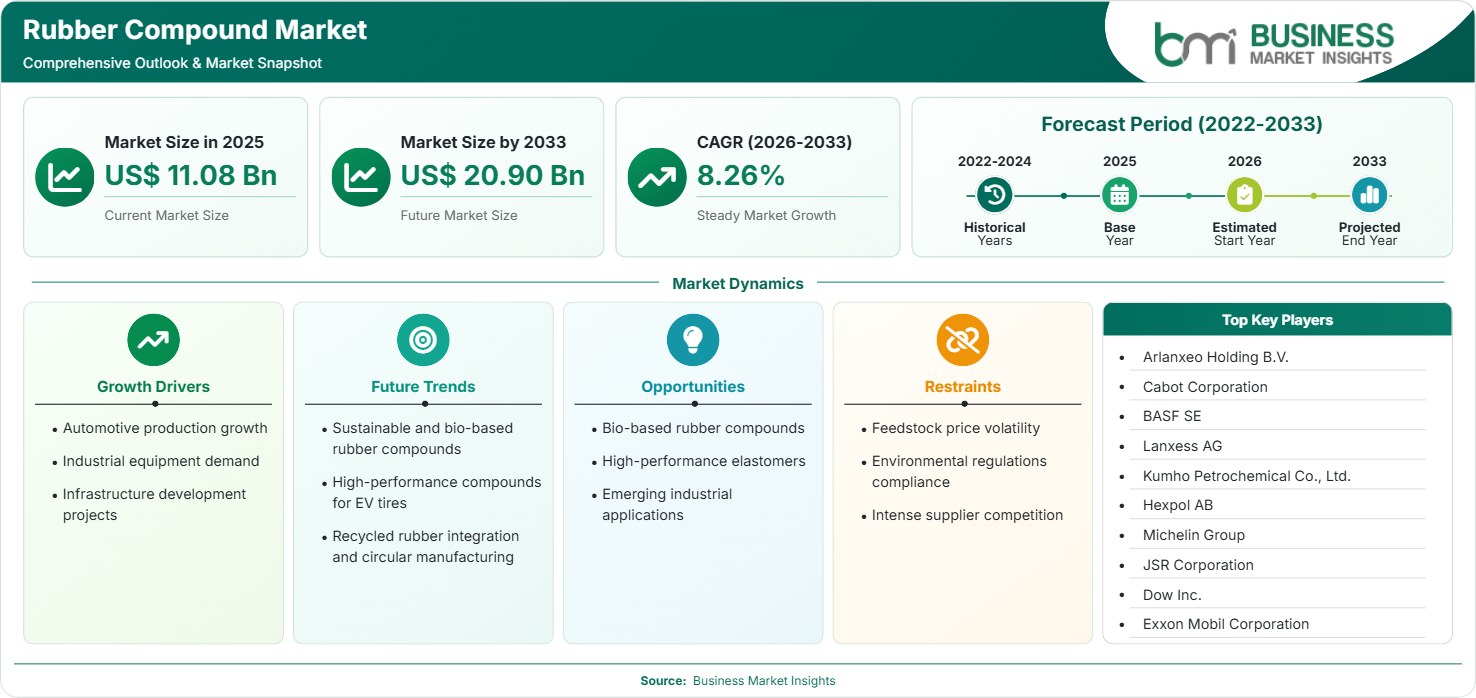
The Rubber Compound Market size was valued at US$ 11.08 billion in 2025 and is projected to reach US$ 20.90 billion by 2033, growing at a CAGR of 8.26% during 2026–2033. Market expansion is supported by increasing automotive production, rising industrial equipment demand, infrastructure development activities, and growing adoption of advanced elastomer solutions across transportation and manufacturing industries.

Report Coverage
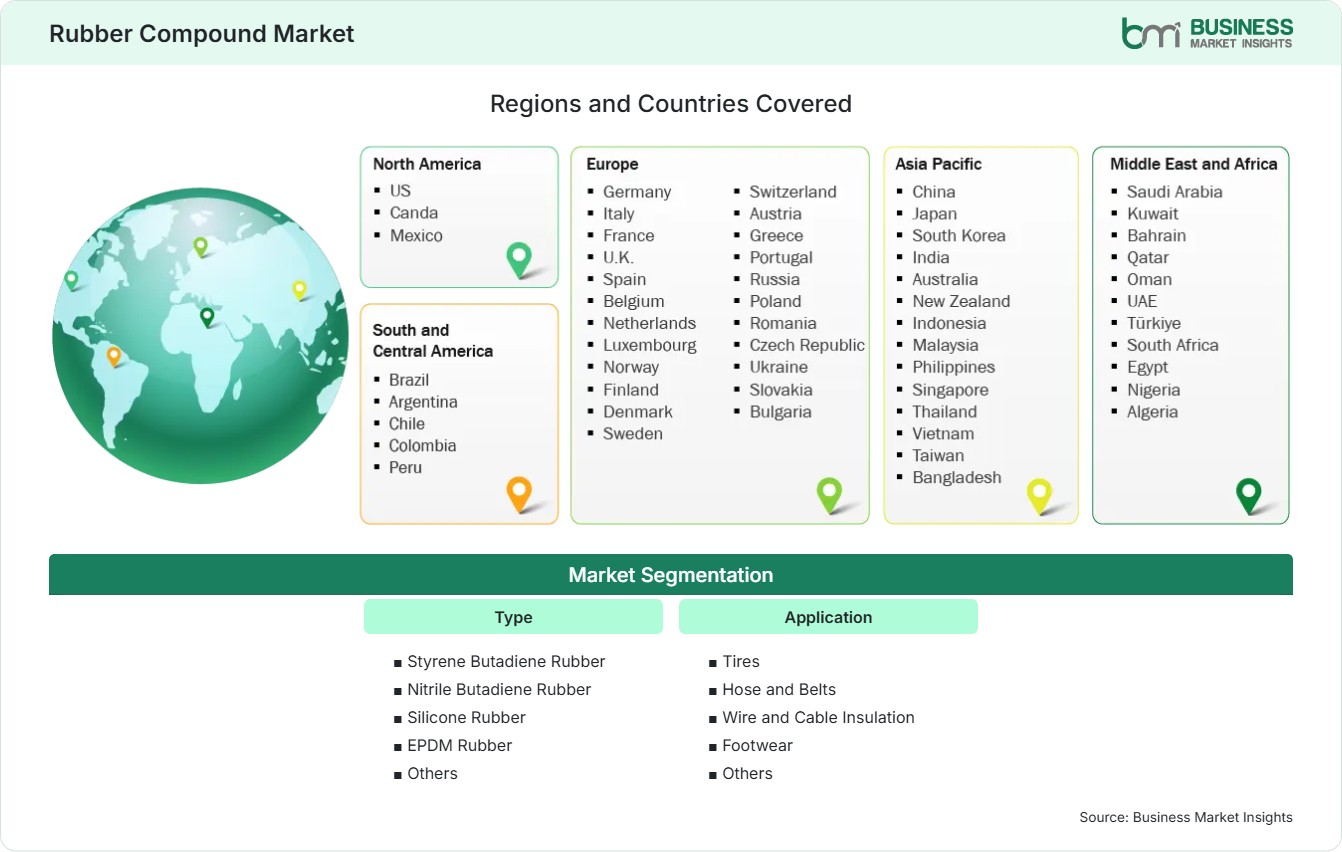
  • Type: Styrene Butadiene Rubber, Nitrile Butadiene Rubber, Silicone Rubber, EPDM Rubber, Others
  • Application: Tires, Hose and Belts, Wire and Cable Insulation, Footwear, Others
US$ 11.08 Bn Market size in 2025
US$ 20.90 Bn Market Size by 2033
8.26% CAGR, 2026 - 2033
2026-2033 Forecast Period

01 AI Overview

Rubber Compound Market Summary

  • North America Region: North America holds 24%–27% share in 2025 and is projected to expand at a 7%–8% CAGR during 2026–2033. Growth is supported by automotive manufacturing recovery, industrial modernization, replacement tire demand, and investments in advanced rubber technologies. The U.S. market benefits from strong automotive and industrial sectors, with growth projected at 7%–8% CAGR through 2033 due to increasing demand for specialized rubber compounds.
  • Fastest Growing Region: Asia Pacific represents 42%–45% share in 2025 and is expected to grow at a 9%–10% CAGR during 2026–2033. Expanding automotive production, infrastructure investments, industrial manufacturing growth, and increasing elastomer consumption across emerging economies are accelerating regional opportunities.
  • Leading Segment: Styrene Butadiene Rubber accounts for 35%–38% share in 2025 and is projected to grow at a 8%–9% CAGR during 2026–2033. Demand is supported by extensive tire applications, cost efficiency, durability, and broad adoption across automotive manufacturing.
  • High Growth Segment: Silicone Rubber represents 10%–13% share in 2025 and is expected to grow at a 10%–11% CAGR through 2033. Growth is driven by high-temperature resistance requirements, advanced industrial applications, healthcare uses, and electrical insulation demand.
  • Key Market Opportunity: Development of bio-based rubber compounds, high-performance elastomers, and emerging industrial applications creates opportunities for manufacturers to improve sustainability, enhance material performance, and expand into specialized end-use sectors.
  • Major Market Players: Arlanxeo Holding B.V., Cabot Corporation, BASF SE, Lanxess AG, Kumho Petrochemical Co., Ltd., Hexpol AB, Michelin Group, JSR Corporation, Dow Inc., Exxon Mobil Corporation.
02 Strategic Insights

Rubber Compound Market: Strategic Insights

Rubber Compound Market Strategic Framework
FREE PDF
Request your free sample
Request free sample
03 Stakeholder View

Key Takeaways

  • The market value chain is becoming increasingly integrated, with raw material suppliers, compound manufacturers, tire producers, and industrial component companies collaborating to improve performance and supply reliability.
  • Automotive applications remain the primary growth contributor, while industrial equipment, electrical components, and specialized elastomer applications provide additional expansion opportunities.
  • Innovation is shifting toward high-performance elastomers, sustainable formulations, improved wear resistance, and materials designed for electric vehicles and advanced industrial systems.
  • Asia Pacific represents the strongest investment opportunity due to expanding automotive manufacturing, infrastructure development, industrialization, and increasing demand from emerging economies.
  • Competitive strategies are increasingly focused on capacity expansion, sustainable material development, strategic partnerships, and technology-driven product differentiation.
  • Environmental compliance is becoming a major strategic factor as manufacturers invest in cleaner production methods, alternative feedstocks, and solutions that reduce lifecycle environmental impact.
04 Geographic Outlook

Rubber Compound Market Regional Highlights

North America Rubber Compound Market

North America accounted for 24%–27% share in 2025 and is projected to expand at a 7%–8% CAGR from 2026–2033. The region benefits from established automotive manufacturing, industrial equipment demand, and replacement tire consumption. Growth is supported by investments in advanced materials, infrastructure modernization, and manufacturing efficiency improvements. The Rubber Compound Market share reflects steady demand from transportation, industrial machinery, and specialized elastomer applications across the region.

  • The U.S. remains a key market due to strong automotive production, industrial manufacturing activities, and increasing demand for performance-based rubber materials.
  • Manufacturers are investing in advanced elastomer technologies to improve durability, efficiency, and compliance with evolving automotive performance requirements.
  • Infrastructure renewal programs are supporting demand for rubber-based components used in construction equipment and industrial applications.
  • Growing electric vehicle production is encouraging development of specialized rubber compounds with enhanced thermal and mechanical properties.

US Rubber Compound Market

The U.S. market represented 20%–23% share in 2025 and is expected to grow at a 7%–8% CAGR between 2026–2033. The country remains an important production and consumption hub due to automotive manufacturing, industrial equipment demand, and technological advancement in material science. The Rubber Compound Market growth is supported by replacement tire demand, industrial modernization, and increasing adoption of high-performance elastomer solutions.

  • Automotive manufacturers are increasing demand for advanced rubber compounds supporting vehicle durability, safety, and improved performance characteristics.
  • Industrial sectors are adopting specialized rubber components for machinery, sealing systems, hoses, and vibration-control applications.
  • Research investments are supporting development of sustainable rubber solutions with improved environmental performance and material efficiency.

Europe Rubber Compound Market

Europe held 22%–25% share in 2025 and is forecast to grow at a 6%–8% CAGR during 2026–2033. The region benefits from advanced automotive manufacturing, strong chemical industry capabilities, and increasing focus on sustainable materials. Germany, France, Italy, and the United Kingdom represent major markets, while Germany and France maintain strong demand due to automotive and industrial applications.

  • Germany supports market development through its strong automotive ecosystem and demand for high-quality rubber components.
  • France is advancing sustainable material adoption through industrial innovation and environmental initiatives across manufacturing sectors.
  • Italy benefits from automotive component manufacturing and specialized industrial applications requiring durable elastomer solutions.
  • The United Kingdom is increasing adoption through industrial modernization and demand for advanced material technologies.

Asia Pacific Rubber Compound Market

Asia Pacific represented 42%–45% share in 2025 and is projected to achieve a 9%–10% CAGR from 2026–2033, making it the fastest-growing regional Rubber Compound Market. The region benefits from large-scale automotive production, industrial expansion, infrastructure investments, and growing manufacturing capabilities. China, India, Japan, South Korea, and Southeast Asian countries are major growth contributors.

  • China maintains market leadership through extensive tire production, chemical manufacturing capacity, and growing demand from industrial sectors.
  • India is expanding rapidly due to automotive growth, infrastructure projects, and increasing manufacturing investments.
  • Japan supports demand through advanced automotive technologies and specialized elastomer applications requiring high performance.
  • Southeast Asian economies are attracting manufacturing investments, increasing consumption of rubber compounds across transportation and industrial sectors.

Rest of World Rubber Compound Market

Rest of World accounted for 7%–9% share in 2025 and is expected to grow at a 7%–9% CAGR during 2026–2033. Latin America, the Middle East, and Africa are developing markets supported by automotive growth, industrial investments, and infrastructure projects. Brazil, Mexico, Saudi Arabia, and South Africa represent emerging opportunities for rubber compound suppliers.

  • Brazil is experiencing demand growth through automotive manufacturing, tire production, and industrial development activities.
  • Mexico benefits from expanding automotive supply chains and increasing manufacturing investments requiring rubber-based components.
  • Saudi Arabia is creating opportunities through infrastructure development and industrial diversification programs.
  • South Africa is supporting market growth through mining, transportation, and industrial equipment applications.
  • Emerging economies provide opportunities for suppliers developing cost-effective and application-specific rubber compound solutions.
Global Market Geography
FREE PDF
Request your free sample
Request free sample
05 Segment Analysis

Rubber Compound Market Segmentation

Type

The Type segment represents a critical component of the Rubber Compound Market forecasts, with demand shaped by material performance requirements across automotive, industrial, electrical, and consumer applications. Styrene Butadiene Rubber accounted for approximately 35%–38% share in 2025 and is projected to grow at a 8%–9% CAGR from 2026–2034. Adoption is influenced by tire manufacturing demand, cost efficiency, abrasion resistance, and broad industrial applicability across multiple end-use sectors.

  • Styrene Butadiene Rubber: Styrene Butadiene Rubber maintains strong demand due to excellent abrasion resistance, cost advantages, and extensive utilization in passenger vehicle tires, commercial tires, and automotive components.
  • Nitrile Butadiene Rubber: Nitrile Butadiene Rubber is preferred for applications requiring oil resistance, chemical durability, and reliable performance in hoses, seals, gaskets, and industrial equipment components.
  • Silicone Rubber: Silicone Rubber adoption is increasing due to superior temperature stability, electrical insulation properties, flexibility, and suitability for advanced industrial, automotive, and specialty applications.
  • EPDM Rubber: EPDM Rubber continues gaining demand due to weather resistance, ozone durability, and performance in automotive sealing systems, construction materials, and outdoor industrial applications.
  • Others: Other rubber compounds support specialized applications requiring customized characteristics, including improved mechanical strength, chemical resistance, and performance under specific operating conditions.

Application

The Application segment remains a major contributor to the Rubber Compound Market, supported by increasing transportation demand, industrial production, and infrastructure development activities. Tires accounted for approximately 45%–48% share in 2025 and are projected to grow at a 8%–9% CAGR from 2026–2034. Growth is supported by rising vehicle production, replacement tire demand, electric mobility development, and continuous improvements in tire performance technologies.

  • Tires: Tires represent the leading application due to increasing automotive production, replacement demand, fuel efficiency requirements, and adoption of advanced rubber formulations.
  • Hose and Belts: Hose and belt applications are expanding through industrial machinery growth, automotive system requirements, fluid transfer needs, and demand for durable mechanical components.
  • Wire and Cable Insulation: Wire and cable insulation applications are supported by electrification trends, infrastructure expansion, and demand for materials offering electrical resistance and long-term reliability.
  • Footwear: Footwear applications continue contributing to market demand through consumer goods manufacturing, comfort-focused designs, and use of rubber compounds with flexibility and wear resistance.
  • Others: Other applications include construction materials, industrial components, medical products, and specialized manufacturing uses requiring customized rubber compound characteristics.
06 Market Forces

Rubber Compound Market Dynamics

Key Market Drivers

Automotive Production Growth Supporting Rubber Demand

Growth in automobile production continues to be a key growth driver for the market because automobiles need a lot of rubber products such as tires, seals, hose, vibration systems, and insulation rubber. Rising vehicle manufacturing activity, production of electric vehicles, and increased production of replacement tires is leading to the use of high-performance elastomers. Trends in the Rubber Compound Market suggest that rubber compound manufacturers are trying to make compounds which are more durable and offer high heat resistance and low rolling resistance. Rubber compound manufacturers are increasingly partnering with automotive companies to produce high-end rubber products.

Industrial Equipment Demand Increasing Material Consumption

The increased need for machines and equipment in industry is driving the increased use of rubber compounds in manufacturing, construction, energy, and processing industries. The need for rubber compounds is necessary in the manufacturing of hoses, belts, gaskets, and vibration-proofing parts which have to endure difficult conditions. Industrial growth in emerging nations is raising the need for strong materials that can withstand pressure, temperature changes, and chemicals. Manufacturers are creating specific elastomers for particular uses to enhance machine efficiency and cut down maintenance.

Infrastructure Development Expanding Elastomer Applications

Construction projects are generating new demand for rubber compounds for use in construction equipment, transport mechanisms, seals, and other industrial machinery. Countries are making investments in road networks, urban infrastructure, power generation units, and factories, leading to an increased utilization of resilient materials. Rubber compounds offer flexibility, durability in different weather conditions, and consistency in performance in the infrastructural segment. The contribution to the increase in the demand comes from developing countries, which are involved in extensive construction and industrial activities.

Key Market Opportunities

Growth of Bio-Based Rubber Compound Solutions

Biomaterials offer significant possibilities as more companies focus on using environmentally friendly products and manufacturing processes that cause less harm to the environment. The development of bio-based rubber compounds involves investment in renewable materials, raw materials and technology that will help reduce the use of fossil fuels as raw materials. The commitment towards sustainability by automotive and industrial manufacturers has fueled the growing need for eco-friendly rubber materials. Bio-based rubber materials provide chances of differentiation and meet regulatory requirements.

Adoption of High-Performance Elastomer Technologies

Advanced elastomers are creating many growth prospects because there is a need for better protection against heat, chemicals, abrasions, and difficult working environments. High-performance rubber compounds are becoming more crucial in electric cars, aerospace applications, automated systems, and specialized machines. There is a need for the production of compounds that enhance efficiency, durability, and performance. More research and development efforts are being done to make use of special silicon rubber, EPDM, and other specialty rubber compounds. There are great prospects for firms with material science knowledge because of the growing need for specialty rubber.

Expansion into Emerging Industrial Applications

Growth potential lies in upcoming industrial uses, as rubber compounds gain popularity in renewable energy devices, sophisticated manufacturing machinery, electronics, and engineered goods. Industrial innovations and the trend toward electrical components have created a need for materials with better insulation, sealing, and mechanical properties. Chemical producers, along with component manufacturers and industrial end-users, are working on new applications beyond conventional automobile and tire uses in order to develop alternative sources of income. Collaboration among chemical producers, component makers, and industrial consumers will lead to greater innovation and rapid commercialization of special compounds.

Market Restraints and Challenges

Feedstock Price Volatility Impacting Production Costs

Factor: Rubber compound production relies on raw materials such as synthetic rubber, natural rubber, carbon black, and chemical additives, whose prices are influenced by crude oil fluctuations, supply disruptions, and agricultural conditions.

Impact: Feedstock price volatility can increase manufacturing costs, reduce profit margins, and create pricing challenges across the value chain. Producers must manage supply risks through diversified sourcing strategies, operational efficiency improvements, and long-term supplier agreements. Cost fluctuations may also influence purchasing decisions among downstream industries, encouraging manufacturers to optimize formulations and explore alternative materials to maintain competitiveness.

Environmental Regulations Increasing Compliance Requirements

Factor: Environmental regulations related to emissions, chemical usage, waste management, and sustainable material production are becoming stricter across major industrial regions. Impact: Compliance requirements can increase operational expenses, require additional investments in cleaner technologies, and affect production processes for rubber compound manufacturers. Companies must adapt through sustainable manufacturing practices, improved recycling capabilities, and the development of environmentally responsible formulations. Regulatory pressure may create challenges for smaller suppliers with limited resources, while larger manufacturers with advanced research capabilities may gain competitive advantages through early adoption of sustainable solutions.

07 Company Analysis

Competitive Landscape

The Rubber Compound Market analysis highlights a competitive environment shaped by global chemical producers, elastomer manufacturers, tire companies, and specialty material suppliers. Key participants are focusing on capacity expansion, sustainable compound development, advanced elastomer technologies, and customized solutions for automotive and industrial applications. Competitive positioning is influenced by raw material integration, product innovation, geographic presence, manufacturing capabilities, and partnerships with downstream industries requiring high-performance rubber materials.

Company Name

Overview

Products and Services relevant to this market

Arlanxeo Holding B.V.

Global synthetic rubber producer specializing in advanced elastomer technologies and industrial applications.

Synthetic rubber compounds, specialty elastomers, automotive rubber solutions, and industrial rubber materials.

Cabot Corporation

Specialty chemicals company providing performance materials and reinforcement solutions globally.

Carbon black, rubber reinforcement materials, elastomer additives, and tire compound solutions.

BASF SE

Global chemical company developing advanced materials for multiple industrial applications.

Synthetic rubber solutions, performance additives, elastomer technologies, and specialty chemical materials.

Lanxess AG

Specialty chemicals company focused on high-performance materials and synthetic rubber solutions.

EPDM rubber, specialty elastomers, rubber chemicals, and industrial compound technologies.

Kumho Petrochemical Co., Ltd.

South Korean chemical manufacturer specializing in synthetic rubber production.

Styrene Butadiene Rubber, Nitrile Butadiene Rubber, synthetic elastomers, and rubber materials.

Hexpol AB

Global polymer group providing engineered rubber compounds and solutions.

Rubber compounds, custom elastomer formulations, sealing materials, and industrial rubber products.

Michelin Group

Global tire manufacturer with expertise in rubber material innovation and mobility solutions.

Tire rubber compounds, advanced elastomer technologies, sustainable rubber solutions, and mobility applications.

JSR Corporation

Japanese materials company specializing in synthetic rubber and advanced polymer technologies.

Synthetic rubber products, specialty elastomers, polymer solutions, and industrial applications.

Dow Inc.

Global materials science company offering advanced polymer and chemical solutions.

Silicone rubber, elastomer technologies, performance materials, and industrial polymer solutions.

Exxon Mobil Corporation

Energy and chemical company producing specialty elastomer materials worldwide.

Synthetic rubber, specialty polymers, elastomers, and performance materials for industrial applications.

08 Industry Activity

Recent Developments

June 2026

Zeon Corporation launched its first subscription-based data management system for elastomer R&D, enabling customers to digitally manage research data, improve development efficiency, and accelerate innovation in elastomer and rubber compounding applications.

April 2026

Hexpol AB forecasted a recovery in rubber compounding demand, driven by automotive electrification, infrastructure investments, and increased outsourcing by customers. The company also highlighted growth opportunities in renewable energy applications, including sealing and insulation solutions for solar and wind power, while evaluating capacity expansion in China, India, and Southeast Asia.

April 2026

Hexpol AB announced its "Mixing 5.0" initiative, scheduled for launch in spring 2027, to introduce automated, data-driven, and safer rubber compounding operations across its European facilities. The program is designed to improve production consistency, precision, lead times, workplace safety, and sustainability under the company's Hexgreen strategy.

March 2026

Omni United appointed Dr. Mika Lahtinen as Associate Vice President, Raw Materials and Compounding, strengthening the company's expertise in tyre material innovation and rubber compounding to support the continued development of its Radar Tyres portfolio.

10 Trust & Transparency

Research Methodology

The market analysis combines proprietary research with secondary data from government agencies, company disclosures, regulatory filings, industry databases and expert interviews. Market estimates are validated through data triangulation, cross-market benchmarking and analyst review.

View Full Research Methodology

11 Questions Answered

Frequently Asked Questions

What does the Rubber Compound Market Report include?

The report includes market size analysis, segmentation insights, regional trends, competitive landscape, growth drivers, opportunities, restraints, and future industry outlook through 2033.

Which industries are creating new opportunities for rubber compounds?

Emerging opportunities are developing in electric vehicles, renewable energy systems, advanced manufacturing equipment, industrial automation, and specialized engineering applications requiring high-performance materials.

How are sustainability trends influencing rubber compound development?

Sustainability trends are encouraging manufacturers to develop bio-based compounds, improve recycling capabilities, reduce emissions, and introduce environmentally responsible elastomer production methods.

Which rubber compound type has the largest market demand?

Styrene Butadiene Rubber has strong demand due to its extensive use in tire manufacturing, cost efficiency, abrasion resistance, and suitability for automotive applications.

What factors are driving the market Rubber Compound Market growth?

The market is driven by automotive production growth, industrial equipment demand, infrastructure development, and increasing adoption of advanced elastomer materials across transportation and manufacturing industries.

Access the Full Rubber Compound Market Report

Get segment-level forecasts, regional estimates, competitive benchmarking, company profiles and downloadable Excel datasets.

Access the full Rubber Compound Market Report
350 pages PDF & Excel | 2026-07-30