
Wire & Cable Compounds Market Outlook: Size, Share, Trends, Growth Analysis, Competitive Landscape & Forecast, 2022-2033

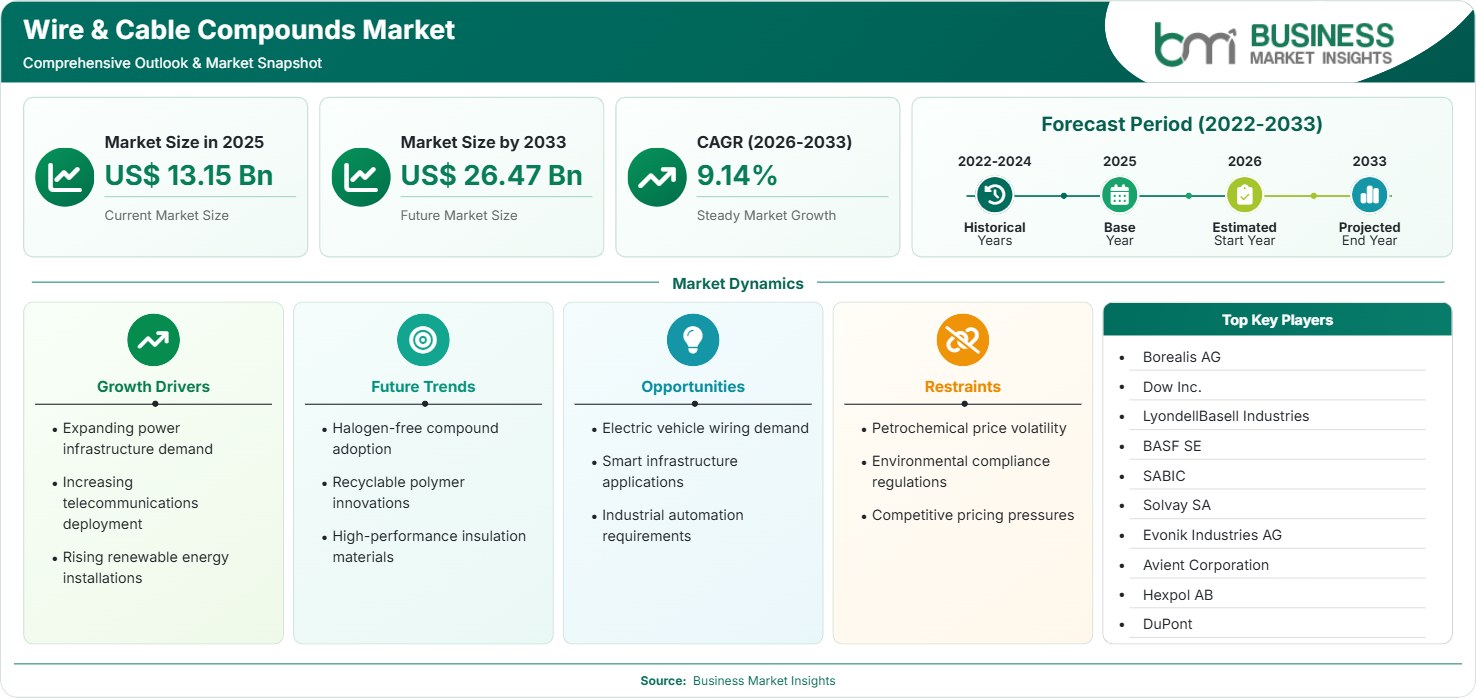
The Wire & Cable Compounds Market size was valued at USD 13.15 billion in 2025 and is projected to reach USD 26.47 billion by 2033, growing at a CAGR of 9.14% during 2026–2033. Rising investments in power transmission infrastructure, accelerating renewable energy deployment, and increasing electric vehicle production are driving demand, while smart grid modernization and advanced polymer compound innovations create substantial long-term growth opportunities.

Report Coverage
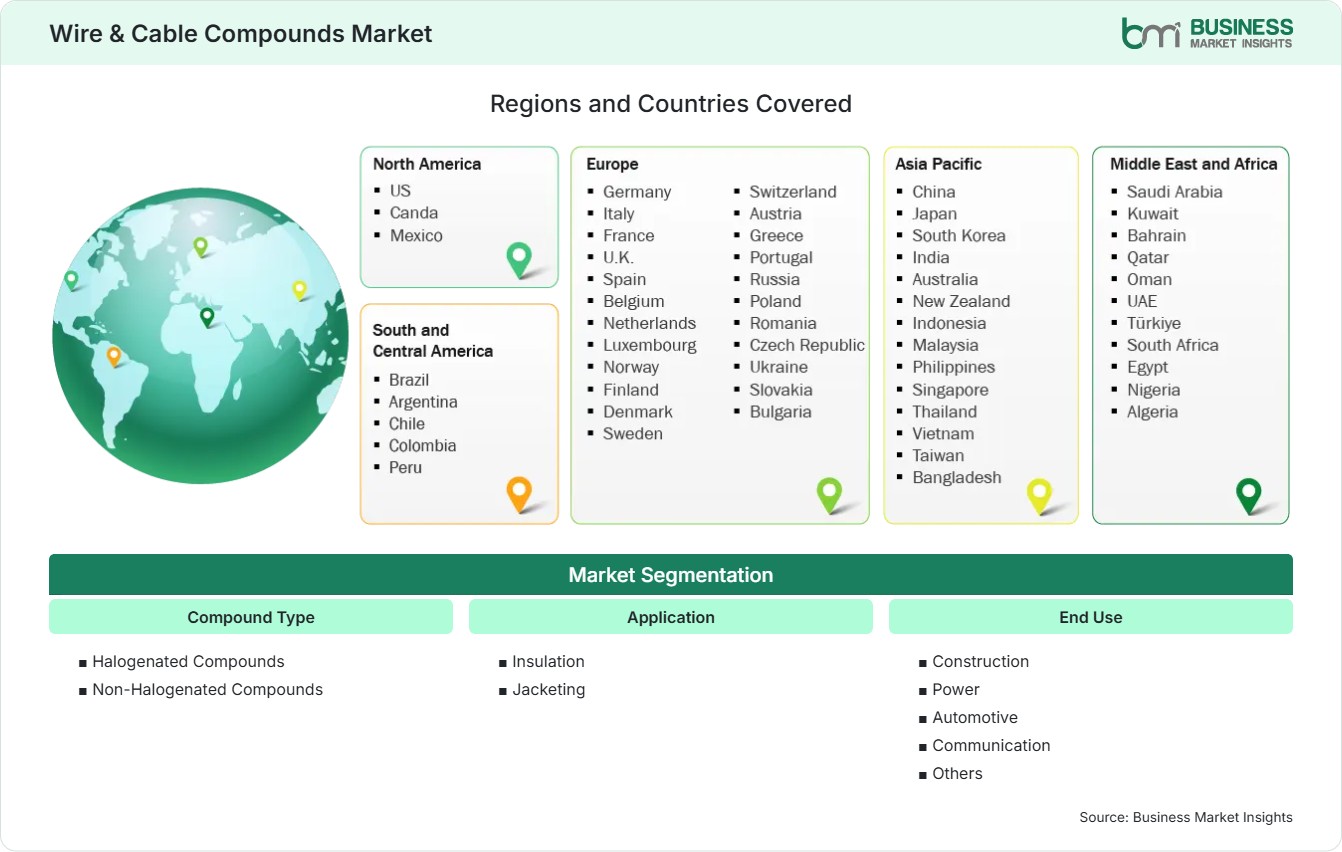
  • Compound Type: Halogenated Compounds, Non-Halogenated Compounds
  • Application: Insulation, Jacketing
  • End Use: Construction, Power, Automotive, Communication, Others
US$ 13.15 Bn Market size in 2025
US$ 26.47 Bn Market Size by 2033
9.14% CAGR, 2026 - 2033
2026-2033 Forecast Period

AI Overview

Wire & Cable Compounds Market Summary

  • North America Region: North America holds 31%–34% market share in 2025, growing with a 8.2%–8.7% CAGR during 2026–2033, supported by grid modernization, renewable energy integration, and rising investments in high-performance cable insulation materials. The United States remains the regional leader, expanding at a 8.4%–8.8% CAGR through infrastructure modernization and EV manufacturing growth.
  • Fastest Growing Region: Asia Pacific accounts for 37%–40% market share in 2025 and is projected to expand at a 10.1%–10.6% CAGR through 2033, driven by industrialization, power transmission projects, telecommunications expansion, and strong manufacturing investments across emerging economies.
  • Leading Segment: Non-Halogenated Compounds represent 62%–65% market share in 2025 and are expected to grow at a 9.6%–10.1% CAGR during 2026–2033, supported by stricter fire safety regulations, environmental compliance requirements, and increasing preference for low-smoke cable materials.
  • High Growth Segment: Power accounts for 29%–32% market share in 2025 while registering a 10.3%–10.8% CAGR through 2033, driven by transmission network expansion, renewable energy installations, and smart grid investments across developed and developing economies.
  • Key Market Opportunity: Growing investments in smart grid infrastructure, offshore wind projects, and high-voltage transmission networks are accelerating demand for advanced polymer compounds offering enhanced thermal, electrical, and fire-resistant performance.
  • Major Market Players: Borealis AG, Dow Inc., LyondellBasell Industries N.V., BASF SE, Saudi Basic Industries Corporation (SABIC), Solvay SA, Evonik Industries AG, Avient Corporation, HEXPOL AB, DuPont de Nemours, Inc.
Strategic Insights

Wire & Cable Compounds Market: Strategic Insights

Wire & Cable Compounds Market Strategic Framework
FREE PDF
Request your free sample
Request free sample
Stakeholder View

Key Takeaways

  • The industry value chain is becoming more and more integrated with resin makers, additives, compounding, cable making, EPC service providers, utilities, and OEMs to build supply chain resilience through enhanced material innovation and manufacturing efficiency.
  • There are numerous high growth areas available in power transmission, renewables, electric cars, and telecommunications where better compounds can contribute towards enhancing safety and reliability.
  • The focus for research and development is now on halogen-free flame-retarding polymers, recyclable polymer technology, light-weight insulating material, and polymer compounds that can withstand high temperatures and voltages.
  • Asia Pacific provides the greatest opportunity for investment because of the growing manufacturing industry, urbanization, initiatives by the government for infrastructure and renewable energy transmissions.
  • Collaboration, manufacturing capacity increase, and licensing of technologies continue to be the main competitive strategies.
Geographic Outlook

Wire & Cable Compounds Market Regional Highlights

North America Wire & Cable Compounds Market

North America accounted for 31%–34% of the Wire & Cable Compounds Market share in 2025 and is expected to expand at a 8.2%–8.7% CAGR during 2026–2033. The regional demand is driven by substantial investments in grid modernization, renewable energy transmission systems, EV charging stations, and industrial automation technologies. The government-funded investments into infrastructure development, as well as the replacement of outdated power grids, have been increasing demand for high-performing materials with improved thermal resistance and flame retardancy.

  • The United States leads regional demand through substantial investments in transmission infrastructure, hyperscale data centers, electric vehicle production, and renewable energy projects requiring advanced cable compound technologies.
  • Canada continues expanding through grid reliability projects, clean energy investments, and mining sector developments that require durable, low-smoke, halogen-free cable compounds across harsh operating environments.
  • Increasing adoption of halogen-free flame-retardant materials aligns with evolving fire safety regulations and sustainability initiatives across commercial buildings, transportation infrastructure, and industrial facilities.

US Wire & Cable Compounds Market

The United States represents the largest national market in North America, accounting for 24%–27% of global revenue in 2025 while recording a 8.4%–8.8% CAGR through 2033. Rising investments in semiconductor manufacturing, renewable energy, electric mobility, and broadband infrastructure continue strengthening domestic demand for advanced wire and cable materials capable of meeting stringent safety and performance requirements.

  • Federal infrastructure investments continue accelerating upgrades to aging transmission networks, substations, and public utilities, increasing demand for durable insulation compounds with superior electrical and thermal performance.
  • Growing electric vehicle manufacturing and charging infrastructure require lightweight, flame-retardant, and high-temperature-resistant polymer compounds supporting long-term cable reliability.
  • Expansion of hyperscale data centers and broadband deployment strengthens consumption of specialty cable compounds for high-speed communication and digital infrastructure projects.

Europe Wire & Cable Compounds Market

Europe held 24%–27% of global market revenue in 2025 and is projected to grow at a 8.7%–9.2% CAGR through 2033. Strong environmental regulations, renewable energy investments, and modernization of electrical infrastructure continue supporting market expansion. Germany remains the largest regional market owing to its industrial manufacturing base, while Poland records the highest growth driven by infrastructure modernization and expanding industrial investments.

  • Germany leads regional consumption through advanced automotive manufacturing, renewable energy deployment, and strong demand for premium halogen-free cable compounds across industrial applications.
  • Poland is projected to achieve the highest regional CAGR of 9.6%–10.1%, supported by rapid industrialization, grid modernization initiatives, and increasing foreign manufacturing investments.
  • European Union regulations promoting low-smoke, halogen-free cable systems continue encouraging adoption across commercial buildings, transportation, and public infrastructure developments.

Asia Pacific Wire & Cable Compounds Market

Asia Pacific accounted for 37%–40% of global Wire & Cable Compounds Market revenue in 2025 and is anticipated to expand at a 10.1%–10.6% CAGR through 2033, making it the fastest-growing regional market. Rapid urbanization, industrial expansion, power transmission investments, and telecommunications infrastructure development continue driving regional demand. China remains the largest contributor, while India demonstrates the fastest growth due to expanding manufacturing capacity and infrastructure development.

  • China dominates regional consumption through large-scale power grid expansion, renewable energy deployment, and extensive manufacturing of electrical cables serving domestic and export markets.
  • India is forecast to record the highest regional CAGR of 10.8%–11.3%, supported by smart city initiatives, transmission infrastructure expansion, electric vehicle production, and industrial corridor development.
  • Southeast Asian economies continue strengthening regional demand through increasing investments in telecommunications, industrial parks, renewable energy facilities, and urban infrastructure projects.

Rest of World Wire & Cable Compounds Market

The Rest of World region represented 7%–9% of global revenue in 2025 and is projected to grow at a 8.8%–9.3% CAGR during the forecast period. South & Central America continue to benefit from expanding power distribution projects, mining developments, and industrial infrastructure investments that require reliable cable materials.

The Middle East & Africa are witnessing increasing demand through renewable energy projects, utility modernization, oil and gas infrastructure upgrades, and smart city developments. Brazil remains the leading market in South & Central America, while Saudi Arabia records the highest regional growth due to extensive infrastructure diversification and energy transition initiatives.

  • Brazil leads regional demand through transmission expansion, industrial manufacturing, renewable energy integration, and modernization of public utility infrastructure requiring advanced insulation compounds.
  • Saudi Arabia is expected to achieve the highest regional CAGR of 9.5%–10.0%, driven by Vision 2030 infrastructure investments, industrial diversification, and utility modernization programs.
  • Mining, oil and gas, and utility industries continue creating steady demand for durable cable compounds capable of operating under harsh environmental conditions.
Global Market Geography
FREE PDF
Request your free sample
Request free sample
Segment Analysis

Wire & Cable Compounds Market Segmentation

Compound Type

Compound Type represents the largest segment owing to its direct influence on cable performance, fire safety, durability, and regulatory compliance across industrial applications. Non-Halogenated Compounds dominate adoption due to increasing environmental regulations and demand for low-smoke, flame-retardant materials. The segment accounted for 62%–65% market share in 2025 and is anticipated to expand at a 9.6%–10.1% CAGR through 2033. The Wire & Cable Compounds Market scope continues expanding as advanced polymer technologies improve electrical insulation, thermal stability, and sustainability.

  • Halogenated Compounds: Conventional compounds continue serving cost-sensitive applications requiring proven processing performance, mechanical durability, and compatibility with established cable manufacturing systems across construction, utilities, and industrial installations.
    • Polyvinyl Chloride (PVC): PVC remains extensively utilized because of its excellent insulation properties, affordability, processing flexibility, and broad acceptance across low- and medium-voltage cable manufacturing applications.
    • Chlorinated Polyethylene (CPE): CPE provides superior weather resistance, flexibility, abrasion protection, and chemical durability, making it suitable for demanding industrial environments and specialty cable applications.
  • Non-Halogenated Compounds: Growing regulatory emphasis on fire safety and environmental compliance accelerates adoption of advanced polymer compounds offering reduced smoke emissions, improved flame retardancy, and enhanced electrical performance.
    • Cross-Linked Polyethylene (XLPE): XLPE delivers outstanding dielectric strength, thermal endurance, and moisture resistance, supporting high-voltage transmission, renewable energy systems, and underground power distribution applications.
    • Thermoplastic Elastomers (TPE): TPE compounds combine flexibility, mechanical resilience, and efficient processing, making them suitable for automotive wiring, robotics, and flexible industrial cable systems.
    • Thermoplastic Olefins (TPO): TPO materials offer lightweight performance, weather resistance, and chemical stability while supporting recyclable cable designs aligned with evolving sustainability requirements.
    • Thermoplastic Polyurethane (TPU): TPU provides exceptional abrasion resistance, flexibility, oil resistance, and mechanical strength for demanding automation, mining, and heavy-duty industrial cable applications.
    • Thermoplastic Vulcanizates (TPV): TPV compounds enhance elasticity, thermal stability, and environmental durability, enabling reliable performance across automotive wiring harnesses and outdoor electrical infrastructure.

Application

Application segmentation is primarily driven by performance requirements, electrical safety standards, and operational reliability across diverse industries. Insulation remains the dominant application because it ensures electrical protection, dielectric strength, and long-term cable integrity. This segment accounted for 55%–58% of the market in 2025 while registering a 9.1%–9.6% CAGR during the forecast period, supported by expanding investments in power transmission, industrial automation, and telecommunications infrastructure.

  • Insulation: Insulation compounds ensure electrical safety, voltage stability, moisture protection, and long-term operational reliability, supporting widespread adoption across power distribution, automotive, telecommunications, and industrial electrical systems.
  • Jacketing: Jacketing compounds protect cables against abrasion, chemicals, ultraviolet radiation, moisture, and mechanical damage, extending cable lifespan across demanding outdoor, underground, marine, and industrial environments.

End Use

End-use demand is increasingly shaped by electrification, infrastructure modernization, renewable energy expansion, and digital transformation initiatives worldwide. The Power sector leads market consumption because transmission and distribution networks require high-performance polymer compounds capable of supporting elevated voltage and harsh operating environments. The segment represented 29%–32% market share in 2025 and is projected to grow at a 10.3%–10.8% CAGR through 2033, reflecting strong investments in modern energy infrastructure and smart grid deployment.

  • Construction: Construction applications utilize advanced cable compounds to improve fire safety, building code compliance, electrical insulation, and durability across residential, commercial, and institutional infrastructure developments.
  • Power: Power utilities require premium insulation and jacketing materials capable of withstanding elevated temperatures, environmental exposure, and long-term electrical loading within transmission and distribution systems.
  • Automotive: Automotive manufacturers increasingly adopt lightweight, high-temperature-resistant cable compounds supporting electric vehicles, autonomous driving technologies, advanced electronics, and enhanced vehicle safety systems.
  • Communication: Expanding fiber-optic deployment, 5G infrastructure, and hyperscale data centers continue driving demand for specialized cable compounds offering excellent signal integrity, flexibility, and environmental protection while reflecting emerging Wire & Cable Compounds Market trends.
Market Forces

Wire & Cable Compounds Market Dynamics

Key Market Drivers

Expanding power infrastructure demand

Growth in investments in transmission and distribution systems is rising at a rapid rate in order to modernize the old electrical grid system in each country and incorporate renewable sources into the grid. As per the International Energy Agency (IEA), it is vital that investments be made on an annual basis in order to facilitate the process of grid electrification. Therefore, there exists a constant need for insulation materials.

Increasing telecommunications deployment

Increased demand for advanced wire and cable products is being driven by rapid expansion in broadband connectivity, fiber optics, 5G, and hyperscale data centers. Digital infrastructure improvements have been undertaken across governments globally as part of efforts to increase connectivity and enable industrial digitalization. Companies require effective communication networks to enable cloud computing, artificial intelligence, and automation.

Rising renewable energy installations

The installations of renewable energy capacities are still providing significant demand for specialty cables made of compounds that can stand up to UV exposure, moisture, chemicals, and temperature extremes and perform efficiently throughout the lifetime of operation. Polymer producers are still working on halogen-free and cross-linked insulations of cables that comply with rising requirements of environmental and safety regulations.

Key Market Opportunities

Electric vehicle wiring demand

The production of electric vehicles across the world is rising exponentially, providing great chances for companies that manufacture high-performance wire and cable compounds. These compounds have to be light-weight and durable enough to withstand heat, vibration, and electrical stresses. According to Wire & Cable Compounds Market Forecasts, there are growing investments being made into flame retardant, recyclable, and high voltage insulation compounds for electric mobility.

Smart infrastructure applications

The need for smart cables is rising owing to their applications in intelligent cities, smart transport systems, smart buildings, and utility networks, all of which involve surveillance and digital communications. For these systems, materials that can provide superior performance in terms of fire retardance, durability, and weathering capability are required.

Industrial automation requirements

The increased usage of robotics, automated manufacturing facilities, Internet of Things applications in industry, and advanced manufacturing machinery provides room for the utilization of specific cable compounds that are more flexible and mechanically tough. Flexible robotic cables, fast data communication networks, and motion control devices need polymer materials which can withstand bending, wear, chemicals, and mechanical stresses.

Market Restraints and Challenges

Petrochemical price volatility

Factor: Fluctuating crude oil and feedstock prices directly influence the cost of polyethylene, PVC, elastomers, and performance additives used in cable compounds.

Impact: Manufacturers experience margin pressure, pricing uncertainty, and procurement complexity, often requiring contract renegotiations and inventory optimization strategies. Smaller producers are particularly affected because they possess limited purchasing power and reduced flexibility to absorb prolonged raw material cost fluctuations.

Environmental compliance regulations

Factor: Compliance with evolving environmental standards requires continuous reformulation of compounds, additional product testing, certification processes, and investment in sustainable manufacturing technologies.

Impact: Product development costs increase while commercialization timelines may extend, particularly for manufacturers serving multiple international markets with differing regulatory requirements. Companies must therefore invest consistently in research, compliance management, and environmentally responsible material innovations to maintain long-term competitiveness.

Company Analysis

Competitive Landscape

The competition environment is marked with sustained investments in polymer innovation, flame-retardants technology, sustainable materials development, and expansion of capacities. The Wire & Cable Compounds Market analysis states that the competition in the industry is based on vertical integration, innovative compounding technology, cooperation with cable producers, and diversified production bases.

Company Name

Overview (1–2 lines)

Products and Services Relevant to this Market

Borealis AG

Global polyolefin manufacturer specializing in advanced polymer solutions for energy, infrastructure, and wire and cable applications.

XLPE compounds, polyolefin insulation materials, semiconductive compounds, cable material technologies, and technical support services.

Dow Inc.

International materials science company delivering high-performance polymers and specialty materials for electrical infrastructure applications.

Wire and cable insulation resins, elastomers, silicone technologies, flame-retardant compounds, and polymer innovation solutions.

LyondellBasell Industries N.V.

Global chemical producer with extensive expertise in polyolefins and advanced polymer technologies for industrial markets.

Polyethylene compounds, cable insulation materials, specialty polymers, compound technologies, and sustainable material solutions.

BASF SE

Leading global chemical company focused on advanced performance materials and sustainable polymer innovations.

Engineering plastics, flame-retardant additives, polymer compounds, cable insulation materials, and specialty chemical solutions.

Saudi Basic Industries Corporation (SABIC)

Diversified global petrochemical producer supplying advanced thermoplastics and polymer solutions for electrical industries.

Polyolefin compounds, engineering thermoplastics, cable insulation materials, specialty resins, and sustainable polymer technologies.

Solvay SA

Specialty chemicals company recognized for high-performance polymers used in demanding electrical and industrial environments.

High-performance polymers, specialty cable compounds, flame-retardant materials, and advanced insulation technologies.

Evonik Industries AG

Global specialty chemicals manufacturer emphasizing innovative additives and performance materials for polymer applications.

Performance additives, specialty polymers, cable compound additives, processing aids, and material optimization solutions.

Avient Corporation

Global provider of customized polymer compounds and color technologies serving diverse industrial applications.

Customized cable compounds, flame-retardant formulations, thermoplastic elastomers, color solutions, and technical compounding services.

HEXPOL AB

International polymer compounding company serving electrical, automotive, industrial, and infrastructure sectors.

Thermoplastic compounds, elastomer compounds, specialty cable materials, customized formulations, and polymer processing expertise.

DuPont de Nemours, Inc.

Advanced materials company supplying high-performance polymers for electrical insulation and critical infrastructure applications.

Engineering polymers, specialty insulation materials, high-performance resins, cable technologies, and advanced material engineering.

Industry Activity

Recent Developments

October 2025

Borealis AG announced a significant investment to expand XLPE production capacity at its Stenungsund, Sweden facility, increasing the supply of insulation materials for medium-, high-, and extra-high-voltage power cables used in grid modernization and renewable energy infrastructure.

May 2025

Borealis AG and Borouge Plc announced a major expansion of their global cross-linked polyethylene (XLPE) and semiconductive (SEMICON) compound production capacity, including the completion of a semiconductive compounding upgrade in Antwerp and the ongoing expansion of XLPE production at the Borouge 4 facility in the UAE to support high-voltage power cable demand.

April 2025

Prysmian Group and Dow Inc. partnered to enhance production of Sirocco microduct fiber-optic cables using Dow's AXELERON telecommunications cable compound, improving cable manufacturing efficiency and supporting the expansion of high-speed broadband infrastructure.

February 2025

Avient Corporation expanded its ECCOH XL portfolio with the launch of ECCOH XL 8054, a cross-linkable flame-retardant compound for low-smoke wire and cable insulation designed to meet stringent European fire safety requirements.

Trust & Transparency

Research Methodology

The market analysis combines proprietary research with secondary data from government agencies, company disclosures, regulatory filings, industry databases and expert interviews. Market estimates are validated through data triangulation, cross-market benchmarking and analyst review.

View Full Research Methodology

Questions Answered

Frequently Asked Questions

What are the emerging opportunities for manufacturers?

Major opportunities include advanced compounds for electric vehicles, smart grids, renewable energy infrastructure, industrial automation, recyclable polymer technologies, and halogen-free flame-retardant materials that support increasingly stringent environmental and electrical safety standards.

Which companies are covered in the Market Report?

The Wire & Cable Compounds Market Report includes Borealis AG, Dow Inc., LyondellBasell Industries N.V., BASF SE, Saudi Basic Industries Corporation (SABIC), Solvay SA, Evonik Industries AG, Avient Corporation, HEXPOL AB, and DuPont de Nemours, Inc.

Which region is expected to experience the highest growth?

Asia Pacific is projected to register the fastest expansion during the forecast period with a 10.1%–10.6% CAGR, supported by rapid industrialization, grid expansion, renewable energy investments, telecommunications infrastructure development, and increasing manufacturing capacity.

Which compound type dominates the market?

Non-Halogenated Compounds hold the largest market position with a 62%–65% share in 2025. Their adoption is increasing due to stringent fire safety regulations, environmental compliance requirements, and superior low-smoke performance across power, construction, transportation, and industrial applications.

What are the primary factors driving the Wire & Cable Compounds Market?

The market is primarily driven by expanding electricity transmission infrastructure, renewable energy integration, rapid deployment of telecommunications networks, industrial automation, and increasing production of electric vehicles requiring high-performance insulation and jacketing compounds.

Access the Full Wire & Cable Compounds Market Report

Get segment-level forecasts, regional estimates, competitive benchmarking, company profiles and downloadable Excel datasets.

Access the full Wire & Cable Compounds Market Report
350 pages PDF & Excel | 2026-07-31