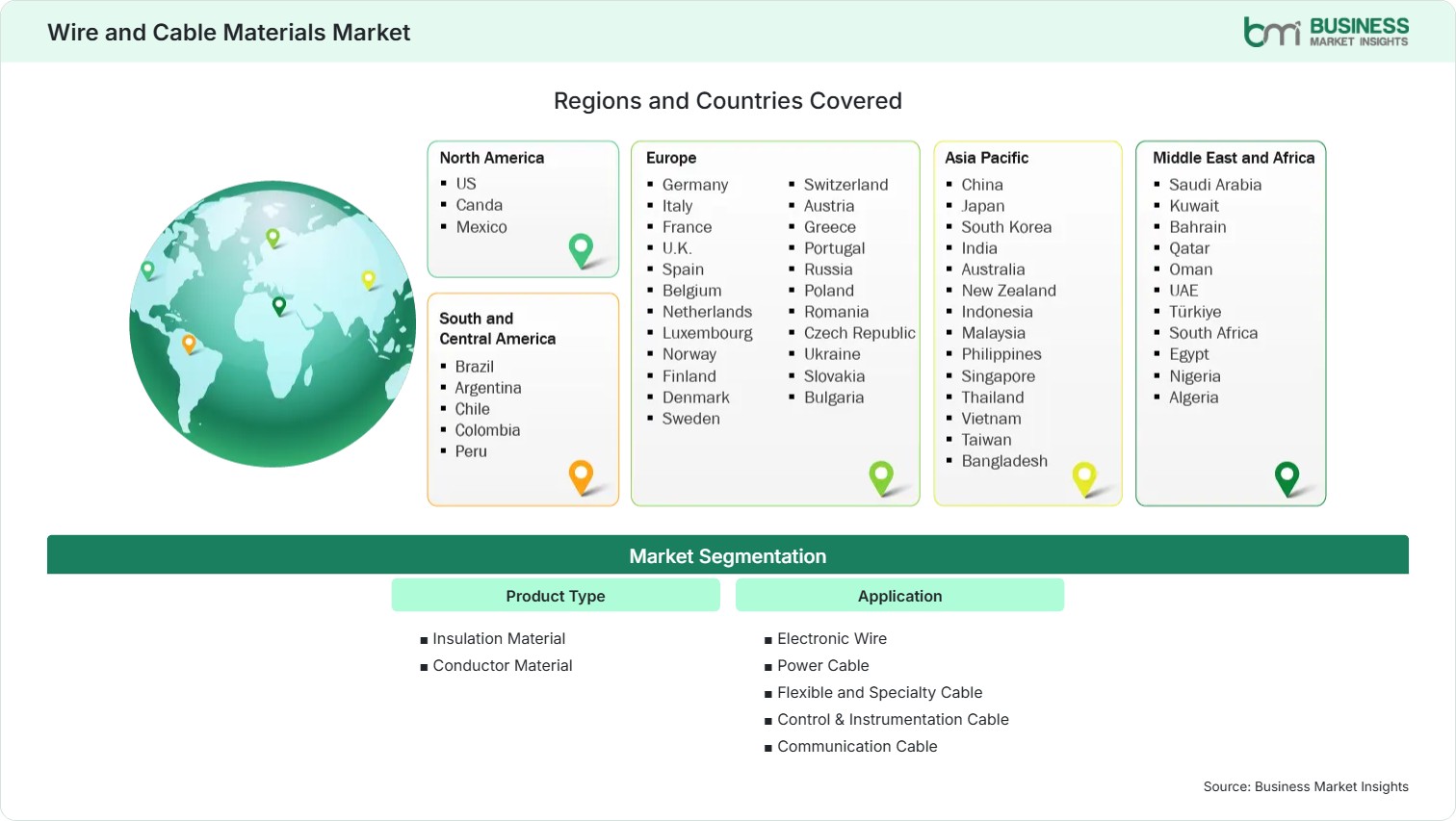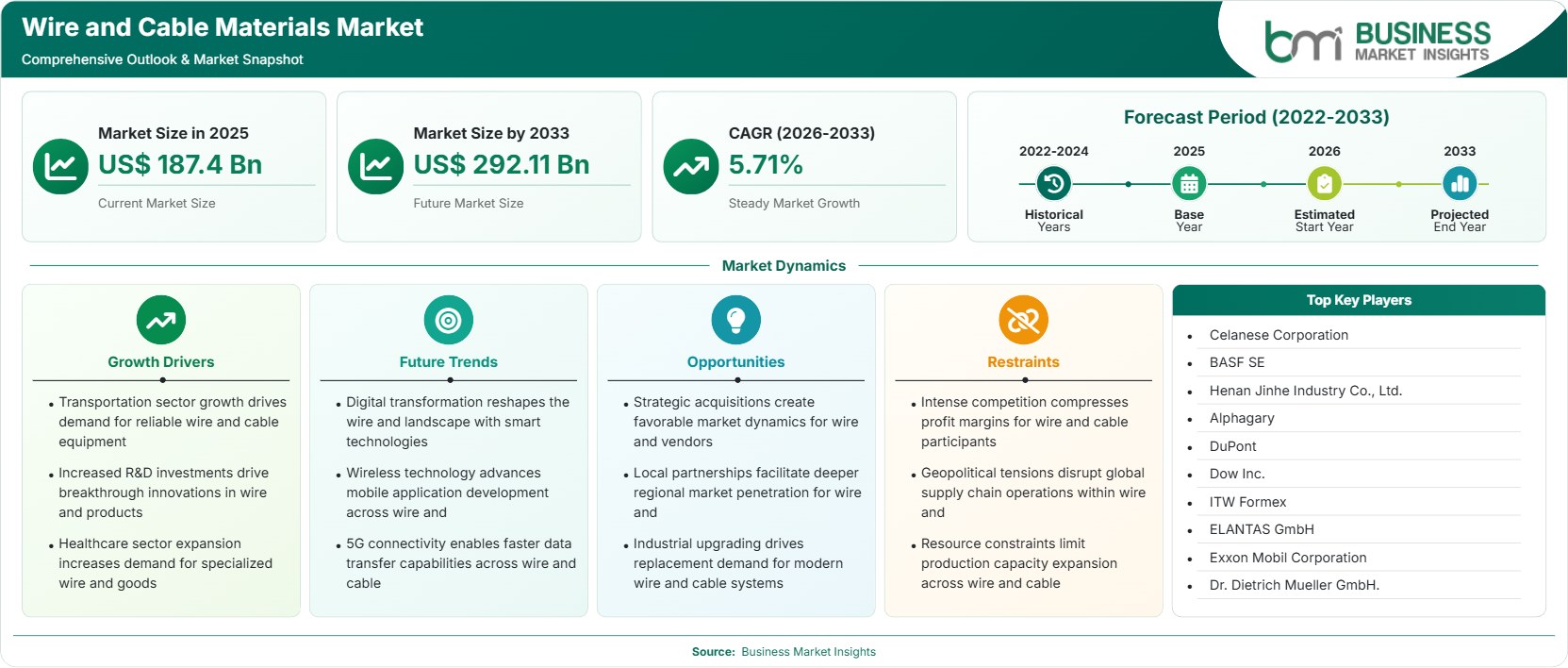
Wire and Cable Materials Market Regional Highlights
North America Wire and Cable Materials Market
North America represents approximately 22%–24% share in 2025, with a 5.3%–5.7% CAGR from 2026–2033. Demand is supported by grid replacement, data-center construction, EV infrastructure, industrial automation, and renewable integration. The US dominates regional consumption, while Canada benefits from transmission investment and clean-energy projects. Mexico adds manufacturing demand through automotive and electronics production. Regional Wire and Cable Materials Market share is reinforced by strong material qualification standards and demand for high-performance compounds.
- Grid modernization is supporting demand for XLPE, high-voltage insulation, semiconductive compounds, and durable jacketing materials as utilities increase transmission capacity and improve network reliability.
- Data-center construction is expanding demand for low-smoke, flame-retardant, high-speed communication, power, and flexible cable materials designed for dense installations and demanding thermal environments.
- Automotive electrification is increasing demand for lightweight, heat-resistant, abrasion-resistant materials capable of protecting high-voltage battery, charging, sensor, and powertrain wiring.
- Regional Wire and Cable Materials Market growth is supported by domestic manufacturing investments, reshoring initiatives, industrial automation, and infrastructure programs requiring dependable electrical connectivity.
US Wire and Cable Materials Market
The US accounts for approximately 70%–75% of North American demand in 2025 and is projected to expand at a 5.4%–5.8% CAGR, according to Wire and Cable Materials Market Forecasts. Demand is concentrated across power transmission, construction, data centers, automotive, aerospace, industrial automation, and communications. The country's material mix favors certified insulation and jacketing compounds capable of satisfying UL, NEC, IEEE, and application-specific requirements. Federal and private infrastructure investment strengthens the long-term procurement pipeline.
- Hyperscale data-center expansion is increasing demand for high-speed communication cables, flame-retardant materials, power distribution cables, and compounds capable of maintaining reliability in high-density environments.
- Transmission investment is strengthening demand for XLPE and semiconductive systems. The IEA identifies cable supply chains as an important constraint as grid investment accelerates globally.
- EV adoption is creating new requirements for flexible charging cables, high-voltage battery systems, lightweight conductors, and thermally stable insulation materials.
Europe Wire and Cable Materials Market
Europe holds approximately 19%–21% share in 2025, expanding at 4.8%–5.2% CAGR through 2033. Germany, France, Italy, and the UK remain important industrial markets, while Spain and Poland provide attractive growth opportunities. Europe combines stringent fire-safety requirements with decarbonization objectives, increasing demand for low-smoke, halogen-free, recyclable, and high-performance compounds. The region's Wire and Cable Materials Market share is shaped by renewable integration, rail electrification, EV manufacturing, industrial automation, and cross-border transmission projects.
- Germany remains a leading industrial market, with approximately 4.8%–5.2% CAGR, supported by automotive electrification, machinery, renewable generation, automation, and electrical equipment manufacturing.
- France is positioned around 4.7%–5.1% CAGR, with demand linked to grid reinforcement, rail systems, nuclear-related electrical infrastructure, renewable projects, and industrial modernization.
- Spain and Poland provide higher-growth opportunities, with approximately 5.5%–6.2% CAGR, reflecting renewable deployment, manufacturing investment, construction activity, and infrastructure modernization.
- Fire performance and low-emission requirements are strengthening demand for HFFR, LSFH, and specialized jacketing compounds in transportation, buildings, data infrastructure, and public facilities.
Asia Pacific Wire and Cable Materials Market
Asia Pacific accounts for approximately 43%–46% share in 2025, making it the largest regional market, with 6.1%–6.6% CAGR through 2033. China, Japan, South Korea, and India lead consumption, while Southeast Asia provides accelerating opportunities. Regional Wire and Cable Materials Market growth is supported by industrial expansion, urban electrification, renewable generation, EV manufacturing, telecommunications, electronics production, and large-scale transmission projects. China remains the largest demand center, while India provides strong incremental growth potential.
- China is the leading regional market and is estimated at approximately 6.0%–6.5% CAGR, supported by EV production, renewable power, industrial automation, telecommunications, and extensive grid investment.
- India represents a high-growth market at approximately 7.0%–7.6% CAGR, supported by electrification, manufacturing expansion, renewable projects, rail infrastructure, data centers, and urban development.
- Japan and South Korea remain technologically advanced markets, with approximately 4.8%–5.4% CAGR, driven by automotive electronics, robotics, semiconductors, industrial automation, and specialized electrical equipment.
- Southeast Asia is attracting cable-material investment through manufacturing relocation, infrastructure development, renewable energy projects, and expanding electronics and automotive supply chains.
Rest of World Wire and Cable Materials Market
Rest of World represents approximately 10%–12% Wire and Cable Materials Market share in 2025, with a 5.6%–6.2% CAGR through 2033. South and Central America benefit from renewable generation, mining, industrial electrification, and telecommunications upgrades. Brazil and Mexico are important demand centers, while Chile and Colombia provide infrastructure opportunities. Middle Eastern markets are investing heavily in grid expansion, renewable power, industrial facilities, and smart infrastructure, increasing demand for advanced cable insulation and durable jacketing compounds.
Latin American demand is increasingly linked to renewable generation, mining electrification, urban construction, and industrial modernization. Brazil is estimated at approximately 5.8%–6.3% CAGR, while Chile and Colombia offer approximately 6.0%–6.6% CAGR opportunities.
- Saudi Arabia and the United Arab Emirates are supporting higher-value cable-material demand through renewable projects, smart-city programs, industrial diversification, and large-scale infrastructure development.
- Brazil remains a regional anchor because renewable electricity, transmission expansion, industrial projects, and construction activity require substantial volumes of power and specialty cables.
- Chile's mining sector creates demand for highly durable materials capable of resisting heat, abrasion, chemicals, moisture, and continuous industrial operation.
- Middle Eastern renewable projects increasingly require materials engineered for high ambient temperatures, ultraviolet exposure, mechanical stress, and long service intervals.