
Biodegradable Mulch Film Market Outlook: Size, Share, Trends, Growth Analysis, Competitive Landscape & Forecast, 2026-2033

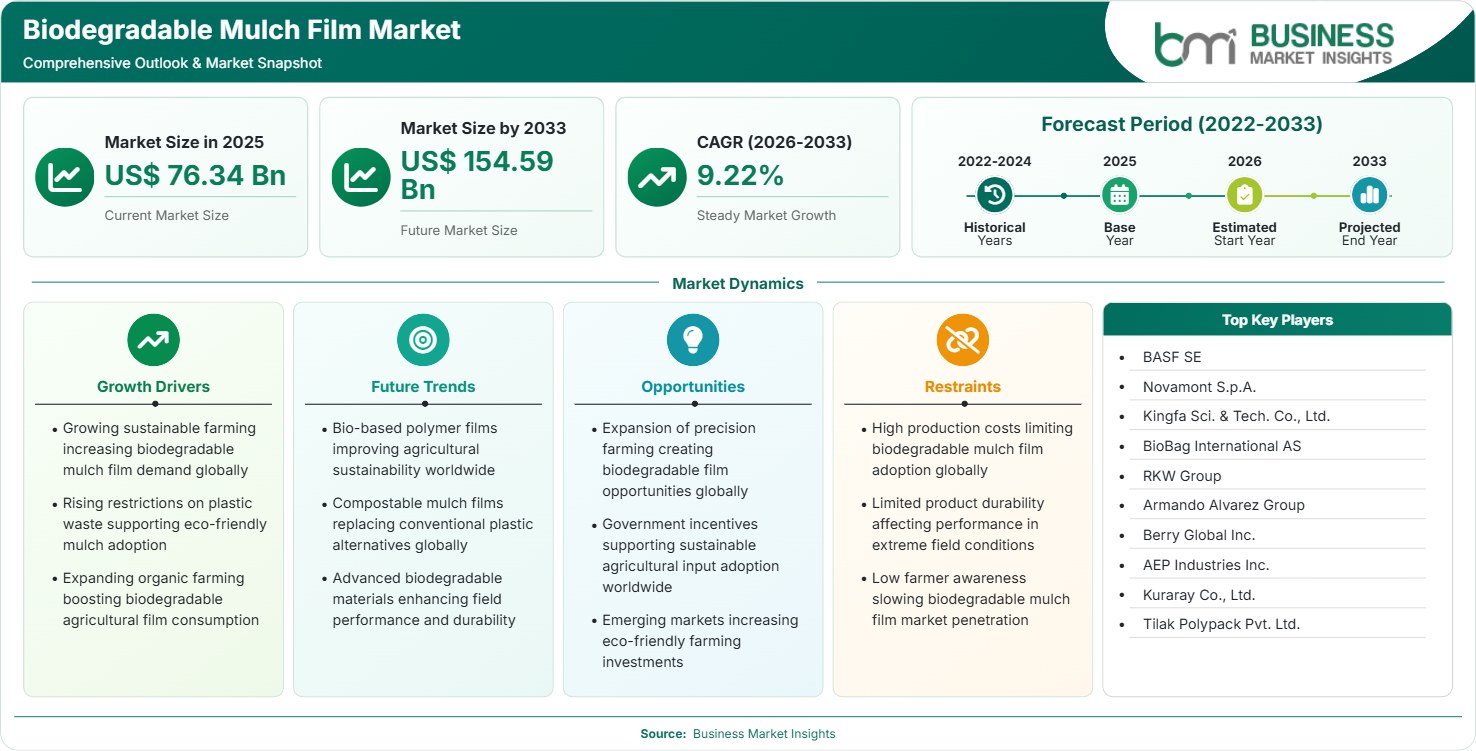
The Biodegradable Mulch Film Market size was valued at US$ 76.34 billion in 2025 and is projected to reach US$ 154.59 billion by 2033, growing at a CAGR of 9.22% during 2026–2033. Market expansion is supported by sustainable farming practices, organic agriculture growth, government initiatives promoting eco-friendly agricultural inputs, and increasing restrictions on conventional plastic mulch films.

Report Coverage
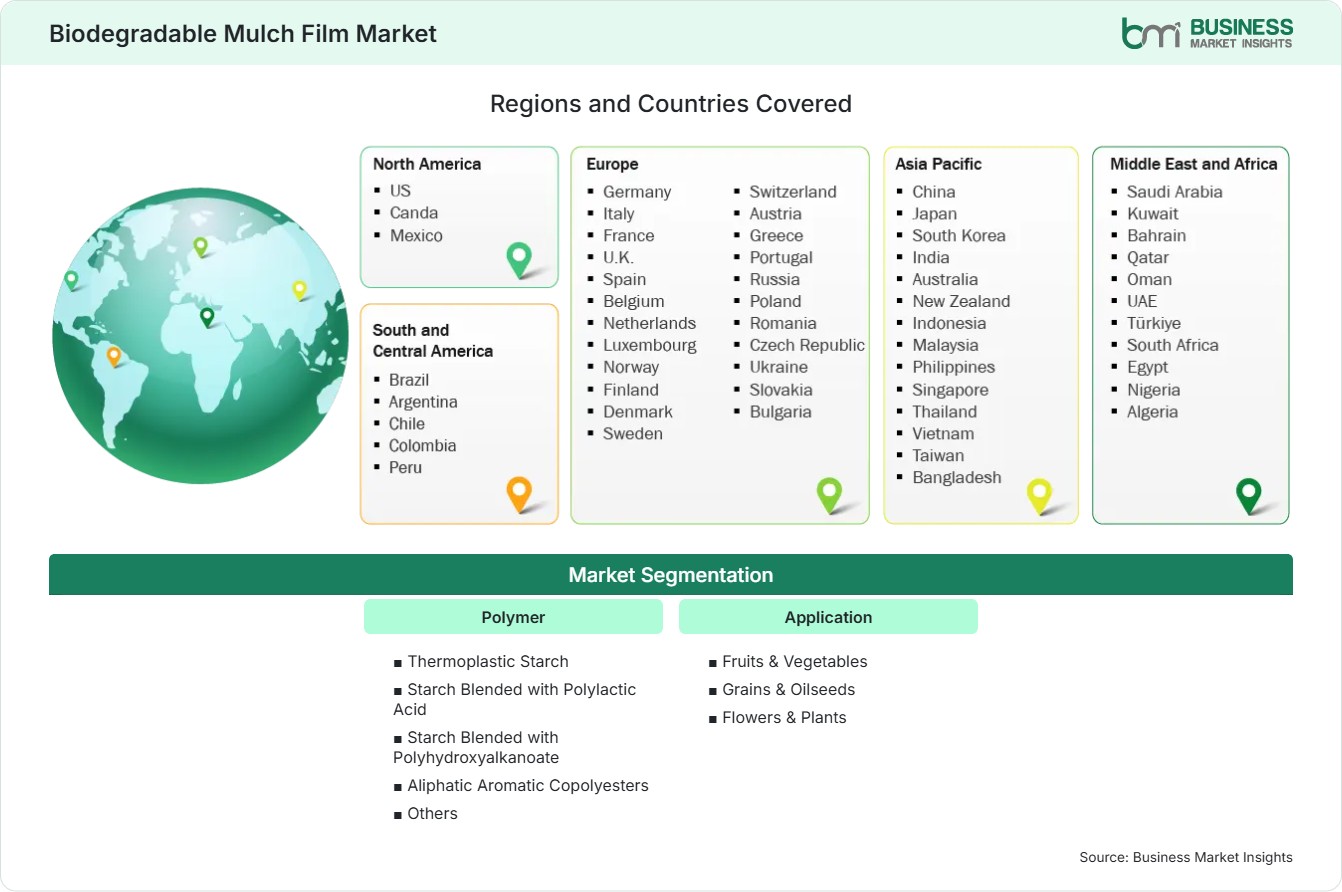
  • Polymer: Thermoplastic Starch, Starch Blended with Polylactic Acid, Starch Blended with Polyhydroxyalkanoate, Aliphatic Aromatic Copolyesters, Others
  • Application: Fruits & Vegetables, Grains & Oilseeds, Flowers & Plants
US$ 76.34 Bn Market size in 2025
US$ 154.59 Bn Market Size by 2033
9.22% CAGR, 2026 - 2033
2026-2033 Forecast Period

AI Overview

Biodegradable Mulch Film Market Summary

  • North America Region: North America accounted for 22%–26% market share in 2025 and is projected to grow at a CAGR of 8.3%–9.1% during 2026–2033. Growth is driven by sustainable agriculture initiatives, government support for environmentally friendly farming practices, and increasing adoption of biodegradable agricultural products. The United States remains the dominant regional market with a CAGR of 8.5%–9.3%.
  • Fastest Growing Region: Asia Pacific represented 38%–42% market share in 2025 and is expected to register a CAGR of 10.0%–10.8% during 2026–2033. Expansion is supported by growing agricultural production, rising organic farming, government sustainability initiatives, and increasing awareness regarding biodegradable farming materials.
  • Leading Segment: Thermoplastic Starch (TPS) accounted for 28%–33% biodegradable mulch film market share in 2025 and is anticipated to grow at a CAGR of 9.0%–9.8% during 2026–2033 due to biodegradability, affordability, and compatibility with agricultural applications.
  • High Growth Segment: Fruits & Vegetables represented 46%–51% market share in 2025 and are projected to grow at a CAGR of 9.8%–10.6% during 2026–2033 owing to increasing demand for sustainable crop cultivation and improved soil management.
  • Key Market Opportunity: Precision farming expansion, eco-friendly agricultural practices, and supportive government policies are creating significant opportunities for biodegradable mulch film manufacturers.
  • Major Market Players: BASF SE, Novamont S.p.A., Kingfa Sci. & Tech. Co., Ltd., BioBag International AS, RKW Group, Armando Alvarez Group, Berry Global Inc., AEP Industries Inc., Kuraray Co., Ltd., Tilak Polypack Pvt. Ltd.
Strategic Insights

Biodegradable Mulch Film Market: Strategic Insights

Biodegradable Mulch Film Market Strategic Framework
FREE PDF
Request your free sample
Request free sample
Stakeholder View

Key Takeaways

  • Sustainable farming practices and plastic waste reduction initiatives are driving global adoption of biodegradable mulch films.
  • Precision agriculture and organic farming represent significant opportunities for manufacturers and raw material suppliers.
  • Innovation is focused on improving durability, biodegradability, crop productivity, and cost-effective polymer formulations.
  • Asia Pacific offers substantial growth opportunities due to expanding agricultural activities and government sustainability programs.
  • Strategic collaborations, research investments, and production capacity expansion remain major competitive strategies.
  • Increasing environmental regulations are encouraging farmers to transition from conventional plastic mulch films to biodegradable alternatives.
Geographic Outlook

Biodegradable Mulch Film Market Regional Highlights

North America Biodegradable Mulch Film Market

North America accounted for approximately 22%–26% of global demand in 2025 and is projected to grow at a CAGR of 8.3%–9.1% during 2026–2033. The Biodegradable Mulch Film Market share in the region is supported by advanced farming practices, environmental regulations, and increasing adoption of sustainable agricultural technologies. Government initiatives promoting biodegradable materials and strong organic farming industries continue supporting market expansion.

  • The United States dominates regional demand through advanced agricultural practices and increasing biodegradable product adoption.
  • Canada supports market growth through sustainable farming initiatives and expanding organic cultivation.
  • Government policies encouraging plastic waste reduction continue accelerating biodegradable mulch film demand.
  • Agricultural technology adoption supports improved field productivity and environmental sustainability.

US Biodegradable Mulch Film Market

The United States represented approximately 82%–86% of North America's market in 2025 and is expected to register a CAGR of 8.5%–9.3% during 2026–2033. Growth is supported by expanding organic agriculture, precision farming technologies, and increasing regulatory focus on reducing agricultural plastic waste. Farmers are adopting biodegradable mulch films to improve soil quality while reducing disposal costs and environmental impact.

  • Organic farming expansion continues increasing biodegradable mulch film demand.
  • Precision agriculture technologies are supporting efficient crop management practices.
  • Government sustainability initiatives encourage adoption of environmentally friendly agricultural inputs.
  • Manufacturers continue investing in high-performance biodegradable film technologies.

Europe Biodegradable Mulch Film Market

Europe accounted for approximately 27%–31% of global demand in 2025 and is forecast to grow at a CAGR of 8.7%–9.5% during 2026–2033. Strong environmental regulations, extensive organic farming activities, and sustainability-focused agricultural policies support market expansion across the region. Countries including Germany, Italy, France, and Spain are investing in biodegradable agricultural products to reduce conventional plastic usage and improve environmental performance.

  • Germany promotes sustainable agriculture through environmentally responsible farming practices.
  • Italy remains a major producer and adopter of biodegradable mulch film technologies.
  • France supports market expansion through organic farming incentives.
  • Spain continues increasing demand through horticulture and fruit cultivation activities.
  • Regional manufacturers are investing in innovative biodegradable polymer technologies.

Asia Pacific Biodegradable Mulch Film Market

Asia Pacific accounted for approximately 38%–42% of global demand in 2025 and is projected to expand at a CAGR of 10.0%–10.8% during 2026–2033. The region represents the fastest-growing market due to increasing agricultural production, government support for sustainable farming, expanding organic cultivation, and rising awareness regarding environmentally friendly agricultural inputs. China, India, Japan, South Korea, and Southeast Asian countries are key contributors. Farmers are increasingly adopting biodegradable mulch films to improve crop productivity while reducing plastic waste.

  • China leads regional demand through large-scale agricultural production and sustainable farming initiatives.
  • India is expanding adoption due to growing organic farming and government support for eco-friendly agricultural practices.
  • Japan and South Korea continue investing in advanced agricultural technologies and biodegradable farming inputs.
  • Southeast Asian countries are increasing biodegradable mulch film usage across horticulture and vegetable cultivation.
  • Regional manufacturers are expanding production capacity to meet rising domestic and export demand.

Rest of World Biodegradable Mulch Film Market

The Rest of World accounted for approximately 8%–12% of global demand in 2025 and is expected to grow at a CAGR of 8.4%–9.2% during 2026–2033. Latin America, the Middle East, and Africa are witnessing increasing adoption due to agricultural modernization, government sustainability initiatives, and expanding commercial farming activities. Countries including Brazil, Mexico, South Africa, and the UAE are investing in environmentally sustainable agricultural technologies.

Latin America continues expanding biodegradable mulch film adoption through commercial fruit and vegetable production, while Middle Eastern and African countries are promoting water-efficient farming and sustainable agricultural practices to improve productivity under challenging climatic conditions.

  • Brazil and Mexico are increasing adoption through commercial horticulture expansion.
  • Middle Eastern countries support demand through sustainable farming initiatives.
  • South Africa is investing in environmentally responsible agricultural technologies.
  • Agricultural modernization programs continue improving biodegradable mulch film adoption.
  • Manufacturers are strengthening regional distribution and technical support networks.
Global Market Geography
FREE PDF
Request your free sample
Request free sample
Segment Analysis

Biodegradable Mulch Film Market Segmentation

Polymer

The Polymer segment includes Thermoplastic Starch (TPS), Starch Blended with Polylactic Acid (PLA), Starch Blended with Polyhydroxyalkanoate (PHA), Aliphatic Aromatic Copolyesters (AAC), and Others. Thermoplastic Starch (TPS) accounted for the largest share at 28%–33% in 2025 and is projected to grow at a CAGR of 9.0%–9.8% through 2033. The Biodegradable Mulch Film Market scope continues expanding due to increasing demand for biodegradable polymer materials that improve agricultural sustainability while reducing environmental impact.

  • Thermoplastic Starch (TPS): Widely adopted because of cost-effectiveness, biodegradability, and compatibility with agricultural applications.
  • Starch Blended with Polylactic Acid (PLA): Provides enhanced mechanical strength and biodegradability for commercial farming applications.
  • Starch Blended with Polyhydroxyalkanoate (PHA): Supports high biodegradability with improved environmental performance and soil compatibility.
  • Aliphatic Aromatic Copolyesters (AAC): Offers balanced flexibility, durability, and decomposition characteristics for agricultural mulch applications.
  • Others: Includes additional biodegradable polymer formulations developed for specialized farming requirements.

By Application

The Application segment includes Fruits & Vegetables, Grains & Oilseeds, and Flowers & Plants. Fruits & Vegetables represented the largest application with 46%–51% market share in 2025 and are projected to grow at a CAGR of 9.8%–10.6% during 2026–2033. Increasing commercial horticulture, organic vegetable cultivation, and demand for improved soil moisture management continue supporting segment growth.

  • Fruits & Vegetables: Leading application supported by commercial horticulture, moisture retention, weed control, and improved crop quality.
  • Grains & Oilseeds: Adoption is increasing through sustainable farming practices and improved soil management techniques.
  • Flowers & Plants: Demand continues rising across commercial nurseries, landscaping, and ornamental plant cultivation.
Market Forces

Biodegradable Mulch Film Market Dynamics

Key Market Drivers

Growing sustainable farming increasing biodegradable mulch film demand globally

Growing sustainable farming is increasing biodegradable mulch film demand as agricultural producers adopt environmentally responsible cultivation practices. Farmers are replacing conventional plastic mulch with biodegradable alternatives that naturally decompose after crop production, reducing waste disposal challenges and improving soil health. Governments and agricultural organizations are encouraging sustainable farming methods through awareness programs and policy support. The Biodegradable Mulch Film Market trends indicate increasing preference for biodegradable polymers, precision agriculture, and environmentally friendly crop production technologies. Manufacturers continue investing in innovative materials that enhance durability while maintaining biodegradability, supporting broader commercial adoption across global agricultural markets.

Rising restrictions on plastic waste supporting eco-friendly mulch adoption

Increasing restriction of plastic wastes is leading farmers to use biodegradable mulch films which are eco-friendly and also meet the sustainability standards. There are numerous nations which have adopted strategies to restrict traditional agricultural plastic products and encourage the production of biodegradable ones. The adoption of such strategies has led to an increase in investments in eco-friendly agricultural products along with development of innovative biodegradable polymers technology. Farmers are gaining advantages through reduced need for collection and disposal and meeting environmental standards.

Expanding organic farming boosting biodegradable agricultural film consumption

The increase in the production of organic crops is increasing the use of biodegradable films as the producers prefer cultivation methods that are environmentally sustainable. The organic farms make use of biodegradable films to control weeds, retain soil moisture, control soil temperature and increase crop yield without creating any plastic waste. The rising demands from the consumers for organic produce will always motivate investments in sustainable agriculture methods. The manufacturers have been producing biodegradable films with good performance in diverse climatic zones and crops.

Key Market Opportunities

Expansion of precision farming creating biodegradable film opportunities globally

Expansion of precision farming is creating significant opportunities for biodegradable mulch film manufacturers as advanced agricultural technologies improve resource efficiency and crop productivity. Precision farming practices rely on optimized soil management, irrigation, and crop monitoring, making biodegradable mulch films valuable for moisture conservation, weed suppression, and temperature regulation. Biodegradable Mulch Film Market Forecasts indicate that increasing adoption of smart farming technologies will continue supporting demand for sustainable agricultural materials. Farmers are investing in innovative cultivation methods that improve yields while reducing environmental impact. Manufacturers are developing biodegradable films compatible with precision agriculture systems, strengthening long-term market opportunities across commercial farming operations.

Government incentives supporting sustainable agricultural input adoption worldwide

The government incentives that have been provided for adopting sustainable agricultural inputs are motivating farmers to shift from using normal plastics to using biodegradable plastics. The funding, awareness campaign, subsidies, and sustainability programs are helping in ensuring that environmentally sound practices are adopted by the farmers in developed as well as developing nations. The public initiatives towards soil conservation, reduction in wastes, and environmentally sound cultivation practices are boosting the investments in biodegradable agricultural inputs. The companies and the agricultural organizations are working in collaboration to increase the availability of these products to farmers.

Emerging markets increasing eco-friendly farming investments

Growing investments by emerging countries into environment-friendly agriculture practices will drive the demand for biodegradable farming products in the coming years as more focus is being placed on sustainable production of food products. Growing initiatives toward agricultural modernization, growing environmental consciousness and more organic farming practices are driving the use of biodegradable farming products. Emerging countries in the Asia-Pacific, Latin American and African regions are increasingly making efforts to adopt sustainable farming practices that can increase their productivity without any negative impact on the environment.

Market Restraints and Challenges

High production costs limiting biodegradable mulch film adoption globally

Factor: Higher raw material prices, specialized manufacturing processes, and limited production scale increase the overall production cost of biodegradable mulch films.

Impact: Elevated production costs increase product prices, making biodegradable mulch films less affordable than conventional plastic alternatives, particularly for cost-sensitive farmers. Limited manufacturing capacity and higher biodegradable polymer costs can slow adoption in developing agricultural markets. Small-scale farmers may continue using traditional mulch films because of lower upfront costs despite environmental concerns. Manufacturers are investing in production efficiency, material innovation, and economies of scale to reduce costs. However, affordability remains an important challenge affecting widespread commercial adoption across global agriculture.

Limited product durability affecting performance in extreme field conditions

Factor: Environmental conditions such as excessive rainfall, prolonged sunlight exposure, high temperatures, and demanding soil conditions can influence biodegradable mulch film durability.

Impact: Reduced durability under extreme field conditions may affect crop protection performance, requiring careful material selection based on local agricultural requirements. Farmers operating in challenging climates may hesitate to adopt biodegradable mulch films if performance expectations are not consistently achieved. Manufacturers are investing in advanced polymer formulations that improve mechanical strength, weather resistance, and controlled biodegradation without compromising environmental benefits. Continuous research and product development remain essential for improving durability and expanding adoption across diverse agricultural environments.

Company Analysis

Competitive Landscape

The Biodegradable Mulch Film Market analysis highlights a competitive environment driven by sustainable polymer innovation, agricultural technology advancements, production capacity expansion, and environmentally responsible farming solutions. Leading companies are investing in biodegradable material development, strategic partnerships, and manufacturing expansion to strengthen their market positions. Product innovation, research activities, and regional distribution networks remain key competitive strategies supporting long-term industry growth.

Company Name

Overview

Products and Services relevant to this market

BASF SE

Global chemical company developing advanced biodegradable materials for agricultural applications.

Biodegradable polymers, agricultural mulch films, sustainable material solutions, and specialty chemicals.

Novamont S.p.A.

Manufacturer specializing in biodegradable and compostable bioplastic technologies.

Biodegradable mulch films, compostable polymers, agricultural bioplastics, and sustainable material solutions.

Kingfa Sci. & Tech. Co., Ltd.

Advanced materials company producing biodegradable polymer products for multiple industries.

Biodegradable resins, agricultural films, polymer compounds, and eco-friendly plastic solutions.

BioBag International AS

Company focused on compostable and biodegradable products for environmental applications.

Biodegradable agricultural films, compostable products, sustainable packaging, and environmental solutions.

RKW Group

Manufacturer of industrial and agricultural film products serving global markets.

Agricultural mulch films, biodegradable films, packaging films, and industrial plastic solutions.

Armando Alvarez Group

Producer of agricultural films and flexible packaging products.

Biodegradable mulch films, greenhouse films, silage films, and agricultural plastic products.

Berry Global Inc.

Global manufacturer of engineered materials and flexible packaging products.

Agricultural films, specialty plastics, sustainable packaging, and engineered polymer solutions.

AEP Industries Inc.

Manufacturer supplying industrial and agricultural plastic film products.

Agricultural mulch films, specialty plastic films, industrial film solutions, and packaging materials.

Kuraray Co., Ltd.

Chemical company developing specialty polymers and advanced material technologies.

Biodegradable polymers, specialty resins, agricultural materials, and performance chemicals.

Tilak Polypack Pvt. Ltd.

Manufacturer specializing in agricultural plastic and biodegradable film solutions.

Biodegradable mulch films, agricultural films, plastic packaging products, and farming solutions.

Trust & Transparency

Research Methodology

The market analysis combines proprietary research with secondary data from government agencies, company disclosures, regulatory filings, industry databases and expert interviews. Market estimates are validated through data triangulation, cross-market benchmarking and analyst review.

View Full Research Methodology

Questions Answered

Frequently Asked Questions

What information is included in a Biodegradable Mulch Film Market Report?

A Biodegradable Mulch Film Market Report includes market size, market share, segmentation, regional analysis, competitive landscape, growth drivers, opportunities, restraints, recent developments, and future industry outlook.

What challenges affect biodegradable mulch film adoption?

Major challenges include high production costs, limited durability under extreme field conditions, higher prices compared to conventional plastic mulch films, and performance variations across different climatic environments.

Why are biodegradable mulch films becoming popular in agriculture?

Biodegradable mulch films help conserve soil moisture, suppress weeds, regulate soil temperature, reduce plastic waste, and eliminate the need for post-harvest plastic collection, making them an environmentally sustainable farming solution.

Which polymer segment dominates the market?

Thermoplastic Starch (TPS) holds the leading position due to its biodegradability, affordability, environmental compatibility, and suitability for a wide range of agricultural mulch film applications.

What factors are driving the market growth?

The market is driven by sustainable farming practices, increasing restrictions on agricultural plastic waste, expanding organic farming, government support for eco-friendly agricultural inputs, and growing environmental awareness among farmers.

Access the Full Biodegradable Mulch Film Market Report

Get segment-level forecasts, regional estimates, competitive benchmarking, company profiles and downloadable Excel datasets.

Access the full Biodegradable Mulch Film Market Report
350 pages PDF & Excel | 2026-08-10