
Flexible Film Market Outlook: Size, Share, Trends, Growth Analysis, Competitive Landscape & Forecast, 2026-2033

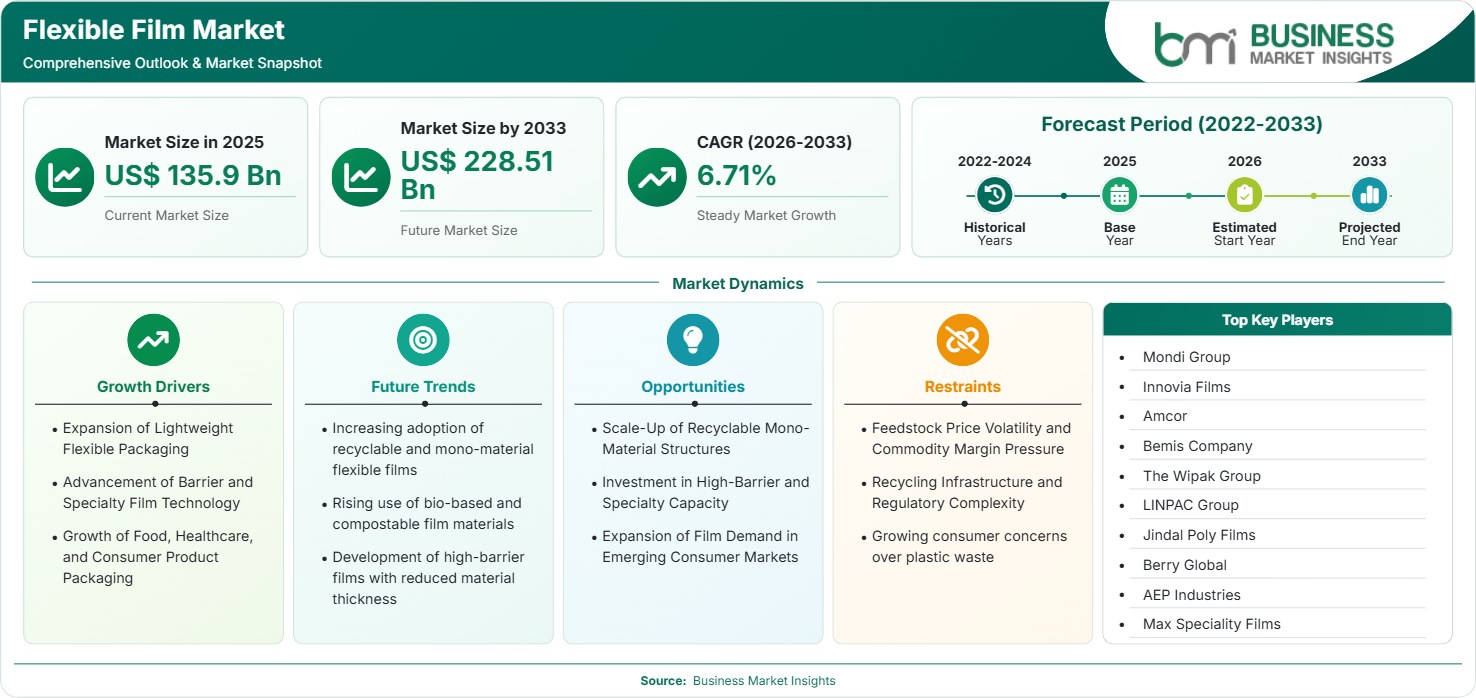
The Flexible Film Market size was valued at US$ 135.9 Billion in 2025 and is projected to reach US$ 228.51 Billion by 2033, growing at a CAGR of 6.71% during 2026–2033, driven by lightweight packaging, recyclable structures, specialty films, e-commerce, food protection, and capacity expansion.

Report Coverage
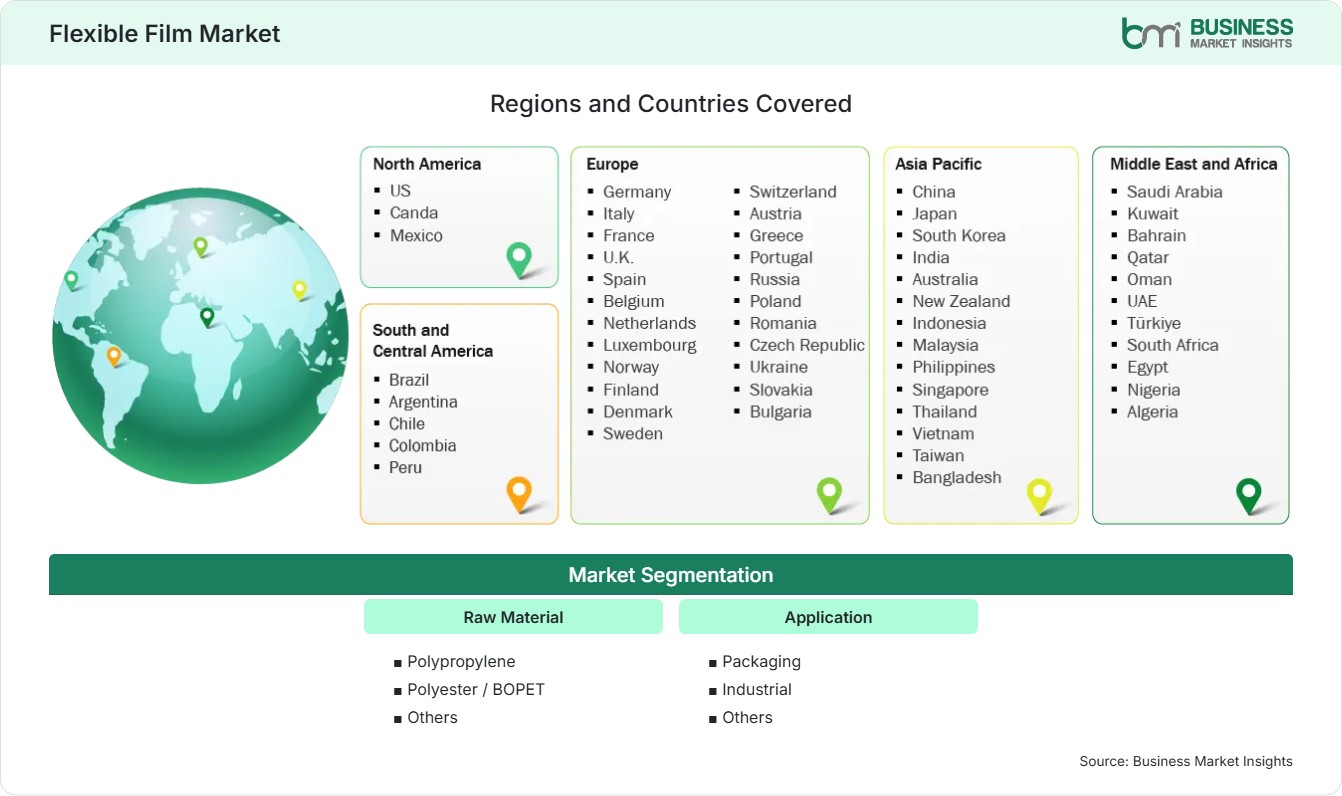
  • Raw Material: Polypropylene , Polyester / BOPET , Others
  • Application: Packaging, Industrial, Others
US$ 135.9 Bn Market size in 2025
US$ 228.51 Bn Market Size by 2033
6.71% CAGR, 2026 - 2033
2026-2033 Forecast Period

AI Overview

Flexible Film Market Summary

  • North America Region: North America holds market share of 22%–25% in 2025, growing with a CAGR of 5.8%–6.4% during 2026–2033, influenced by packaged food demand, pharmaceutical packaging, lightweighting, recycling investment, and premium barrier applications. The US market remains technologically advanced, with estimated growth of 6.0%–6.5% during 2026–2033, supported by food, healthcare, personal care, and recyclable packaging conversion.
  • Fastest Growing Region: Asia Pacific holds market share of 44%–48% in 2025, growing with a CAGR of 7.2%–7.8% during 2026–2033, supported by expanding FMCG consumption, urbanization, e-commerce, domestic film capacity, export manufacturing, and sustainability-led product upgrades.
  • Leading Segment: Packaging holds market share of 78%–82% in 2025, growing with a CAGR of 6.5%–7.1% during 2026–2033, supported by food, beverages, personal care, pharmaceuticals, convenience formats, lightweighting, and replacement of selected rigid packaging formats.
  • High Growth Segment: Polyester / BOPET holds market share of 25%–29% in 2025, growing with a CAGR of 7.0%–7.6% during 2026–2033, driven by high-barrier structures, electronics, premium packaging, retort applications, metallization, and high-performance multilayer designs.
  • Key Market Opportunity: Mono-material structures, high-barrier coatings, recycled content, thinner gauges, specialty labels, and recyclable laminates create attractive investment opportunities as converters balance performance, regulation, material efficiency, and brand-owner sustainability commitments.
  • Major Market Players: Mondi Group, Innovia Films, Amcor, Bemis Company, The Wipak Group, LINPAC Group, Jindal Poly Films, Berry Global, AEP Industries, Max Speciality Films
Strategic Insights

Flexible Film Market: Strategic Insights

Flexible Film Market Strategic Framework
FREE PDF
Request your free sample
Request free sample
Stakeholder View

Key Takeaways

  • The value chain is becoming more integrated as resin suppliers, film producers, coating specialists, metallizers, converters, recyclers, and brand owners collaborate earlier during package design. Competitive advantage increasingly depends on qualification speed, process consistency, technical service, and reliable regional supply rather than film volume alone.
  • Packaging remains the principal demand engine, but the highest-value opportunities are shifting toward specialty BOPP, BOPET, CPP-compatible structures, barrier films, retort grades, label facestocks, and engineered industrial films where technical performance supports stronger realization.
  • Product innovation is moving toward mono-material compatibility, thinner gauges, improved oxygen and moisture barriers, heat resistance, anti-fog performance, and coatings that preserve machinability. Cosmo Films, for example, has expanded its specialty portfolio around BOPP, CPP, and BOPET solutions.
  • Asia Pacific provides the strongest investment case because it combines high consumption growth with large converting ecosystems and expanding production capacity. India is particularly attractive for specialty film investments because domestic demand, exports, and packaging modernization are developing simultaneously.
  • Investment activity is increasingly concentrated around capacity expansion and specialty conversion. Cosmo First commissioned an 81,200-tonne BOPP line in June 2025, increasing its BOPP capacity by approximately 40% to 277,000 tonnes annually.
  • Sustainability is shifting from a marketing attribute toward a qualification requirement. Producers able to demonstrate recyclability, recycled-content integration, lower material intensity, and dependable food-contact performance are better positioned to retain multinational customers.
Geographic Outlook

Flexible Film Market Regional Highlights

North America Flexible Film Market

North America accounts for a 22%–25% share in 2025 and is projected to expand at a 5.8%–6.4% CAGR during 2026–2033. Demand will be driven by applications in the food industry, health care sector, personal care industry, home care industry, and industrial packaging. The converters will also focus more on downgauging and recycling friendly structures, while the resilience of domestic production will play an important strategic role. The pharmaceutical and medical industries will drive higher-value applications of polyester and barrier films.

  • Packaging of food and beverages continues to be the primary volume driver due to the need for high-clarity, sealable films for convenience foods, snacks, frozen foods, and portion-controlled products.
  • Healthcare packaging requires high-performance polyester structures due to the need for dimensional stability, cleanliness, barrier properties and controlled seals.
  • Recycling requirements have been driving the use of mono-material structures and increasing the need for coating and barrier solutions that enable package functionality.
  • The activities of food processing, consumer products and manufacturing operations in Canada and Mexico increase demand in films.

US Flexible Film Market

The US represents approximately 17%–20% of the global market and is estimated to grow at 6.0%–6.5% during 2026–2033. Packaged food & beverage, pharmaceutical, personal care, and eCommerce industries ensure sustained demand. An increasing emphasis on source reduction, recycled content, machinability, and packaging redesign is noted among buyers. While the synergy between brand owners' sustainability initiatives and state-of-the-art conversion processes facilitates the use of premium films, resin price volatility affects buying decisions in the Flexible Film Market.

  • Lightweight packaging will favor the flexible packaging market by reducing transport weight and improving product-to-package ratios in high-volume consumer segments.
  • Pharmaceuticals and medical devices packaging will promote the use of BOPET and barrier films due to their dimensional stability, clean surface, permeability control, and converting performance.
  • Recycled content objectives will motivate companies to invest in appropriate raw materials and process technologies despite restrictions of recycling due to food contact needs.

Europe Flexible Film Market

Europe holds a 17%–20% share in 2025 and is projected to grow at a 5.6%–6.2% CAGR through 2033. These countries continue to play a key role as production and conversion hubs, but Germany and Italy are particularly well-equipped in specialty films. Packaging legislation plays an important role as a driver of demand. The EU Packaging and Packaging Waste Directive is stimulating innovation in designs, recycling, material optimization, and circularity, thereby adding value to technologically advanced films.

  • Germany provides technological excellence in converting and robust demand for food, pharmaceuticals, automotive, and industrial products, which is beneficial for barrier and engineered films.
  • Italy plays a crucial role in flexible packaging machinery and converting, thus providing a conducive environment for specialty films with coating, printing, laminating, and sealing characteristics.
  • In France and Spain, demand for packaged food and personal care products, along with sustainability pressures, promotes the use of recyclable packaging and lighter packages.
  • The United Kingdom is a major market for food, household, and pharmaceutical packaging, where recyclability, material use, and supply chain reliability influence purchasing decisions.

Asia Pacific Flexible Film Market

Asia Pacific commands a 44%–48% share in 2025 and is projected to record a 7.2%–7.8% CAGR through 2033, making it the fastest-growing regional market. Production and consumption is anchored in China, India, Japan, South Korea, Indonesia, and Thailand. The most significant growth potential lies in India and Southeast Asia as packaged foods, retail organization, e-commerce, exportation, and local film capacity grow together. Manufacturers have been increasingly building metallization, coating, and specialty capacities along with basic film capacity.

  • China continues to be an important hub for manufacturing and consumption, with high-volume manufacturing of BOPP and BOPET to meet domestic FMCG needs and for international packaging.
  • India continues to see capacity investments driven by growth in packaged foods, retail, e-commerce, and film conversions; UFlex and Cosmo First are examples of such investments in BOPP manufacturing.
  • Japan and South Korea provide opportunities for value-added products that require high optical properties, dimensional stability, electronic-grade products, and barrier properties.
  • Indonesia and Thailand provide high-growth opportunities due to growing consumer product usage and exports that will increase demands for flexible packaging substrates.
  • The region provides integration of resin, film, printing, coating, and converting infrastructure which enables producers to reduce costs while producing high-value specialty resins.

Rest of World Flexible Film Market

Rest of World represents approximately 9%–12% of 2025 in Flexible Film Market share and is projected to expand at a 6.0%–6.7% CAGR. The growth of packaged foods and agricultural produce, and the the modernization of consumer goods, provide advantages for South and Central America, where Brazil and Mexico are significant consumers. Opportunities are available in the Middle East and Africa with food processing, beverages, pharmaceutical packaging, and local production growth. Converters in the regions are now seeking a stable supply of BOPP, BOPET, CPP-compatibles, and barrier films.

  • Brazil has a huge food processing industry along with growing consumer packaging needs, which helps in driving volume and use of specialty films in food and beverages applications.
  • The manufacturing integration of Mexico with North America makes the need for flexible packaging in food, industrial, personal care, and export consumer products applications.
  • Saudi Arabia and the United Arab Emirates offer possibilities for high-end packaging of food, beverages, and pharmaceuticals due to growing domestic production and distribution networks.
  • South Africa is an important African hub for converting, where packaging companies give more importance to quality of films and sustainability aspects of their products.
Global Market Geography
FREE PDF
Request your free sample
Request free sample
Segment Analysis

Flexible Film Market Segmentation

Raw Material

Polypropylene and polyester collectively define the core material base, with the raw-material segment representing the principal technology pathway for flexible films. Polypropylene holds a 48%–52% share in 2025 and is projected to grow at a 6.4%–7.0% CAGR during 2026–2033. BOPET remains strategically important for demanding barrier, dimensional stability, and industrial applications in Flexible Film Market. Material selection increasingly reflects recyclability, performance, gauge reduction, and converting requirements.

  • Polypropylene: Widely used in flexible packaging due to its clarity, moisture resistance, printability, sealability, and good processing performance.
    • BOPP: Common in packaging and labeling for its clarity, strength, printability, and moisture barrier properties.
    • CPP: Used mainly where heat-sealing, flexibility, and good seal strength are required, including lidding films and laminate structures.
  • Polyester / BOPET: Used in packaging and industrial applications where higher strength, dimensional stability, heat resistance, and good print performance are needed.
    • Thin Film: Mainly used in flexible packaging, labels, and laminates where lightweight construction and good barrier or print performance are important.
    • Thick Film: Used for applications requiring greater stiffness, durability, dimensional stability, and mechanical strength.

Application

Packaging represents the leading application, accounting for 78%–82% of 2025 demand and growing at a 6.5%–7.1% CAGR during 2026–2033 in Flexible Film Market. Flexible packaging remains attractive because it reduces material use, transportation weight, and storage volume while supporting long shelf life. Industrial applications provide diversification through electrical, construction, agricultural, automotive, and technical uses. Product differentiation increasingly depends on coating, metallization, barrier performance, and application-specific functionality.

  • Packaging: Food, beverage, pharmaceutical, personal-care, household, and pet-food packaging drive consumption, with mono-material structures, high barriers, sealability, printability, and downgauging shaping future product specifications.
  • Industrial: Industrial films serve electrical, agricultural, construction, automotive, insulation, labeling, and protective applications where mechanical strength, dimensional stability, thermal resistance, and controlled surface properties are essential.
Market Forces

Flexible Film Market Dynamics

Key Market Drivers

Expansion of Lightweight Flexible Packaging

Flexible packaging is replacing some rigid packaging formats as brands look for lighter materials, easier handling, and more efficient transportation. Growing demand for snacks, ready-to-eat foods, confectionery, pet food, personal care, and pharmaceutical products is supporting the use of flexible films. BOPP and BOPET are widely used because they offer a useful balance of moisture resistance, sealability, printability, strength, and processing performance. Flexible Film Market growth is being supported by the shift toward lightweight packaging and more efficient material use. Film manufacturers are also focusing on thinner gauges, better material yield, specialty coatings, and films suited to high-speed converting, while brand owners are looking for packaging that protects products and reduces material usage.

Advancement of Barrier and Specialty Film Technology

Film technology is moving toward structures that deliver barrier performance without relying exclusively on complex multilayer combinations. Metallized BOPP and BOPET, transparent barrier coatings, heat-resistant grades, anti-fog surfaces, and high-clarity films are gaining relevance as converters redesign packaging. Cosmo Films describes BOPP as a preferred food-packaging substrate because of moisture resistance, sealability, clarity, graphic reproduction, and suitability for homogeneous structures. Flexible Film Market trends increasingly reward suppliers that combine film production with coating and metallization expertise. These capabilities allow manufacturers to address premium applications where functionality, downgauging, recyclability, and machine performance must coexist. The resulting shift raises the strategic value of R&D, customer qualification, process control, and application engineering.

Growth of Food, Healthcare, and Consumer Product Packaging

Food and consumer products continue to support demand for flexible films, as packaging needs to protect products while also allowing easy filling, handling, transport, and display. Healthcare and pharmaceutical packaging adds demand for films with good dimensional stability, barrier performance, clean processing, and reliable sealing. Pet food packaging is also creating opportunities for heat-resistant, retort, lidding, and high-barrier films. These changing application needs are supporting Flexible Film Market growth, with manufacturers placing greater focus on engineered film grades rather than standard packaging materials. This shift is particularly important where longer shelf life, product protection, and reliable processing add value for converters and brand owners.

Key Market Opportunities

Scale-Up of Recyclable Mono-Material Structures

Recyclable mono-material structures are becoming an important area of development as brand owners look for packaging that combines product protection with better recyclability. Film manufacturers and converters are working on structures that can deliver barrier performance, sealability, printability, and mechanical strength while remaining within compatible material families. This is encouraging a move from sustainability goals toward commercially usable packaging solutions. Flexible Film Market Forecasts are increasingly shaped by suppliers that can develop recyclable sealants, coatings, barrier layers, and printing systems. BOPP-based and polyester-compatible structures are also creating opportunities for higher-value packaging applications as the industry moves toward more recyclable film solutions.

Investment in High-Barrier and Specialty Capacity

Investment in specialty film capacity is helping manufacturers reduce reliance on standard commodity grades and compete through product performance. High-barrier transparent films, metallized films, retort films, lidding films, label facestocks, and heat-resistant grades are gaining attention where packaging requires specific technical properties. Producers are also expanding BOPP capacity alongside specialty capabilities to serve changing converter and brand-owner requirements. This approach allows manufacturers to combine production scale with product differentiation, creating better opportunities in applications where barrier protection, heat resistance, sealability, and consistent processing are important.

Expansion of Film Demand in Emerging Consumer Markets

Emerging markets offer a dual opportunity through rising packaged-product consumption and expanding domestic manufacturing. India, Southeast Asia, Latin America, the Middle East, and Africa are developing larger food, beverage, personal-care, and pharmaceutical packaging ecosystems. Local production reduces lead times and import dependence while enabling manufacturers to tailor film grades to regional converters. The Flexible Film Market Forecasts opportunity is strongest where film producers can combine competitive base-film economics with specialty coating, metallization, and technical support. Export-oriented manufacturing further improves capacity utilization. Investors can therefore target integrated facilities near resin availability, converting clusters, ports, and high-growth consumer markets to capture both domestic and international demand.

Market Restraints and Challenges

Feedstock Price Volatility and Commodity Margin Pressure

Factor: Polypropylene and polyester feedstock costs remain exposed to crude-oil movements, refinery economics, regional supply disruptions, currency changes, and capacity additions. Impact: producers of standard films can experience rapid margin compression when resin costs change faster than customer contracts can be repriced. Additional capacity can intensify competition in commodity grades, particularly in regions with large BOPP manufacturing bases. Cosmo First reported pressure on BOPP base-film margins associated with domestic capacity commissioning, illustrating how supply additions can affect realizations. Flexible Film Market participants therefore need differentiated products, energy efficiency, yield optimization, long-term supply agreements, and specialty portfolios to protect profitability when standard-film pricing weakens.

Recycling Infrastructure and Regulatory Complexity

Factor: Recyclability depends not only on film design but also on collection, sorting, recycling capacity, food-contact requirements, labeling systems, and regional regulation. Impact: a film can be technically recyclable while remaining commercially difficult to recover where suitable infrastructure is limited. Europe is advancing packaging rules that encourage circularity, while other markets have different timelines, definitions, and recycled-content requirements. Producers must therefore manage multiple specifications rather than develop one universal solution. Amcor reported that 49% of its flexible packaging production by weight was designed for recyclability at the end of FY2025, highlighting the technical complexity of transitioning large portfolios.

Company Analysis

Competitive Landscape

This Flexible Film Market analysis indicates competition is divided between multinational packaging groups, specialized film producers, regional manufacturers, and vertically integrated converters. Scale remains important for standard grades, while technical differentiation increasingly determines access to premium applications.

Company Name

Overview

Products and Services relevant to this market

Mondi Group

Global packaging and paper producer with substantial flexible packaging capabilities and strong sustainability positioning.

Flexible packaging films, barrier structures, recyclable packaging solutions, laminates, coatings, and packaging technologies.

Innovia Films

Specialist producer known for high-performance polypropylene films serving packaging and labeling applications.

BOPP films, specialty films, label facestocks, coatings, and high-performance packaging substrates.

Amcor

Global packaging company with extensive flexible packaging capabilities following its combination with Berry Global.

Flexible films, recycle-ready packaging, high-barrier structures, pharmaceutical packaging, and specialty packaging platforms.

Bemis Company

Established flexible packaging business now incorporated into Amcor's broader packaging operations.

Flexible packaging films, laminates, barrier structures, food packaging, and healthcare packaging technologies.

The Wipak Group

European packaging specialist serving food, medical, and pharmaceutical customers with high-performance packaging.

Barrier films, multilayer packaging, medical films, food packaging, printing, and laminating solutions.

LINPAC Group

Packaging manufacturer with historical expertise in flexible and food-packaging solutions across European markets.

Flexible packaging materials, films, food packaging, barrier structures, and converted packaging products.

Jindal Poly Films

Indian producer with major capabilities in polyester and polypropylene films for global packaging markets.

BOPP, BOPET, coated, metallized, specialty, and packaging films serving multiple end-use industries.

Berry Global

Major packaging manufacturer whose operations became part of Amcor following the 2025 combination.

Flexible films, packaging components, healthcare packaging, consumer packaging, and engineered polymer solutions.

AEP Industries

Flexible packaging producer with expertise in films and converted packaging applications in North America.

Polyethylene and flexible packaging films, bags, pouches, liners, and industrial packaging solutions.

Max Speciality Films

Indian specialty-film manufacturer focused on differentiated packaging and industrial film applications.

BOPP, BOPET, specialty, coated, metallized, and high-performance packaging films.

Trust & Transparency

Research Methodology

The market analysis combines proprietary research with secondary data from government agencies, company disclosures, regulatory filings, industry databases and expert interviews. Market estimates are validated through data triangulation, cross-market benchmarking and analyst review.

View Full Research Methodology

Questions Answered

Frequently Asked Questions

Which capabilities can differentiate film manufacturers from commodity competitors in Flexible Film Market report?

Differentiation increasingly comes from specialty extrusion, coating, metallization, barrier engineering, application testing, rapid qualification, recycling compatibility, and technical customer support.

How is e-commerce affecting film specifications?

E-commerce increases demand for packaging that tolerates handling, vibration, stacking, and distribution while minimizing weight.

What role does metallization play in flexible films?

Metallization improves barrier performance and optical appearance while potentially reducing dependence on thicker structures.

Why are high-barrier films becoming strategically important in Flexible Film Market?

High-barrier films extend shelf life by limiting oxygen, moisture, light, or aroma transmission.

How does film gauge reduction influence packaging economics?

Gauge reduction can lower polymer consumption, package weight, transportation requirements, and waste while maintaining required mechanical performance.

Access the Full Flexible Film Market Report

Get segment-level forecasts, regional estimates, competitive benchmarking, company profiles and downloadable Excel datasets.

Access the full Flexible Film Market Report
350 pages PDF & Excel | 2026-09-03