
Flexible Foam Market Outlook: Size, Share, Trends, Growth Analysis, Competitive Landscape & Forecast, 2026-2033

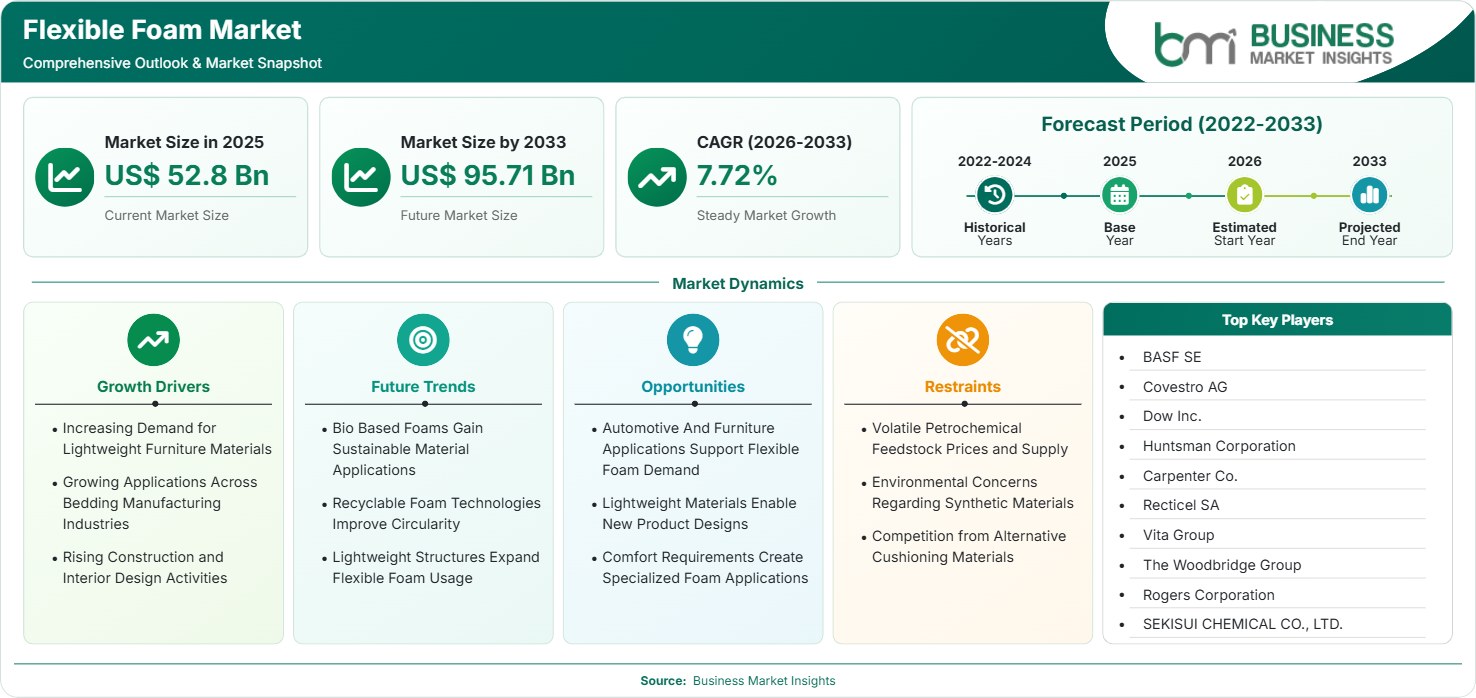
The Flexible Foam Market size was valued at US$ 52.8 Billion in 2025 and is projected to reach US$ 95.71 Billion by 2033, growing at a CAGR of 7.72% during 2026–2033. Demand from furniture, automotive lightweighting, sustainable cushioning materials, e-commerce packaging expansion, and bio-based polyurethane innovation remains key growth catalysts and opportunity areas.

Report Coverage
  • Type: Polyurethane, Polypropylenem, Polyethylene
  • End-Use: Furniture & Upholstery, Automotive, Packaging, Building & Construction, Consumer Goods, Others
US$ 52.8 Bn Market size in 2025
US$ 95.71 Bn Market Size by 2033
7.72% CAGR, 2026 - 2033
2026-2033 Forecast Period

AI Overview

Flexible Foam Market Summary

  • North America Region: Holds a 32%–35% share in 2025, growing at a CAGR of 6.5%–7.0% during 2026–2033. Growth is supported by premium furniture demand, vehicle interior innovation, recycled-content adoption, manufacturing modernization, sustainability mandates, durable foam applications, comfort-focused consumer spending, advanced material development, and circular economy investments. US market benefits from bedding innovation, automotive seating demand, and sustainability initiatives, advancing at 6.7%–7.2% CAGR.
  • Fastest Growing Region: Asia Pacific holds a 38%–41% share in 2025 and expands at a CAGR of 8.5%–9.0% during 2026–2033. Growth is supported by urbanization, industrial expansion, rising furniture production, automotive manufacturing, residential construction activity, export competitiveness, expanding middle-class consumption, supply chain investments, and growing regional processing capabilities.
  • Leading Segment: Polyurethane holds a 54%–58% share in 2025 and advances at a CAGR of 7.5%–8.0% through 2033. Leadership stems from superior comfort properties, design flexibility, broad industrial adoption, lightweight performance, durability advantages, cost optimization, product customization, energy absorption characteristics, and extensive manufacturing infrastructure.
  • High Growth Segment: Automotive accounts for 18%–22% share in 2025 and grows at a CAGR of 8.5%–9.2% through 2033. Rising vehicle production, electric mobility adoption, lightweight seating solutions, comfort enhancement requirements, acoustic insulation demand, safety improvements, emission reduction goals, and advanced interior component innovation support expansion.
  • Key Market Opportunity: Bio-based feedstocks, circular polyurethane technologies, recycled-content integration, low-emission manufacturing platforms, smart cushioning solutions, sustainable building applications, and electric vehicle interior demand create long-term value generation opportunities across multiple end-use sectors.
  • Major Market Players: BASF SE, Covestro AG, Dow Inc., Huntsman Corporation, Carpenter Co., Recticel SA, Vita Group, The Woodbridge Group, Rogers Corporation, SEKISUI CHEMICAL CO., LTD.
Strategic Insights

Flexible Foam Market: Strategic Insights

Flexible Foam Market Strategic Framework
FREE PDF
Request your free sample
Request free sample
Stakeholder View

Key Takeaways

  • The value chain is increasingly integrating chemical suppliers, foam processors, converters, furniture manufacturers, automotive OEMs, and recyclers to improve material efficiency and sustainability.
  • Automotive electrification and premium furniture applications present the strongest upside due to rising demand for lightweight, durable, and high-comfort cushioning materials.
  • Bio-based feedstocks, recycled-content foams, and circular polyurethane technologies are reshaping product development priorities across major manufacturers.
  • Asia Pacific offers the most compelling investment case due to scale advantages, manufacturing concentration, urbanization, and rising consumer spending.
  • Strategic acquisitions continue to focus on specialty foam technologies, regional manufacturing assets, and sustainability-driven product portfolios.
  • Digital manufacturing and predictive quality control technologies are improving consistency, reducing waste, and strengthening profitability.
Geographic Outlook

Flexible Foam Market Regional Highlights

North America Flexible Foam Market

North America accounted for approximately 32%–35% of revenue in 2025 and is expected to grow at a CAGR of 6.5%–7.0% through 2033. Strong bedding demand, automotive manufacturing, and sustainable material adoption support expansion. The Flexible Foam Market share remains high due to advanced production infrastructure and innovation capabilities. Major manufacturers are investing in recycled-content solutions and biomass-balanced materials to satisfy corporate sustainability goals and regulatory expectations.

  • Premium mattress and furniture demand continues supporting utilization rates among regional producers.
  • Automotive seating, insulation, and acoustic applications remain significant consumption sources.
  • Sustainability regulations are encouraging circular material strategies and recycled-content integration.
  • Strong R&D investments improve durability, comfort, and environmental performance.
  • Industrial automation enhances production efficiency and quality consistency across facilities.

US Flexible Foam Market

The United States represents roughly 78%–82% of North American demand and is projected to expand at a CAGR of 6.7%–7.2%. Residential furnishing expenditures, vehicle production recovery, and commercial refurbishment activities support consumption. Producers continue focusing on low-carbon materials and customized comfort solutions for premium applications. Large-scale domestic manufacturing capacity strengthens competitiveness and innovation.

  • Bedding innovation remains a major driver of foam consumption.
  • Growing emphasis on sustainable chemistry encourages adoption of renewable feedstocks.
  • Vehicle interior comfort requirements support advanced polyurethane solutions.
  • Manufacturing modernization improves operational productivity and cost efficiency.

Europe Flexible Foam Market

Europe held a 24%–27% share in 2025 and is forecast to record a CAGR of 6.8%–7.4%. Germany remains the leading market, while Poland and Eastern Europe exhibit faster expansion. Environmental standards accelerate development of recycled and low-emission foam products. Furniture production and automotive seating applications remain core demand generators across the region.

  • Germany leads regional consumption through automotive and industrial manufacturing.
  • Poland shows strong capacity expansion supported by export-oriented production.
  • Circular economy regulations stimulate recycling and sustainable product innovation.
  • Building renovation programs support insulation-related applications.
  • Automotive lightweighting remains a strategic market opportunity.

Asia Pacific Flexible Foam Market

Asia Pacific accounted for 38%–41% of global demand during 2025 and represents the fastest-growing region with an 8.5%–9.0% CAGR. China leads regional consumption, while India records the strongest growth trajectory. Rising disposable income, urban housing development, furniture manufacturing growth, and expanding automotive production contribute to rapid market expansion and Flexible Foam Market share gains.

  • China remains the largest manufacturing and consumption center.
  • India benefits from rising furniture demand and industrial investment.
  • Southeast Asia continues attracting export-oriented production facilities.
  • E-commerce growth strengthens packaging-related foam requirements.
  • Urbanization supports broad-based consumption across applications.

Rest of World Flexible Foam Market

Rest of World represents 8%–10% share in 2025 and is projected to expand at a CAGR of 7.3%–7.8%. South & Central America benefit from furniture manufacturing development, while the Middle East and Africa gain momentum from infrastructure investments and consumer goods demand. Brazil leads Latin America, whereas Saudi Arabia and the UAE are emerging growth centers.

  • Brazil remains the largest regional consumer supported by manufacturing activity.
  • Mexico strengthens export-linked industrial applications.
  • GCC investments encourage development of advanced materials industries.
  • Construction activity supports commercial and residential demand.
  • Consumer goods production expands foam application diversity.
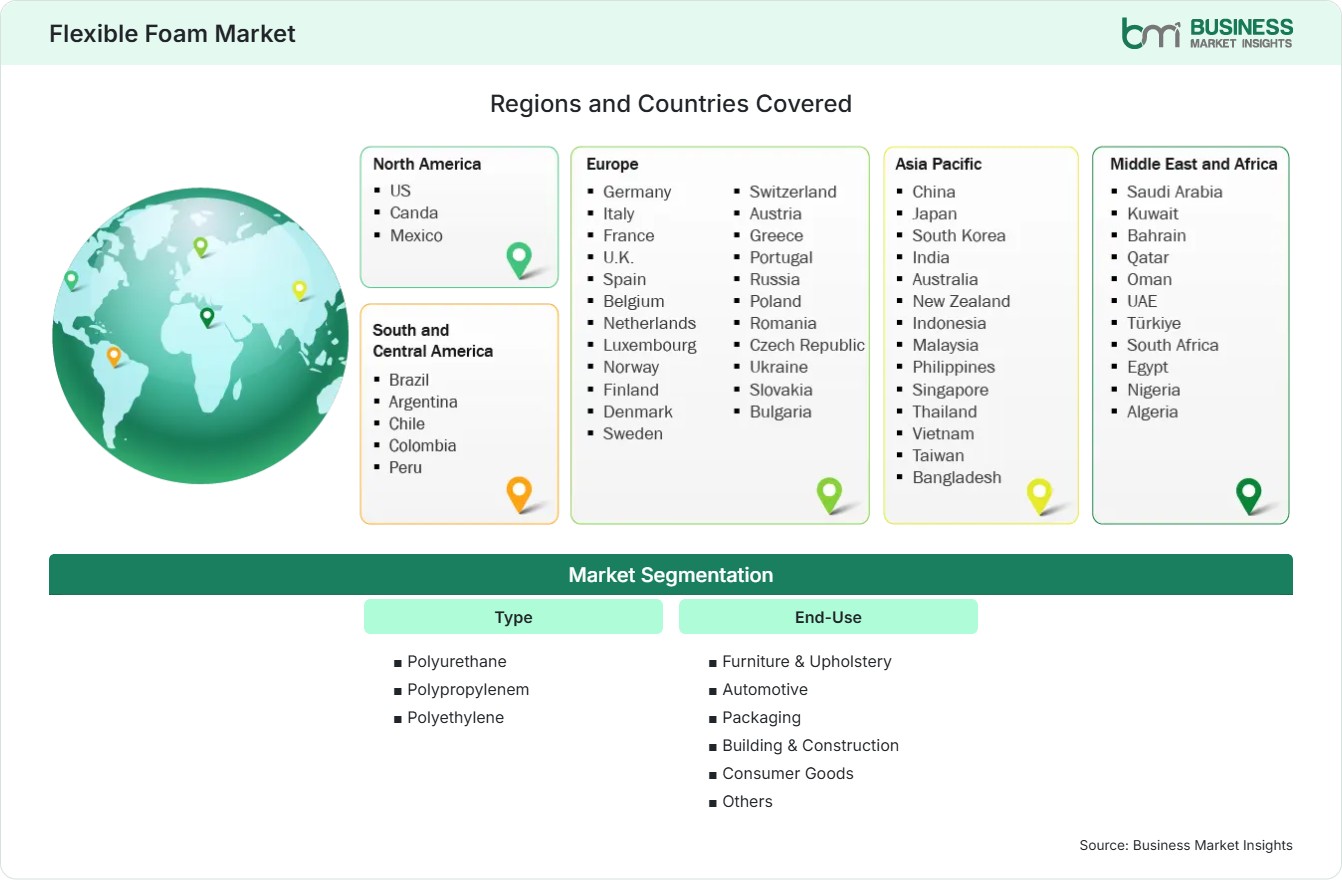
Global Market Geography
FREE PDF
Request your free sample
Request free sample
Segment Analysis

Flexible Foam Market Segmentation

Type

This segment accounted for the largest portion of industry revenue. The Flexible Foam Market scope continues expanding through polymer innovation, sustainability initiatives, and broad application diversity. Type-based demand reflects performance requirements across furniture, transportation, packaging, and consumer products. The segment held 54%–58% share and delivers 7.5%–8.0% CAGR.

  • Polyurethane: Dominant material due to versatility, comfort performance, design adaptability, durability advantages, and extensive usage in automotive interiors, bedding products, furniture cushioning, and residential applications worldwide.
  • Polypropylene: Increasing adoption in lightweight applications requiring chemical resistance, durability, recyclability, structural integrity, and improved performance across transportation, industrial packaging, and consumer-oriented products.
  • Polyethylene: Utilized for protective packaging, shock absorption, insulation performance, and lightweight product requirements across commercial distribution networks and industrial handling environments.

End-Use

End-use consumption is influenced by consumer comfort expectations, industrial production, and sustainability factors. Furniture products have maintained their leadership position with a market share of 28%-31% and a CAGR of 7.0%-7.5%, but Automotive shows the highest growth rate at 8.5%-9.2%. Flexible Foam Market trends reflect increasing diversification of applications.

  • Furniture & Upholstery: Demand driven by mattresses, seating systems, ergonomic products, residential renovation activity, premium comfort preferences, and commercial furniture replacement cycles.
  • Automotive: Growth supported by seating, headrests, armrests, noise reduction systems, vehicle lightweighting objectives, and electric mobility platform expansion.
  • Packaging: Expanding e-commerce networks increase requirements for protective cushioning and product safety during logistics operations.
  • Building & Construction: Adoption is supported by insulation applications, comfort products, and energy-efficiency initiatives within commercial and residential structures.
  • Consumer Goods: Growth reflects utilization in footwear, appliances, sporting goods, personal care products, and diverse lifestyle-oriented applications.
Market Forces

Flexible Foam Market Dynamics

Key Market Drivers

Expansion of furniture and bedding consumption

Demand for flexible foams will be sustained by continued global housing construction, purchases of new furniture, and premium mattresses. The increasing disposable incomes in emerging countries are driving consumers to buy high-quality mattresses and upholstery. The growing focus on comfort, durability, and sustainability is helping manufacturers create more value-added products. Increasing distribution of products through organized retail and e-commerce channels makes them more available. With urbanization and smaller living spaces, demand for space-saving furniture solutions that incorporate advanced cushioning technologies is increasing.

Automotive lightweighting and comfort enhancement

The automobile industry is devoting considerable effort to lightweight design to increase fuel economy, reduce emissions, and enhance the driving range of electric cars. Flexible foams are a critical component because they help minimize weight while enhancing comfort and noise, vibration, and harshness (NVH). The fast-growing electric car industry is spurring the development of novel interior materials that ensure comfort and help save energy. Manufacturers want their products to be eco-friendly and recyclable, and the development of polyurethane technologies is progressing and opening new doors for interior material suppliers.

Sustainable material innovation

The increase in environmental regulation and sustainability is boosting the use of foam products containing recycled content, bio-based materials, and biomass-balanced foam. In 2025, BASF developed biomass-balanced Elastoflex polyurethane systems that can reduce the carbon footprint of products by up to 75%. In addition, companies' sustainability goals and the implementation of a circular economy approach drive investment in renewable materials, advanced recycling techniques, and environmentally friendly production. These trends will contribute to the transformation of the foam industry toward lower-carbon, more sustainable, and environmentally responsible solutions.

Key Market Opportunities

Bio-based polyurethane commercialization

The commercial manufacturing of bio-based polyurethane is gaining popularity due to organizations’ search for environmentally friendly solutions to replace conventional petrochemical products. The extensive use of renewable raw materials helps firms minimize carbon dioxide emissions while providing high-quality goods. This opens up substantial opportunities for differentiation in the market and for meeting new environmental requirements. Businesses that produce low-carbon polyurethanes will have a good chance of meeting increasing demand in the automotive, furniture, bedding, packaging, and consumer goods industries. Moreover, the Flexible Foam Market Forecasts suggest that sustainability-oriented purchasing practices are becoming increasingly popular, making environmental performance a key factor in supplier selection and long-term market growth.

Growth across electric vehicle interiors

Rapid electrification of the transportation industry will offer ample scope for innovative interior solutions, including new seating, thermal management, and acoustic solutions. With EV manufacturers seeking to increase driving range, lightweight interior solutions have become important, as they can enhance battery efficiency and, consequently, the car's performance. Furthermore, customer demand for premium, comfortable, and quiet cabins has increased the need for cushioning and insulation materials unique to electric mobility. Material suppliers that manufacture formulations tailored to EV interiors will see above-average growth and strengthen their competitive advantage in the evolving automotive market.

Circular economy and recycling infrastructure

The growth of investment in polyurethane recycling technology and the implementation of a closed-loop system will create substantial opportunities for value addition in the business. The recycling technologies will ensure that materials are recovered and reused to reduce reliance on virgin raw materials and generate less waste. Increasing regulatory scrutiny and sustainability needs will drive the demand for recycled content. Companies that invest in recycling operations will benefit from improved reputation, more efficient use of resources, new revenue streams, and stronger relationships with customers seeking sustainable and circular-economy solutions.

Market Restraints and Challenges

Volatile petrochemical feedstock pricing

Relying on petroleum-derived raw materials exposes polyurethane producers to continuous fluctuations in the prices of major inputs such as polyols and isocyanates. This unpredictability causes considerable margin pressure, making it difficult to develop appropriate pricing strategies and offering little insight into future profitability. Sudden spikes in raw material prices will discourage companies from signing long-term contracts and make the procurement process highly uncertain. Small producers of polyurethanes have more to fear because of their weak negotiating position and poor capacity to cope with rising input costs without affecting competitiveness.

Environmental compliance complexity

The need for additional environmental laws on emissions, waste, chemical substances, and sustainable products would increase compliance, monitoring, and reporting costs for companies. Such expenses will be increased at the expense of innovation and other growth opportunities. Companies that operate in multiple regions also face difficulties due to differing legal requirements, reporting, and approval procedures. This situation leads to higher administrative expenses, delayed product commercialization, and compliance issues among smaller companies with limited resources, who may struggle to maintain compliance effectively.

Company Analysis

Competitive Landscape

Flexible Foam Market analysis indicates competition is driven by scale, sustainability capabilities, product innovation, and regional manufacturing presence.

Company Name

Overview

Products and Services relevant to this market

BASF SE

Global chemical leader with extensive polyurethane technologies and sustainability-focused innovations.

Flexible polyurethane systems, polyols, specialty foam formulations, technical support services.

Covestro AG

Major materials company focused on advanced polyurethane solutions.

Polyurethane raw materials, performance foams, sustainable material technologies.

Dow Inc.

Diversified materials producer serving multiple industrial sectors.

Polyols, polyurethane additives, comfort and packaging foam materials.

Huntsman Corporation

Global specialty chemicals company with strong polyurethane portfolio.

MDI systems, polyurethane technologies, foam development solutions.

Carpenter Co.

Leading vertically integrated polyurethane foam manufacturer.

Flexible polyurethane foams, bedding, furniture, transportation applications.

Recticel SA

European specialist focused on insulation and comfort products.

Flexible foams, bedding materials, specialty comfort solutions.

Vita Group

Major European foam manufacturer serving diverse sectors.

Comfort foams, industrial foams, recycled-content materials.

The Woodbridge Group

Automotive-focused foam solutions provider.

Seating systems, molded foams, vehicle interior components.

Rogers Corporation

Advanced engineered materials manufacturer.

Specialty foam products, cushioning solutions, industrial materials.

SEKISUI CHEMICAL CO., LTD.

Diversified chemical enterprise with advanced foam technologies.

Polyolefin foams, industrial materials, packaging solutions.

Trust & Transparency

Research Methodology

The market analysis combines proprietary research with secondary data from government agencies, company disclosures, regulatory filings, industry databases and expert interviews. Market estimates are validated through data triangulation, cross-market benchmarking and analyst review.

View Full Research Methodology

Questions Answered

Frequently Asked Questions

What does a Flexible Foam Market Report typically evaluate?

It evaluates market size, demand drivers, competitive positioning, technological developments, regional dynamics, segmentation performance, investment opportunities, and future business outlooks.

How is sustainability influencing industry strategies?

Manufacturers are investing in recycled-content foams, bio-based feedstocks, circular production models, and lower-carbon materials to meet customer and regulatory expectations.

Which region presents the strongest long-term opportunity?

Asia Pacific offers the strongest opportunity due to industrial expansion, urbanization, population growth, furniture manufacturing, and automotive production increases.

What makes polyurethane the dominant material type?

Polyurethane offers a combination of lightweight performance, comfort, durability, design flexibility, and cost-effectiveness across numerous industrial and consumer applications.

Which end-use industry generates the greatest demand?

Furniture and upholstery remain the largest consumers due to extensive usage in mattresses, seating systems, and residential comfort products.

Access the Full Flexible Foam Market Report

Get segment-level forecasts, regional estimates, competitive benchmarking, company profiles and downloadable Excel datasets.

Access the full Flexible Foam Market Report
350 pages PDF & Excel | 2026-09-16
Similar Research

Related Market Reports