
Flexible Plastic Packaging Market Outlook: Size, Share, Trends, Growth Analysis, Competitive Landscape & Forecast, 2026-2033

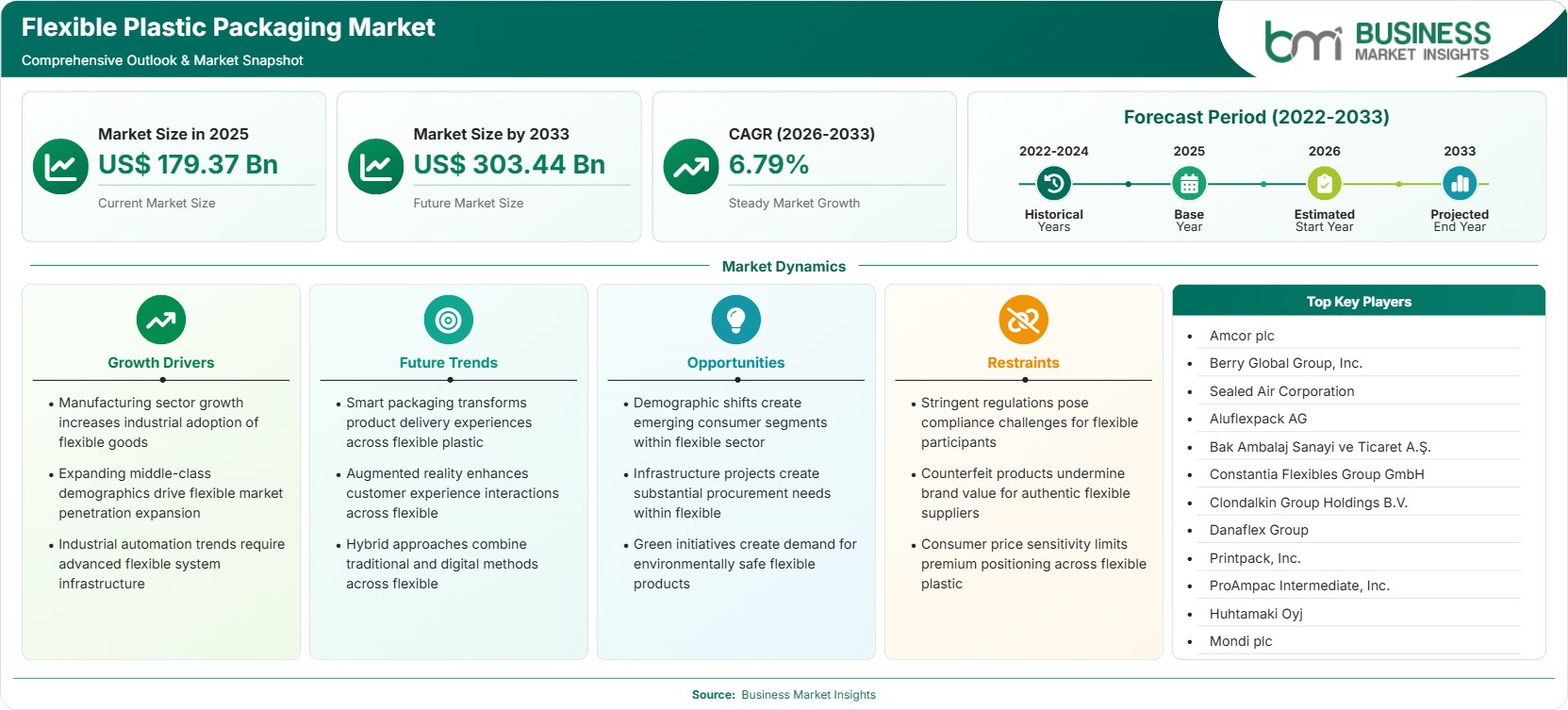
The Flexible Plastic Packaging Market size was valued at US$ 179.37 Billion in 2025 and is projected to reach US$ 303.44 Billion by 2033, growing at a CAGR of 6.79% during 2026–2033, driven by lightweighting, convenience formats, e-commerce, food protection, healthcare demand, and recyclable material innovation.

Report Coverage
  • Material: Polyethylene , Polypropylene , Polyethylene Terephthalate , Polyvinyl Chloride , Others
  • Product Type: Bags, Pouches & Sachets, Films & Laminates, Tapes & Labels, Tubes, Others
  • End-use Industry: Food & Beverage, Healthcare, Home Care, Personal Care, Agriculture, E-commerce, Others
US$ 179.37 Bn Market size in 2025
US$ 303.44 Bn Market Size by 2033
6.79% CAGR, 2026 - 2033
2026-2033 Forecast Period

AI Overview

Flexible Plastic Packaging Market Summary

  • North America: North America holds a 27%–30% flexible plastic packaging market share in 2025, growing at a 5.8%–6.4% CAGR, supported by e-commerce, convenience foods, healthcare packaging, lightweighting, recycled-content adoption, and sophisticated converting infrastructure.
  • Fastest Growing Region: Asia Pacific holds a 32%–35% share in 2025 and expands at a 7.6%–8.5% CAGR, supported by urbanization, packaged-food penetration, expanding retail networks, e-commerce fulfillment, rising disposable incomes, manufacturing investment, and flexible packaging conversion capacity.
  • Leading Segment: Food & Beverage holds a 42%–46% share in 2025 and expands at a 6.7%–7.3% CAGR, supported by shelf-life requirements, portion formats, processed foods, beverage applications, barrier films, retort structures, convenience consumption, and food-safety requirements.
  • High Growth Segment: Pouches & Sachets represent a 24%–28% share in 2025 and expand at an 8.0%–8.8% CAGR, driven by portability, resealability, material efficiency, single-serve consumption, home-care applications, personal-care products, pet food, and e-commerce-friendly formats.
  • Key Market Opportunity: High-barrier mono-material films, post-consumer recycled content, refillable pouches, recyclable healthcare packs, and digitally printed short runs create opportunities as brands balance compliance, performance, shelf life, and material efficiency.
  • Major Market Players: Amcor plc, Berry Global Group, Inc., Sealed Air Corporation, Aluflexpack AG, Bak Ambalaj Sanayi ve Ticaret A.Ş., Constantia Flexibles Group GmbH, Clondalkin Group Holdings B.V., Danaflex Group, Printpack, Inc., ProAmpac Intermediate, Inc., Huhtamaki Oyj, Mondi plc, Sonoco Products Company, Coveris Management GmbH, and Transcontinental Inc.
Strategic Insights

Flexible Plastic Packaging Market: Strategic Insights

Flexible Plastic Packaging Market Strategic Framework
FREE PDF
Request your free sample
Request free sample
Stakeholder View

Key Takeaways

  • Food and beverages will continue to be an important demand generation industry due to the wide use of flexible packaging of processed, fresh, frozen, and ready-to-eat products.
  • Polyethylene will remain important as it provides flexibility, durability, moisture resistance, and processing capability.
  • Pouches and sachets will see more popularity as they provide easy packaging in light and space-saving format.
  • Films and laminates will continue to be important due to their application needs of barrier properties, printing, sealing, and product preservation.
  • Pharmaceutical and healthcare packaging will increase demand for high-barrier, durable, and contamination resistant packaging formats.
  • The flexible plastic packaging market forecast indicates that E-commerce will increase the demand for lightweight and protective packaging to aid product transportation and delivery.
  • The recyclable mono-material structures will become increasingly important due to packaging companies responding to regulation and sustainability considerations.
  • Asia Pacific will remain an important regional market due to its manufacturing base, increased consumer population and growth in packaged goods industries.
Geographic Outlook

Flexible Plastic Packaging Market Regional Highlights

North America Flexible Plastic Packaging Market

North America represents a mature flexible plastic packaging market supported by strong demand from food and beverage, healthcare, personal care, home care, and e-commerce industries. The region benefits from established packaging manufacturing capabilities, sophisticated retail networks, and increasing demand for lightweight and convenient formats. Sustainability initiatives are also encouraging manufacturers and brand owners to adopt recyclable structures and improve material efficiency.

  • The U.S. is the key regional market owing to its large industry base of packaged foods, its extensive retailing network, and its considerable consumption of packaged consumer goods.
  • Manufacturers of foods and beverages are adopting more and more the use of pouches, films, bags, and laminates as packaging materials for their products.
  • Healthcare and pharmaceutical industries are contributing to the demand for packaging materials offering high barrier and protection.
  • E-commerce growth has led to the need for light yet robust packaging that would survive the transport process.
  • There is increasing focus on recyclable and mono-material packaging, leading to the redesign of traditional multilayer packaging by packaging manufacturers.

US Flexible Plastic Packaging Market

The US represents approximately 75%–80% of North America's regional share in 2025 and records a 5.9%–6.5% CAGR through 2033. The flexible plastic packaging market trend suggest that the converters are investing in automation, recyclable film structures, recycled-content solutions, and premium printing. The market also benefits from sophisticated brand-owner qualification systems, supporting rapid commercialization of packaging technologies with validated barrier and sealing performance across demanding consumer categories.

  • Consumer packaged goods companies increasingly evaluate packaging on material efficiency, recyclability, shelf life, branding, and logistics performance simultaneously, increasing demand for technically differentiated films and pouches.
  • Pharmaceutical and medical packaging supports specialized flexible plastic packaging market growth through high-barrier laminates, sterile products, unit-dose formats, and tamper-evident structures that require stringent manufacturing controls.
  • Recycled-content adoption is encouraging converters to strengthen resin sourcing, traceability, and quality-management systems while maintaining consistent film properties across high-volume production environments.

Europe Flexible Plastic Packaging Market

Europe represents an established flexible plastic packaging market characterized by sophisticated packaging infrastructure, strong food and beverage production, and increasing emphasis on packaging sustainability. Environmental regulations and consumer preferences are encouraging companies to reduce material usage, improve recyclability, and develop packaging structures with lower environmental impact. These changes are influencing material selection and packaging design across multiple industries.

  • The main markets of Europe include Germany, France, Italy, United Kingdom, and Spain because of developed industries of food, beverages, healthcare, and consumer goods.
  • The trend towards increased sustainability leads to the development of recyclable and mono-material constructions by packagers.
  • The manufacturers of foods and beverages use flexible packages because of their light weight and appropriate usage in packaging and processing of products.
  • The applications from healthcare and personal care industry generate a need for unique films, laminates, tubes, and pouches.
  • The increased attention to the issue of packaging waste generation results in downgauging and optimization of materials.

Asia Pacific Flexible Plastic Packaging Market

The region benefits from a large consumer base, rapid urbanization, expanding packaged food consumption, rising disposable incomes, and increasing e-commerce activity. China is a major flexible plastic packaging market within the region, while India and Southeast Asian economies are providing additional growth opportunities.

  • China remains a major regional market because of its extensive manufacturing base, large consumer population, expanding food processing industry, and strong e-commerce ecosystem.
  • India is experiencing increasing demand as packaged food consumption, modern retail, urbanization, and consumer spending continue to expand.
  • Southeast Asian countries are generating additional demand through rising consumer goods consumption and development of organized retail and online commerce.
  • Pouches and other flexible formats are gaining adoption because they offer lightweight construction, convenience, and efficient transportation.
  • Regional manufacturers are increasingly investing in recyclable and mono-material packaging technologies in response to sustainability requirements.

Rest of World Flexible Plastic Packaging Market

Rest of World includes Latin America, the Middle East, and Africa. These markets are supported by expanding packaged food consumption, population growth, urbanization, and improving retail infrastructure. Increasing penetration of modern retail and e-commerce is also creating demand for convenient and lightweight packaging formats.

  • Latin America benefits from established food processing and agricultural industries that require flexible packaging for food, beverages, and consumer products.
  • Brazil and Mexico represent important markets due to their large consumer populations and expanding packaged food industries.
  • Middle Eastern markets are supported by growing food and beverage consumption, retail modernization, and increasing demand for personal care products.
  • Africa provides longer-term opportunities as packaged food consumption, urbanization, and organized retail infrastructure continue to develop.
  • Rising demand for affordable packaging formats is supporting adoption of bags, pouches, sachets, and flexible films across emerging flexible plastic packaging market.
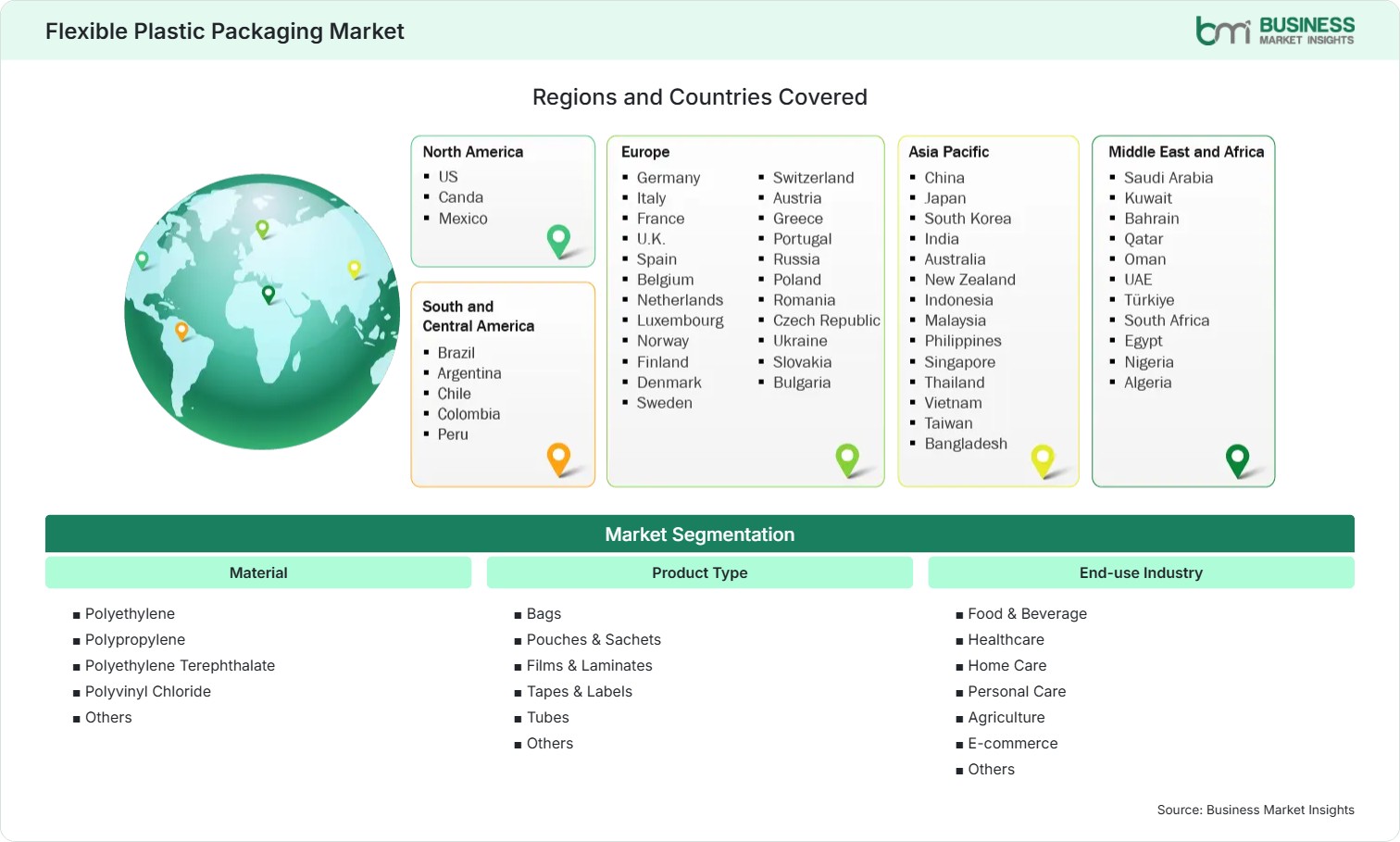
Global Market Geography
FREE PDF
Request your free sample
Request free sample
Segment Analysis

Flexible Plastic Packaging Market Segmentation

Material

Material selection determines barrier performance, machinability, recyclability, cost, and product compatibility. Polyethylene leads broad flexible-film consumption, while polypropylene supports heat resistance and clarity. PET remains important in laminates requiring strength and barrier properties. The material segment represents the largest value pool, with a 6.4%–7.0% CAGR through 2034.

  • Polyethylene (PE): PE supports films, bags, stretch applications, and pouches because of flexibility, sealing performance, moisture resistance, and established recycling pathways across numerous packaging applications.
  • Polypropylene (PP): PP serves snack packs, labels, pouches, and high-temperature applications where stiffness, clarity, heat resistance, and strong sealing performance are commercially important.
  • Polyethylene Terephthalate (PET): PET contributes strength, dimensional stability, printability, and barrier performance, making it valuable in multilayer laminates and applications requiring mechanical durability.
  • Polyvinyl Chloride (PVC): PVC remains relevant in selected films, labels, and specialty packaging where clarity, flexibility, and processing characteristics support application-specific performance requirements.

Product Type

Product formats determine convenience, material intensity, filling efficiency, branding, and distribution economics. Bags and pouches remain central formats, while films and laminates provide broad converter flexibility. The product-type segment records a 6.9%–7.5% CAGR through 2034 as brands prioritize lightweight formats and efficient production.

  • Bags: Bags offer economical containment for food, agriculture, household products, and industrial goods, with demand supported by lightweight construction, high-volume filling, transport efficiency, and flexible sizing.
  • Pouches & Sachets: Pouches and sachets provide portability, portion control, resealability, and attractive shelf presentation, supporting strong adoption across food, personal care, home care, pet food, and pharmaceuticals.
  • Films & Laminates: Films and laminates deliver tailored barrier, seal, strength, and print properties, enabling converters to engineer structures for demanding food, healthcare, industrial, and consumer applications.
  • Tapes & Labels: Tapes and labels support identification, branding, tamper evidence, and functional applications, with growth linked to premium printing, logistics requirements, and differentiated product presentation.
  • Tubes: Tubes combine flexible bodies with controlled dispensing, supporting cosmetics, personal care, pharmaceuticals, and selected food applications where convenience and precise product delivery matter.

End-use Industry

End-use demand is diversified across food, healthcare, personal care, home care, agriculture, and e-commerce. Food and beverage remain the leading application base because flexible packaging extends shelf life and improves logistics. The segment records a 6.7%–7.3% CAGR through 2034.

  • Food & Beverage: Food and beverage applications prioritize shelf life, food safety, barrier performance, lightweighting, portion formats, and convenient opening, making films, pouches, laminates, and sachets essential packaging formats.
  • Healthcare: Healthcare packaging requires high barrier protection, sterile performance, traceability, seal integrity, and controlled contamination risk, supporting specialized films, pouches, sachets, and medical packaging systems.
  • Home Care: Home-care products increasingly use flexible packs for detergents, cleaning liquids, refills, wipes, and concentrates, where lightweighting and refillability can reduce material and transport requirements.
  • Personal Care: Cosmetics and personal-care brands use flexible formats to improve portability, dispensing, visual differentiation, and refill options, with premium printing and barrier performance supporting product positioning.
  • Agriculture: Agricultural applications use flexible films and bags for seeds, fertilizers, crop products, and related materials, requiring durability, moisture protection, efficient handling, and storage performance.
  • E-commerce: E-commerce packaging emphasizes lightweight protection, compact dimensions, puncture resistance, tamper evidence, and efficient fulfillment, increasing demand for flexible mailers, films, pouches, and protective structures.
Market Forces

Flexible Plastic Packaging Market Dynamics

Key Market Drivers

Rising Demand for Lightweight and Convenient Packaging

The growing trend of flexible packaging has become favorable due to its use of fewer materials, lesser weight, and less need for storage space compared to many forms of rigid packaging. The ease of handling and control of portions through bags, pouches, sachets, and films are beneficial for products such as food, beverages, cosmetics, and household goods.

Growing Demand for Packaged Food and Beverages

With the increase in demand for packaged products such as processed food products, ready-to-eat food, ready-to-cook foods, frozen food products, and packaged foods, there has been an increased demand for flexible packaging that can help in protecting products as well as increase their shelf life. There is a growing demand for flexible structures due to its protective properties.

Increasing Adoption Across E-commerce and Consumer Goods

Growth in online retail is creating demand for flexible plastic packaging market that is lightweight, durable, space-efficient, and suitable for transportation through complex fulfillment networks. Flexible formats can reduce storage requirements and transportation weight while providing protection during handling and delivery. Increasing online purchases of food, personal care, household, and other consumer products are therefore expanding packaging requirements.

Key Market Opportunities

Expansion of Recyclable Mono-material Packaging

The transition from complex multilayer structures toward recyclable mono-material PE and PP packaging is creating significant opportunities for converters and material suppliers. Advances in barrier coatings, film structures, and processing technologies are helping manufacturers address performance requirements while improving recyclability. Recent research also indicates that shifting from multi-material to mono-material multilayer structures can improve the environmental performance of recyclable flexible food packaging.

Growing Demand for High-Barrier Packaging Solutions

Increasing requirements for extended shelf life, product protection, and food safety are creating opportunities for high-barrier films and laminates. These solutions are particularly relevant for processed foods, pharmaceuticals, personal care products, and other sensitive products. Manufacturers that can combine barrier performance with reduced material consumption and improved recyclability can address both functional and sustainability requirements.

Expansion of Sustainable Packaging Innovations

Packaging producers are investing in downgauged films, post-consumer recycled content, bio-based polymers, improved recycling technologies, and alternative barrier systems. These developments are creating opportunities for companies capable of reducing material use without compromising sealing, durability, product protection, or machinability. Sustainability is increasingly becoming an important procurement and product-development consideration across the value chain.

Market Restraints and Challenges

Recycling Challenges Associated with Multilayer Structures

Factor: Many flexible packaging products use multiple polymer layers or combinations of plastics, coatings, adhesives, and other materials to achieve required barrier and mechanical performance.

Impact: These structures can be difficult to collect, separate, and mechanically recycle through conventional recycling systems. The technical challenge is encouraging manufacturers to redesign packaging while maintaining the barrier and performance characteristics required by end users.

Volatility in Polymer Raw Material Prices

Factor: Flexible plastic packaging production depends heavily on polymer resins such as polyethylene, polypropylene, and other petrochemical-derived materials. Changes in feedstock costs, energy prices, trade conditions, and supply availability can affect resin pricing.

Impact: Fluctuating input costs can pressure packaging manufacturers' margins and make pricing more difficult to manage. Companies may need to improve production efficiency, optimize material consumption, and strengthen procurement strategies to manage cost volatility. This can hamper the flexible plastic packaging market growth.

Company Analysis

Competitive Landscape

The Flexible Plastic Packaging Market is highly competitive and fragmented, with global packaging companies competing alongside regional converters and specialized manufacturers. Competition is centered on manufacturing scale, material efficiency, barrier performance, product customization, sustainability, and geographic reach. Major companies are investing in recyclable structures, lightweight films, high-barrier packaging, and advanced conversion technologies to strengthen their positions.

Company Name

Overview

Products and Services relevant to this market

Amcor plc

Global packaging company with extensive flexible and healthcare capabilities, combining scale, material science, converting expertise, and sustainability-focused product development.

Flexible films, pouches, laminates, high-barrier healthcare packaging, recycle-ready structures, PCR solutions, and specialty packaging systems.

Berry Global Group, Inc.

Major packaging producer with broad polymer-processing capabilities and strong exposure to flexible films, healthcare, consumer, and industrial applications.

Stretch films, flexible films, packaging components, recycled-content solutions, consumer packaging, and healthcare-related flexible formats.

Sealed Air Corporation

Packaging technology company focused on food protection, automation, industrial packaging, and solutions designed to improve product safety and distribution efficiency.

Food packaging films, vacuum systems, barrier packaging, protective films, shrink solutions, and automated packaging technologies.

Aluflexpack AG

European flexible packaging specialist serving food, coffee, pharmaceuticals, pet food, and consumer products with technically engineered packaging structures.

Flexible laminates, lidding materials, pouches, films, and high-barrier packaging for food and pharmaceutical applications.

Bak Ambalaj Sanayi ve Ticaret A.Ş.

Türkiye-based flexible packaging producer serving food, industrial, and consumer markets with printing and converting capabilities.

Printed flexible films, laminates, pouches, bags, and packaging solutions for food and consumer products.

Constantia Flexibles Group GmbH

Global flexible packaging specialist with strong food, pharmaceutical, and consumer packaging capabilities and emphasis on recyclable structures.

Flexible laminates, films, pouches, pharmaceutical packaging, and high-barrier solutions for demanding applications.

Clondalkin Group Holdings B.V.

European packaging group with specialist converting operations serving food, healthcare, industrial, and consumer applications.

Flexible packaging, films, laminates, bags, labels, and customized converted packaging solutions.

Danaflex Group

Flexible packaging manufacturer serving food, beverage, pet food, personal care, and household-product markets with integrated production capabilities.

Printed films, laminates, pouches, bags, and customized flexible packaging for consumer products.

Printpack, Inc.

US-based flexible packaging company focused on high-performance printed packaging for food, beverage, healthcare, and consumer markets.

Films, pouches, bags, laminates, shrink packaging, and customized printed flexible packaging solutions.

ProAmpac Intermediate, Inc.

Global packaging company combining flexible packaging, specialty materials, and product development for food, healthcare, and industrial customers.

Flexible films, pouches, bags, specialty laminates, high-barrier packaging, and recyclable packaging technologies.

Huhtamaki Oyj

Global packaging producer with established flexible packaging operations and growing focus on recyclable and lower-plastic packaging solutions.

Flexible films, laminates, pouches, sachets, pharmaceutical packaging, and recyclable packaging structures.

Mondi plc

Integrated packaging and paper company developing flexible solutions around recyclability, material efficiency, barrier performance, and customer-specific packaging systems.

Flexible pouches, films, laminates, flow-wrap, wet-wipe packaging, barrier materials, and recyclable packaging solutions.

Sonoco Products Company

Diversified packaging producer serving food, healthcare, consumer, and industrial markets through broad material and converting capabilities.

Flexible packaging, films, pouches, specialty packaging, healthcare formats, and protective packaging systems.

Coveris Management GmbH

European packaging manufacturer focused on sustainable flexible packaging and advanced film solutions for food, healthcare, and consumer products.

Flexible films, pouches, bags, laminates, recyclable packaging, and high-performance food packaging structures.

Transcontinental Inc.

Canadian packaging and printing company with strong flexible packaging capabilities serving food, consumer, and retail customers.

Printed films, pouches, bags, laminates, flexible packaging graphics, and customized packaging solutions.

Trust & Transparency

Research Methodology

The market analysis combines proprietary research with secondary data from government agencies, company disclosures, regulatory filings, industry databases and expert interviews. Market estimates are validated through data triangulation, cross-market benchmarking and analyst review.

View Full Research Methodology

Questions Answered

Frequently Asked Questions

How can companies use this Flexible Plastic Packaging Market Report?

Businesses can use the report to evaluate regional demand, material choices, product-format opportunities, end-use applications, competitive positioning, sustainability priorities, investment opportunities, and emerging technologies. The analysis can support strategic planning, capacity decisions, product development, partnership evaluation, and market-entry assessments.

What role does healthcare play in flexible packaging demand?

Healthcare requires packaging that protects products from moisture, oxygen, contamination, mechanical damage, and unauthorized access. Flexible formats support sterile barriers, unit-dose applications, medical devices, diagnostic products, and pharmaceutical delivery systems. Expansion of healthcare manufacturing in emerging economies is increasing demand for localized high-performance packaging capacity.

Why are pouches gaining share across consumer industries?

Pouches combine low material intensity, portability, efficient transportation, resealability, and strong printing surfaces. They can also support refill concepts and convenient dispensing. These characteristics make them attractive for snacks, pet food, detergents, cosmetics, pharmaceuticals, and other products requiring compact, consumer-friendly formats.

How is flexible packaging adapting to stricter sustainability requirements?

Converters are redesigning multilayer structures, increasing mono-material PE and PP formats, integrating PCR, reducing material thickness, and developing recyclable high-barrier coatings. The objective is to preserve packaging performance while improving recovery potential and reducing dependence on virgin polymers.

What factors are most important when selecting flexible packaging materials?

Material selection depends on barrier requirements, sealing temperature, mechanical strength, product chemistry, shelf-life targets, filling equipment, recyclability requirements, and total packaging cost. Food applications may prioritize oxygen and moisture barriers, while pharmaceutical applications require additional protection, traceability, and validated manufacturing controls.

Access the Full Flexible Plastic Packaging Market Report

Get segment-level forecasts, regional estimates, competitive benchmarking, company profiles and downloadable Excel datasets.

Access the full Flexible Plastic Packaging Market Report
350 pages PDF & Excel | 2026-09-04